New at the Archives – The Richmond Review

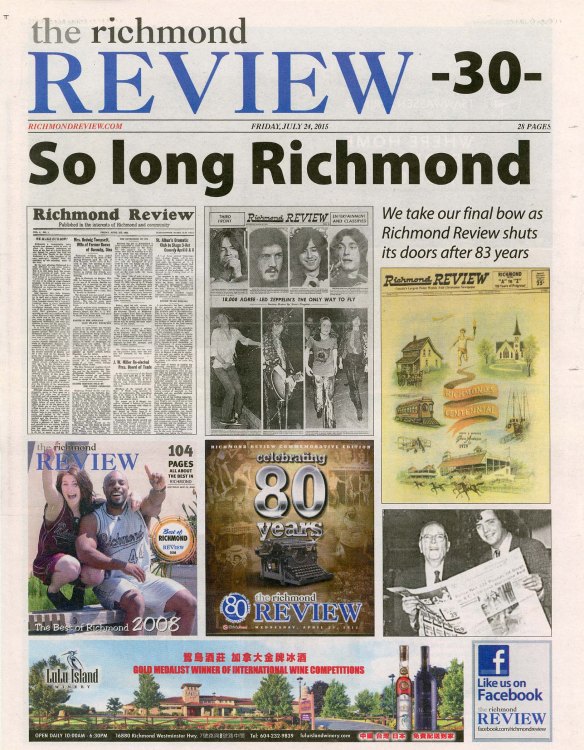
One of the top news stories for Richmondites in 2015 was the end of the local newspaper, the Richmond Review. 

Last Review

The front page of the last edition of the Richmond Review, July 24, 2015.

The Review began life in 1932, a gesture of optimism in an otherwise depressed period of time. After a few issues published by founder Bill Carruthers, it was sold to Ethel Tibbits, who ran it until 1948.

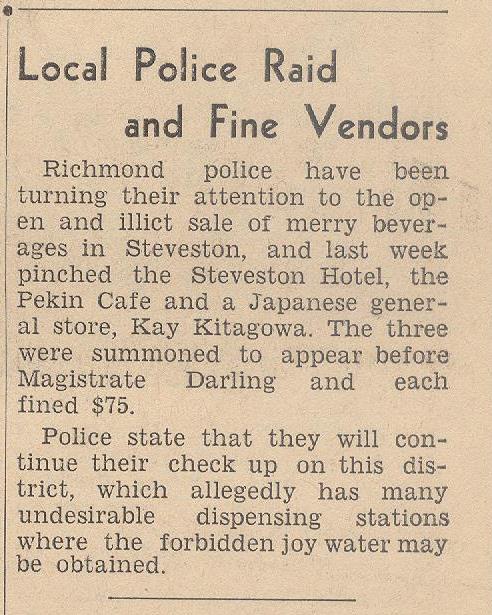
Police1937

The police news was a popular feature of the Marpole-Richmond Review where the latest police activities could be followed and names were named, even for minor infractions. This clip from 1937 relates the fallout from illegal liquor sales in Steveston.

For much of its existence it was known as the Marpole-Richmond Review. By the 1970’s it was BC’s largest circulating biweekly. The last issue came out on July 24th 2015; the publishers citing market forces as the culprit, making competition with another newspaper impossible to carry on.

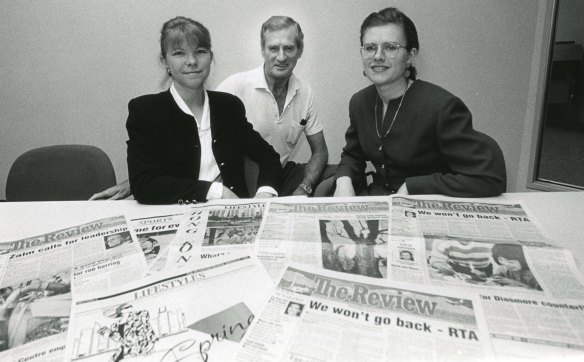
Review staff

The Richmond Review staff, ca. 1990; left to right – Publisher Susan Tweedie, Composing Room Foreman Fred Meyer and Editor Diane Strandberg. City of Richmond Archives photograph 2015 19.

Before the offices of the Richmond Review were completely vacated, the City of Richmond Archives was invited to visit the location to retrieve records which we would consider important to the community.

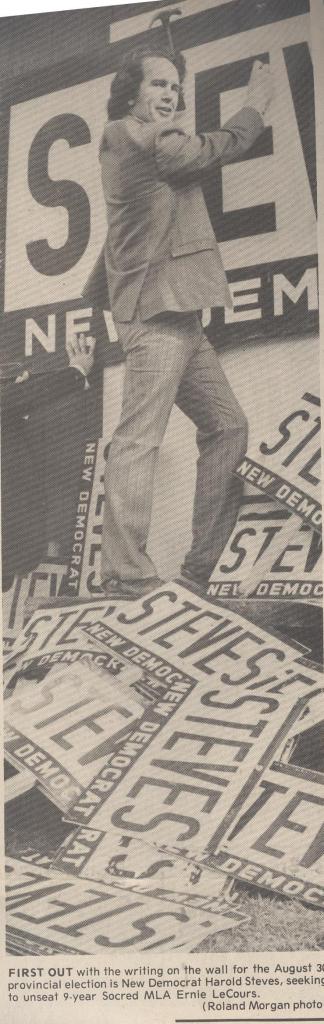
Steves72

The Review was an important source of information for readers during elections, featuring interviews, candidate’s platforms, etc. This clipping shows well-known local politician Harold Steves beginning his successful run for the NDP in the 1972 Provincial election.

The bulk of this accession is more than 50,000 images taken by Review reporters, now housed in the climate-controlled and secure stacks of the Archives. These photographs are both in 35mm and digital formats, and represent the transition to the use of digital cameras.

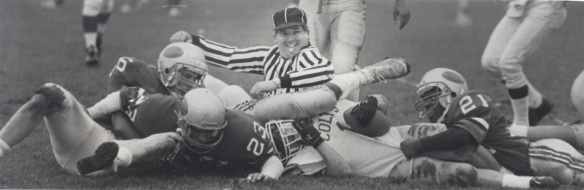
1988 121 - Richmond Review - Oct.21, 1989

The sports section of the Review showed images from many Richmond games, including this one from October 21, 1989. This is just one of the many thousands of photographs form the paper, now housed in the City of Richmond Archives. (City of Richmond Archives – Richmond Review photo 1988 121)

These recent images are in addition to previous accessions of photographs from the Review which date back to 1982, bringing the date range for Review photographs held by the Archives to about 33 years.

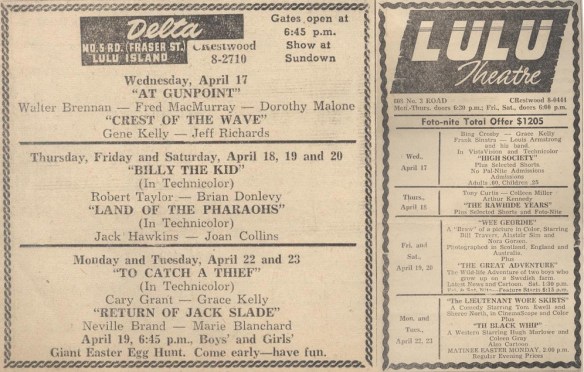
comp

Advertising helps pay for the operation of any newspaper and the Review was no exception. Local advertising allowed Richmondites to choose which sales they would attend at local stores or, in this case from 1957, which local theatre they would attend to see Hollywood’s latest offerings.

The Archives has also newly acquired the collection of the Richmond Review from the Richmond Public Library, both recent hard-copy and historical issues on microfilm. Combined with the hard-copy and historical issues already in our holdings we now have a complete run of the paper to 2015 available to the public.

[Note – this is a version of an article first published in the Spring 2016 issue of the Archives News]

Focus on the Record – Production and Mapping Centre, Planning and Development Photographs

As part of the City of Richmond Archives’ ongoing digitization program, Archives volunteer Graham Turnbull has digitized 3,621 colour slides from the City of Richmond’s Production and Mapping Centre.

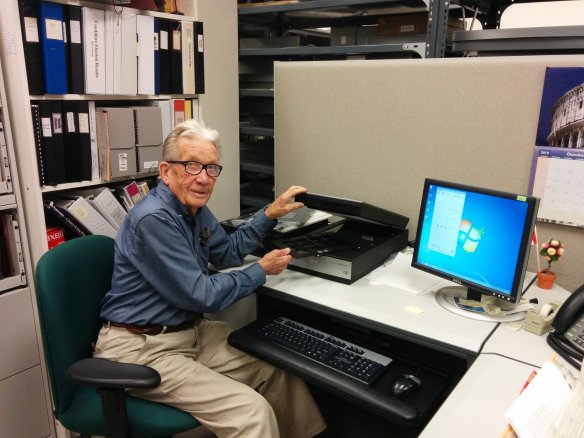
Graham with new scanner

Archives volunteer Graham Turnbull is shown here digitizing photographs using a new scanner purchased by the Friends of the Richmond Archives in 2015. The Production and Mapping Centre, Planning and Development photographs were the first photographs to be digitized using the new scanner. Richmond Archives photograph.

The slides date from 1981–1995 and were taken by Production Centre staff. The photographs record natural features of Richmond along with buildings, subdivisions, community events, farming and industrial activities.

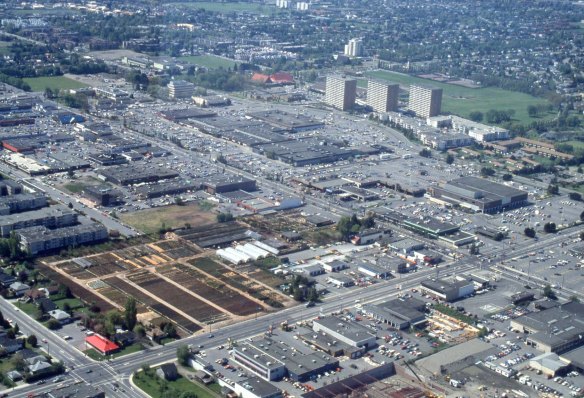
2008 39 5 61

An aerial view looking south-west over the intersection of Westminster Highway and No.3 Road, the Park Towers and Minoru Park. City of Richmond Archives photograph 2008 39 5 61.

These photographs were used in various Richmond municipal publications and in public presentations of the Planning Department. The slides document a time of changing landscape in Richmond’s history.

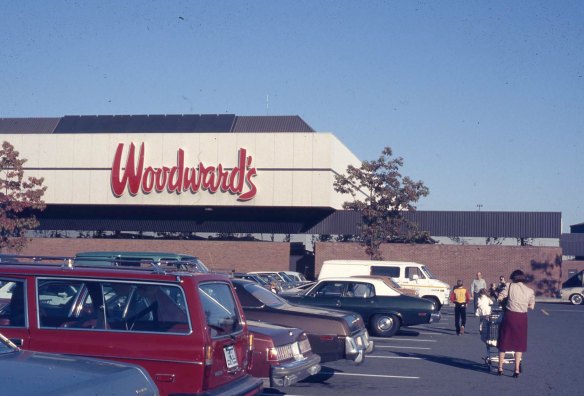
2008 39 2 70

Woodward’s Store at Lansdowne Mall, 1982. City of Richmond Archives photograph 2008 39 2 70.

2008 39 2 202

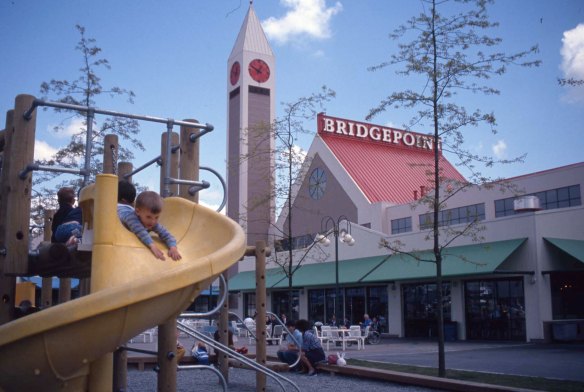
Bridgepoint Market children’s play area, 1990. City of Richmond Archives photograph 2008 39 2 202.

To view these images, either the original slides or digitized copies, researchers are welcome to make an appointment to visit the Archives. These images will also be described and made available online when the Archives Database and Web Search Upgrade project is launched in 2016.

2008 39 3 148

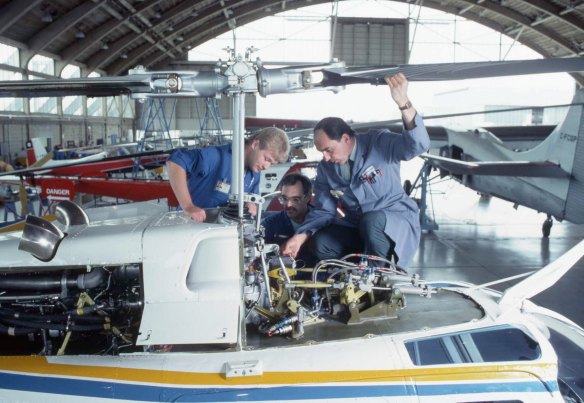
Working on a helicopter at the BCIT Aerospace Technology Campus. City of Richmond Archives photograph 2008 39 1 148.

2008 39 3 235

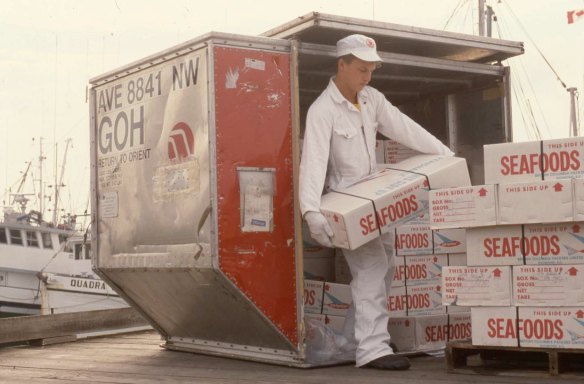
Loading seafood for export into an aircaft container. City of Richmond Archives photograph 2008 39 3 235.


[Note – this is a version of an article first published in the Spring 2016 issue of the Archives News]

From Soup to Nuts at Grauer’s Store

Grauer’s Store was a Richmond institution which had a history going back to pioneer days and the development of the community of Eburne, built along the banks of the North Arm of the Fraser River. Located on the northwest corner of Sea Island and across the river in Vancouver, Eburne was serviced by businesses on both sides of the bridge that connected the two halves of the community and provided the only road access to Richmond and the village of Steveston.
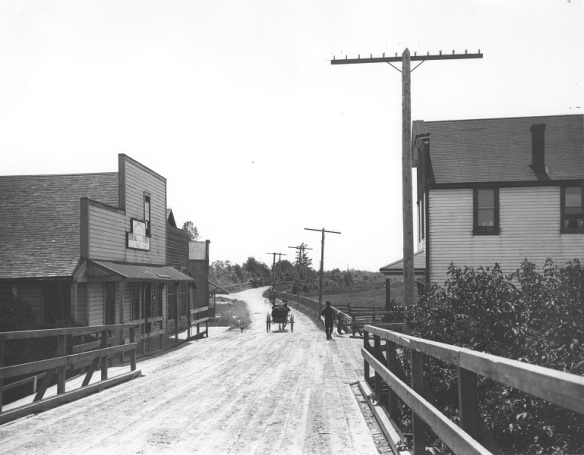
1977 2 34

Eburne on Sea Island, ca. 1906. The post Office, General Store and butcher shop are on the left in this photo, taken from the end of the Eburne Bridge. (City of Richmond Archives photograph 1977 2 34)

Harry Eburne, who gave his name to the community, opened a general store and post office on Sea Island which he sold in 1898 to Churchill and McKay. In 1894 Jacob Grauer and his wife Marie opened a butcher shop near the store and ran it until 1910, when it was sold to Pat Burns & Co. who operated it as part of a chain of butcher shops. The Burns company moved their operation across the bridge in 1911 to the part of Eburne which would rename itself Marpole in 1916.
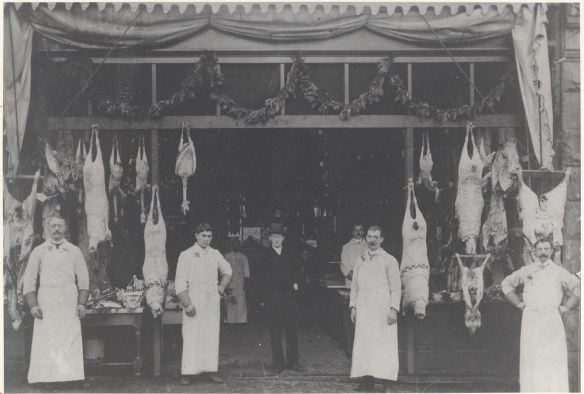
RCF 87

Grauer’s Butcher Shop in Eburne, shown here in the 1890s, became a focal point in the growing community. (City of Richmond Archives photo RCF 87)

 When Burns moved in 1911 the property was purchased by the Grauer’s son, R.M. “Rudy” Grauer, who expanded and developed it into “the largest independent business in the Fraser Valley”.
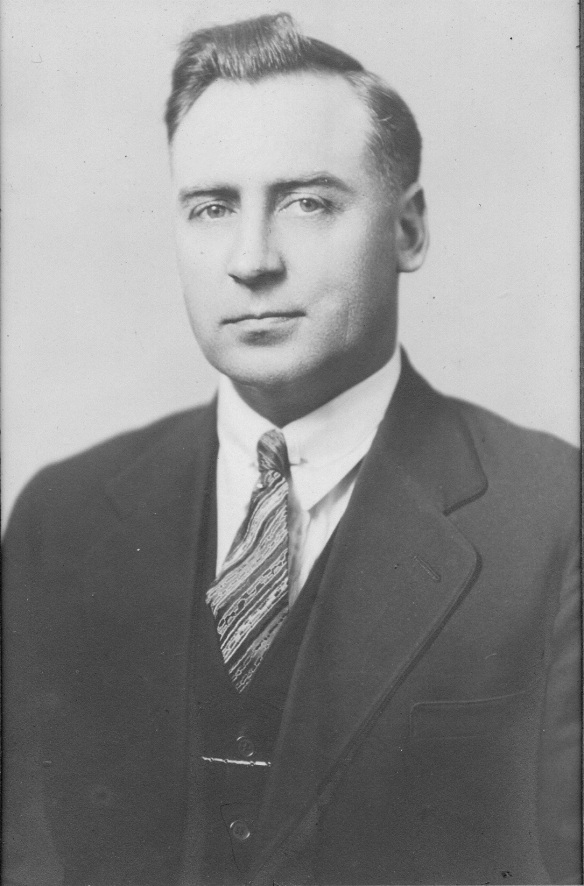
2008-34-6-15

R.M. Grauer, ca. 1930. (City of Richmond Archives photograph 2008 34 6 15)

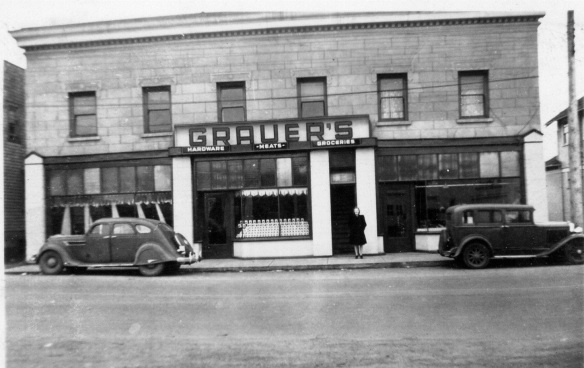
Rudy Grauer’s Store was one of those nostalgic things from our more rural past, a place where locals would drop by to stand around the stove and hear the latest gossip, talk about agriculture, the weather, politics, sports or whatever, early networking at its best. A true General Store, it carried all the goods that anyone might need. As reported in the May 26, 1951 Vancouver Sun, “It is virtually a department store on one floor. The stock includes hardware, dry goods, groceries, meats and produce. On one floor you can purchase lamb chops or a garden tractor, corn flakes or a refrigerator, cow medicine or rubber boots.”
2008-34-6-86

Grauer’s Store in the 1930s. (City of Richmond Archives photograph 2008 34 6 86)

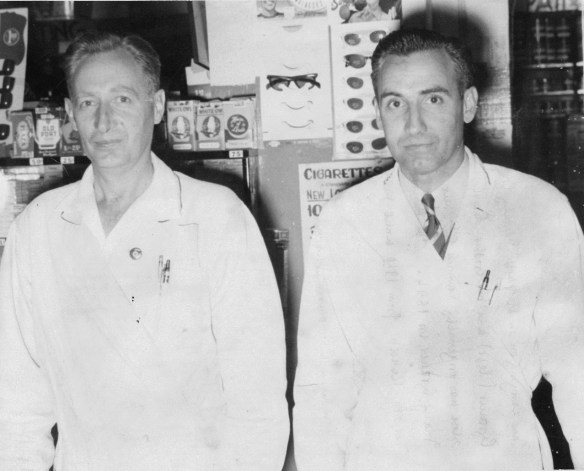
Mr. Grauer was very involved in community life. He served as President of the Richmond Agricultural and Industrial Society, President of the BC Amateur Lacrosse League, Richmond School Board and was the longest serving Reeve of Richmond from 1930 to 1949, through the Depression and World War 2. He retired from the store in the late 1940s, leaving his sons, Lester and Carl to carry on with the business, Lester in charge of produce and groceries and Carl in charge of hardware and meats.
2008-34-6-92

Lester Grauer, left, and Carl Grauer, right, took over the operation of the store after their father’s retirement and ran it until it closed. (City of Richmond Archives photograph 2008 34 6 92)

The store had a diverse customer base. Local householders, farmers and business owners could drop in to shop, or phone their orders in and have them delivered. The Grauer property included a water lot and wharf where fish boats could stop and stock up before heading off to the next opening up the coast. Tugs would often call in their orders by radio-telephone while towing booms or barges toward the North Arm, their supplies ready for pick up when they were heading back out.
map

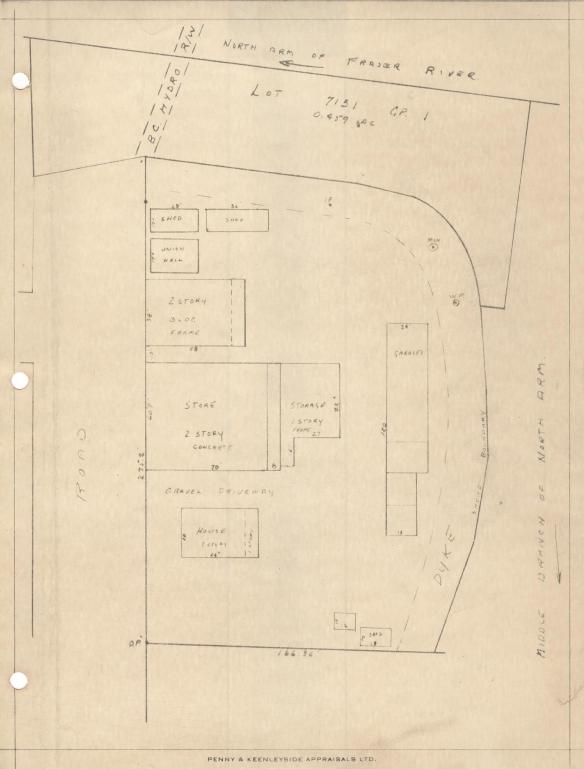
The Grauer property on Sea Island was slightly over one acre in size and included a water lot and dock. Several buildings were on the property, including the old Grauer family home, later converted to two rental suites, the store building, which had four rental suites on the second floor, the old post office/print shop building, which had two rental suites on the second floor, a small building used as a meeting hall and numerous sheds and storage buildings. (City of Richmond Archives accession 2008 34)

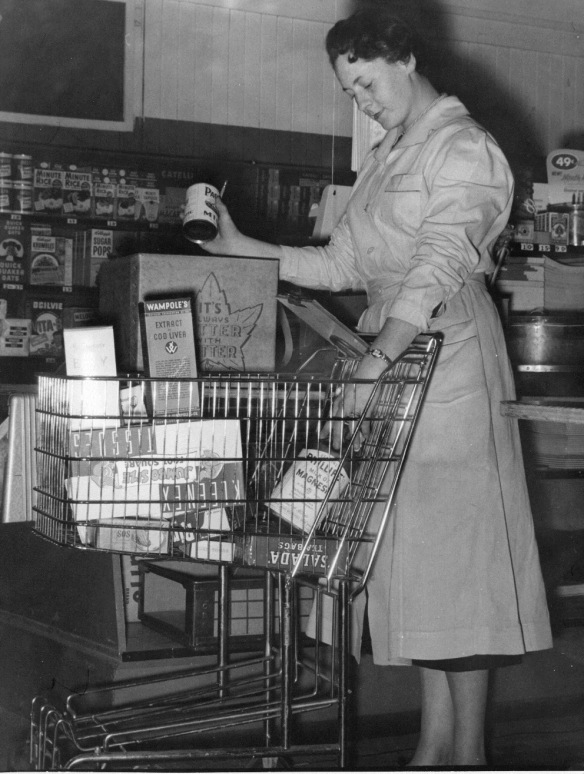
The Grauers estimated that during the store’s peak, 75-85% of business was carried out over the telephone. Customers could phone their order in to one of the store’s three telephones where a clerk would take the information and go to work filling the request at a special counter at the rear of the store.
2008-34-6-95

A sales clerk makes up an order for delivery at Grauer’s Store, 1956. (City of Richmond Archives photograph 2008 34 6 95)

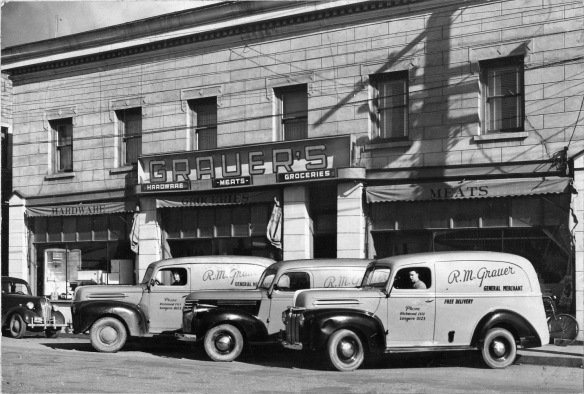
The order would be packaged up and, if for delivery to nearby areas, would be delivered the same day by one of the Grauer’s fleet of three delivery trucks.
2008-34-6-80

Grauer’s fleet of delivery trucks. (City of Richmond Archives photograph 2008 34 6 80)

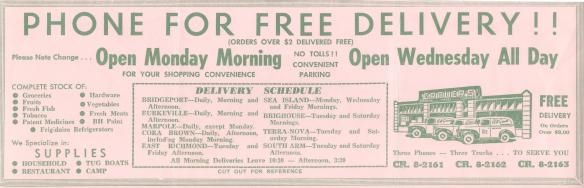
Deliveries to more distant locations would be done according to a scheduled route. The store carried a staff of 14 , including salesclerks and delivery drivers. Many were long term employees.
ad

An advertisement for Grauer’s Store with the grocery delivery schedule. (City of Richmond Archives accession 2008 34)

Pressures started gathering against the store’s business in the 1950s when the Federal Government began the expropriation of land on Sea Island for the expansion of the airport. Quoting Carl Grauer in a March 1972 Vancouver Province article, “Every time they took a house they took one of our customers.” Their losses were gradual, but after the Oak Street Bridge was opened in 1957, the tolls on that bridge shifted drivers toward the old Marpole Bridge. In response, the Provincial Government shut the old bridge down.
2008-34-6-81

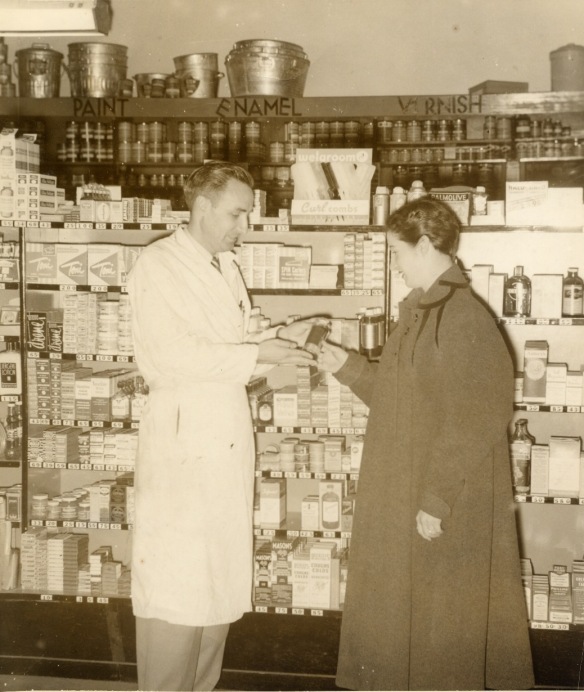
Carl Grauer assists a customer with a selection at the store in 1956. (City of Richmond Archives photograph 2008 34 6 81)

“People kept on using the old Hudson Street Bridge,” said Les Grauer, “because they didn’t have to pay the toll. So Gaglardi had to get that bridge out of the way, and he did. Right away, our business dropped off two-thirds.”
2008-34-6-90

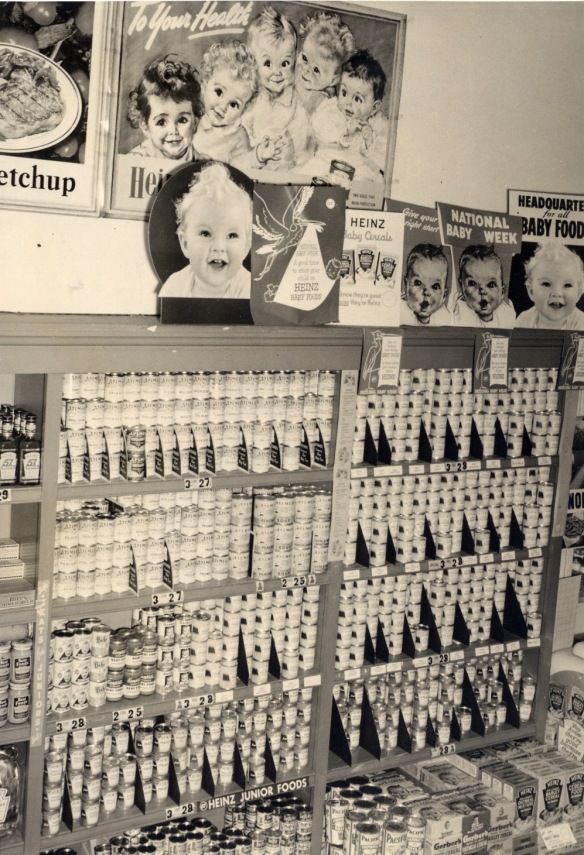
Grauer’s Store was a true General Store, carrying everything from gumboots to baby food, veterinary and beauty supplies, appliances and pork chops. (City of Richmond Archives photograph 2008 34 6 90)

The brothers complaints to the government about the Marpole Bridge closure fell on deaf ears for the most part, and hopes for a fair expropriation deal from the Federal Government were not forthcoming. In the early 1960s a deal was almost struck to sell their property to a developer who wanted to build a large hotel on the site. That deal was quashed by the Ministry of Transport. According to Carl, the Ministry of Transport was against it. It said that the pilots objected to a hotel at that point, since it would be in line with a proposed runway.
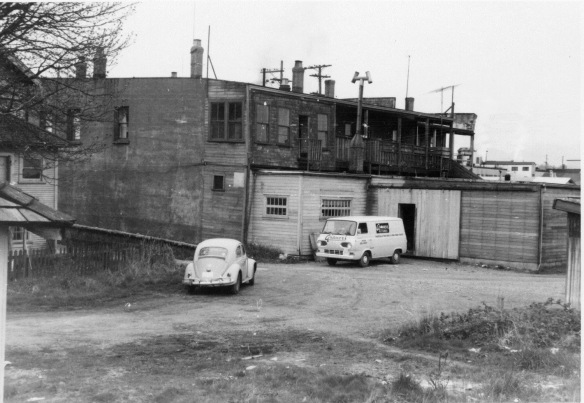
2008-34-6-84

The back of Grauer’s Store in 1967. Four rental suites were located on the top floor of the building. (City of Richmond Archives photograph 2008 34 6 84)

In the 1970s the final blow came with the construction of the Arthur Laing Bridge. Isolated behind the bridge construction while the vibration from the pile drivers knocked stock off the shelves, broke windows, shook holes in the plaster and bricks from the chimney, business evaporated. Tenants in the other buildings on the property left because of the noise. Finally on May 31, 1976 the Grauer brothers were forced to close the failing old store.
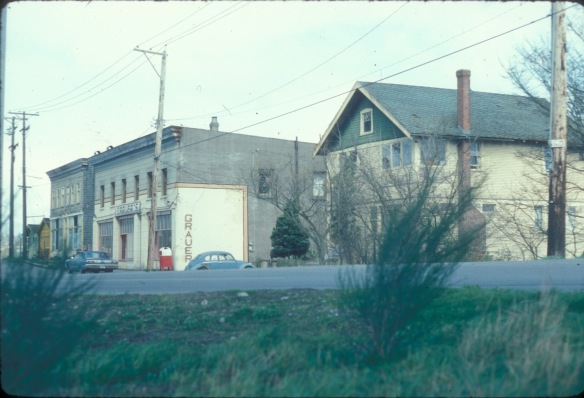
1997 42 1 258

This photo from 1977 shows the last remnants of old Eburne, lying in the shadow of the Arthur Laing Bridge which opened the year before. The two large commercial buildings are the old Post Office / Print shop building on the left and Grauer’s Store on the right. Rental units were located on the upper floors of these buildings as well as in the house to the right. (City of Richmond Archives photo 1997 42 1 258)

Once work on the bridge was finished some of the rental buildings on their property were rented for a time but finally the Grauers sold the  property to the North Fraser Harbour Commission and on January 13, 1981 the store and the other buildings on the property were demolished. A plaque at the Harbour Commission’s building commemorates the site of the Grauer Family Home and R.M. Grauer Stores, 1895 – 1980.
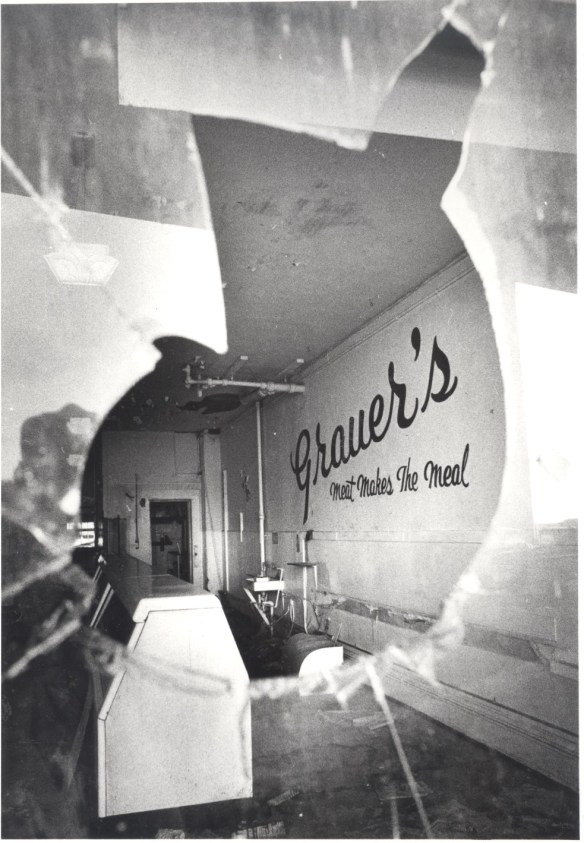
1988 121 - Richmond Review - Jan. 14

An image taken through the front window of Grauer’s Store just before it was demolished in 1981. (City of Richmond Archives photograph 1988 121-Richmond Review- Jan.14)
Dr. R. W. Large – Medical Missionary in Steveston

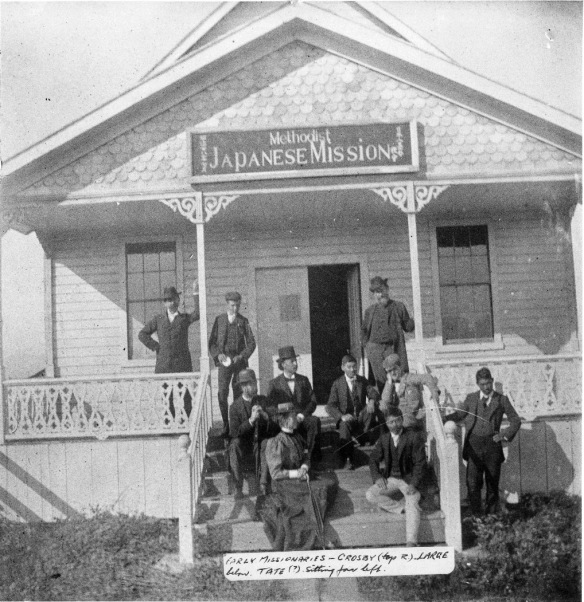
The Japanese Methodist Mission was established in Steveston in 1896 to serve the needs of the Japanese fishermen of the area, offering spiritual and moral guidance as well as providing medical assistance when needed. A small building was erected on the property of the Phoenix Cannery to house the mission.

2012 3 8

The Methodist Japanese Mission in Steveston, ca. 1898, with several early missionaries posing on the stairs. Rev. Thomas Crosby is at top right, (with beard), Dr. R.W. Large directly in front of him. (City of Richmond Archives photograph 2012 3 8)


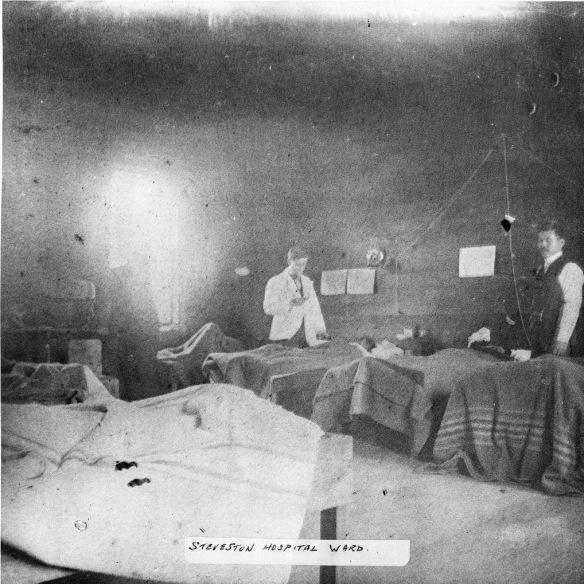
Almost as soon as it was ready, an outbreak of typhoid fever made it necessary to use the building as a hospital. The hospital operated for two years with the help of volunteer Japanese nurses.

2012 3 3

The Methodist Japanese Mission set up as a hospital ward. (City of Richmond Archives photograph 2012 3 3)

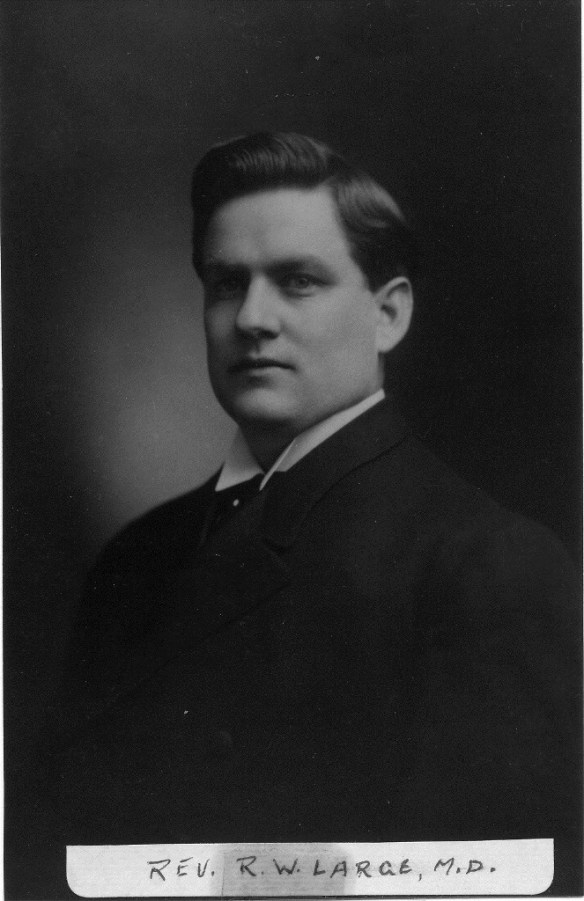
In 1898 the Canadian Methodist Church hired Dr. Richard Whitfield Large ( 1874 – 1920 ) to work at the mission during the fishing season.

2012 3 1

Rev. R.W. Large, MD. (City of Richmond Archives photograph 2012 3 1)

Dr. Large was the son of a Methodist Minister in Ontario and graduated from Trinity Medical College in Toronto.  The photographs shown in this post were taken during his two seasons in Steveston and offer a view into the primitive conditions encountered by doctors serving the small communities on the coast of British Columbia. They were donated to the Archives by a member of his family.

2012 3 6

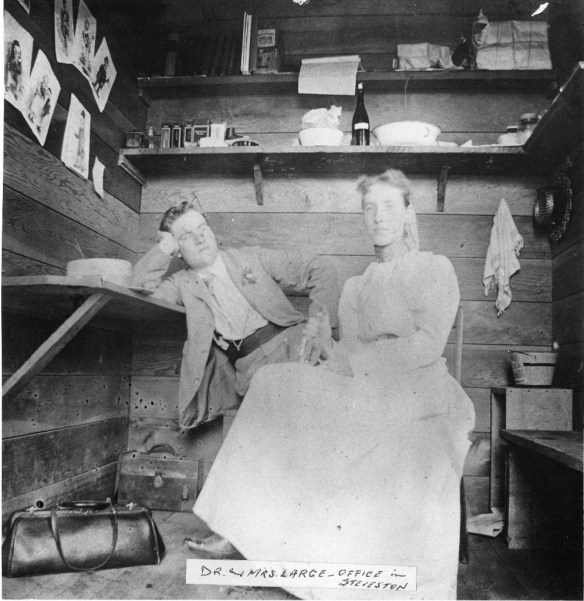
Dr. and Mrs. Large in the Doctor’s office in Steveston. (City of Richmond Archives photograph 2012 3 6)

Dr. Large married Bella Geddes in 1899 and she assisted him during that season in Steveston. The next year he was appointed to take charge of the Mission in Bella Bella and worked there until 1910 when he transferred to the Mission Hospital in Port Simpson. The R.W. Large Memorial Hospital in Bella Bella was named in his memory after his death in 1920.

2012 3 7

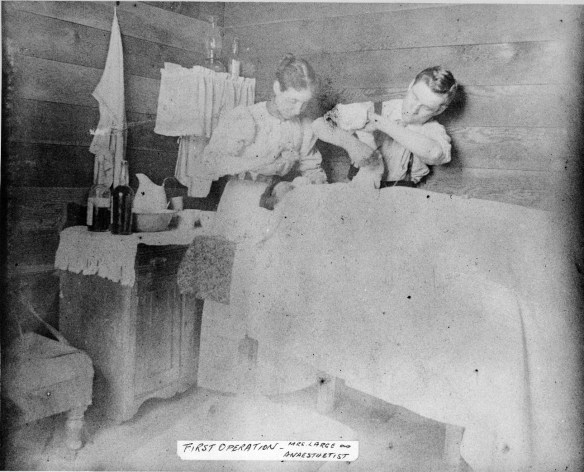
Dr. Large performs the first operation in Steveston. Mrs. Large assists as the anaesthetist. (City of Richmond Archives photograph 2012 3 7)

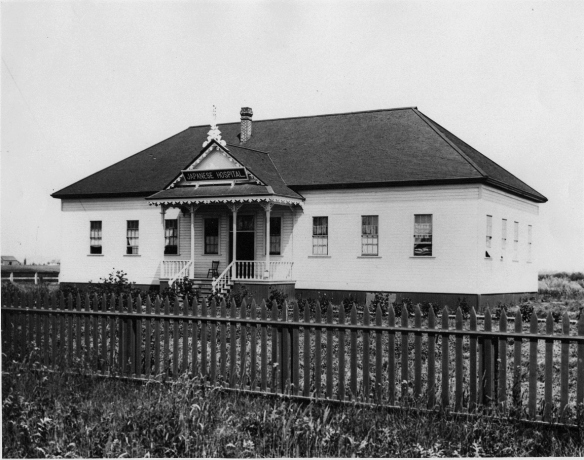
In 1900, the Japanese Fisherman’s Hospital took over the medical needs of the Japanese community in Steveston and operated until 1942 when the internment of Japanese-Canadians took place.

1978 14 10

The Steveston Japanese Hospital took over the medical needs of the Japanese community starting in 1900. Image ca. 1920. (City of Richmond Archives photograph 1978 14 10)

What’s in a Name – Minoru Park

An oasis in Richmond’s City Centre, Minoru Park is home to a wide range of recreational and cultural facilities. Areas set up for a variety of field sports, a walking and running track, ice rinks and swimming pools, as well as museums, a library, archives, spaces for arts and crafts, senior’s facilities, etc. make the park a popular and well used part of life in our city. With the Japanese origin of the name Minoru, one might think that it connects to Richmond’s history of Japanese immigration, but in fact, the name comes to us from across the Atlantic Ocean.

Eida family-1

The Eida Family, clockwise from left, Tassa, Charlie, Claire, Kaiji and Minoru. (City of Richmond Archives photograph 2009 23)

Between 1906 and 1910, Colonel William Hall Walker, a wealthy Scotsman, was having a Japanese garden built at his estate, the Tully Stud near Kildare in Ireland. The gardens were laid out and built by Japanese master gardener Tassa Eida, who did such a magnificent job that the gardens remain a popular tourist attraction today. A successful breeder of race horses, Walker named one of his colts Minoru after the son of his gardener. In 1907, Col. Walker leased a half-dozen yearlings to King Edward VII, including Minoru.

The horse Minoru had a profitable career in the King’s colours, winning at Epsom as a two-year-old and, ridden by jockey Bertie Jones, winning the Greenham Stakes and the 2000 Guineas as a three-year-old. His greatest triumph was in winning the 1909 Epsom Derby for the King, the first time a reigning monarch had won the coveted prize. The horse came in fourth at the Doncaster St.Leger Stakes, missing a chance to win the British Triple Crown. Two more wins that year finished his year with five wins in seven starts.

2014 26 1

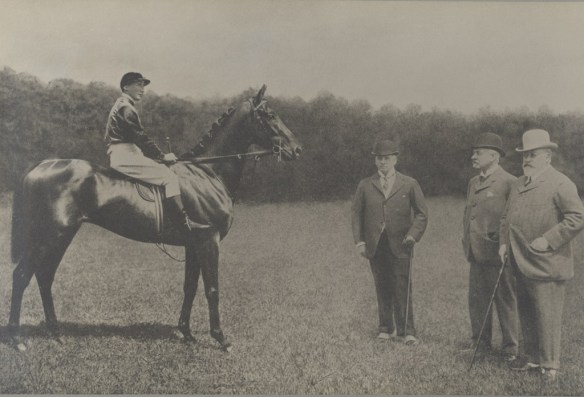
King Edward VII (R) with Minoru after winning the Epsom Derby in 1909. Bertie Jones is the jockey. (City of Richmond Archives photograph 2014 26 1)

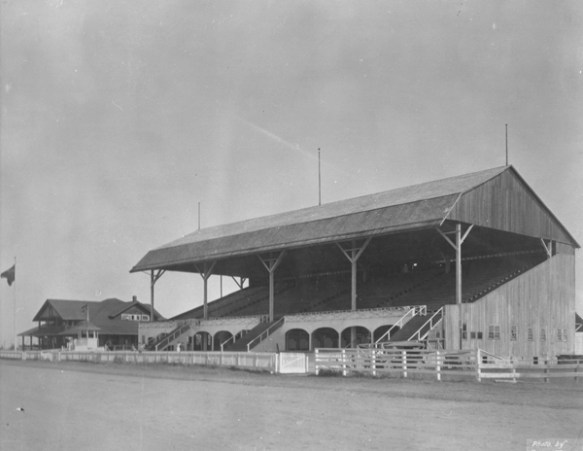
In Richmond in 1909 a group of businessmen, Messrs. H. & T. Springer, Suckling, Lewis and Marpole, were building the Township’s first thoroughbred horseracing track on land they had purchased from Samuel Brighouse. In 90 days a mile-long oval, a grandstand, a clubhouse and a mile of barns were built at a cost of $75,000. In choosing a name for the track, they settled on the name of the horse that had just won the Derby for the King and Minoru Park Racetrack was born. Opening day at Minoru Park was attended by 7000 race fans.

2001 09 24

The Minoru Park Racetrack grandstand and clubhouse in 1909. (City of Richmond Archives photograph 2001 9 24)

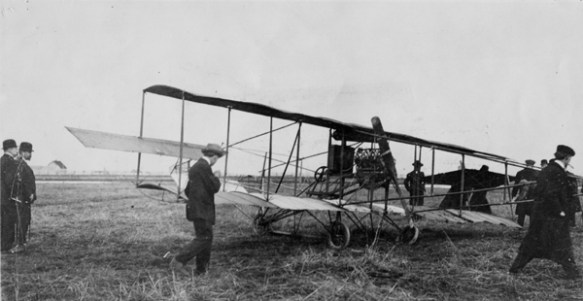
The track was used for many events in addition to horse racing. Minoru Park was used as a landing strip for aircraft, and was the location of the first flight by an airplane in Western Canada on March 25, 1910, the starting point for the first flight across the Rocky Mountains and the venue for air shows hosted by the Aerial League of Canada.

1978 15 18

On March 25, 1910 Mr. Charles K. Hamilton made the first aircraft flight in Western Canada, taking off in front of 3500 spectators at Minoru Racetrack. (City of Richmond Archives photograph 1978 15 18)

Automobile racing exhibitions were also held at the track, hosting well-known drivers like Barney Oldfield, Bob Burman and “Terrible” Teddy Tetzlaff and cars like the famous “Blitzen Benz” and the “Romano Special”. Polo matches were held in the middle of the track, temporary boxing rings were set up for fans of the pugilistic arts and community events, such as May Day celebrations, were held there as well.

1984 17 69

Racing driver Harry Hooper in the “Vulcan Kewpie” Stutz, accompanied by silent film star Priscilla Dean, raced against an airplane piloted by Lieut. G.K. Trim at Minoru in an event hosted by the Aerial League of Canada on Dominion Day, 1919. The event included lots of aerial stunts and wing walking. A house was erected in the middle of the track so it could be blown up by bombs dropped from aircraft, but exploded on its own, much to the amusement of the crowd. (City of Richmond Archives photograph 1984 17 69)

With the outbreak of World War I in 1914, Minoru Park closed until 1920 when it reopened and was renamed Brighouse Park. Brighouse Park Racetrack operated until 1941 when it closed for racing permanently, although it continued to be used as a training and boarding facility. The land was purchased by the British Columbia Turf and Country Club in 1945 and in 1958 the Municipality of Richmond purchased the property. The park reclaimed the name Minoru in 1960 to honour the long history of horse racing at the site. In 1962 the Mayor and Council purchased the Brighouse Estate, allowing the park to expand to its present size and develop into today’s complex of recreational parkland, buildings and services, a complex which is presently being upgraded with the construction of a new aquatic centre, sports facility and seniors facility.

This 1951 aerial view over the intersection of Granville Avenue and No.3 Road shows Brighouse (Minoru) Racetrack while under the ownership of the BC Turf and Country Club. Richmond Municipal Hall is on the corner in the same location as City Hall Today. (City of Richmond Archives photograph 1984 17 5)

This 1951 aerial view over the intersection of Granville Avenue and No.3 Road shows Brighouse (Minoru) Racetrack while under the ownership of the BC Turf and Country Club. Richmond Municipal Hall is on the corner in the same location as City Hall Today. (City of Richmond Archives photograph 1984 17 5)

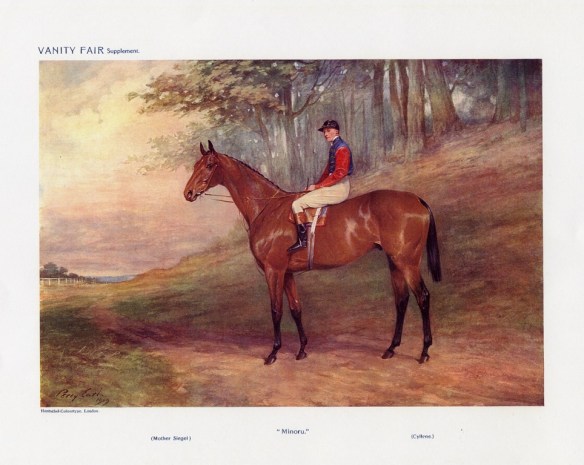
Minoru the racehorse was retired to the Tully Stud in 1910 and in 1913 was sold to a Russian stud farm. The horse’s history after that is lost in the chaos of the Russian Revolution, although stories are told of Minoru being shot by an English officer to prevent him being abused by the Bolsheviks, or of a possible escape across Ukraine and Russia to the Black Sea and by ship to Turkey.

A print of Minoru from Vanity Fair, 1909. (City of Richmond Archives accession 2009 23)

A print of Minoru from Vanity Fair, 1909. (City of Richmond Archives accession 2009 23)

In 2009, in commemoration of the 100th Anniversary of the opening of Minoru Park, a bronze statue of Minoru was unveiled near the Richmond Cultural Centre. Created by artist Sergei Traschenko and donated to the City of Richmond by the Milan & Maureen Ilich Foundation, the statue was dedicated to the winning spirit of Richmond’s early pioneers of both Eastern and Western cultures and the men and women of the early thoroughbred racing industry in Richmond. The unveiling event was attended by many citizens and dignitaries, including Brian Eida, the son of Minoru (Jack) Eida who gave his name to a horse, which gave its name to a racetrack, which gave its name to a park.

The bronze statue of Minoru in Minoru Park. (City of Richmond Archives photograph)

The bronze statue of Minoru in Minoru Park. (City of Richmond Archives photograph)