Wells Air Harbour

Lulu Island was the location of many of BC’s pioneering aviation milestones but since the opening of the Vancouver Airport and Seaplane base on Sea Island on July 22, 1931 the majority of Richmond’s aviation activity has taken place there.

1989 19 11

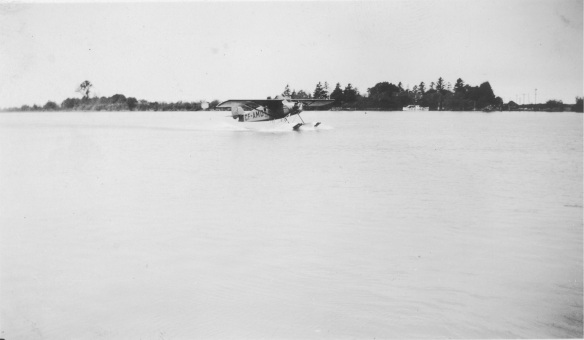
A float plane taxis on the Middle Arm of the Fraser River in this photo, ca. 1930. (City of Richmond Archives photo 1989 19 11)

One exception to this was Wells Air Harbour, a seaplane base and repair facility on the Lulu Island side of the middle arm. The facility was built by Air Land Manufacturing and started operations in 1929, becoming an important base for seaplane operations. It became generally known by the name of its operator, Hunter Wells, during the early 1930s.

water map

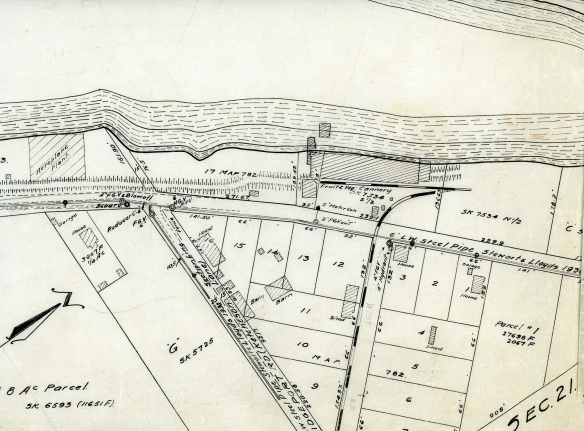
This waterworks map from the late 1930s shows the Wells Air Harbour building, labelled “Aeroplane Plant”, on the upper left, just south of the end of Bridgeport Road. (City of Richmond Archives map – Sea Island and No.3 Road Water Linens)

The business was located on River Road near the present end of Bridgeport Road, easily accessible from Vancouver via the Marpole Bridge. Aircraft that landed on the Middle Arm could moor at the terminal’s floats or, if in need of repairs, could be hauled up the ramp into the hangar.

1985 1 21

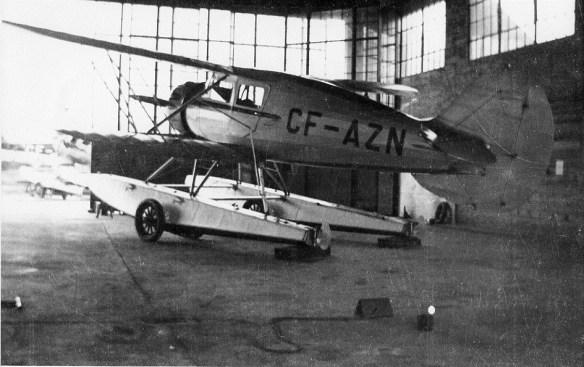
Bush pilot Ginger Coote operated his airline out of Wells Air Harbour. Shown here is his Waco YKS-6 in a hangar. (City of Richmond Archives photo 1985 1 21)

The Harbour was the base of operations for many aviation companies. Wells Air Transport, Alaska-Washington Airways of BC, Commercial Airways and Canadian Airways all used the facility. Ginger Coote Airways, run by legendary bush pilot Russell L. “Ginger” Coote also used the base. Coote was a WWI fighter pilot and after the war personified the image of the daring bush pilot.

2012 12 1

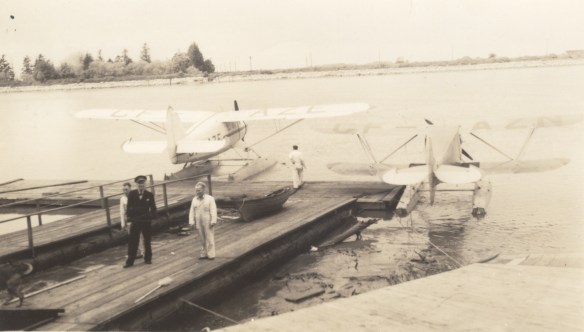
Russel L. “Ginger” Coote, in the pilot’s uniform, stands on the float at Wells Air Harbour, ca. 1935. In the right foreground is the ramp to the hangar where Tommy Jones repaired and rebuilt aircraft. (City of Richmond Archives photo 2012 12 1)

Tommy Jones ran a profitable aircraft overhaul and repair business at the Air Harbour as well. Many of the classic seaplanes were serviced there, with work from regular maintenance to complete overhauls taking place. It was not unusual to see groups of women at the repair shop stitching and fitting fabric to the wings and fuselages of various aircraft.

1977 1 99

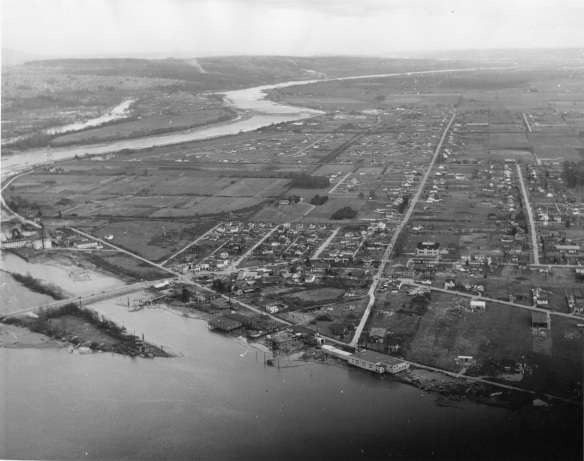
This aerial view shows the former Wells Air Harbour hangar building at the end of Bridgeport Road in 1953 with the ramp used to haul aircraft into the hangar removed. The building has seen many uses over the years, from an aluminum factory to a restaurant, and survives to this day. (City of Richmond Archives photo 1977 1 99)

Wells Air Harbour and Jones’ repair business closed as better facilities became available around the Lower Mainland with the onset of WWII. The hangar building is still standing, tucked between the two bridges to YVR, and for many years has been home to the Richmond Boathouse Restaurant.

Capture

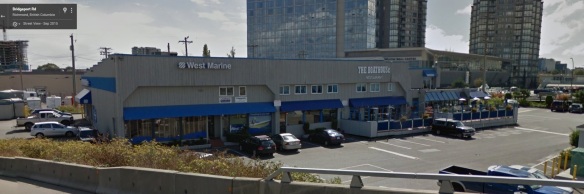
A Google Street View capture shows the Boathouse – West Marine location on River Road. The large hangar door openings can still be seen, a leftover from the days when this building was one of the busiest seaplane bases in the Lower Mainland. Infill has separated the building from the Middle Arm and provided a parking lot.


New at the Archives – The Richmond Review

One of the top news stories for Richmondites in 2015 was the end of the local newspaper, the Richmond Review. 

Last Review

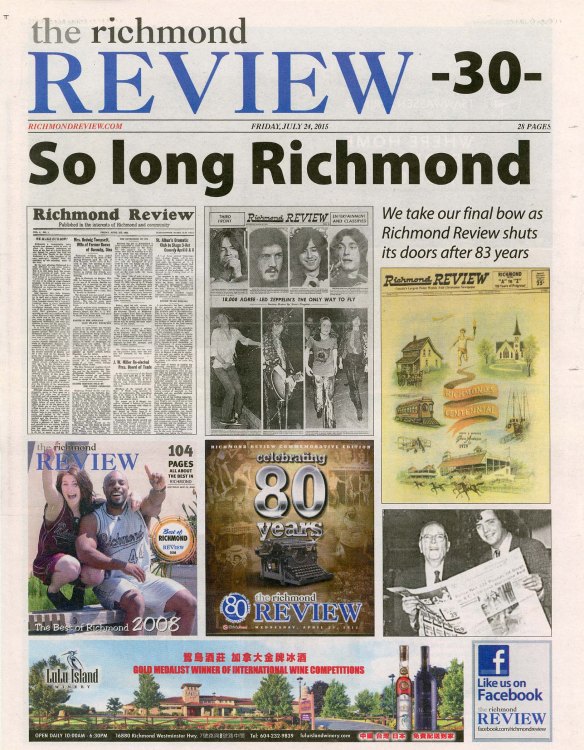
The front page of the last edition of the Richmond Review, July 24, 2015.

The Review began life in 1932, a gesture of optimism in an otherwise depressed period of time. After a few issues published by founder Bill Carruthers, it was sold to Ethel Tibbits, who ran it until 1948.

Police1937

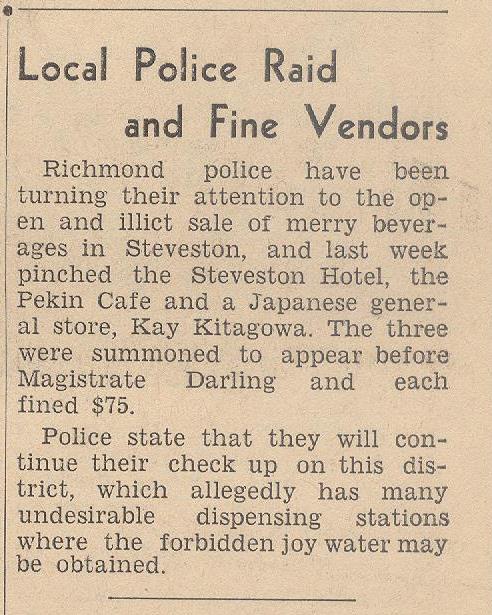
The police news was a popular feature of the Marpole-Richmond Review where the latest police activities could be followed and names were named, even for minor infractions. This clip from 1937 relates the fallout from illegal liquor sales in Steveston.

For much of its existence it was known as the Marpole-Richmond Review. By the 1970’s it was BC’s largest circulating biweekly. The last issue came out on July 24th 2015; the publishers citing market forces as the culprit, making competition with another newspaper impossible to carry on.

Review staff

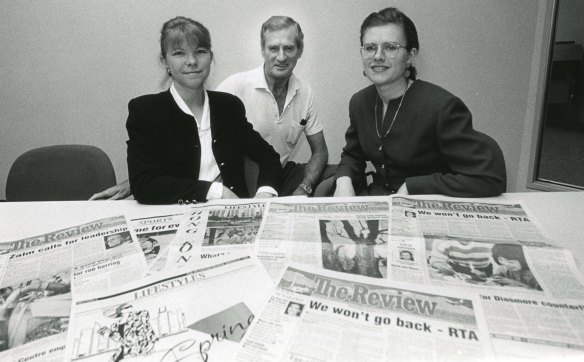
The Richmond Review staff, ca. 1990; left to right – Publisher Susan Tweedie, Composing Room Foreman Fred Meyer and Editor Diane Strandberg. City of Richmond Archives photograph 2015 19.

Before the offices of the Richmond Review were completely vacated, the City of Richmond Archives was invited to visit the location to retrieve records which we would consider important to the community.

Steves72

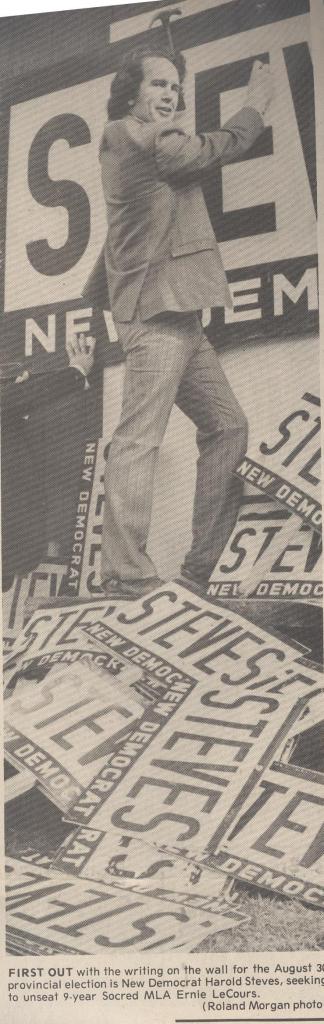
The Review was an important source of information for readers during elections, featuring interviews, candidate’s platforms, etc. This clipping shows well-known local politician Harold Steves beginning his successful run for the NDP in the 1972 Provincial election.

The bulk of this accession is more than 50,000 images taken by Review reporters, now housed in the climate-controlled and secure stacks of the Archives. These photographs are both in 35mm and digital formats, and represent the transition to the use of digital cameras.

1988 121 - Richmond Review - Oct.21, 1989

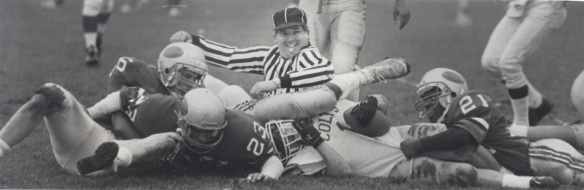
The sports section of the Review showed images from many Richmond games, including this one from October 21, 1989. This is just one of the many thousands of photographs form the paper, now housed in the City of Richmond Archives. (City of Richmond Archives – Richmond Review photo 1988 121)

These recent images are in addition to previous accessions of photographs from the Review which date back to 1982, bringing the date range for Review photographs held by the Archives to about 33 years.

comp

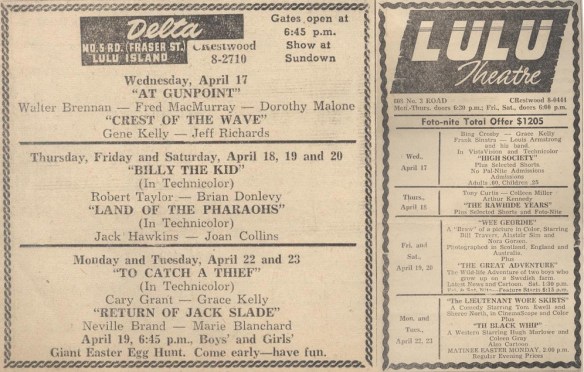
Advertising helps pay for the operation of any newspaper and the Review was no exception. Local advertising allowed Richmondites to choose which sales they would attend at local stores or, in this case from 1957, which local theatre they would attend to see Hollywood’s latest offerings.

The Archives has also newly acquired the collection of the Richmond Review from the Richmond Public Library, both recent hard-copy and historical issues on microfilm. Combined with the hard-copy and historical issues already in our holdings we now have a complete run of the paper to 2015 available to the public.

[Note – this is a version of an article first published in the Spring 2016 issue of the Archives News]

Focus on the Record – Production and Mapping Centre, Planning and Development Photographs

As part of the City of Richmond Archives’ ongoing digitization program, Archives volunteer Graham Turnbull has digitized 3,621 colour slides from the City of Richmond’s Production and Mapping Centre.

Graham with new scanner

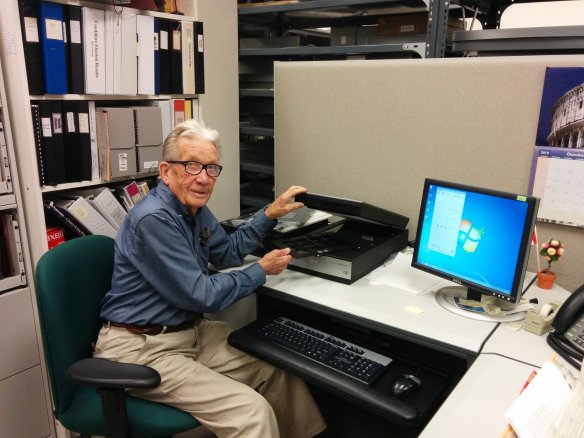
Archives volunteer Graham Turnbull is shown here digitizing photographs using a new scanner purchased by the Friends of the Richmond Archives in 2015. The Production and Mapping Centre, Planning and Development photographs were the first photographs to be digitized using the new scanner. Richmond Archives photograph.

The slides date from 1981–1995 and were taken by Production Centre staff. The photographs record natural features of Richmond along with buildings, subdivisions, community events, farming and industrial activities.

2008 39 5 61

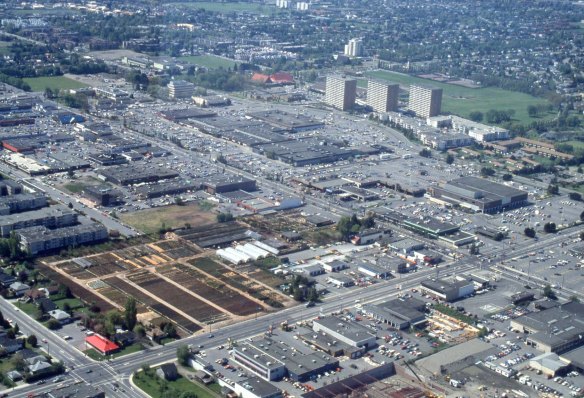
An aerial view looking south-west over the intersection of Westminster Highway and No.3 Road, the Park Towers and Minoru Park. City of Richmond Archives photograph 2008 39 5 61.

These photographs were used in various Richmond municipal publications and in public presentations of the Planning Department. The slides document a time of changing landscape in Richmond’s history.

2008 39 2 70

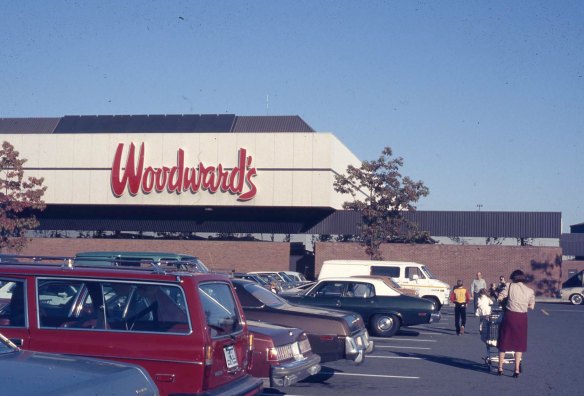
Woodward’s Store at Lansdowne Mall, 1982. City of Richmond Archives photograph 2008 39 2 70.

2008 39 2 202

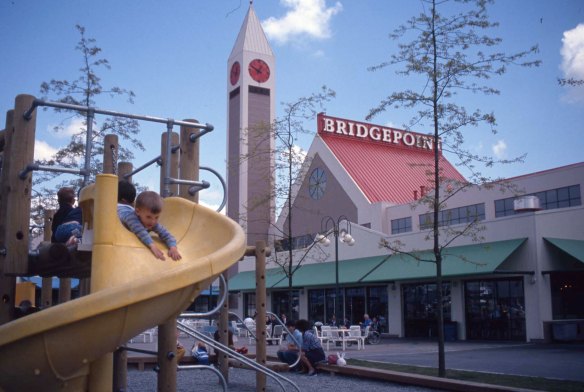
Bridgepoint Market children’s play area, 1990. City of Richmond Archives photograph 2008 39 2 202.

To view these images, either the original slides or digitized copies, researchers are welcome to make an appointment to visit the Archives. These images will also be described and made available online when the Archives Database and Web Search Upgrade project is launched in 2016.

2008 39 3 148

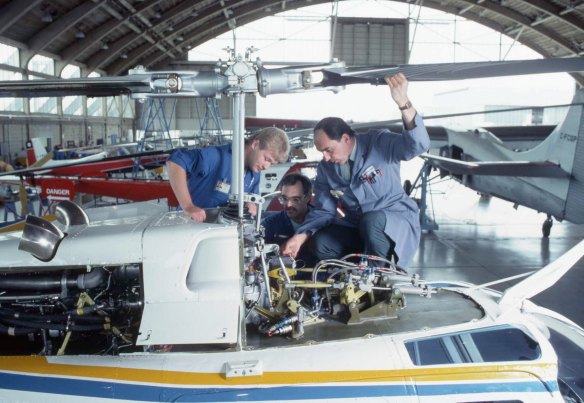
Working on a helicopter at the BCIT Aerospace Technology Campus. City of Richmond Archives photograph 2008 39 1 148.

2008 39 3 235

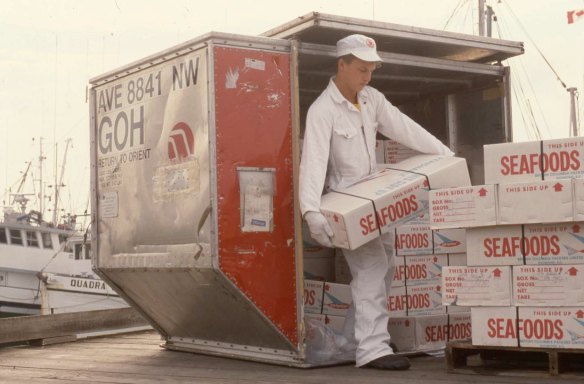
Loading seafood for export into an aircaft container. City of Richmond Archives photograph 2008 39 3 235.


[Note – this is a version of an article first published in the Spring 2016 issue of the Archives News]

Dr. R. W. Large – Medical Missionary in Steveston

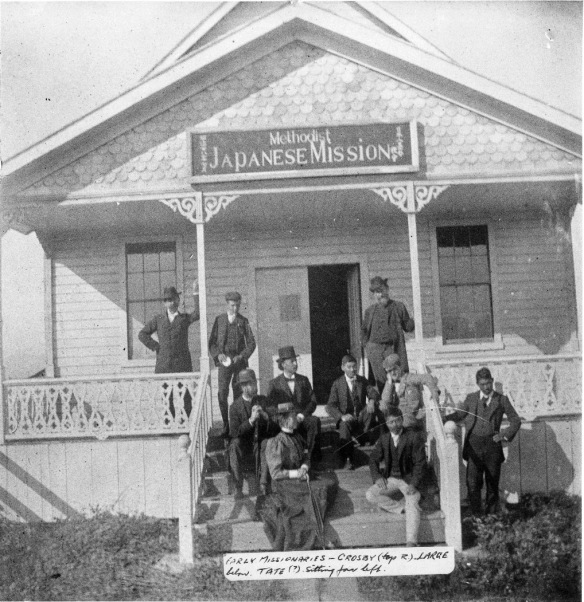
The Japanese Methodist Mission was established in Steveston in 1896 to serve the needs of the Japanese fishermen of the area, offering spiritual and moral guidance as well as providing medical assistance when needed. A small building was erected on the property of the Phoenix Cannery to house the mission.

2012 3 8

The Methodist Japanese Mission in Steveston, ca. 1898, with several early missionaries posing on the stairs. Rev. Thomas Crosby is at top right, (with beard), Dr. R.W. Large directly in front of him. (City of Richmond Archives photograph 2012 3 8)


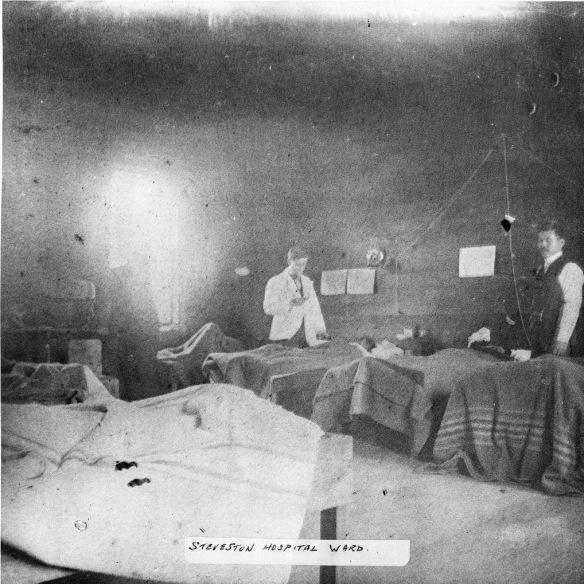
Almost as soon as it was ready, an outbreak of typhoid fever made it necessary to use the building as a hospital. The hospital operated for two years with the help of volunteer Japanese nurses.

2012 3 3

The Methodist Japanese Mission set up as a hospital ward. (City of Richmond Archives photograph 2012 3 3)

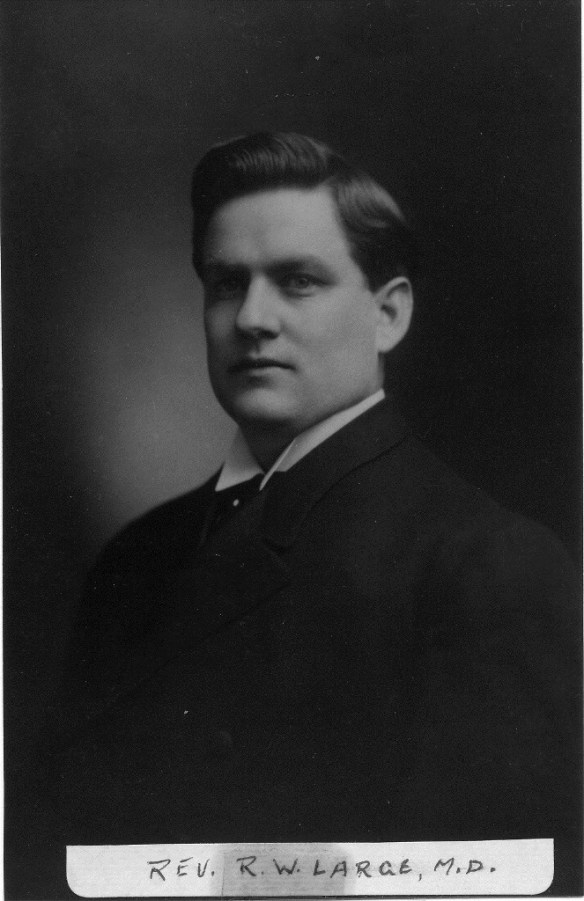
In 1898 the Canadian Methodist Church hired Dr. Richard Whitfield Large ( 1874 – 1920 ) to work at the mission during the fishing season.

2012 3 1

Rev. R.W. Large, MD. (City of Richmond Archives photograph 2012 3 1)

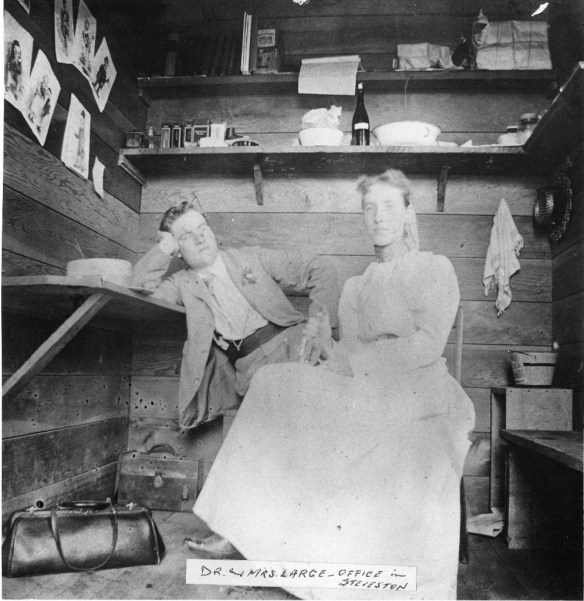
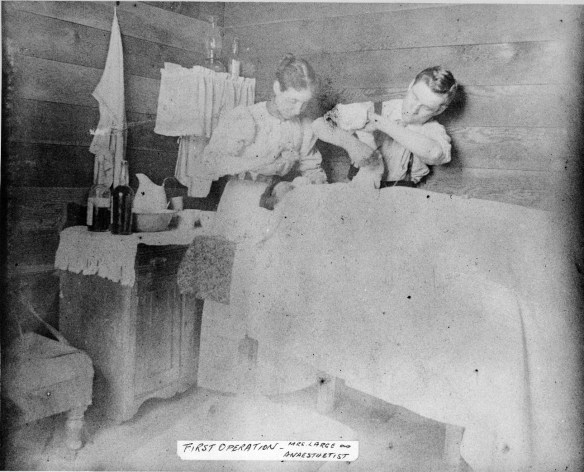
Dr. Large was the son of a Methodist Minister in Ontario and graduated from Trinity Medical College in Toronto.  The photographs shown in this post were taken during his two seasons in Steveston and offer a view into the primitive conditions encountered by doctors serving the small communities on the coast of British Columbia. They were donated to the Archives by a member of his family.

2012 3 6

Dr. and Mrs. Large in the Doctor’s office in Steveston. (City of Richmond Archives photograph 2012 3 6)

Dr. Large married Bella Geddes in 1899 and she assisted him during that season in Steveston. The next year he was appointed to take charge of the Mission in Bella Bella and worked there until 1910 when he transferred to the Mission Hospital in Port Simpson. The R.W. Large Memorial Hospital in Bella Bella was named in his memory after his death in 1920.

2012 3 7

Dr. Large performs the first operation in Steveston. Mrs. Large assists as the anaesthetist. (City of Richmond Archives photograph 2012 3 7)

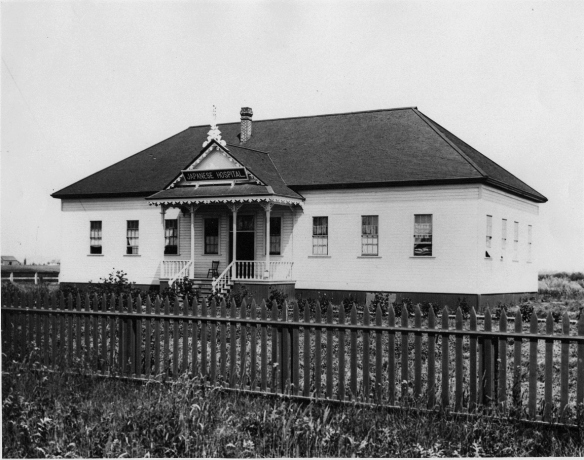
In 1900, the Japanese Fisherman’s Hospital took over the medical needs of the Japanese community in Steveston and operated until 1942 when the internment of Japanese-Canadians took place.

1978 14 10

The Steveston Japanese Hospital took over the medical needs of the Japanese community starting in 1900. Image ca. 1920. (City of Richmond Archives photograph 1978 14 10)

Focus on the Record – Early Records of the Municipal Waterworks System

The importance of a municipal waterworks system to the daily lives of residents is often overlooked.  In Richmond, it wasn’t until 1910 that a system for piping drinking water was established.  Prior to this date, drinking water was normally available only through the use of rain barrels or by delivery, often in milk cans, by water wagon or train.

The development of Richmond’s waterworks system is well documented in records held at the City of Richmond Archives.  City bylaws, Council minutes and reports, and files relating to the building, regulation and taxation of the water system provide an accurate picture of its installation, maintenance, expansion and continual modernization.

First page of 1930 agreement whereby Richmond joined the Greater Vancouver Water District. City of Richmond Archives MR 66, File 548 First page of 1930 agreement whereby Richmond joined the Greater Vancouver Water District. City of Richmond Archives MR 66, File 548

Records at the Archives speak to the importance of the 1909 bylaw authorizing an agreement with the City of New Westminster to supply piped water to Richmond and the 1930 agreement to join the Greater Vancouver Water District and the implications of that to the present day.

Charles Jones, Waterworks Superintendent. City of Richmond Archives Photograph 1986 19 1 Charles Jones, Waterworks Superintendent. City of Richmond Archives Photograph 1986 19 1

In addition to City government records, the private papers at the City of Richmond Archives of Charles Jones, the waterworks superintendent for the municipality from 1913 to 1952, enable researchers to understand the complexity of the work performed and the challenges facing a municipality situated on islands at the mouth of the Fraser River.  The manner in which Jones laid the watermain on the river bed to supply water from Lulu Island to Sea Island in 1937 was celebrated as a technical feat never before seen in the province.

Laying of Watermain to Sea Island. Diagram of the laying of the watermain to Sea Island, 1937. City of Richmond Archives Accession 2011 25

City records such as the 1936 Waterworks Atlas, which mapped all built structures in the municipality and their proximity to connections to watermains, are consulted on a regular basis today by environmental and property researchers studying land use and development in Richmond.

Waterworks atlas map for area near Alexandra Station, 1936. City of Richmond Archives Map 1991 40 75 Waterworks atlas map for area near Alexandra Station, 1936. City of Richmond Archives Map 1991 40 75

In total, the early records of waterworks tell the story of the growth of the municipality through the building of an infrastructure which many people now take for granted.

[Note – this is an updated version of an article first published in the Spring 2015 issue of the Archives News]