A city or municipality needs to define itself with a symbol of its identity, a connection to its history and a visual representation of its stature and image. Coats of Arms, official seals, flags, and logos all function to promote a positive public image to residents, visitors, and potential investors, as well as serve to authenticate documents and official correspondence. Here is a brief history and explanation of Richmond’s symbols.
The Official Seal
On November 10, 1897, Lulu and Sea Islands became the Corporation of Richmond by Letters Patent under the Public Seal of the Province of British Columbia. One of the orders of business during the first year of Richmond’s incorporation was the adoption of an official seal. Used to authenticate legal documents and be a credible indication of the validity of municipal documents, Richmond’s first official seal was adopted at the Council meeting of Saturday June 19, 1880. The entry in the minutes reads, “Moved by Councillor Smith seconded by Councillor Kilgour that the seal impressed on the margin be adopted as the seal of the Corporation of Richmond … Carried”. In the left margin of the page beside the entry, a blob of red sealing wax is impressed with an indistinct shape.
The first Seal of the Corporation of Richmond, adopted June 19, 1880 as shown in this photo from the Council minutes. City of Richmond Archives photograph.
The first seal was not in use for very long. It was quickly replaced by the more modern embossed seal using a design which has symbolized Richmond up to today, the Cornucopia (Horn of Plenty). The design was suggested by Richmond’s first Warden (Reeve, Mayor) Hugh Boyd and was adopted at the July 5, 1880 council meeting. It shows the cornucopia in the centre, encircled by the words “Municipality of Richmond B.C.” In the words of early Richmond historian Thomas Kidd, it was “considered a very appropriate symbol at that time and it is to be hoped that the prosperity of these islands will always justify it remaining so.”
The embossed Corporate Seal of the Municipality of Richmond is shown here in the minutes from the July 5, 1880 Council meeting. The entry says, “Moved by Councillor Kilgour seconded by Councillor Steves that the new seal impressed on the margin be adopted as the Corporate Seal of Richmond in lieu of the one adopted on the 19th of June… Carried.” City of Richmond Archives photograph.A colourful version of Richmond’s seal. City of Richmond Archives photograph.
The cornucopia has been a constant symbol of Richmond’s identity, the image changing slightly over the years and the text changing from “Municipality of Richmond B.C.” to “The Corporation of the Township of Richmond B.C.” to “Corporation of Richmond” with “Incorporated 1879” placed inside the circle. In 1979 in celebration of Richmond’s 100th Anniversary a new emblem of the Corporation was unveiled, still bearing the image of the cornucopia but incorporating registered symbols of heraldry.
The Coat of Arms
In August 1978 the Richmond’s Municipal Council adopted a resolution to petition the College of Arms in London, England to grant the Municipality a Coat of Arms and Badge as part of the celebrations around the Municipality’s centennial on November 10, 1979. After consultation with Mr. Robert D. Watt, Chief Curator of the Vancouver Centennial Museum and a Director of the Heraldry Society of Canada, a letter was sent to the York Herald of Arms, Dr. Conrad Swan, PhD., M.A., requesting that the Municipality be granted a Coat of Arms and badge. Some preliminary design ideas were provided which were considered, modified slightly to conform with the requirements of the Kings of Arms and approved. Once the design was approved the process of producing Letters Patent of Armorial Bearings was undertaken over several months. The Letters Patent were presented to the Corporation of the Township of Richmond by Lieutenant Governor Henry Bell-Irving, representing the Crown and assisted by Dr. Conrad Swan, York Herald of Arms at a ceremony on November 10, 1979, the centennial of the incorporation of Richmond.
The Letters Patent granting the Coat of Arms to Richmond and bearing the seals of the Kings of Arms. The text opens with the salutation, “TO ALL AND SINGULAR to whom these Presents shall come Alexander Colin Cole, Esquire Commander of the Royal Victorian Order upon whom has been conferred the Territorial Decoration, Garter Principal King of Arms, Sir Anthony Richard Wagner, Knight Commander of the Most Honourable Order of the Bath, Knight Commander of the Royal Victoria Order, Clarenceux King of Arms and Walter John George Verco, Esquire, Commander of the Royal Victoria Order, Norroy and Ulster King of Arms Send Greetings! ” City of Richmond Archives photograph.
Heraldry harks back to the 12th century when the markings were used to identify the warriors on the battlefield, much like the colours and logos on the uniforms of modern sports teams. A Coat of Arms is made up of several elements:
The Coat of Arms of Richmond. City of Richmond photograph.
Colours – The predominant colours in Richmond’s Coat of Arms are Blue and Gold.
The Shield –The shield is gold with a wavy blue bar, known as the pale, symbolizing the Fraser River and featuring three leaping salmon, representing the most common species in the waters around Richmond and its links to the fishing industry. From the Letters Patent: “Or on a Pale wavy Azure three leaping Salmon proper”.
The Helmet and Mantling –Above the shield sits a helmet mantled in blue and gold.
The Crest and Wreath – Atop the helmet is the wreath of gold and blue supporting a circlet of red maple leaves, representing Canada, and white dogwood flowers for British Columbia. The Crest is a dove rising with an olive twig in its beak, relating to the story of Noah and land rising from the waters as the islands of Richmond have. From the Letters Patent: “And for the rest Upon a Helm with a Wreath Or and Azure Rising from a Circlet of Maple Leaves Gules and Dogwood Flowers alternatively a Dove volant in its beak a sprig of Olive proper”.
The Supporters –On either side of the shield are two supporters, both representing the Goddess Fortuna, the bearer of prosperity. Each supporter holds a cornucopia, representing the fruitfulness of the land. The supporter to the right of the shield wears a red ribbon embroidered with white roses. The red and white represents Canada while the white roses represent the first Richmond in Yorkshire which has white roses in its coat of arms. From the Letters Patent: “Supporters following that is to say: – On the Lecter side a female figure proper crined or vested Argent supporting with the exterior hand a Cornucopia at the mouth its tail over her shoulder proper On the sinister side a like figure above her shoulders a Riband Gules thereon Roses Argent barbed and seeded proper and supporting with the exterior hand a Cornucopia by its tail also proper its mouth to the ground”.
The Compartment – The area upon which the shield and supporters stand is known as the compartment and shows green foliage and stems of blueberries, a common local crop, and once again representing the fertility of the land. From the Letters Patent: “the Compartment comprising a grassy mount with sprigs of Blueberry fructed growing therefrom all proper”.
The Motto – Below the compartment is a banner with the Motto, “Child of the Fraser.” The Motto comes from the first line of the poem “Lulu Island” by early Richmond settler and historian Thomas Kidd. The first verse of the poem reads, “Child of the Fraser River and the Sea, / Fair Lulu Island where I built my home, / Though I had seen fair lands ere I saw thee, / I came and saw and said, ‘No more I’ll Roam.'”
The Badge
Richmond’s Badge. City of Richmond photo.
Included with the granting of a Coat of Arms is a Badge. Richmond’s Badge shows an anchor, signifying the sea and a connection to the fishing industry, and a strawberry vine and blossoms, signifying the fruitfulness of the land. The strawberry blossom also connects to the Coat of Arms of the Frasers, which also carry the strawberry blossom and gives a link to the Fraser River. From the Letters Patent: “And We do further grant and assign the following Device or Badge that is to say: An Anchor Azure charged in base with a Strawberry Flower proper from the ring reflexed towards the sinister fluke and behind the Anchor’s stock a branch of Strawberry flowered and leaves proper”.
The Flag
On July 22, 1985, Municipal Council directed staff to prepare a report on the design of a civic flag. The civic flag was designed by Municipal employees Rod Lynde with assistance from Frank Sciberras and was officially introduced to the public at the opening of Brighouse Park on April 12, 1986 by Mayor Gil Blair.
The civic flag of Richmond. City of Richmond Archives photograph.
The flag is blue and gold, Richmond’s accepted colours. The shield in the centre of the flag is from the Coat of Arms, gold with a wavy pale bar in blue and three salmon. The gold background and blue borders of the flag represents Richmond’s fertile lands surrounded by the waters of the Fraser River.
The Heron Logo
Richmond’s most familiar symbol today is based on the bird commonly seen fishing in the shallows around our city. The stylized heron logo is simple, yet iconic and was first used by Tourism Richmond in the 1990s. This first logo featured the words “Richmond – Island City, by Nature” with the heron’s head rising from the “N” in Richmond.
This Tourism Richmond Visitor Guide cover image using the stylized heron logo was published in 1995. City of Richmond image.
The heron logo and slogan was adopted a in 1998 by Richmond’s Year 2000 Committee. In 2000 the City also adopted the heron logo, but in 2002 changed the slogan to “Better in Every Way” as part of a promotional campaign to attract investment to the city.
The “Better in Every Way” tagline on the Heron logo lasted only for a few years. City of Richmond image.
In 2008, with the 2010 Winter Olympics on the horizon, the City adopted a new consolidated visual identity and logo for itself and its partners, one which would reflect the past but fit in with the changes occurring with the Olympic era. The new logo was also a stylized heron, but facing to the right and in colours consistent with the Olympic palette, although the design’s colour is easily changed for other uses. The design of the heron demonstrates the elements of flow, flight, and fusion – concepts used in the design of Richmond’s Olympic Oval. The “Better in Every Way” logo was dropped and a new tagline, “Soar Beyond” was suggested. The design was accepted by the committee but the new tagline was rejected and the tried and true “Island City, by Nature” was preserved to be used when a slogan was found to be desirable.
The new heron logo was adopted in 2008 and appears in colours consistent with those of the 2010 Olympics. City of Richmond image.The heron logo in basic black identifies vehicles and equipment in the City’s fleet. City of Richmond photograph.
The City’s corporate symbols have changed over its history but it retains an image from its earliest past with the cornucopia in the Coat of Arms, still used in official documents, and an image from more recent times, the stylized heron seen widely around the city on signs, buildings, and City vehicles. The future may bring new designs to represent our city but the images shown in this post will always remain as a part of Richmond’s visual identity.
“I think that I shall never see, A poem as lovely as a tree.”
Joyce Kilmer’s 1913 poem, “Trees” describes the way that many people feel about trees. Valued for the natural cooling effect of the shade they provide, their addition of oxygen to the environment and the general improvement to the quality of an urban landscape, most people prefer the presence of trees in spite of the mess made by falling leaves, damage from falling branches and trunks, damage to infrastructure by root systems and getting in the way of development.
Native and Introduced Species
Richmond’s native tree species are adapted to a high water table and peat and silt loam soil. The most common native species in Richmond before non-Indigenous settlement were Shore Pine, Sitka Spruce, Pacific Crabapple, Willow, Black Cottonwood and Black Hawthorn. These trees, many little more than shrubs, lined the shores of Lulu and Sea Islands, shaded the paths of sloughs and grew in groves in areas of prairie grasslands. An ancient beach berm along the west side of Lulu Island, once lined with native crabapple trees, is followed today by the Crabapple Ridge bike route. A large conifer at Garry point, most likely a spruce, was used as a navigation marker, guiding ships and boats into the channel at the mouth of the Fraser River until it was washed away in the flood of 1891.
Native shrubs and trees line the path of this slough just west of the London Farm house in 1977. City of Richmond Archives photograph 1984 4 21.
Trees native to Richmond are not generally long-lived, 100 to 300 years at most, and often die before maturity due to bog fires, diseases and other reasons. Native tree species, important to the natural history of Richmond, are protected by the acquisition of land by the City and by the declaration of environmentally sensitive areas, the emphasis being the preservation of forested areas and allowing natural regeneration rather than the protection of individual trees.
This map shows the types of vegetation existing in Richmond and the rest of the Fraser Lowlands between 1858 and 1880. City of Richmond Archives Map 1987 76 8.
Around 1860, non-Indigenous settlers began arriving in present day Richmond. Wanting farmland, they cleared native vegetation and dyked and drained the land. They also planted non-native trees which provided shade and shelter for livestock, protected crops from wind and produced fruit and nuts. Non-native trees planted by settlers or later residents of Richmond, depending on their age, size, species, setting, landmark, ecological value, aesthetics, and condition are often be considered to be heritage trees or trees of significance.
Protecting Trees
Early in 1987, with an eye towards preservation, the City sponsored a Tree Contest to make use of citizen’s local knowledge of possibly significant trees. Ads in the Richmond Review invited people to submit an entry form with a photograph and location of trees in Richmond which they thought might win in one of four categories, oldest tree, tallest tree, rarest tree and most interesting tree. A $100 prize was awarded for the winner in each category. About 100 entries and photographs of trees from all over town were submitted during the month-long contest which was judged by the City’s Environmental Control Officer and a professional Forester.
This ad and entry form appeared in the May 1, 1987 edition of the Richmond Review,
Winner of the oldest tree was a Giant Sequoia on No.4 Road which was 104 years old at the time. Honorable Mention went to another Sequoia at Cambie and No.4 Road which was 95 years old. The tallest tree winner was a Douglas Fir at Chatham and First Ave. which was 114 feet tall, Honorable Mention was a Hemlock on Garden City Road at 103 feet.
Winner of the tallest tree category was this Douglas Fir located on Chatham Street just east of First Avenue, submitted by the residents of the Lions Manor in Steveston. City of Richmond Archives Accession 1987 60.
Rarest tree was an Ontario Sugar Maple on Sexsmith Road, planted in 1910 by a member of the Sexsmith Family. Honorable Mention in that category was a Fig Tree on Glenacres Drive. The prize for the Most Interesting Tree was won by a Chinese Dawn Redwood on Alexandra Road. The Honorable Mention went to a Pear Tree near General Currie School with four varieties of fruit grafted to it.
This Weeping Willow tree under the Arthur Laing Bridge was planted by the Grauer Family to commemorate the birth of a child and was considered a tree of significance. Grauer’s Store can be seen in the background. City of Richmond Archives photograph 1997 42 1 440.
A few years later the City hired a Landscape Architect to create Richmond’s first professionally prepared list of Heritage Trees. The Consultant identified 127 significant trees or groves of trees, a list that was enhanced by the collection of historical data by other consultants and a citizen’s advisory committee. All of this groundwork was intended to lead to a way to preserve trees of significance, a challenging prospect considering the subjective nature of determining exactly what criteria identifies a Heritage tree. Attempts at protecting specific trees with bylaws or by heritage designation proved to be impractical and today those protections have been superseded by Tree Protection Bylaw 8057 which offers much broader protection to all trees 20cm or greater diameter as measured 1.4 m above the ground. Even with this bylaw it has to be recognized that at some point in a tree’s life they can get old, diseased, get costly and difficult to maintain and become hazardous and need to be removed. There is also a limit to what a city can do to with respect to tree preservation on private property.
A Richmond Tree
As an example of a tree of significance, let’s focus on one that has been in the public eye since it was planted around 1920. After the end of World War One the former Minoru Racetrack reopened as Brighouse Park Racetrack.
Race fans crowd the rail in front of the clubhouse to watch the Parade to the Post at Brighouse Park Racetrack, ca. 1924. At the centre of the photograph, the young American Elm grows. City of Richmond Archives photograph 2001 9 30.
Michael Wilkinson Brighouse purchased the racetrack property and made several changes, improving and enlarging the grandstands, clubhouse and grounds and planting a number of trees. Quite a few of those trees are still standing but one in particular stands out, planted on its own rather than in a group and in an area that has been photographed many times over the years.
This aerial image taken in 1951 shows the now defunct Brighouse Park Racetrack and Richmond Town Hall. The grandstand has been removed but the clubhouse is still there and the Elm tree, much larger and full of foliage, still stands beside the track. City of Richmond Archives photograph 1984 17 5.
This tree, an American Elm (Ulmus americana), has stayed rooted in the same spot for about 100 years, while the City has changed around it. Once a small trackside shade tree it has seen the demise of horse racing in Richmond, had a road built past it separating it from some of its fellow racetrack trees, shaded the back of the Richmond Twin Theatres, the Richmond Centre parkade and now is dwarfed by high-rise buildings behind it.
Workmen lay foundations for the Richmond Twin Theatres under the boughs of the American Elm in this January, 1968 Richmond Review picture. Other trees from the racetrack grow in the background. City of Richmond Archives, Richmond Review, Frank Dawson photograph.
The American Elm tree is located on City property and can be more easily maintained and protected by the City than trees located on private property. Many trees considered to be of heritage value have been lost to disease, out growing their locations, age or safety but many have also been saved through the work of private citizens and City staff.
Looking west toward the Minoru Cultural Centre ca. 1995. The American Elm stands close to the Richmond Centre Parkade. City of Richmond Archives photograph 2008 39 1 184.The American Elm today with new buildings rising behind. John Campbell photograph.
Hopefully this tree and others like it will be preserved so that future generations can appreciate their beauty as well as their significance to the heritage of our City. As Joyce Kilmer closed his poem,
“Poems are made by fools like me, But only God can make a tree”
Richmond has a long and rich history of Japanese immigration and settlement. Various places around Richmond, Sea Island, Don Island and, in particular, Steveston were areas where Japanese immigrants lived, worked, raised families and contributed to the diverse cultural blend of our city.
Steveston looking west along Moncton Street from No.1 Road around 1940. The majority of the businesses along this street were operated by Japanese-Canadian entrepreneurs at the time. City of Richmond Archives photograph RCF 274.
Japanese immigrants (Nikkei) arrived in Steveston around the time that the English Cannery opened in 1882 and by the 1900s made up a large portion of the Steveston population. Mostly male and mostly fishermen, they were accommodated in bunkhouses built by the canneries. During the fishing season Japanese “Bosses,” who had control of twenty or thirty boats, would negotiate contracts with the canneries for them and take care of their needs such as food, clothing and other services in return for a percentage of their wages.
This image taken on November 22, 1936 shows members of the Japanese community gathered outside the Japanese Buddhist Mission on First Avenue to commemorate the ceremony of “Putting in the Buddha.” City of Richmond Archives photograph 1995 3 1.
Although the original intention of many of the men was to return to Japan after working in Canada, many decided to stay permanently. Some returned to Japan to find wives, others had their families back home arrange marriages with suitable women, the so-called “Picture Brides”. Bunkhouses were unsuitable for married couples, so canneries built small houses to accommodate families.
A group of Japanese girls pose for a picture in traditional May Day dress outside the Steveston Japanese School ca. 1926. City of Richmond Archives photograph 1978 1 36.
The Nikkei population grew, the men fishing and their wives working in the canneries and raising families. They diversified, expanding into boatbuilding, buying property, farming and starting businesses. People joined Faith communities, formed sports teams and created a rich community life.
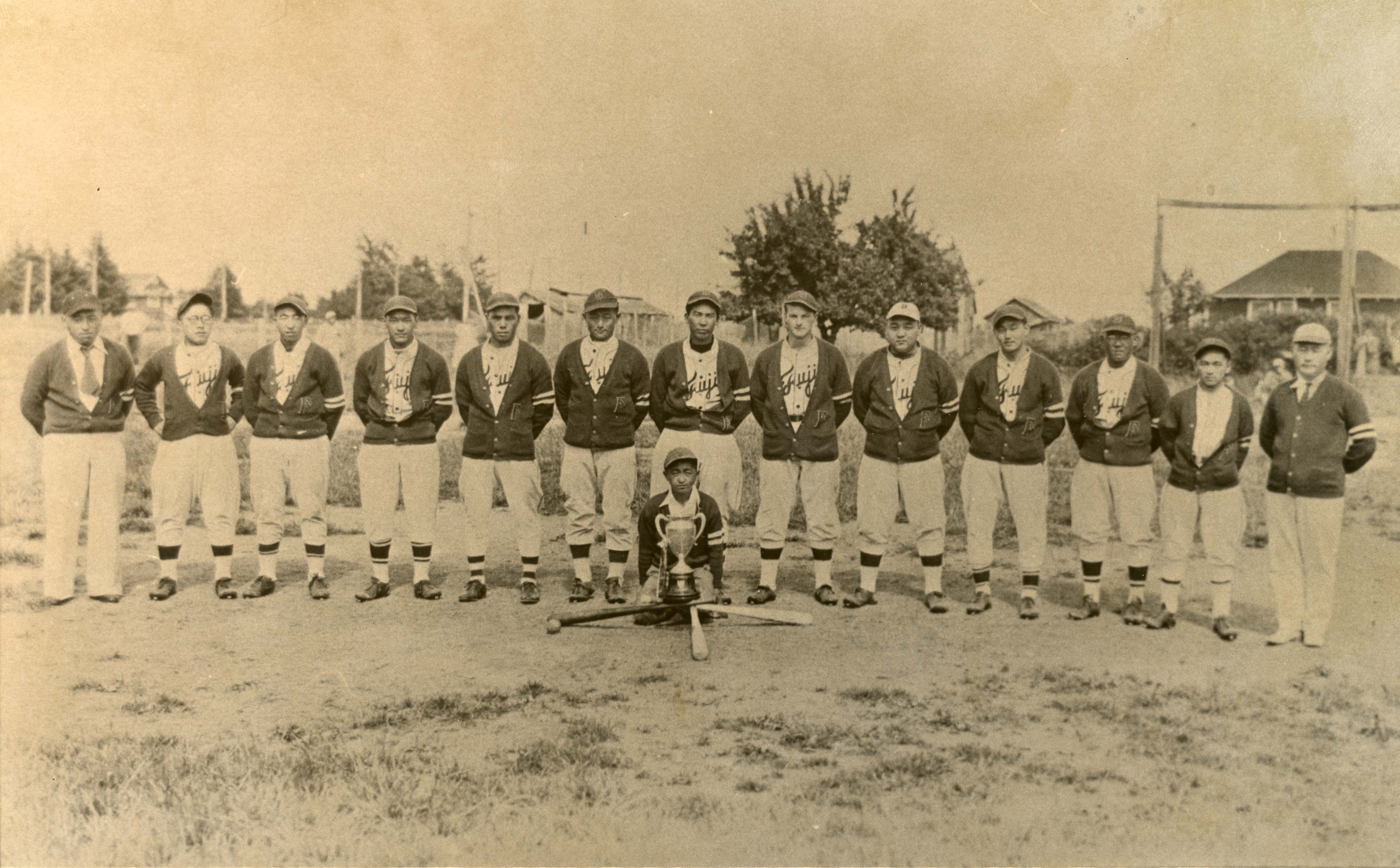
The Steveston Fuji baseball team played in the Vancouver Japanese League with the Asahi Giants, Powell Drugs and Union Fish teams. City of Richmond Archives photograph 1977 7 12.
Contending with discrimination and exclusion, The Japanese Fishermen’s Benevolent Society was formed in 1897 to protect the interests of the Nikkei fishermen and the community, A 1906 decision by the Richmond School Board to ban children of non-property owners effectively deprived most of the Nikkei children of an education and resulted in the construction of the Steveston Japanese School. To ensure that the health needs of the community were met, the Japanese Fishermen’s Hospital was built, Richmond’s first.
The Japanese Fishermen’s Hospital on No.1 Road in Steveston, ca. 1915. City of Richmond Archives photograph 2006 39 47.
By the 1930s the Japanese population had grown to account for two-thirds to three quarters of the total population of Steveston, approximately 3500 people. Nikkei owned businesses and stores of every description lined Moncton Street from No.1 Road to Third Avenue. Grocery stores, meat and fish markets, hardware and general stores, a bicycle shop, the River Garage, a billiard hall and clothing stores operated by Nikkei entrepreneurs could be found on both sides of the street. Five confectioneries (candy and chocolate shops) satisfied those with a craving for sweets.
The Mukai Confectionary stood at the corner of Moncton Street and No.1 Road and had a confectionary in the front, a pool hall in the back and ten bedrooms upstairs. It also housed a taxi business and had space used by a dentist who came to Steveston once a week. The building was lost in a fire sometime between 1942 and 1951 but the location is still known as Mukai Corner. City of Richmond Archives photograph RCF 272.
The density of the Japanese Canadian population in Steveston is very obvious when looking at the meticulous research done by Haruji (Harry) Mizuta who, using maps from the 1936 Waterworks Atlas of Richmond, marked the locations of Nikkei homes and businesses from the Scottish Canadian Cannery in what is now Garry Point Park to the Winch Cannery at the foot of No.2 Road. This is especially true with the map he marked as #30-2 1930s – Gulf of Georgia Cannery and Old Steveston Town – Steveston BC.
This map, created by Haruji (Harry) Mizuta illustrates the quantity of Nikkei homes and businesses, marked by blue and red dots, in Steveston during the Thirties. City of Richmond Archives Reference Files.
The growth of “Japan Town” came to a sudden halt with the forced relocation of Japanese Canadians from the Coast of British Columbia. Families were uprooted, stripped of their property and moved to areas where they had to start over and rebuild their lives, often in harsh circumstances. Steveston became a virtual ghost town with so many of its residents suddenly gone. In 1949 when Nikkei families were permitted to come back to the coast, those who decided to return rebuilt their lives and community again. Today the legacy of Japan Town is a cherished and honoured part of Steveston’s and Richmond’s history.
Haruji (Harry) Mizuta’s research shows some of the businesses and business owners along Moncton Street during the 1930s. City of Richmond Archives Reference files.
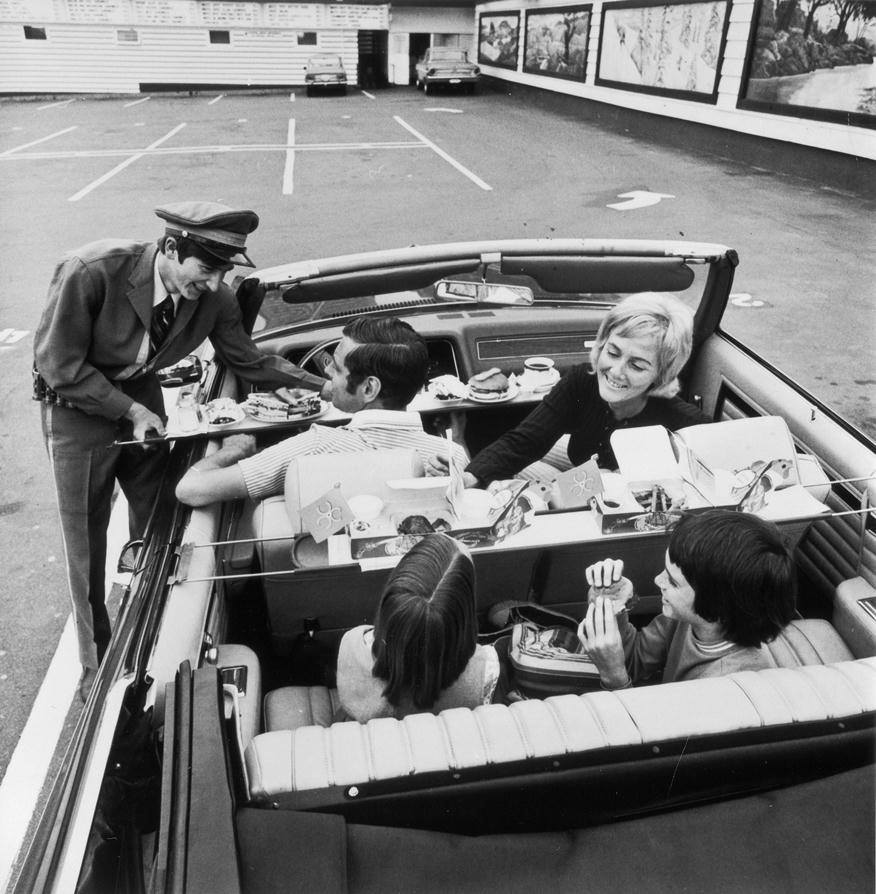
An iconic symbol of youth and car culture during the ’50s, ’60s and ’70s was the drive-in restaurant. Popularized during a thriving post-war economy, the baby boom and the rapid growth of car ownership, drive-ins typically featured large parking areas and little or no indoor seating. Menus, visible from your car, displayed inexpensive meals which included burgers, chicken and fries. In contrast to the modern “drive-thru” concept, many drive-ins were self serve, where you walked to a window, ordered and picked up your food and took it back to your car. Others provided car service, your order taken and food delivered to your car by staff known as “carhops” who would attach a tray to your window with your meal on it. “Lights On For Service!”
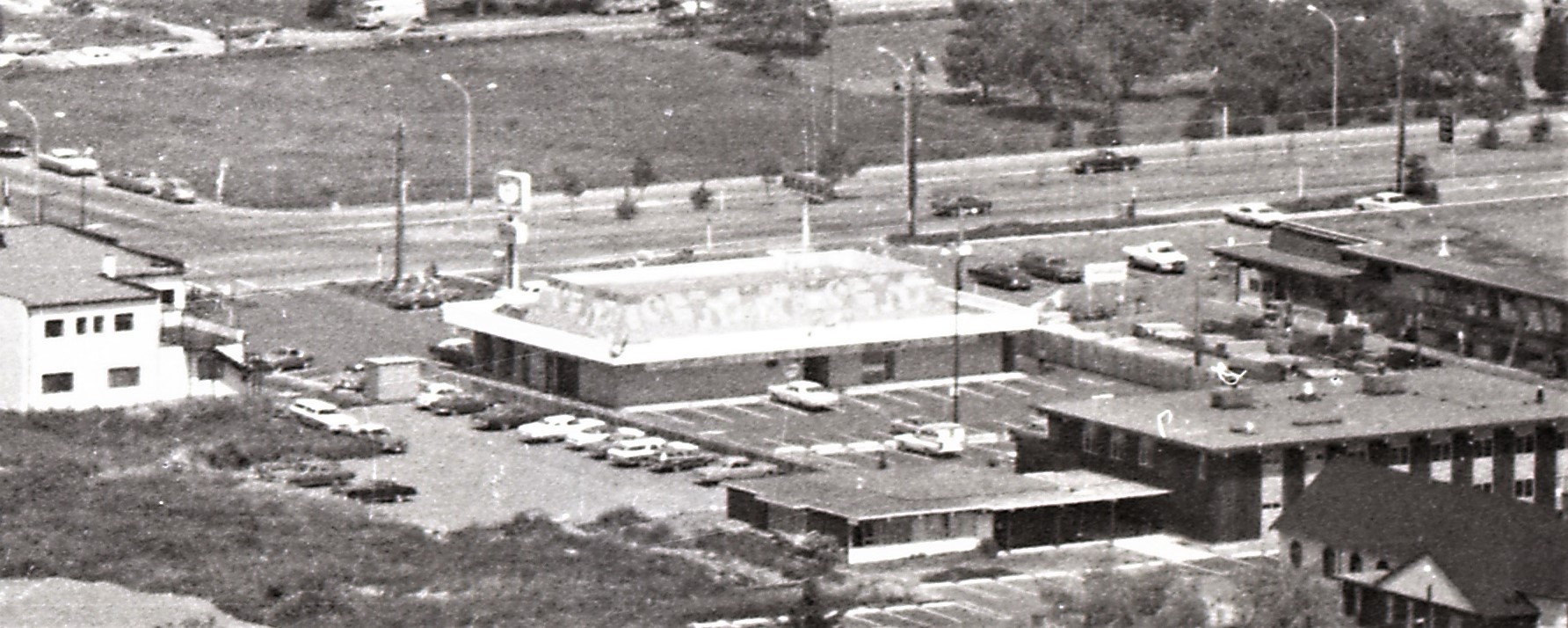
The first McDonald’s outside the United States was this one on No.3 Road in Richmond. A great example of fast food architecture, this standardized McDonald’s design featured an eye-catching “Golden Arches” sign at the entrance and a distinctly shaped yellow, red and white building with an angled roof supported by two arches. The building design is carried over to the logo on the sign with its two arches and angled line across them, replicating the building when viewed at an angle from the street. City of Richmond Archives photograph 1987 61 3.
The first known drive-in, Kirby’s Pig Stand, was built in Dallas, Texas in 1921 and was described by critics as for people who were “too lazy to get out of their car and enter the restaurant.” In British Columbia, the first White Spot drive-in opened in Marpole in 1928, a brand which pioneered the use of carhops and window trays. Drive in architecture often featured round or polygonal buildings which allowed vehicles to park around the building giving easy access to cars. Some buildings would include eye-catching features or rooflines and large colourful signs to entice customers into their lots. Kitchens were usually laid out in an efficient manner allowing quick production of meals and were sometimes visible from inside or outside the restaurant. Drive-ins could be single small businesses or larger regional chains with multiple locations. Some evolved into huge national and international brands which are still around today.
The Seabright
Richmond’s first drive-in style restaurant/snack bar was the Seabright. It was built and run by the Doherty family, owners of the Seabright Dairy on Sea Island and was positioned to give customers a good view of aircraft landing and leaving from the new Vancouver Airport, a popular attraction in the 1930s. The building was about 40 feet by 24 feet in size and an eight-foot wide veranda gave customers some covered space. Soft drinks, homemade ice cream and milkshakes, tea, coffee and sandwiches were offered for sale at the building on Buckingham Road and plenty of parking was available in the 240 by 70 foot parking lot.
The Seabright is shown here ca. 1936. City of Richmond Archives photograph 2000 3.
The Garden City Drive-In
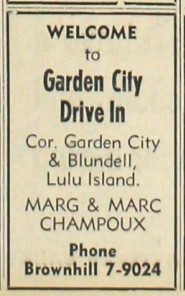
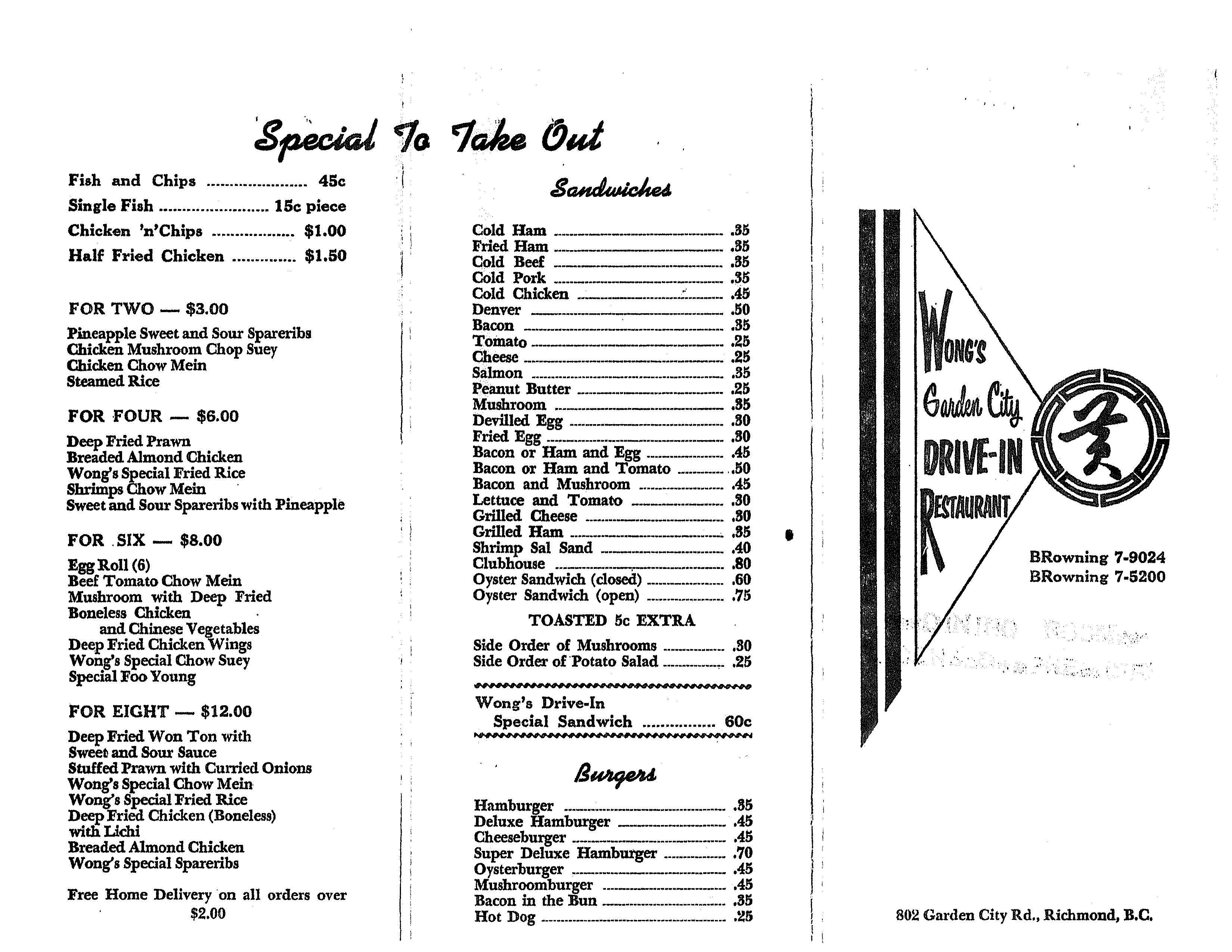
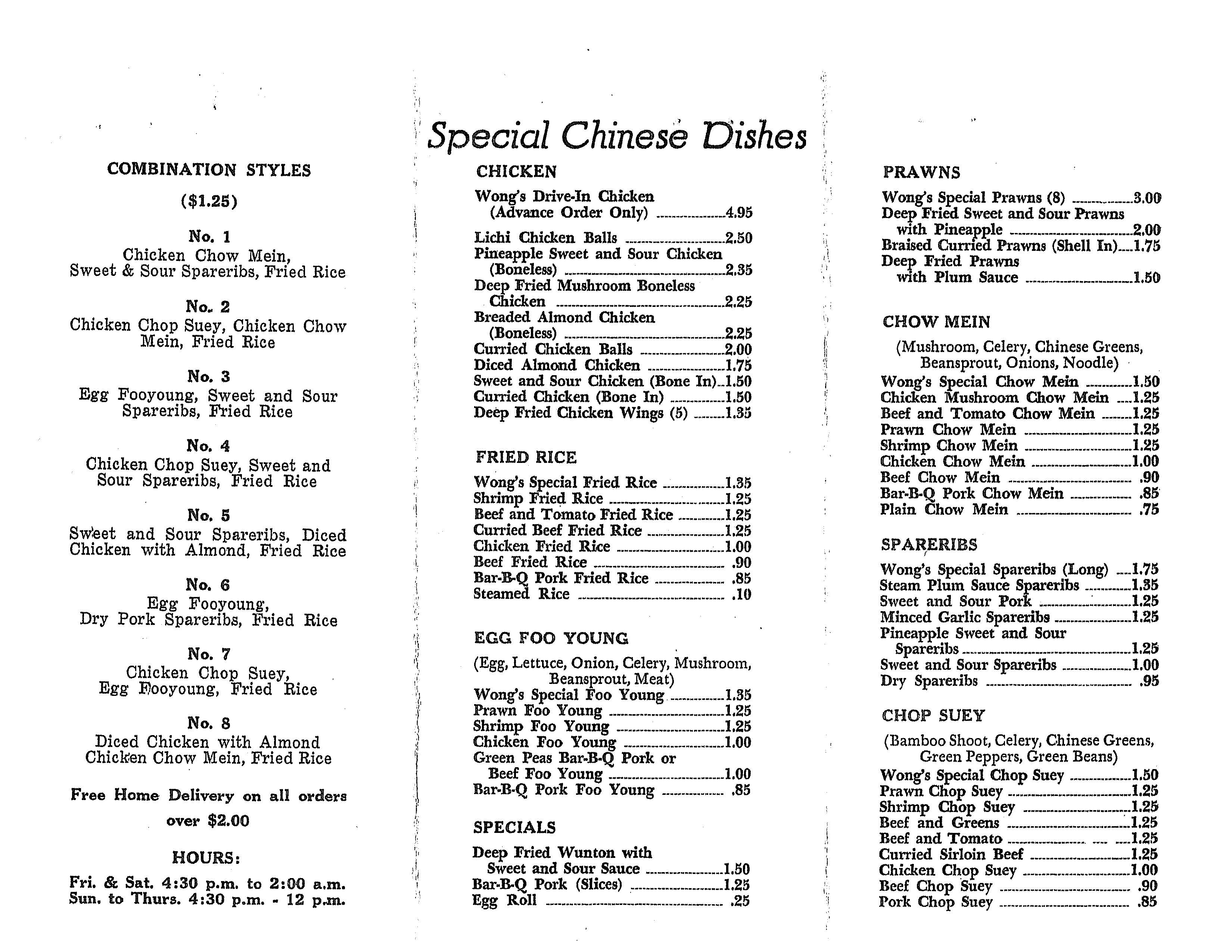
Around 1954 a restaurant opened at 802 Garden City Road (8020 today), near the intersection with Blundell Road. The Garden City Drive-In was owned by Marg and Marc Champoux and offered dining room or car service. By 1960 it had become Wong’s Garden City Drive-In, offering a selection of Chinese and Western dishes with dining room, car service or free delivery.
A Richmond Review ad for the Garden City Drive-In from January 15, 1958.
Richmond Review ad for Wong’s Garden City Drive-In from 1960.
Sometime during the 1960s the drive-in was renamed the Richmond Drive-In, a name it had until about 1973 when it became Wah Do Restaurant.
The Garden City Drive-In can be seen in the centre of this photo beside the garage on the corner of Garden City and Blundell Roads. Cropped from City of Richmond Archives photograph 1978 37 11.A menu from Wong’s Garden City Drive-In. City of Richmond Archives Accession 2019 49.
Around 1975 the restaurant was closed and demolished to make way for construction of the Garden City Shopping Centre.
The Dairy Queen
On September 5, 1958, Ray Van Humbeck opened his new Dairy Queen ice cream business at 633 No.3 Road (6331 today), a standard drive-in design with a large parking lot and free standing sign featuring an ice cream cone to attract customers. He offered a free sundae, milk shake or malt with every one purchased at regular price on opening day. Dairy Queen products were “favourites for people like you in 2500 cities throughout Canada, the Commonwealth and the United States. They enjoy it as a treat for taste – a food for health!”, stated his ad in the Richmond Review.
Ray Van Humbeck’s Dairy Queen is shown in the centre of this image with a car entering from No.3 Road. Cropped from City of Richmond Archives photograph 1984 17 58.Grand Opening advertisement from the Richmond Review, 1958.
Ray Van Humbeck was a local businessman who believed in giving back to his community. He supported many community initiatives, including sporting events and sponsored a softball team for many years.
The 1969 Dairy Queen softball team. City of Richmond Archives photograph 2017 45 5.
Starting out as a business selling soft frozen dairy products in Joliet, Illinois in 1940, the Dairy Queen brand grew and spread; the first Canadian store opening in Estevan Saskatchewan in 1953. The product line evolved and expanded from sundaes, shakes, malts and banana splits to include such favourites as the “Dilly Bar,” “Buster Bar,” the “Scrumpdillyishus Peanut Buster Parfait” and the “Blizzard.” The franchise’s menu made a significant change when hot “Brazier Foods” became available, cooked in the trademark “Sizzle Kitchen.” Mr. Van Humbeck’s No.3 Road Dairy Queen changed along with the times, receiving new signage and a raised red roof along the way.
Taken in 1971, this photograph shows the Dairy Queen building after being modified and equipped with equipment for the serving of hot “Brazier” foods. City of Richmond Archives photograph 1983 7 9.
Around 1974, Ray Van Humbeck closed the business on No.3 Road and relocated to the Anderson Square Shopping Centre, occupying three units where Anderson Road met Buswell Road. The business became a fixture there until it closed in 2016. Today there are three Dairy Queen stores in Richmond, one at No.3 Road and Francis Road, which was relocated from the Buswell and Anderson location, one at the Minato Village at Steveston Highway and No.1 Road and one located in the food fair in Richmond Centre Mall, not far from the location where Mr. Van Humbeck opened the first one in 1958.
Chipper’sDrive-In
In January 1957 an application was made for the sub-division and rezoning of a property on No.3 Road to allow the construction of a meat packing plant for the B.C. Chip Steak Co. Ltd. and a drive-in restaurant. The application was approved and the plant and drive-in, known as Chipper’s, opened at 331 (3311 today) No.3 Road in July 1958.
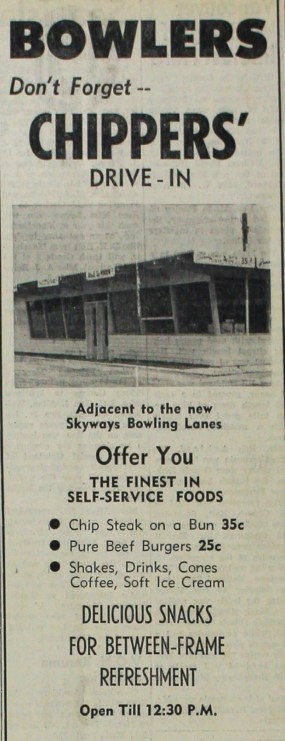
Chippers’ announced their opening in this July 30, 1958 ad in the Richmond Review.
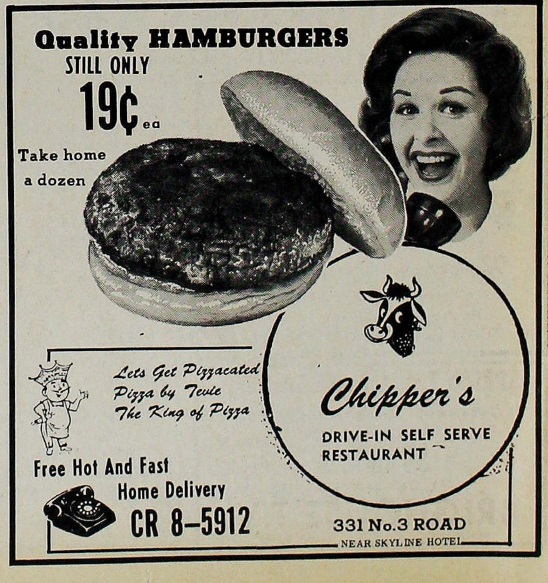
Chipper’s was the first “American Graffiti” style drive-in in Richmond. It was very popular meeting place with the young crowd, frequented by hot rodders and drag racers and was the terminus/turn around point for people cruising the No.3 Road strip. Chipper’s advertised a variety of food, from chipped steak on a bun and beef burgers (Made in our own factory from government inspected beef), all you can eat waffles for seventy-five cents (the ones they had in mind when they invented syrup), nineteen cent burgers (Take home a dozen!) and pizza by Tevie (The King of Pizza). Owner/operator Tevie Smith promoted his business actively, using advertising space in the Richmond Review frequently and by sponsoring bowling teams at the Skyway Lanes next door while offering ice cream and burgers as prizes.
Chipper’s took advantage of its proximity to the Skyway Lanes bowling alley, building business by associating themselves with the sport. Richmond Review ad 1965.
Chipper’s was a self-service drive-in but also offered fast home delivery. Richmond Review 1965.Chipper’s ads usually pointed out that the drive-in was close to the Skyline Hotel, Richmond Review 1965.
Not all of the advertising for Chipper’s was good. In April of 1962 reports of bad behavior and hooliganism by unruly customers were common and led to the Municipal Licensing Committee and the RCMP meeting with one of the owners of the restaurant regarding disturbances at the drive-in. The owner promised the Committee that he would clear up the problem immediately and the Committee in turn promised that they would “keep in close touch with the situation.”
This 1970 aerial view shows the location of Chipper’s in relation to No.3 Road, the Skyway Lanes Bowling Alley and the BC Chip Steak Co. meat packing plant. Immediately to the left of the restaurant is a tire shop. Cropped from City of Richmond Archives photograph 1983 6 90.
The warnings must have had an effect because the drive-in remained in business until the early 1970s and remains a nostalgic memory in the minds of folks who were young during that era.
Kings Burgers
An article in the January 25,1962 Richmond Review announced “Two new drive-ins to be built here”. One of the new facilities was Kings Burgers to be built on Westminster Highway near the intersection with No.3 Road. Kings Drive-In Ltd. was a successful Lower Mainland chain that opened six locations around Vancouver, North Vancouver, Burnaby, Surrey and Richmond. The property that the Richmond location was built on first had to be rezoned from agricultural district to general commercial, with a special use permit as drive-ins were not included in that category.
A car enters the parking lot of Kings Burgers from Westminster Highway in this aerial photograph from 1964. The building was typical of drive-ins of the period. Just above Kings is the Super Valu store which faces on to No.3 Road. Cropped from City of Richmond Archives photograph 1984 17 61.
Like Chipper’s, Kings Burgers became a well loved and popular drive-in, especially with younger people. Driving by the restaurant gave a view of hot rods, sport cars and modified vehicles, hoods up in the parking lot. No doubt many strips of rubber marked the exit from the drive-in’s parking area.
A menu for Kings Burgers, printed in the Richmond Review.
Kings’ menu was also typical of drive-ins of the period. Burgers, fries, fish and chips with an apple turnover for dessert pretty much covered it. The restaurant’s “Kingburger”, prepared in advance and kept in a heated drawer, was its most popular item at 19 cents each.
Kings Burgers in December 1976 as renovations begin. City of Richmond Archives photograph 2021 29 32.
Kings did not escape the stigma of having young people as a large part of its customer base. In June 1966 the Richmond Review reported “HOODLUM VICTIMS PROTEST,” detailing complaints from the Royal Canadian Legion, located across the street from the drive-in, about willful damage caused by the “young element”. The Legion claimed that groups gathering outside the restaurant would move across to the Legion and break into cars and destroy property. “They have no regard for private property,” the Legion protested. The Municipality’s Licensing Committee agreed to seek the cooperation of the drive-in’s management to combat the problem.
Kings Burgers in April 1977 after renovations. City of Richmond Archives photograph 2021 29 33.
From late 1976 to early 1977 the Kings underwent renovations and began to look less like a drive-in and more like a regular restaurant. Around 1981 the name was changed to “Big B” Burgers and later around 1986 it became Umbertino’s Pasta Palace. In 1987 the location is listed as “Vacant” in the street directory.
The A&W
The other restaurant mentioned in the January 25, 1962 Richmond Review was an A&W drive-in, to be built on the west side of No.3 Road just south of Capstan Way. The A&W did not have an easy start in Richmond. The first hurdle encountered were delays in rezoning the property where it was to be built. Although announced in January, by April rezoning was still being squabbled about by the Municipal Planning Committee with some wanting to delay for another year. Representatives for the A&W were upset, saying that they had been all but guaranteed of the rezoning eight months earlier. The delay was partly in response to a public outcry over perceived problems arising from the project. Under a headline which read “Rootbeering teens bring angry protest,” an article in the Richmond Review said that Council had been petitioned by an angry group of homeowners who claimed that allowing another drive-in to open in their neighbourhood would affect property values, add to litter problems, attract undesirable types of teenagers and keep residents awake at night. Most of these problems already exist to some extent because of the existing drive-in (Chippers). “It’s not an environment that I want for my boys”, said one protester. “Young hot rodders and young fellows and girls acting in an unbecoming manner. We see enough of this already”. Despite protests and zoning application issues the restaurant opened at its location at 359 No.3 Road (3591 today) and became another popular location for youth and car enthusiasts. The drive-in provided full carhop service, occasionally with the servers on roller skates, delivering food on the iconic window trays with tall, frosty mugs of root beer.
Carhop Linda Billwiller, carries trays of root beer to a customer at the No.3 Road A&W, ca. 1969. Photo from Facebook post, link here.
Like many large drive-in chains, A&W got its start in the United States in 1919 when Roy W. Allen set up a stand selling root beer at a parade in Lodi, California. In 1923 he and his partner Frank Wright opened the first A&W restaurant in Sacramento. A&W grew their business, selling franchises throughout the United States and expanded into Canada in 1956. By 1960 there were 2000 A&Ws in operation. In 1972 the Canadian side of the business split from the American chain and became its own corporate entity. The No.3 Road A&W Drive-in closed around 1982 but today there are nine A&W outlets in Richmond.
Ernie’s Take Home – Kentucky Fried Chicken
Harland David Sanders began selling chicken dishes from a restaurant in Kentucky during the Great Depression. By 1940 he had developed his patented “secret recipe” for cooking chicken in a pressure fryer, allowing faster cooking than regular frying. In 1952 Sanders, by now a “Kentucky Colonel” commissioned by the Governor of Kentucky, began offering franchises for his “Kentucky Fried Chicken”. In the 1950s Nat Bailey was offered the British Columbia franchise for Kentucky Fried Chicken. While he was worried that the brand might compete with his White Spot chain, which also offered chicken dishes on the menu, his partners convinced him that the product was different enough to not cause any issues. Bailey and his partners formed a separate company called Ernie’s Fine Foods which was named after Ernie M. Creamer, Bailey’s friend and partner who was to head the new enterprise. Six stores were opened in Vancouver, Victoria, New Westminster, North Vancouver, Penticton and Richmond under the name Ernie’s Take Home. The Richmond store opened in a unit at the Hyland Park Shopping Centre at 632 (6320 today) No.3 Road.
This ad from a 1965 Richmond Review invites customers to pick up a bucket or two of Colonel Sanders’ “Finger-Licken’ Good” chicken from Ernie’s Take Home at the Hyland Park location.
Colonel Sanders came to Vancouver to meet his new business partners after they had opened three of their franchises. He was described as a “real southern gentleman”, wearing his trademarked white suit, string tie, goatee and cane and kissing all the ladies’ hands. Unlike other Kentucky Fried Chicken franchises, Bailey and his partners served their own style of potato salad, macaroni salad, coleslaw and biscuits, apparently with the Colonel’s approval.
Nat Bailey sold his restaurant businesses to General Foods in 1968, including the company’s six Ernie’s Take Home locations. By the early 1970s they had closed the Hyland Park location, reopening in a red and white striped drive-in style restaurant at 810 (8100 today) Anderson Road, on a lot that spanned the area between Anderson Road and Granville Avenue. In 1984 the restaurant had changed its address to 8111 Granville Avenue, rebranded as Kentucky Fried Chicken, without the Ernie’s Take Home name, and had installed the iconic bucket of chicken signpost to attract customers driving down busy Granville Avenue. A second location at the Seafair Shopping Centre opened the same year. Today there are four KFC outlets in Richmond.
McDonald’s
In 1960 Ray Kroc took over a restaurant run by the McDonald Brothers in Sacramento California and the rest is history. Over the next five years Kroc transformed the business, opening hundreds of locations featuring unique architecture and high efficiency kitchens serving inexpensive meals, and turning McDonald’s into a public company listed on the New York Stock Exchange. In 1967 Kroc took his business outside of the United States for the first time, opening a restaurant at 712 (7120 today) No.3 Road in Richmond on June 1. George Tidball was in charge of the Canadian inaugural operation, and Richmond was chosen because, according to Kroc, it was a community of many young adults in the middle income bracket. The chain was distinguished by its 18 cent hamburger, ” formula boneless chuck and plate beef, 10 hamburgers to the pound,” and a “Triple thick” 25 cent milkshake.
The McDonald’s Drive-In on No.3 Road on July 21, 1974. City of Richmond Archives photograph 2021 29 4.
McDonald’s was notable, not only for its unique architecture and cheap meals, but also for its lack of some other things. There were no juke boxes or cigarette machines, “They don’t enhance the image we want,” said Kroc. Also, there were no telephone booths or female employees, “Girls and telephones are distractions.” Ray Kroc explained, “We are not interested in motorcyclists, hot rodders or rock and rollers unless they come on our terms. We run a clean place that welcomes families, boy scouts, church and civic groups.”
Ad from Richmond Review July 2, 1967.
George Tidball stated that the Richmond restaurant provided fulltime employment for 36 young people, adding that one out of every five applicants passed the rigid requirements for the job, a much higher amount than in the United States: “Richmond seems to have a greater number of neat-appearing, responsible, clean-cut type of youth.”
Ray Kroc, behind the counter of the Richmond McDonald’s, serves a meal to his wife during their visit. Photograph from the July 26,1967 Richmond Review.
Ray Kroc made a whirlwind trip to the Richmond McDonald’s the month after it was opened, staying for about a half hour to look over the operation, speak to the press and have a photo-op. Then he was gone, planning the opening of other restaurants around Canada.
The original McDonald’s, ready to be torn down, stands beside its replacement in this image from March 2, 1975. The Golden Arches remained there and are still there today in front of the third restaurant to occupy the site. City of Richmond Archives photograph 2021 29 8.
In 1975 the original drive-in was replaced by a larger, more modern building with room for indoor seating, a play area, and eventually, a drive-thru window ending its state as a drive-in. The restaurant has since been replaced by a third building on the property but the original 1967 Golden Arches are still there attracting drivers into the the place. Today there are seven McDonald’s locations in Richmond, but only one can claim to be the location of the first outside the United States. There are still no cigarette machines or juke boxes, but everyone has a telephone in their pocket and women are allowed to work there now.
The second McDonald’s on No.3 Road, ca. 1975. City of Richmond Archives photograph 1987 61 1.
White Spot
Nat Bailey got his start selling hot dogs and ice cream from a converted Model T Ford truck in Stanley Park, probably Vancouver’s first food truck. He opened the first White Spot Restaurant in Marpole in 1928, a place which was probably the first drive-in restaurant in Canada. Bailey and his partner Bob Stout are also credited with developing the world’s first drive-in food tray, originally a white-painted cedar plank which was placed across the space between the driver’s and passenger windows, modernized later using plastic and steel. White Spot was also probably the first drive-in to employ carhops to serve customers in their cars.
The trays used by carhops at White Spot were an early innovation in the history of drive-in restaurants. Photograph from White Spot Facebook page, link here.
Bailey retired from the restaurant business in 1968 after building and expanding the chain into one of the best-loved restaurant/drive-in chains in BC. When he retired he sold the business, which included 13 White Spot Drive-In/Dining Room Restaurants, six Kentucky Fried Chicken franchises and other assets such as BC’s largest chicken farm, to General Foods. General Foods was based in New York State with a Canadian office in Toronto. The company immediately started to expand the business building new restaurants. Around 1975 they built Richmond’s last true drive-in at 814 Granville Avenue.
The White Spot on Granville Avenue, across the road from the end of Buswell Street, ca. 1975. Cropped from City of Richmond Archives photograph 1987 23 313.
The restaurant offered both dining room and carhop service, with all the favourite White Spot menu items available. Around 1999 the Granville Avenue restaurant closed, replaced by other non-drive-in locations around town. Today there are three White Spot Restaurants in Richmond with an additional two Triple O’s franchise locations.
A view down Granville Avenue, ca.1995, shows signs for two drive-ins, Kentucky Fried Chicken on the left and White Spot farther down on the right. City of Richmond Archives photograph 2008 39 7 248.
By the 1970s drive-ins were being replaced by drive-thru restaurants which didn’t require as much parking space and, as carhops became obsolete, could be run by fewer employees. There are a few old style drive-ins remaining, but they have become a thing of the past for the most part.
The language and content encountered in historical records may be offensive or emotionally harmful. Historical records preserved by the City of Richmond Archives reflect the society in which they were created. The quotations below are presented in full as written by William Henry Barker. If you have any concerns, please speak to one of our Archivists at 604-247-8305 or email archives@richmond.ca
William Henry Barker (1853-1929) was a businessman who was instrumental in the development of the fishing industry in British Columbia. He was born in Manchester, England and after school and brief careers in his father’s shipping business and the merchant navy, emigrated to the United States. Settling in Oregon, he began a career in the fledgling salmon canning industry, rising through the management ranks of several companies. He formed the George and Barker Packing Company in Astoria, later amalgamating it with other companies to form the Columbia River Packer’s Association over which he attained a high level of administrative and managerial authority. He resigned from his position in 1901 to focus on the George and Barker Company, and as manager oversaw its expansion and construction of a new cannery at Point Roberts.
In 1904 he moved to Vancouver to carry on with the successful amalgamation of canneries into the British Columbia Packer’s Association, the largest fish-packing business in the province. He became General Manager and then President of the company. Barker was seen as a practical man who was very familiar with the business and well able to take care of the company’s affairs. Throughout his time at the company he insisted that they follow sound business principles, and although his language and attitudes were typical of his time, he fought strongly against the Federal Government’s policies on the hiring and licensing of workers based on their race. He promoted conservation of the resource by advancing the establishment of hatcheries and maintenance of spawning grounds. Mr. Barker was instrumental in “patriating” the company, incorporated in New Jersey when it was formed, and having it registered it in British Columbia.
The Barker Letter Books, Volumes One and Two. (City of Richmond Archives photo)
During Barker’s 22 year tenure at BC Packers his outgoing correspondence was preserved in two letterpress copybooks. They have left us with an insight into a period of BC’s history when the expansion of the fishing industry was taking place, and a record of a loyal and tenacious businessman who’s primary focus was the welfare of the company. The letters deal with the day to day operation of the company, but the reader also peers through a window into the history of the time. He mentions historical occurrences such as the San Francisco Earthquake, the blasting in the Fraser Canyon which blocked the path of spawning salmon, the official “White Only” policies of the Government, the onset of motor boats in the industry and much more. The letters are addressed to many company officials, shareholders and government figures, but most are addressed to AEmilius Jarvis, the Vice-President of the company, who was located in Toronto and who replaced Barker as President when he resigned.
One of the things that most frustrated Mr. Barker was his perception of interference from the Government. The over-issuing of fishing licenses, interference in hiring practices based on race, and treating the Company like a monopoly in its dealings were constant sources of irritation, leading to him resigning as General Manager. Here are a few of his comments:
Jan. 7, 1908 – Politicians – “The writer has come to the conclusion that these politicians are good at promising, but use their pleasure about keeping what they promise. The writer does not like that kind of people; in fact, that business is disagreeable to him – kind of two-faced, and he would rather do most anything else.”
Nov. 20, 1912 – On licensing of independent fishermen – “You can well understand that besides being unprofitable, it will make the men more independent and hard to manage by being able to sell their fish to the highest bidder.”
May 27, 1916 – On Government refusing to award licenses to BCP – “The idea of the Department seems to be to cater to the fishermen’s vote. As a matter of fact, nearly all these fishermen are of foreign birth, Swedes, Scandinavians, Russian Fins, Germans, Austrians, etc., and nearly all are Pro-German. There are localities that are being specially catered to where not a man has gone to the front.”
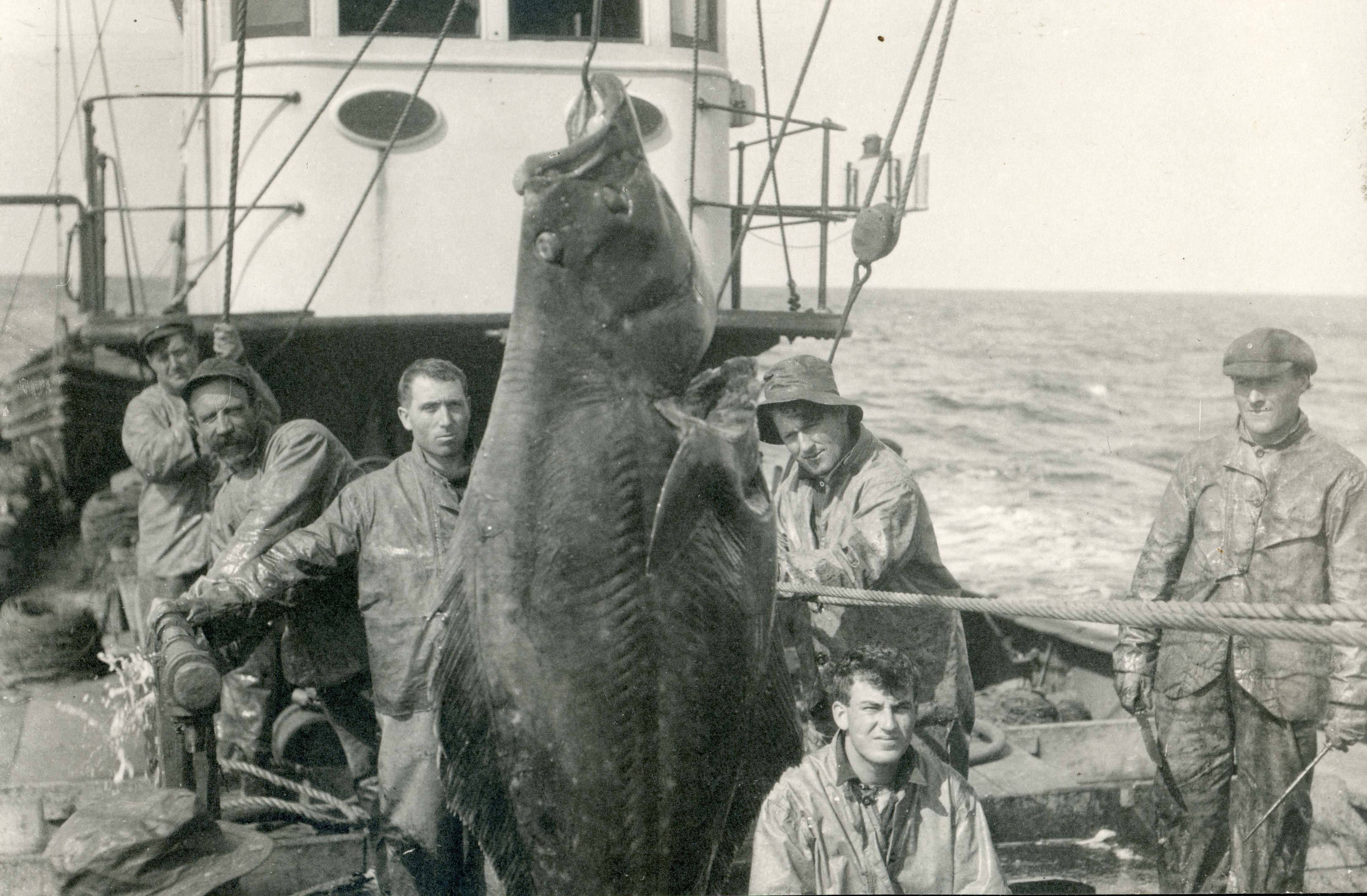
BC Packers was not only employed in the salmon fishing industry but also fished for halibut which were quick frozen and shipped by rail to eastern Canada. Here’s a big one aboard the halibut boat “Andrew Kelly”, ca. 1915. (City of Richmond Archives photo 1985 4 880)
July 17, 1916 – Government interference – “We have in no way tried to monopolize anything, but have done a great deal for the industry in many ways. Our every effort has been for better packing – – cleaner and better canneries, and all the time for the conservation of the salmon. We own and operate at our own expense a salmon hatchery on the Nimpkish River, where we turn out 5,000,000 young salmon every year. We have given two sites for hospitals; one at Green’s, Rivers Inlet, the other at Alert Bay, and we help to maintain the hospitals. Our canneries are the best in B. C. The fishermen get higher prices for their fish and make far more than they used to. There is absolutely no reason to think of us as a monopoly, except perhaps the jealousy of some of our competitors who want something we have, and perhaps the desire of the politicians to use the fisheries for political purposes. We must either go ahead or backward. I think that I have demonstrated that I can manage the business fairly well, but I cannot manipulate the Government. You or someone else must do that. To tell the truth I am beginning to feel discouraged.”
Dec.12, 1919 – More Government interference – “Quite a number of these returned men fished at Rivers Inlet and Bella Coola, and a few elsewhere. They did fairly well considering they were new at the business, but only caught about half the number of fish that the Japanese and experienced fishermen caught. You can see that we were forced to give our valuable nets and boats to these inexperienced men, and we must say, that considering their inexperience, they did fairly well, although the loss to us was considerable. This continual changing of the regulations is almost unbearable. We don’t know what to expect; there is absolutely no stability to the Government regarding the fishery regulations.”
Feb.12, 1920 – Resigning as GM over Government interference – “I might say that one reason for my wishing to get rid of the responsibility is the attitude of the Government towards the business. I do not think they are antagonistic to us any more than to others in our line, at the same time, the uncertainty as to what they will do and may do, over which we have no control, keeps one in a constant worry, and interferes very much with the successful working of the business.”
Aug.28, 1916 – On the exclusion of Japanese fishermen – “Japanese fishermen – who are British subjects – are being forced out, and we are told by the Department that it is the intention to force them out entirely. The Japanese fishermen thoroughly understand the business, and work conscientiously and hard, fish or no fish. The Department’s excuse or reason for forcing out these Japanese fishermen is said to encourage white permanent settlers along the Coast. White men can do very much better than fish, as we cannot pay any price asked which would afford them as good a livelihood as they can get in other directions. On the Skeena River, and Fraser River also, the Japanese fishermen average four to five times as many fish as the Whites. Of course there are some few White men who do equally as well, if not better, than the Japanese, but the majority take to it as a temporary employment, and make nothing themselves, and just simply use up and waste our gear. You should personally be well aware that along the Coast there is very little show for White fishermen to establish homes and use up the greater part of the year when not engaged in fishing, in agriculture. There is very little tillable land along the Coast and as we have stated, White men can do so much better in other lines, and they only fish when they can get nothing else to do. In other words, they are not at all reliable.”
Drag seining was one of the methods used for commercial salmon fishing in the early 20th Century. Nets are strung out across the mouth of a river to which salmon are returning. This image, ca. 1920 shows men hauling in the nets, probably at the Nimpkish River near Alert Bay, where BC Packers operated a cannery and a hatchery. (City of Richmond Archives photo 1985 4 118)
Aug. 15, 1922 – “RIVERS INLET – We operated as formerly two Canneries – the Wadhams and Brunswick. A strike occurred with the white fishermen – who are mostly Swedes and Finlanders – and are Bolsheviks and had a strong German feeling all through the war. The Whites, Japanese and Indian [sic] fishermen are about equally divided – about one-third each. The Fisheries Department have already given out information that the licenses of Japanese fishermen will be reduced 50% next year. This will throw us more into the hands of these foreign socialistic fishermen who no doubt will take advantage of it.”
Sept. 19, 1922 – “One other matter that the writer forgot to mention was the Department’s intention to curtail the licenses of Japanese fishermen. We are positive that without these Japanese fishermen on the Naas and Skeena Rivers, no Cannery can successfully operate, and it is a shame to pick on the salmon industry the burden of this Asiatic exclusion. They are here and will be employed somewhere, and why not in the fisheries where they are doing good work.”
Jan. 31, 1923– “Regarding the Government’s action towards Japanese fishermen, we thought best to procure a Naturalization Certificate from one of our Japanese fisherman and enclose a copy herewith. You will note that the Dominion gives to these Japanese Naturalized Citizens all the benefits and privileges of any other Citizen. It would seem that withholding or refusing to give the Japanese fishing licenses, that they are going back on their agreement with the Japanese. Can the Dominion of Canada afford to do this – may it not lead to International complications.”
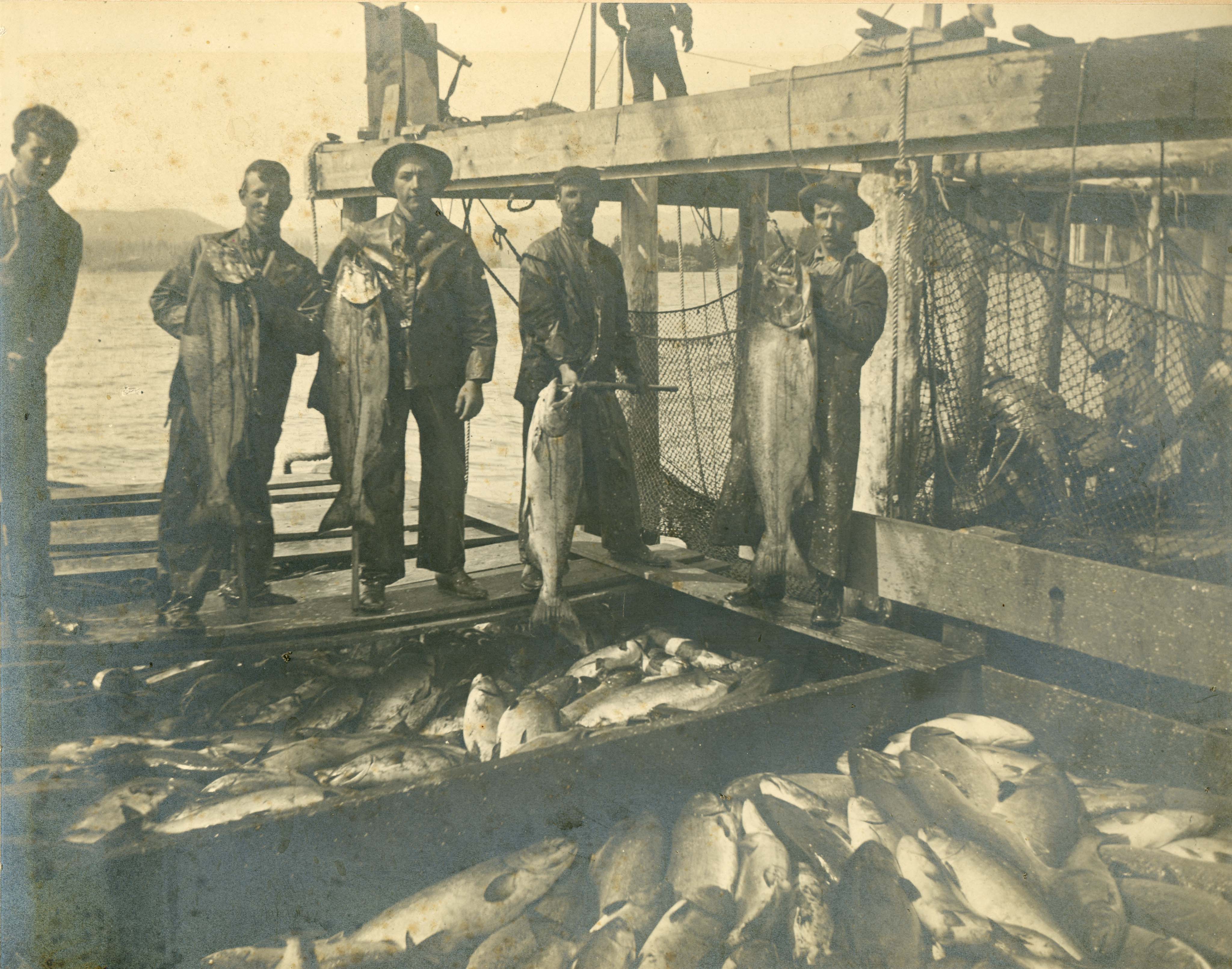
A lesser used type of commercial fishing involved the use of fixed traps. (City of Richmond Archives photo 1985 4 115)
Barker was so concerned about the Government’s licensing policies that he hired a detective from the famous “Pinkerton Agency” to go to Prince Rupert and monitor the situation.”:
May 12 and 26, 1913 – To Mr. M. K. Dickinson of Balmoral Cannery – “Enclosed please find copy of a letter we have given to a “Pinkerton” man, whom we are sending up, first to Prince Rupert to try and find out to whom licenses are issued and all about the Cold Storage there, then he will come to you and present the letter as per copy enclosed. You will furnish him with a small launch when he needs it, and he will look out for our nets and be under your directions. We wish you to keep this entirely to yourself, not letting anyone know who this man is or what he is. You might say that he is working for us or anything you agree upon. We talked the matter over with you regarding having a patrol to see if our men sold fish or others stole our nets. Assist him in every way possible and keep this entirely to yourself. If you feel forced to talk it over with Mr. Buttimer then caution him not to mention it to anyone else. We think this man should run the launch himself after he has been shown the River.”
“We are in receipt of yours of the 21st instant, and note what you say regarding the patrol on the Skeena River. By all means keep the man you have. Probably the ‘Pinkerton’ man will not call on you for some time to come , as he has some work to do at Prince Rupert. In speaking of this man, please mention him as ‘No.29’ and not ‘Pinkerton’.”
Barker’s letters mention several disasters that took place during his employment with BC Packers. Here are a few:
April 19, 1906 – The San Francisco Earthquake – “We are all appalled by the terrific calamity that has overtaken the Metropolis of the Pacific Coast. As yet we only have meagre details of the dreadful calamity and are hoping that same will prove to be greatly exaggerated, but fear they will not. Please remember us to Mrs. Fulton. Hoping you are in good health and thanking you in advance for the report.”
Oct.6, 1913 – The Fraser River slide – “Mr. McIntyre, the Provincial Deputy Fish Commissioner, and Mr. Babcock, assistant to the Provincial Fish Commissioner, have made a trip up the Fraser to see how the Sockeyes were getting to the hatcheries and the spawning grounds, and found that very few have reached either the spawning grounds or hatcheries. Looking for the cause they found millions of fish just below the Skuzzy Rapids which are three miles above Hells Gate, which is also, as its name implies, a rapid and has been hard for the fish to get past. At the Skuzzy Rapids there are quite a number of eddies in which the fish would rest, dropping down from the rapid water and then go on. The Canadian Northern have been blasting their road bed right here, and have sent thousands of tons of rock and filled up these eddies so that the fish have had no resting place and have been unable to get by. A great many thousands have died worn out, being unable to get up. Mr. Babcock got powder from the Railway contractors and got their assistance, and has blown out some of the rock, and we understand that fish are now getting up. Just what effect this will have on our future big years we cannot tell, but we are inclined to think the situation rather serious.”
May 17, 1918 – The Steveston fire – “Regarding the fire at Steveston. This was quite a large fire, and occurred about nine o’clock in the morning. We got in touch with our Imperial Cannery and Cold Storage, and received ‘phone messages every half hour. The fire lasted, burning very brisk, until about 12 o’clock, burning everything up to our Cold Storage. You will remember that there was a break of 100 feet on the west of our Cold Storage, which property we have under lease as fire protection, and is very handy for space to moor boats and discharging coal for our Cold Storage use. Our large pumps at the Cold Storage, and hydrants we had (having the fire risk in mind when we erected the plant) came in very handy, and as we have stated, we had no damage except to two or three Japanese fishermen’s houses on the property behind the Cold Storage, which were covered by insurance.”
The Steveston Fire of 1918 razed a large part of the village. This image, taken from the BC Packers cold storage plant shows some of the damage. (City of Richmond Archives photo 1977 23 1)
Barker was also very active in promoting BC Salmon in overseas markets and trying to get the best price possible for the Company. Their biggest competition came from the Americans who he claimed misrepresented their products as “Sockeye” and were trying to take over markets already held by Canadian producers. He also dealt with promoters trying to get the Company to invest in foreign fisheries, such as in Russia.
April 11, 1907 – To Prime Minister Wilfrid Laurier on tariffs – “The possibility of the Australian Government making a change in their tariff so as to admit our Canned Salmon, free of duty and maintaining a duty on same packed elsewhere, is so attractive and would benefit us so much that we cannot refrain from doing something on the subject. We are fully satisfied that you are aware of the benefits to Canada and particularly the Province of British Columbia, if we could have the excellent market of Australia, as we have that of New Zealand. You are also aware that the Americans have an immense advantage over us, as they have the inexhaustible supply of Salmon in Alaska, where their annual pack will average over 2,000,000 cases per year. These they can pack and sell at a profit, at prices that allow us no profit. They have the English, Australian and other markets on an even footing with us Canadian packers, besides having their own larger country entirely to themselves. The benefits to be derived by an exclusive market, like we have in New Zealand, would be felt all of our Province if not all of the Dominion. If it is impossible to get our Canned Salmon into the Commonwealth free, a preferential tariff similar to one between New Zealand and Canada would be very acceptable.”
Another method of fishing during Barker’s tenure at BC Packers was gillnetting, a method still used today. This image shows fisherman Louie Korens pulling in his new in the Fraser River off Steveston, ca.1945. (City of Richmond Archives photo 1985 4 13)
June 8, 1907 – To the Minister of Trade and Commerce on American canners misrepresenting their product – “Our Agents in Australia called the attention of your Commercial Agent at Melbourne, Mr. D.H.Ross, of the attempt of packers of salmon in Alaska to mislead the trade and public by using the word ‘Sockeye’ on labels on salmon caught and packed in Alaskan waters. We beg to confirm what Mr. Ross has stated, that the name ‘Sockeye’ is a local name, and given to salmon frequenting British Columbia waters, and water of Puget Sound when on route to the Fraser River. Sockeye Salmon are known all over the world for the richness in oil, color and flavor, and, in consequence, are much in demand, bringing the highest prices paid for canned salmon. It is to take advantage of this demand and better prices that some of the U.S. packers in Alaska have labelled their salmon – heretofore known as ‘Alaska Reds’ – ‘Sockeye’. This Alaska Salmon is of good color, but altogether lacking in oil, and in no way compares with our British Columbia Sockeye. We understand that Mr. Ross has written you regarding this matter. We beg to second his efforts in our behalf, and would ask your good offices by writing to the Australian Government, with a view to stopping these packers from using the word ‘Sockeye’ on this Alaska fish. If they are allowed to deceive the trade and public by so doing, it will injure our trade and prices, and tend to lessen the business in this line with Australia.”
Dec. 24, 1907 – On investing in Russian Fishery – “Regarding the Salmon streams in Siberia. The writer knows little that is absolutely reliable. A representative of Mr. E. N. Jaliehanin, who has a concession from the Russian Government for the mouth of Amur River – said to be the best salmon river in Siberia – called upon the writer, and at his request, left a written statement of the proposition, copy of which I enclose. The same proposition was made to several parties, some of whom are well known to the writer – he thinks they are being looked into – it will surprise him very much if they are taken up. These Russians are, to use a slang expression ‘great grafters’; they seem to have quite an idea of the value of their exclusive privileges. The quality of their best fish is not equal to our British Columbia River Sockeye.”
Nov. 9, 1909 – On American poaching – “Talking to the Captain of the ‘Celestial Empire’ a few weeks ago – who was then fishing for us – he stated that the American boats – including the New England vessels – fished inside the three mile limit a good part of the time. On that trip three different American steamers had caught 450,000 inside the limits. I asked him where the patrol boats were; he said, one down here being fixed up and we met the other going up. The fact is, as near as we can tell, both the ‘Kestrel’ and the chartered tug ‘Joliffe’ spend too much of their time away from the fishing grounds, a good deal of it coming and going from Vancouver or Victoria, where they come for supplies, to get paid off every month, etc. No doubt they keep the poachers off when they are on the grounds, but one should be there all the time. They not only steal our fish, but prevent our vessels from using the best grounds.”
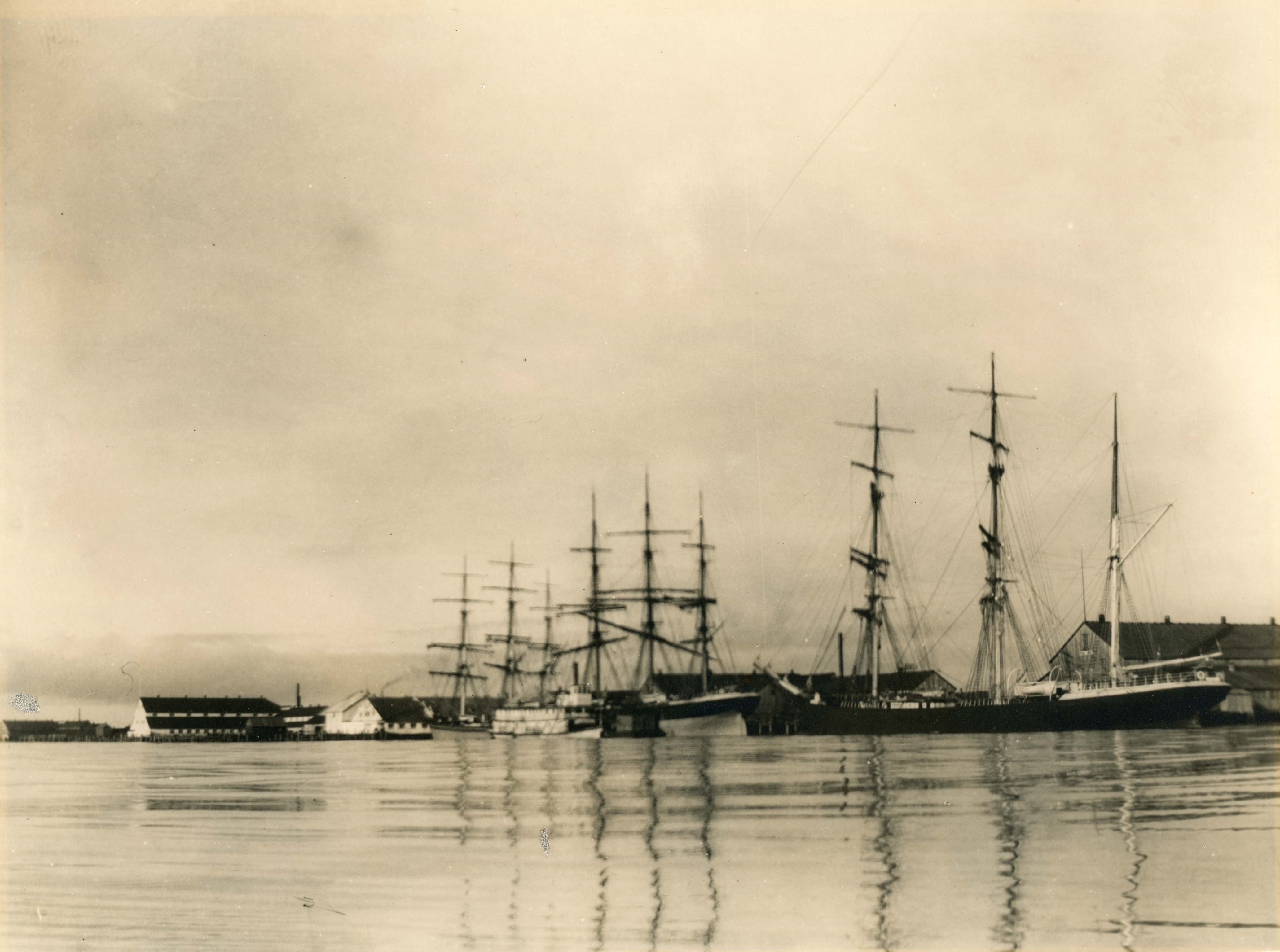
Sailing vessels docked at Steveston, ca. 1899. Much of BC Packers cannery production was shipped overseas to Great Britain and Australia. (City of Richmond Archives photo 1985 4 7)
Mr. Barker felt that the operation of the Company depended on the conservation of the resource and the effective utilization of labour. His letters contain a lot of information about the month by month operation of the business, not only of cannery production, but also hatchery production and numbers of fry released for the year. BC Packers operated the only privately run hatchery in the Province on the Nimpkish River and operated a cannery and sawmill there employing mostly indigenous workers.
March 13, 1906 – On hatchery production – “I mailed to your address yesterday Mr. Babcock’s report which has interested me very much, and which I think you will find interesting. Mr. Ker has just gotten back from the Harrison Lake hatchery. He reports everything in nice shape. 26,000,000 Sockeye fry released out of 31,000,000 Ova collected. At the Pemberton, another Dominion Hatchery on the same chain of lakes, some 29,000,000 which, with Babcock’s Seaton Lake, 46,000,000 makes over 100,000,000; with Shushwap and Bon Accord Hatcheries which have somewhere near 40,000,000 more, this with the ova deposited naturally ought to ensure a good year for four years hence.”
Mar.10, 1922 – To Senator Bostock on preserving the Nimpkish River operation – “Our company as you know own and operate a Cannery at Alert Bay. We have had this plant for over twenty years now, and operate at our own expense a hatchery on the Nimpkish Lake, and also watch the natural spawning carefully, doing everything possible to increase the supply. We have been left alone here until last year, when a license was issued the Preston Packing Company to operate drag-seines on the Nimpkish River. The river is a small one and the supply very limited. The result was, the small pack was divided, the Preston Packing Co. getting less than 2000 cases and our Company getting 3500 cases of Sockeyes. We had fished this Nimpkish in a careful and economical way; the fishermen had made a good living even at the low prices we paid them, which ran from 7 cents to 15 cents per fish. The Preston Packing Co. caused us to pay 40 cents for Sockeyes last year; the result was that where we had a profitable business it became unprofitable, and of little or no value to the Preston Packing Co. These fish we have bred, and we think we have some ownership in them, and to give anyone else fishing licenses on this restricted ground, means loss to all concerned and works a great hardship on us.”
Barker was puzzled by the fact that the Company paid around $3000 in taxes to the State of New Jersey annually, where it had been incorporated, but did no business there. He worked at having the Company registered in British Columbia where it actually operated.
March 14, 1908 – To AEmilius Jarvis on the company being incorporated in New Jersey – “When Mr. E.W. Rollins received his pro-forma Balance Sheet and Profit & Loss Statement, as shown at closing of our books on December 31st, he noticed the charge for taxes in New Jersey, and wrote us about it, asking if there was not some way so as to avoid this expense which is about $3,000.00 a year. We wrote him that we had wondered why the Company was incorporated in New Jersey, and if it could not be changed so as to make this saving. As you had a great deal to do with the organization of the Company, and know why it was incorporated under the laws of the State of New Jersey, perhaps you can let us know if it is possible to make any change and save these New Jersey taxes and other charges there, or is it desirable. We do not know just what would be necessary to accomplish this, and do not wish to do anything until we know whether there are any objections to its being done. Perhaps you could find out, (if you do not already know) just what we would have to do to make this change, if you think it advisable to make it.”
Jan. 22, 1909 – Branding – “During the past year quite a considerable amount of new machinery and some new buildings have been purchased; also the ‘Clover Leaf’, ‘Arrow’ and other brands, all being additional assets.”
March 16,1910 – On incorporating in British Columbia – “We are mailing you to-day under another cover, 100 copies of our Bill as it was finally passed. We have not had time as yet to carefully go over the same, but feel satisfied that they are alright. Now the Bill has passed and we are duly incorporated under the laws of British Columbia, we presume that no time will be lost in winding up the affairs of the Company in New Jersey so that we can re-organize.”
Barker’s letters are also full of historical data about fisheries in the early 20th Century. He was present for the conversion of the fishery to gasoline engines, a change that he did not fully agree with, concerned about overfishing using more efficient boats and the expense to companies. He also commented on the types of fishing used during this period, some of which are no longer used.
Feb. 8, 1917 – On motor boats for fishing – “Regarding motor boats for fishing. You can well understand that a boat provided with a motor will have a decided advantage over a boat propelled by oars or a sail. We figure that one motor boat is fully equal to two ordinary fishing boats. We understand the Department also came to this conclusion, and in the interests of conservation, refused to allow them to be used in the North. We figure there are about 2000 fishing boats in Northern B. C. It would not be practicable to put gasoline motors into the old boats. This we have found from experience on the Fraser River. To build a new boat an equip it with a 5 H.P. engine would cost at least $500.00, perhaps more, and if it is done by one or two Packers (and we fear that it will be), all will have to follow suit. We figure that it would cost our Company at least $250,000.00 to make the change, which is altogether unnecessary, particularly at this time. Then, the Indians [sic], Japanese, and the kind of white men we use in the North for fishing, know little or nothing about a gasoline engine and would be in trouble all the time. It would mean a machine-shop at each Cannery. The cost of gasoline too would be quite heavy and all add to the cost of packing. The bulk of the $1,000,000.00 which the change would cost, would go to the United States where all the small gasoline engines are made; the hardwood and hardware for the boats also come from there. We were under the impression that the Government were trying in every way to keep money in the Country – stop all extravagancies or unnecessary expense, but it seems not.”
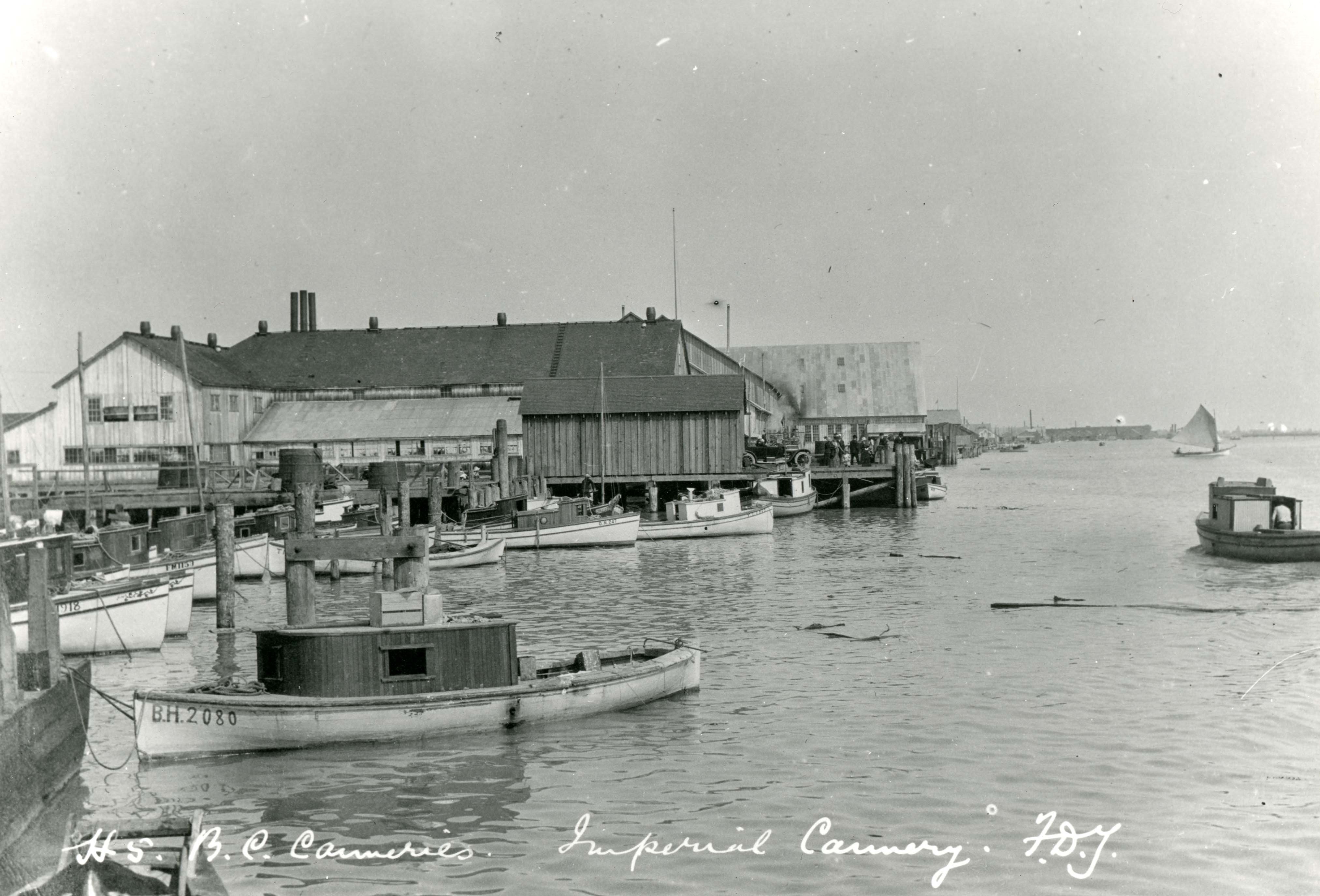
BC Packers’ Imperial Cannery in Steveston, ca.1910. Gas boats have started to take over, although there are still a few sail and rowboats visible. (City of Richmond Archives photo 1985 4 35)
Aug.30, 1920 – Types of fishing employed – “Regarding the annual visit of Mr. W. A. Found, now Deputy Minister of Fisheries, and the Hon. C. S. Ballantyne, Minister of Marine & Fisheries, with both of whom we have had meetings and protested against the continual change of regulations regarding fisheries, it seems that Mr. Found has taken into his head that one method of fishing is more disastrous than others, when we think entirely otherwise. There are four methods of fishing for salmon on this Pacific Coast. The one most commonly used is as you know the “gill-net”, which drifts with the tide and fishes both ebb and flood, but fishes best just before and after slack water, both high and low tides. The trap method of fishing is of course a fixed appliance. Netting, both wire or cotton fixed on piles driven at right angles to the shore which lead into hearts and from them into a pot and spiller through tunnels. These of course can only be driven where the shore slopes out and the driving is good and where the fish run. They are not much used in British Columbia. The purse-seine is an appliance ranging from 300 to 600 fathoms in length when hung and 120 to 150 feet deep. They have floats or buoys on the cork line and rings fastened to the line on the lower end of the net through which runs the purse line. These purse-seines are operated by a power boat of from 40 H.P. to 50 H. P. and manned by about eight men. They are really a floating trap which surround a school or quantity of fish and purse them up with the power used and then brail out the salmon into the boat. The other is the drag-seine, which can only be used on a sandy beach, which usually occurs near the mouth of rivers to which these salmon are going. This drag-seine is usually made of cotton, one end being tied to the shore, the net thrown out and a long line taken to the shore and hauled in by men; usually eight or ten men are used on a drag-seine. This latter is the one to which Mr. Found objects.”
One of the many pages transcribed by Volunteers at the Archives. (City of Richmond Archives photo)
These are just a few excerpts from the 22 years of letters sent by Mr. Barker in his job as General Manager and President of BC Packers. The hardbound copies of the correspondence were held in the BC Packers Limited Archives until 2001 when they were donated to the City of Richmond Archives along with many photographs and other records. The letters are very fragile and it was decided to transcribe them into a searchable database. Esther Rabinovitch and Carol Farrell, volunteers from the Friends of the Richmond Archives, took on the painstaking job, putting in countless hours working from seemingly endless copies and deciphering hand written notes. The transcribed letters are available for interested researchers online at https://www.richmond.ca/cityhall/archives/exhibits/barkerletterbooks.htm?PageMode=HTML
Volunteers Esther Rabinovitch (L) and Carol Farrell (R) along with Archivist Lynne Waller during the transcription of the Barker Letter Books in July 2007. (City of Richmond Archives photo)
William Henry Barker remained in Vancouver after his resignation and passed away on January 9, 1929. He was survived by his wife Orpha, three sons and two daughters.
“…I beg to say that my first thought and every effort will be for the success of the Company.”

















 Outside the Box - The Richmond Archives Blog