“No Better Than a Duck Pond” – Richmond’s Historic Floods

The City of Richmond is built on islands located on the flood plain of the Fraser River, surrounded by the river and exposed to the Strait of Georgia on the west. With an average elevation of just one metre above the present mean sea level, Richmond faces flooding from extreme storm surges, intense rainfall, high tides and seasonal rises in river flows and levels. It was not until the arrival of non-Indigenous settlers in the Lower Mainland that textual records of floods and the damage they caused to dykes, crops, livestock and structures were made, most often in the newspapers of the day. Early landowners in Richmond began the process of dyking the land, usually their own properties, and building flood boxes to allow drainage at low tide and blocking the ingress of water at high tide. Soon, dyking districts were formed which provided funds for dyking and drainage projects through taxation and by the mid 1930s these were amalgamated under the control of the Richmond Municipality. The improvements made by Richmond over the years, ditches, canals, electric pump stations, box culverts and dyke upgrades, have greatly lessened the impact of floods on the city. This post describes some of the floods that occurred through Richmond’s history and some of the steps taken to reduce their consequences.

Several men watch from what is probably the flood box at the north end of No.2 Road while children appear to swim in the outflow, ca. 1930. The No.2 Road flood box was the first in Richmond, built before incorporation. Flood boxes have a balanced gate that allows water to flow out during low tides but blocks water from flowing back in when the tide is high. City of Richmond Archives photograph 1987 104 38.

November 1871 – An intense storm blowing up the river combined with a high tide and storm surge caused dykes to be washed away in Ladner and flooding to occur. While Richmond, which was not incorporated until 1879, was not mentioned in reports, the storm did cause significant damage to the Sand Heads Light Ship, dismasting it and tearing up parts of its deck. It was towed to New Westminster for repairs.

May to June 1894 – The “Great Flood of 1894” caused extensive flooding and damage all through the Fraser Valley. An extreme spring runoff brought on by a cool summer of 1893 which failed to melt snow in the mountains, a record snowfall through the winter of 1893-94 and rain and a heat wave at the end of May raised river levels to the highest ever recorded, 25.75 feet at the Mission Bridge. Dykes were destroyed, bridges and wharves washed away and farms were inundated destroying crops and drowning cattle and causing substantial loss of human life. In Richmond by June 1st, the flood had scoured out the fill around the pilings on the newly completed North Arm (Fraser Street) Bridge, causing about 200 feet of it to be carried away a few days later. Lulu Island was reported to be seriously flooded due to breaks in the dyke at Scott’s Mill at the Queensborough end of the Island and then over the main dykes at high tide. Damage in Richmond Municipality was estimated to be $2000 to the North Arm Bridge and a further $7000 in crop loss due to the flooding.

Steveston, shown here in 1891, was flooded several times in its early history. Cannery floors were awash in water and the plank roads shown here were floated up and washed away. City of Richmond Archives photograph 1984 17 75.

January 1895 – Six months after the 1894 flood, Lulu Island was again hit by flooding, this time by a combination of high river flows and extreme high tides with a strong west wind. Dykes on Lulu Island were washed away in many places, flooding large areas of farmland. Root crops stored in pits were destroyed along with large quantities of potatoes. Houses and barns were flooded and bridges over ditches and canals were washed away. Sea Island was reported to be under as much as three and a half feet of water. In Steveston water flooded over the floors of canneries and some residents had to leave their houses. Steveston’s plank roads floated and were swept away by the water.

1900 – The first of Richmond dyking districts was formed when landowners petitioned the Provincial Government to allow taxation for the construction of dykes and drainage systems under the authority of the Drainage, Dyking and Development Act. The New Lulu Island Slough Dyking District was responsible for the land encompassing the slough complex from Francis Road south to the river. Before this time landowners dyked their own property with other areas being handled by the Township. Commissioners were elected to administer the district and an engineer was hired to draw up technical plans and assessments of the land.

Headlines in the December 27, 1901 Vancouver Daily Province describe some of the damage to Richmond in the 1901 flood.

December 26-27 1901 – Richmond was hammered by a severe gale directed squarely at the mouth of the Fraser combined with very high tides. This was the most extensive and damaging flood in Richmond since 1894. Several canneries were heavily damaged and one, the Labrador Cannery at Terra Nova, was completely destroyed. Miles of dykes were lost along the North and Middle Arms of the river, fishing boats were swept as far as half a mile into farmer’s fields and smashed up. The Japanese boarding house at Terra Nova collapsed with people trapped inside who were rescued by neighborhood residents. Another boarding house with nine men inside was swept into the river. They managed to get on to the roof of the building where they were rescued by men who braved the storm in two boats. Sea Island and the greater part of Lulu Island were reported to be flooded by two to four feet of water. Steveston was under water and the floors in the Gulf of Georgia cannery were completely covered. Outbuildings at the Colonial Cannery were washed away and the plank roads in Steveston and around Lulu Island floated away.

1905 – The second of the dyking districts was formed. The Lulu Island West Dyking District was formed with responsibility for the area west of No. 3 Road.

November 1913 – The highest tides in ten years combined with a storm surge and high winds caused dykes to give way in many places flooding hundreds of acres of farmland. On Lulu Island, the Bridgeport area was inundated. Water covered roads and fields up to two feet deep, while Bridgeport School was surrounded with about three feet of water. Sea Island was similarly affected with about 500 acres of land flooded after the North Arm dyke was breached at the Cooney property on No.13 (Miller) Road. Damage was fairly light at the north-east corner of Sea Island, although the store and meat market sustained significant damage.

January 1914 – Through January 1914 heavy rains and high tides rendered the municipal drainage systems useless causing high water all along No.20 (Cambie) Road from Bridgeport to No.5 Road. The Bridgeport, Cambie and Alexandra areas were flooded with up to two feet of water. Later in the month, the same conditions, worsened by a gale force wind, washed away 150 feet of the dyke on Sea Island, completely flooding the island. Mitchell island, along with smaller islands in the river were also completely flooded. At a ratepayer’s meeting after the flood, keynote speaker John Tilton stated that “…well dyked and well drained, this island would be a beauty spot of Canada. As it is, it is no better than a duck pond.”

Ditches were excavated along most roads in Richmond to help drain the land and gave rise to the municipality’s nickname of “Ditchmond,” As shown in this photograph, ca. 1920, they could pose a hazard to careless drivers as well. City of Richmond Archives photograph 1978 30 2.

January 1921 – Once again the double hit of heavy rain and high tides caused flooding in Richmond. The flood box on Twigg Island was washed away, resulting in the island being completely inundated every time the tide came in. On Mitchell Island a poorly reconstructed dyke, built after the construction of Union Cedar Mills, allowed tide water to surge over and flood the island. On Lulu Island unfinished dykes on the North Arm and on the South Arm at the London property allowed the water to wash over. Large parts of the Alexandra and Garden City areas were flooded. A public meeting held at Richmond Townhall saw citizens, who had already willingly taxed themselves for dyking and drainage to an amount equal to half the general taxes of the municipality, advocating for the installation of powerful electric pumps to drain the island.

January 1933 – The New Lulu Island Slough Dyking District installed the first electric pump in the dyking and drainage system on the South Arm between No. 3 and No. 4 Roads. The 60 horsepower pump would operate automatically only during the highest tides when the flood boxes become ineffective. The pump was expected to remove 16000 gallons per minute and would drain about 4300 acres of land.

People pose in front of the first electric pump in Richmond’s dyking and drainage system, located between No. 3 and 4 Roads on the South Arm. City of Richmond Archives photograph 1988 17 112.

January 1935 – Heavy snowfall followed by higher than normal temperatures and heavy rain caused flooding in the Fraser River Valley and drainage problems in Richmond. Lulu Island was reported to be a series of small lakes and Lansdowne and Brighouse Racetracks were completely flooded.

Water flows onto Lulu Island through a breach in the dyke in 1953. Tire tracks indicate attempts to block the flow by pushing mud into the break. City of Richmond Archives photograph 1977 1 4.

1936 – The Township of Richmond amalgamated its own works with the other two dyking districts, assuming control of all dyking and drainage activities within its boundaries. The work done on the dyking and drainage system was beginning to have a positive effect on flooding problems in Richmond. While some flooding due to high rainfall was still problematic at times, residents did not seem too concerned about the occasional time when one had to wear gumboots to go into their yards. The Richmond Review boasted in the October 6, 1936 edition, “Richmond the Dryest Place in the Valley.” “Richmond should let the world know that it is about the safest place in time of flood from Winnipeg west. Richmond is so near the sea that excess water can readily escape if given half a chance.” The attention given to improving and upgrading dyking and drainage systems was to continue up to the present day.

February 1945 – “The Great Storm of February 7, 1945” was claimed to have caused the worst flood in ten years. Vancouver newspaper reports said that Burkeville was a chain of lakes with about 25 houses surrounded by water, stranding the residents inside. Acres of Lulu Island were under water. However, the Richmond Review reported, “Flood of Short Duration Here.” The rain which caused ditches to fill and property to flood on Wednesday had all run off by Friday.

1948 – In January high tides and storm surge burst through the dykes on Twigg Island. On Lulu Island a few houses were subject to flooding. Then, in May and June the Fraser Valley was hit by the worst flood since 1894. The 1948 flood was one of the most destructive in BC history, causing widespread damage throughout the Fraser Valley. Richmond, however, got off relatively easily because of the the tremendous organization and mobilization of every available resource led by Reeve (Mayor) R.M. Grauer. With help from the military, volunteer labour from Richmond and other cities in the Lower Mainland and some paid labour, the dykes were monitored 24 hours a day, thousands of sandbags were filled, brush along the dykes was cleared and weak spots in the dykes were shored up. Organizing and supervising the workers on the dykes were Ken Fraser, who took care of Steveston to No.2 Road, Archie Blair, the area between No.2 Road and No. 4 Road, Leslie Gilmore, No. 4 to No.6 Roads, Matthew McNair, No.6 to No.7 Roads, Andy Gilmore, No.7 to No.9 Roads, E. Carncross, No.9 Road to Hamilton, Bob Ransford, Hamilton to the eastern boundary, and Doug and John Savage, the northern boundary to No.8 Road. G. Crosby monitored the Middle Arm dyke on Lulu Island and on Sea Island the Grauers watched the North Arm dyke to Cora Brown, Doug Gilmore, the rest of the North Arm Dyke, Cline Hoggard, the Middle Arm to the Airport and the rest was watched by the Airport Authorities.

Mrs. A. E. Vigar sits on a row of sandbags along the Fraser River in Richmond during the 1948 flood. City of Richmond Archives photograph 1987 30 29.

The logistics involved in the “Battle of the Dykes” were akin to a military operation. Hundreds of workers were mobilized and directed to their stations. Canteens were set up at the various command posts, supplied with coffee, sandwiches, soup, cigarettes, donuts, cases of pop and cookies provided by the Municipality, the Red Cross or donated by Lower Mainland businesses and churches. Drivers were busy delivering supplies to the dykes and the canteens. Businesses and private citizens donated the use of cars, trucks and tractors to the effort. The military provided manpower, vehicles, boats and powerful tugs, able to pull barges of rock and earth against the strong current in the river. To help with communications the BC Forest Service provided two mobile radio units, The BC Telephone Company installed temporary telephones at command posts and BC Electric provided power where necessary. All movement of deep sea vessels was suspended on the river. Towing companies were instructed to use only more powerful tugs, speed limits were imposed to prevent damage to dykes and the size of tows was restricted to single barges and booms with an assisting tug. Bridges were closed to traffic from two hours before until two hours after high tide slack.

A group of students from Richmond High School pose atop a stack of sandbags during the 1948 flood. Male students were excused from classes to help fill sandbags and work at the dykes. City of Richmond Archives photograph 2010 35 5.

To make sure that workers remained focused on the job at hand, the liquor licenses at the Steveston Hotel, the Steveston and Sea Island ANAFs and the Royal Canadian Legion were temporarily suspended. In the event that the worst happened, a train was stationed at New Westminster to assist in evacuating people from Richmond.

A notice published in the June 9, 1948 Richmond Review.

The constant monitoring, shoring up of low spots and reinforcing dykes that began to weep paid off in a minimum of damage in the Municipality. There was only one significant problem reported when a “geyser” erupted on the dyke at the Rice Mill resulting in a breach. About 100 yards of the dyke had collapsed into the river at high tide. Fortunately, as the tide receded the flooding stopped and the gap was filled using the Municipal dragline. Repair work was completed before the tide came back in and flooding didn’t penetrate past the CN Rail line.

A Universal Bren Carrier delivers sandbags to the dyke in this clip from a film taken during the 1948 flood in Richmond. To see the whole video visit https://www.youtube.com/watch?v=pR0czKKsehM .

November/December 1951 – In late November a near hurricane storm system and high tidal surge hit the Lower Mainland. At Richmond, River Road near the Sea Island bridge was under about 6 inches of water. Workers from the Lulu Island Canning Company were set to work packing the dykes with sandbags. In nearby low lying areas houses were surrounded by water up to 10 inches deep. The high tides and strong winds breached a low dyke at the end of No.2 Road in Steveston but the water was held back by a higher inside dyke. The ferry to Ladner was put out of service when a pontoon at the Richmond ferry terminal sank.

Strong winds and high tides wash against the dyke at the end of No.1 Road in Steveston during the November/December 1951 storm. City of Richmond Archives photograph 1977 1 24.

January 1953 – Dirt fill around the new $15000 flood box at Finn Slough washed away resulting in the destruction of the flood box. About 50 yards of the dyke near the foot of No.4 Road washed out “as if cut by a knife.” The location of the break was such that trucks could not be brought in so Councillor Archie Blair used his farm tractor to bring in sandbags and to push mud into the breach and a scow delivered a load of soil. Flooding caused significant damage to the Gilmore farm buildings and the family home. It was discovered that wing dams and modifications made by the Federal Government to the south shore of the river in an attempt to increase the water velocity and make the river “self-dredging,” redirected the flow, causing it to scour the area between Woodward’s Landing and Steveston and undermine the dyke. High seasonal tides then ended up breaching the dyke. The dyke was subsequently repaired and armoured with rock.

The brand new Finn Slough flood box was destroyed when soil around it was washed away in 1953. City of Richmond Archives photograph 1977 1 8.
The Gilmore house is surrounded by water in this image from the 1953 flood. The area around Finn Slough could be problematic during high drainage loads and dyke breaches. City of Richmond Archives photograph 1977 1 10.

November 1954 – Very heavy rainfall overwhelmed the drainage system causing an accumulation of water in Richmond that filled ditches and backed up onto the surface of the land. The No.3 Road pump had lost a top main bearing making the situation worse. The most affected area was in the Grauer subdivision and the rest of the area drained by the No.4 Road canal. Crown Zellerbach helped out by placing nine large pumps at Finn Slough which assisted the municipality’s pumps by drawing an additional 22,000 gallons a minute.

Kids wearing gumboots wade in their yards on Dixon Avenue during the 1954 flooding. City of Richmond Archives photograph 1977 1 118.

November 1955 – Heavy rainfalls caused flooding around the Lower Mainland but, according to reports in the Vancouver Sun, flooding in Richmond was “much less than expected.” While some ditches overflowed onto roads, fields and lawns, the municipality’s canal drainage system speeded up the runoff significantly.

The use of natural drainage channels forms part of the strategy of removing water from Richmond. This aerial view, ca. 1980, shows Woodwards Slough which drains into the South Arm near Finn Slough. A flood box and pump station ensure efficient water removal. Horseshoe Slough and Bath Slough are also part of the drainage system. City of Richmond Archives photograph 1988 123 745.

December 1957, January 1958 – High tides, wind and heavy rain caused water to go over the dykes on Mitchell Island. About 100 homes in Richmond were surrounded by water due to blocked drains in the drainage system.

Drainage canals have been an effective way of moving large amounts of water out of Richmond. This image shows the north end of the Gilbert Road canal and pump station. The canal has since been replaced by a box culvert. City of Richmond Archives photograph 1988 123 689.

December 25-26 1972 – Water from rain melting snow caused flooding around Richmond, and damage at the municipal offices.

February 1976 – An exceptionally high tide caused flooding one foot deep around about fifty homes in the Cambie and River Road area when a temporary rock dam was breached where a new pumping station was being installed on the Middle Arm.

The large open drainage canals have been replaced for the most part by enormous box culverts like this one on Gilbert Road which replaced the canal shown in the previous photograph. City of Richmond Archives photograph 1988 123 445.

December 1979 – Once again, extremely heavy rainfall caused drainage problems around Richmond. The flooding caused sanitary sewers to back up at London Junior Secondary School, flooding the gym and closing the school. Wet cables caused the loss of telephone service to about 1000 customers.

To the present- The improvements made to Richmond’s dyking and drainage system have been continuous since the first hand built dykes in the 1800s. Today, around 49 km of dykes hold back water from the sea and the river. 598 km of drainage piping, 61 km of culverts and 151 km of open watercourses move water out of the city. Thirty-nine pump stations, capable of removing 5.3 million litres of water per minute, are ready to discharge rainwater to the river and ocean. Sensors provide real-time information about river levels, rainfall and the drainage of storm water and analysis of weather patterns, snowpack and predicted runoff warn of potential risks to the city. Regular inspection and maintenance of the whole dyking and drainage system takes place with increased patrols during higher risk periods. Richmond’s dyking and drainage system is designed to withstand a one in 500 year flooding event, something that has a 0.2% chance of occurring in any given year. A case in point is the 2021 atmospheric river event, which broke rainfall records around the Pacific Northwest and caused extensive damage in many places, was handled well by Richmond’s system although localized drainage problems did occur.

Many of Richmond’s upgraded pump stations feature public art displays. This image shows the Shell Road North Drainage Pump Station which was upgraded in 2020. The walls show large maps of Richmond with bridges, roads and highways, as well as the paths of some of the City’s historic slough waterways. City of Richmond Engineering and Public Works: Richmond’s Drainage Pump Stations, July 26, 2024. https://corportal1.richmond.ca/portal/apps/storymaps/stories/c4d06a030aa845c981117f95727a4e26

To the future- To prepare for climate change induced sea level rise and increased rainfall the City’s Engineering and Public Works Department has developed a flood protection strategy to prepare for emergencies. To ensure Richmond and its residents remain safe, the City has one of the most comprehensive flood protection systems in BC. To learn about it, visit the City of Richmond’s website at https://www.richmond.ca/services/water-sewer-flood/dikes.htm

A Tree Grows in Richmond

“I think that I shall never see, A poem as lovely as a tree.”

Joyce Kilmer’s 1913 poem, “Trees” describes the way that many people feel about trees. Valued for the natural cooling effect of the shade they provide, their addition of oxygen to the environment and the general improvement to the quality of an urban landscape, most people prefer the presence of trees in spite of the mess made by falling leaves, damage from falling branches and trunks, damage to infrastructure by root systems and getting in the way of development.

Native and Introduced Species

Richmond’s native tree species are adapted to a high water table and peat and silt loam soil. The most common native species in Richmond before non-Indigenous settlement were Shore Pine, Sitka Spruce, Pacific Crabapple, Willow, Black Cottonwood and Black Hawthorn. These trees, many little more than shrubs, lined the shores of Lulu and Sea Islands, shaded the paths of sloughs and grew in groves in areas of prairie grasslands. An ancient beach berm along the west side of Lulu Island, once lined with native crabapple trees, is followed today by the Crabapple Ridge bike route. A large conifer at Garry point, most likely a spruce, was used as a navigation marker, guiding ships and boats into the channel at the mouth of the Fraser River until it was washed away in the flood of 1891.

Native shrubs and trees line the path of this slough just west of the London Farm house in 1977. City of Richmond Archives photograph 1984 4 21.

Trees native to Richmond are not generally long-lived, 100 to 300 years at most, and often die before maturity due to bog fires, diseases and other reasons. Native tree species, important to the natural history of Richmond, are protected by the acquisition of land by the City and by the declaration of environmentally sensitive areas, the emphasis being the preservation of forested areas and allowing natural regeneration rather than the protection of individual trees.


This map shows the types of vegetation existing in Richmond and the rest of the Fraser Lowlands between 1858 and 1880. City of Richmond Archives Map 1987 76 8.

Around 1860, non-Indigenous settlers began arriving in present day Richmond. Wanting farmland, they cleared native vegetation and dyked and drained the land. They also planted non-native trees which provided shade and shelter for livestock, protected crops from wind and produced fruit and nuts. Non-native trees planted by settlers or later residents of Richmond, depending on their age, size, species, setting, landmark, ecological value, aesthetics, and condition are often be considered to be heritage trees or trees of significance.

Protecting Trees

Early in 1987, with an eye towards preservation, the City sponsored a Tree Contest to make use of citizen’s local knowledge of possibly significant trees. Ads in the Richmond Review invited people to submit an entry form with a photograph and location of trees in Richmond which they thought might win in one of four categories, oldest tree, tallest tree, rarest tree and most interesting tree. A $100 prize was awarded for the winner in each category. About 100 entries and photographs of trees from all over town were submitted during the month-long contest which was judged by the City’s Environmental Control Officer and a professional Forester.

This ad and entry form appeared in the May 1, 1987 edition of the Richmond Review,

Winner of the oldest tree was a Giant Sequoia on No.4 Road which was 104 years old at the time. Honorable Mention went to another Sequoia at Cambie and No.4 Road which was 95 years old. The tallest tree winner was a Douglas Fir at Chatham and First Ave. which was 114 feet tall, Honorable Mention was a Hemlock on Garden City Road at 103 feet.

Winner of the tallest tree category was this Douglas Fir located on Chatham Street just east of First Avenue, submitted by the residents of the Lions Manor in Steveston. City of Richmond Archives Accession 1987 60.

Rarest tree was an Ontario Sugar Maple on Sexsmith Road, planted in 1910 by a member of the Sexsmith Family. Honorable Mention in that category was a Fig Tree on Glenacres Drive. The prize for the Most Interesting Tree was won by a Chinese Dawn Redwood on Alexandra Road. The Honorable Mention went to a Pear Tree near General Currie School with four varieties of fruit grafted to it.

This Weeping Willow tree under the Arthur Laing Bridge was planted by the Grauer Family to commemorate the birth of a child and was considered a tree of significance. Grauer’s Store can be seen in the background. City of Richmond Archives photograph 1997 42 1 440.

A few years later the City hired a Landscape Architect to create Richmond’s first professionally prepared list of Heritage Trees. The Consultant identified 127 significant trees or groves of trees, a list that was enhanced by the collection of historical data by other consultants and a citizen’s advisory committee. All of this groundwork was intended to lead to a way to preserve trees of significance, a challenging prospect considering the subjective nature of determining exactly what criteria identifies a Heritage tree. Attempts at protecting specific trees with bylaws or by heritage designation proved to be impractical and today those protections have been superseded by Tree Protection Bylaw 8057 which offers much broader protection to all trees 20cm or greater diameter as measured 1.4 m above the ground. Even with this bylaw it has to be recognized that at some point in a tree’s life they can get old, diseased, get costly and difficult to maintain and become hazardous and need to be removed. There is also a limit to what a city can do to with respect to tree preservation on private property.

A Richmond Tree

As an example of a tree of significance, let’s focus on one that has been in the public eye since it was planted around 1920. After the end of World War One the former Minoru Racetrack reopened as Brighouse Park Racetrack.

Race fans crowd the rail in front of the clubhouse to watch the Parade to the Post at Brighouse Park Racetrack, ca. 1924. At the centre of the photograph, the young American Elm grows. City of Richmond Archives photograph 2001 9 30.

Michael Wilkinson Brighouse purchased the racetrack property and made several changes, improving and enlarging the grandstands, clubhouse and grounds and planting a number of trees. Quite a few of those trees are still standing but one in particular stands out, planted on its own rather than in a group and in an area that has been photographed many times over the years.

This aerial image taken in 1951 shows the now defunct Brighouse Park Racetrack and Richmond Town Hall. The grandstand has been removed but the clubhouse is still there and the Elm tree, much larger and full of foliage, still stands beside the track. City of Richmond Archives photograph 1984 17 5.

This tree, an American Elm (Ulmus americana), has stayed rooted in the same spot for about 100 years, while the City has changed around it. Once a small trackside shade tree it has seen the demise of horse racing in Richmond, had a road built past it separating it from some of its fellow racetrack trees, shaded the back of the Richmond Twin Theatres, the Richmond Centre parkade and now is dwarfed by high-rise buildings behind it.

Workmen lay foundations for the Richmond Twin Theatres under the boughs of the American Elm in this January, 1968 Richmond Review picture. Other trees from the racetrack grow in the background. City of Richmond Archives, Richmond Review, Frank Dawson photograph.

The American Elm tree is located on City property and can be more easily maintained and protected by the City than trees located on private property. Many trees considered to be of heritage value have been lost to disease, out growing their locations, age or safety but many have also been saved through the work of private citizens and City staff.

Looking west toward the Minoru Cultural Centre ca. 1995. The American Elm stands close to the Richmond Centre Parkade. City of Richmond Archives photograph 2008 39 1 184.
The American Elm today with new buildings rising behind. John Campbell photograph.

Hopefully this tree and others like it will be preserved so that future generations can appreciate their beauty as well as their significance to the heritage of our City. As Joyce Kilmer closed his poem,

“Poems are made by fools like me, But only God can make a tree”

Sloughs, Bogs, Grassland and Scrub – The Islands Before Richmond

Richmond is truly a child of the Fraser. The City is built on islands in the delta of the Fraser River which were formed, starting about 11,000 years ago, by the deposition of silt and sand on top of glacial deposits from the last Ice Age. Solid bedrock sits more than 200 meters below the surface. Averaging about one meter above sea level with areas subject to flooding during high water, the islands were drained by a vast system of sloughs which allowed rainwater to run off to the river as well as allowing fresh river water to flow in and out with the tide. The shorelines of the islands changed continuously with the action of the river and tides, sections washing away during spring freshets and other areas growing though deposition of silt.

At one time Lulu Island was separated into two islands by a channel, named Daniel’s Arm by Archaeologist Dr. Leonard Ham, which flowed northwest from Lion and Don Islands on the South Arm to the North Arm at Mitchell Island, the last vestige of this being Bath Slough.

This 1935 aerial photo of Richmond clearly shows the former path of the channel known as Daniels Arm, a strip of farmland in this view, separating the east and west Richmond bogs. City of Richmond Archives map.

The low, slough-drained grass and shrub lands that supplanted the former track of this channel, which filled in around 1000 years ago, separated the east and west Richmond bogs, large sphagnum and cranberry bogs. The west part of Lulu Island was mostly slough-drained grass and shrub land, bordered on the west by the Crabapple Ridge, formed on an early beach berm. The higher banks of the island were edged by clusters of wet coniferous forest, spruce forests and alder scrub.

This map shows the types of vegetation existing in Richmond and the rest of the Fraser Lowlands between 1858 and 1880. City of Richmond Archives Map 1987 76 8.

The vegetation on Sea Island was mostly spruce forests on the east and central portions and grasslands and scrub around the north, west and south parts of the Island.

To the Coast Salish peoples of the area, Richmond’s islands were gardens, with cranberry bogs, crab apple trees and plentiful other plant resources.  Deer grazed in the grassland and the sloughs were home to beaver, muskrats and mink as well as spawning salmon. Sturgeon and salmon were available in the river as well, and wildfowl were plentiful, especially during migration cycles. The natural sloughs were important transportation arteries, giving access deep into the islands. More than 100 km of the sloughs were navigable by canoe.

It is estimated that the population of the land now called Richmond was 1000 to 2000 people during the winter, but swelled to perhaps ten times that many during other times of the year, especially during the fishing season. Archaeologists estimate that as many as six permanent house sites existed on Lulu and Sea Islands as well as many fishing and short term camps, salmon weirs and other miscellaneous sites. The smallpox epidemic of 1781 decimated the population of the area leading to the abandonment of most of the sites, although many continued to be used by the First Nations peoples well after the arrival of European settlers.

Richmond’s Islands were first surveyed in 1859 by Joseph and John Trutch who were awarded a contract from the Colonial Government to survey land along the Fraser River. From this survey we can glean some information about the land and vegetation of Richmond before European settlement. Missing on the 1859 survey is a large block of land in the South Arm “Slough District”, comprising Block 3 N Range 6 W, apparently skipped at the request of the Hudson’s Bay Company who were still actively trapping beaver there at the time. The survey of that section was completed by J.A. Mahood in 1874.

This early map of Richmond is based on the Trutch survey drawings and shows notes on vegetation. Note the blank space at the South Arm “Slough District”, an area not surveyed at the request of the Hudson’s Bay Co. City of Richmond Archives photograph RCF 17.

Early European settlers used the slough complexes for transport, much as the First Nations people had but, with the construction of roads through Richmond the sloughs became a hindrance to development, rather than the benefit they had been. Farmers and road builders built ditches and canals, dyked their property to prevent flooding and filled in the original sloughs. By the end of the First World War most of the natural sloughs in Richmond were gone.

Today very little of the original slough system remains and Lulu and Sea Islands are completely encircled by dykes with drainage systems and pump houses removing water from the land. Few people are aware of the original geography, vegetation and prehistory of the islands they call home.

Island City by Nature – Richmond’s Islands

Richmond is an island city. Built on land created by the action of the Fraser River, our city stands entirely surrounded by flowing waters which continue to deposit land on our shores. Richmond’s boundaries have changed several times over its history but were set in its final configuration in 1934. At that time 26 named islands were included inside our municipal limits. Many were and remain little more than tidal marshes but others became the foundation of today’s city with its agricultural, industrial and residential land.

When Richmond was first incorporated in 1879, its boundaries were defined by the shorelines of Sea and Lulu Islands. This included the Middle Arm and its islands and also  the part of Lulu Island which is now Queensborough,  part of the City of New Westminster.

In 1885 the Corporation of the Township of Richmond extended its boundaries. They now followed the north shore of the North Arm and included all the islands in it. The southern boundary of Richmond was also extended out into the South Arm of the River adding many of the islands there to the Municipality. At this same time, Queensborough was ceded to New Westminster.

In 1910 the boundaries were moved again when the City of South Vancouver extended its boundaries into the North Arm. The new border extended 200 feet south of the low water mark following the shore and reduced Richmond’s area accordingly.

In 1934 a newly enacted bylaw extended Richmond’s boundaries to include ” all the area, lands, foreshore and lands covered by water” lying within its boundaries. The Richmond Municipal Boundaries Extension Bylaw defined the present limits of our city which includes these islands.

1935 Aerial Mosaic of Richmond

The 1935 Aerial Mosaic of Richmond shows Richmond with all of the 26 islands as they were when the Municipal boundaries were set. City of Richmond Archives image.

Lulu Island – The largest island in the group and home to most of Richmond’s population, industry and agriculture, Lulu Island was named for San Francisco actress, singer and dancer Lulu Sweet, as reported in another posting in this blog. (See https://richmondarchives.ca/2016/09/22/whats-in-a-name-lulu-island/  for more information. ) The island was originally two islands, separated by a channel which flowed northwest from Annacis Island in the South Arm to Mitchell Island in the North Arm. The channel was formed by three large sloughs, the main one being known today as Bath Slough.

Sea Island – Richmond’s second largest island, Sea Island was probably named by Captain George Henry Richards who included the name in charts dating from the 1850s. Acknowledged to be the location of the first European homestead in Richmond, Sea Island was once mostly farm land and home to the small communities of Eburne, Burkeville and the Cora Brown subdivision. The island was also the location of the Vancouver and Acme Canneries and, before the Second World War, a large Japanese community. ( See https://richmondarchives.ca/2015/01/06/japanese-canadians-on-sea-island/  for more.) Selected as the location of the Vancouver Airport, which opened in 1931, the continuing expansion of the facility has resulted in the expropriation of agricultural and residential land on the island. The community of Burkeville is the only remaining population centre and farming has been greatly reduced.

The North Arm

Iona Island – Located at the north west end of Sea Island at the mouth of the North Arm, Iona Island is the present home of the Iona Island Wastewater Treatment Plant and the Iona Beach Regional Park. Once little more than a large sand bar, the island was farmed early in its history. It is connected to Sea island by a causeway and was once considered as a potential location for a ferry terminal.

1985 166 12

Iona Island, shown here ca. 1930, is now connected to Sea Island by a causeway and is the home of a large sewage treatment plant and a regional park. The Richmond-Vancouver boundary runs down the middle of the North Arm Channel at the centre of this photo. On the right is Deering Island on the Vancouver side of the channel. City of Richmond Archives photograph 1985 166 12.

Woods Island – This island, located on the north side of Sea Island, is the present day home of McDonald Beach Park with its boat launch, picnic areas and off leash dog park and is hardly a separate island anymore.

1935 Aerial Mosaic of Richmond dtl3

This detail from the 1935 Aerial Mosaic shows the islands surrounding Sea Island. In the North Arm, left to right, are Iona Island, Wood’s Island (tucked in close to the north shore of Sea Island) and Richmond Island, close to the Vancouver side of the channel. In the Middle Arm, left to right, are Swishwash Island, Dinsmore and Pheasant Islands and Duck Island, where the North and Middle Arms join. City of Richmond Archives image.

Richmond Island – Also known as Jimmy’s Island, Richmond Island was the home of the Richmond Cannery from 1882 until around 1909. The island was also home to a hermit, a black man named Jimmy, who might have lived in one of the abandoned cannery buildings. Early Geological maps also indicate that the island was farmed, divided into four lots protected by dykes. Today the island is home to a marina and boatyard as well as a bar and grill. Richmond island is only accessible from the Vancouver side of the river via West 75th Avenue and Bently Street, across a causeway.

~

The next three islands were once separate, but have all been joined and form what is now known as Mitchell Island. These islands were all named for the early pioneers who settled or farmed them.

1935 Aerial Mosaic of Richmond dtl1

This detail shows the three islands which make up the present Mitchell Island, left to right, Eburne Island, Twigg Island and Mitchell Island. City of Richmond Archives image.

Eburne Island – Eburne Island was named for Harry Eburne who lived there for a period of time. Mr. Eburne also gave his name to the community which grew up on both sides of the bridge to Sea Island. The island was also known as Anderson Island.

Twigg Island – Twigg Island was also farmed by it’s namesake J.J.C. Twigg.  Mr. Twigg served as a Richmond Councillor in 1905 and 1906. Twigg Island once joined the two spans of the Fraser Street Bridge which connected Fraser Street in Vancouver to No,5 Road in Richmond.

Mitchell Island – Named for Richmond pioneer Alexander Mitchell, this island is the largest of the three which now form a single large island in the North Arm. A large island with a lot of industrial activity on it, it is accessible using the Knight Street Bridge.

~

Tree Island – Probably named because of the trees which covered it, Tree Island is located in the North Arm just west of the border with Queensborough. The island is more of a peninsula now, infilled at its east end and connected to Lulu Island, but retains its name due to its occupation by the Tree Island Steel Company which has been in operation there for more than 50 years.

1983 6 78TreeIsland

Tree Island, shown here ca. 1960, is the location of the Tree Island Steel Co. and is now more of a peninsula of Lulu Island than a separate Island. City of Richmond Archives photograph 1983 6 78.


The Middle Arm

Swishwash Island – Little more than a tidal marsh, in the late 1880s Swishwash Island became the location of the Sea Island Cannery which burned to the ground in 1899. It was owned and operated by Alexander Ewen and Daniel Munn and pilings from the cannery can still be seen. Dredging spoil enlarged and raised the island to its present state in the 1950s. BC Packers owned Swishwash for many years and donated it to the Nature Conservancy of Canada when the company divested its fishing industry properties.

1997 5 9

At the lower right in this aerial photo, part of Swishwash Island is visible with the pilings of the Sea Island Cannery visible at its tip. Dinsmore and Pheasant Islands are also visible in the channel to the right of the houses of Burkeville. City of Richmond Archives photograph 1997 5 9.

Dinsmore Island – Dinsmore Island, also known as Brough Island, was located in the Middle Arm off the southeast corner of Sea Island. It was named for pioneer John Dinsmore who farmed the island and was an owner of the Dinsmore Island Cannery. The cannery was built in 1894 and was demolished in 1913. The Island was farmed for many years by several owners but by 1952 had become a part of Sea Island due to infilling of the channel. The name is remembered in the Dinsmore Bridge which connects Lulu Island to Sea Island via Gilbert Road, the north end of which sets down on the former island.

1984 17 84 Burkeville

This aerial view of Burkeville, ca. 1944, also shows Pheasant Island and Dinsmore Island connected to Sea Island by a bridge. Both Islands were farmed during their history. City of Richmond Archives photograph 1984 17 84.

Pheasant Island – Pheasant Island was a small island which was just off the north end of Dinsmore Island. Also used as farmland, it was absorbed by Dinsmore Island by channel infilling and thence into Sea Island.

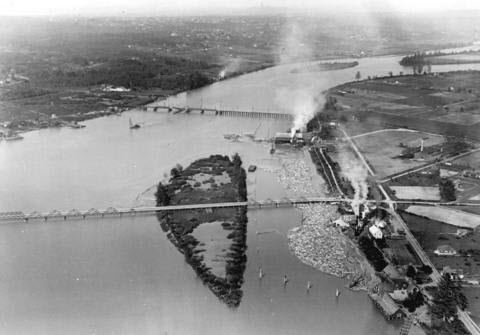
Duck Island – (Middle Arm) – One of two islands inside the Municipality with the name, Duck Island was located between Lulu and Sea Islands at the north end of the Middle Arm of the river. The bridge to Sea Island passed over the island whose channel was used for log storage, wood processing mills being located nearby. A failed attempt to rezone Duck Island as parkland was made in the 1950s after it was approved for dredging spoil disposal. By 1972 the island had been absorbed by Lulu Island and is the present location of the Richmond Night market, a parking lot and the parkade for the River Rock Casino Resort. The last vestige of the island can be seen in the small slough and marsh area near the casino which once formed part of the Duck Island Channel.

2001 26

Duck Island is shown here, ca. 1919, supported part of the bridge to Eburne on Sea Island. Its channel was used as a log storage pond. The island has been completely absorbed into Lulu Island. City of Richmond Archives Accession 2001 26.


The South Arm

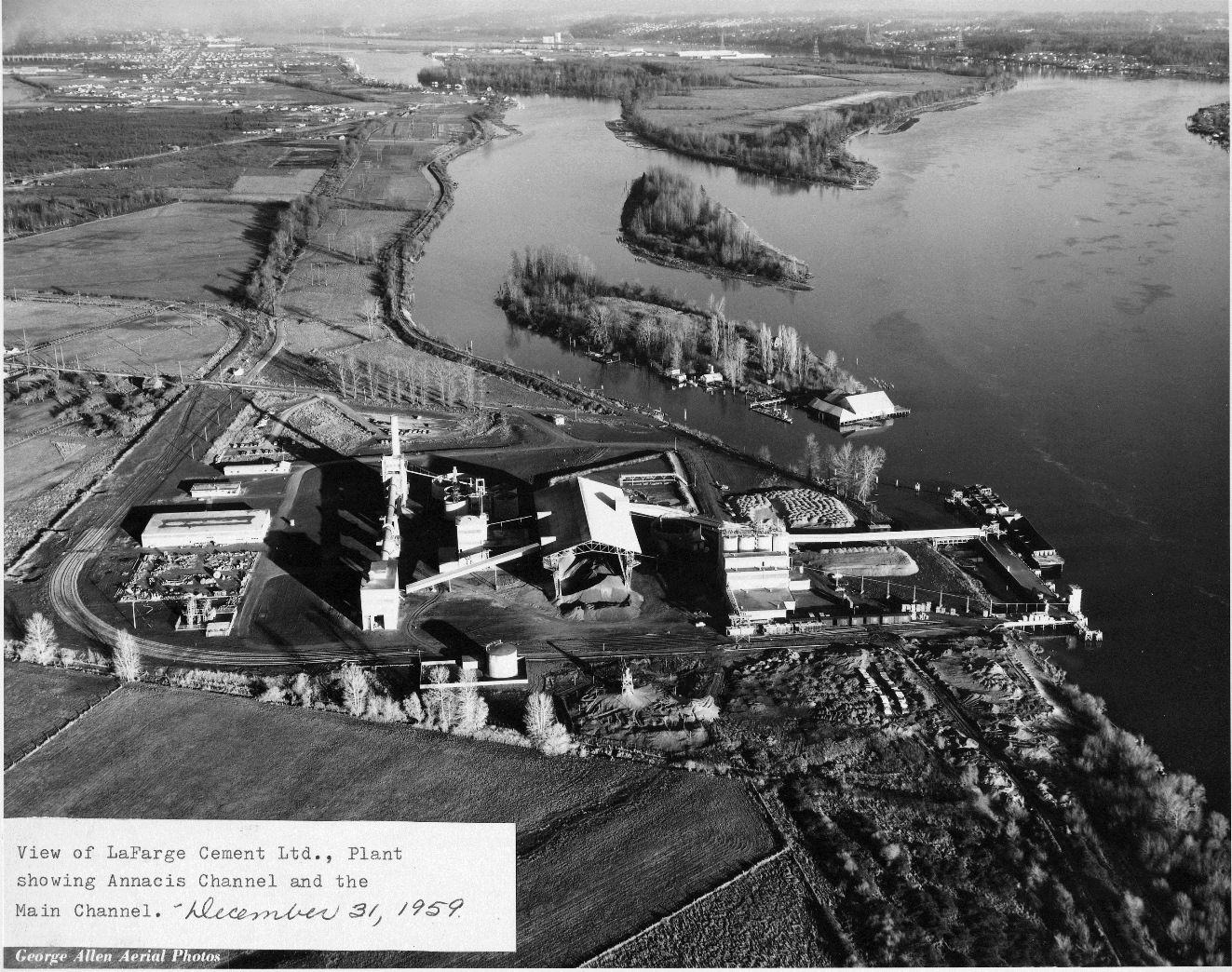
Don Island – Also known as Oikawa Island, Don Island is located in the South Arm of the river west of Annacis Island. It was settled, as was Lion Island, in 1902 by a group of Japanese fishermen and their families, led by entrepreneur Jinsaburo Oikawa,  who supplied fish to and worked at the Ewen Cannery.

Lion Island – Also known as Sato Island, Lion Island was the location of Alexander Ewen’s Cannery, for many years the largest on the Fraser River. The cannery, built in 1876, made “Lion Brand” salmon well known around the British Empire. The cannery closed in 1930, but Lion and Don Islands remained inhabited until the last of the Japanese families were removed in the 1942 internment.

2010 87 31

This aerial view from 1959 shows Lion and Don Islands in the Annacis Island Channel. The Ewen Cannery can be seen on the tip of Lion Island. City of Richmond Archives photograph 2010 87 31.

Whitworth Island – Also known as Gilmore Island, Whitworth Island is separated from Lulu Island by Finn Slough.

~

The next eight islands are located in what is known as the Ladner Reach of the South Arm of the Fraser River. All formed by alluvial deposits from the river, they have been affected by the erection of the Woodward Training Wall, which directs the flow of the river to stabilize the south bank, and by the dyking and farming of some of them. The islands fall within the Agricultural Land Reserve and are under the administration of the BC Ministry of Environment as the South Arm Marshes Wildlife Management Area.

1935 Aerial Mosaic of Richmond dtl2

This detail from the 1935 Aerial Mosaic shows Richmond’s islands in the Ladner Reach. On the right (marked) is Kirkland Island with Rose Island to its left. Rose Island is connected to No.1 Island by the white line of the Woodward Dam which continues down the channel as the Woodward Training wall, through Woodward’s Island. South of Kirkland Island is Williamson Island, then Gunn Island and in the most southerly part of the channel is Barber Island. South of Rose Island is Frenchie’s Island and Duck Island. City of Richmond Archives image.

Kirkland Island – Kirkland Island, named for Ladner resident John Kirkland, is a tidal marsh in the South Arm of the river, owned by the Nature Trust of British Columbia. The island has been dyked and farmed for many years.

Rose Island – Also conserved by the Nature Trust, Rose Island had been dyked and farmed. The channel between Rose and Kirkland Islands has filled in to the point that the two islands are often called Rose-Kirkland Island.

Williamson Island – Williamson Island is a small island south of Kirkland which is also conserved by the Nature Trust. It has been dyked and farmed,

Gunn Island – Another island which was dyked and is farmed, Gunn Island is south of Williamson Island.

Frenchie’s Island – A small privately owned island, Frenchie’s Island is located between Rose and Duck Islands.

Duck Island – (South Arm) – The second island with the name, Duck Island is west of Gunn Island and roughly in the centre of the estuary. An old cannery was located on the island and the pilings can still be seen.

Barber Island – Named for Alfred and Charles Barber, who acquired the island in 1888, Barber Island is the most southerly of Richmond’s islands in the estuary.

No.1 Island – This is a very small island north of Duck Island. The Woodward Dam, part of the Woodward Training Wall, spans the channel between No.1 Island and Rose Island and then runs from No.1 along Woodward’s Island for a distance of 3.7 km.

Woodward’s Island – Named for Nathan and Daniel Woodward who owned the island. Woodward’s Island is the most westerly of Richmond’s South Arm estuary islands.

~

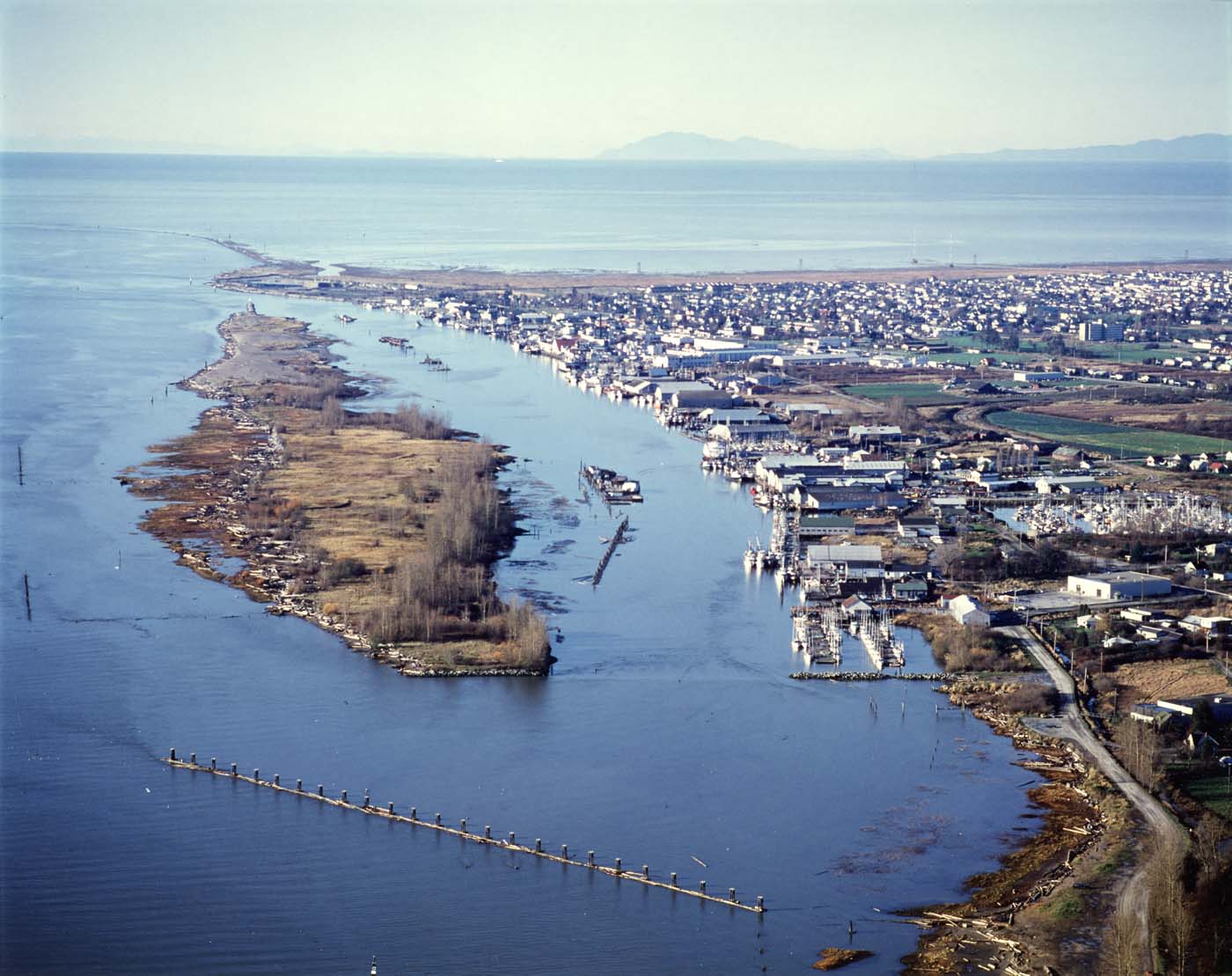
Steveston Island – Originally no more than a sand bar, Steveston Island, also known as Shady Island, was formed by the dumping of dredging spoil and the erection of training structures in the river. It protects the Steveston waterfront. (For more about Steveston Island see https://richmondarchives.ca/2017/03/30/shady-island/)

1988 10 136

Probably the last of Richmond’s Islands to be formed, Steveston (Shady) Island was not much more than a semi-submerged sandbar before dredging spoil and river training devices added to its growth. City of Richmond Archives photo 1988 10 136.

Richmond’s original 26 islands have been reduced due to infilling to 19 which, arguably, could still be referred to as islands, still a respectable amount and more than enough for Richmond to qualify as an “Island City by Nature” and a “Child of the Fraser”.


Shady Island – Man-Made by Nature

One of the best loved features of the Steveston waterfront, Steveston Island, known as Shady Island to locals, is something rare in an urban landscape, an untouched, undeveloped piece of natural land. Home to rare species of plants and many types of birds, the island was little more than a sandbar as far back as the 1920s. Rivers are natural island builders and the Fraser would have formed the island on its own but the process was accelerated by the interference of man, leading to the treed sanctuary we see today.

2004 40 1

In this image of the Steveston Waterfront from 1889 no island protects the waterfront. City of Richmond Archives, photograph # 2004 40 1.

In Steveston’s early days, a naturally formed sandbar protected the waterfront by diverting some of the river’s water away from shore. A natural, protected channel formed behind the bar, suitable for the moorage of fishing boats and the construction of canneries.

001

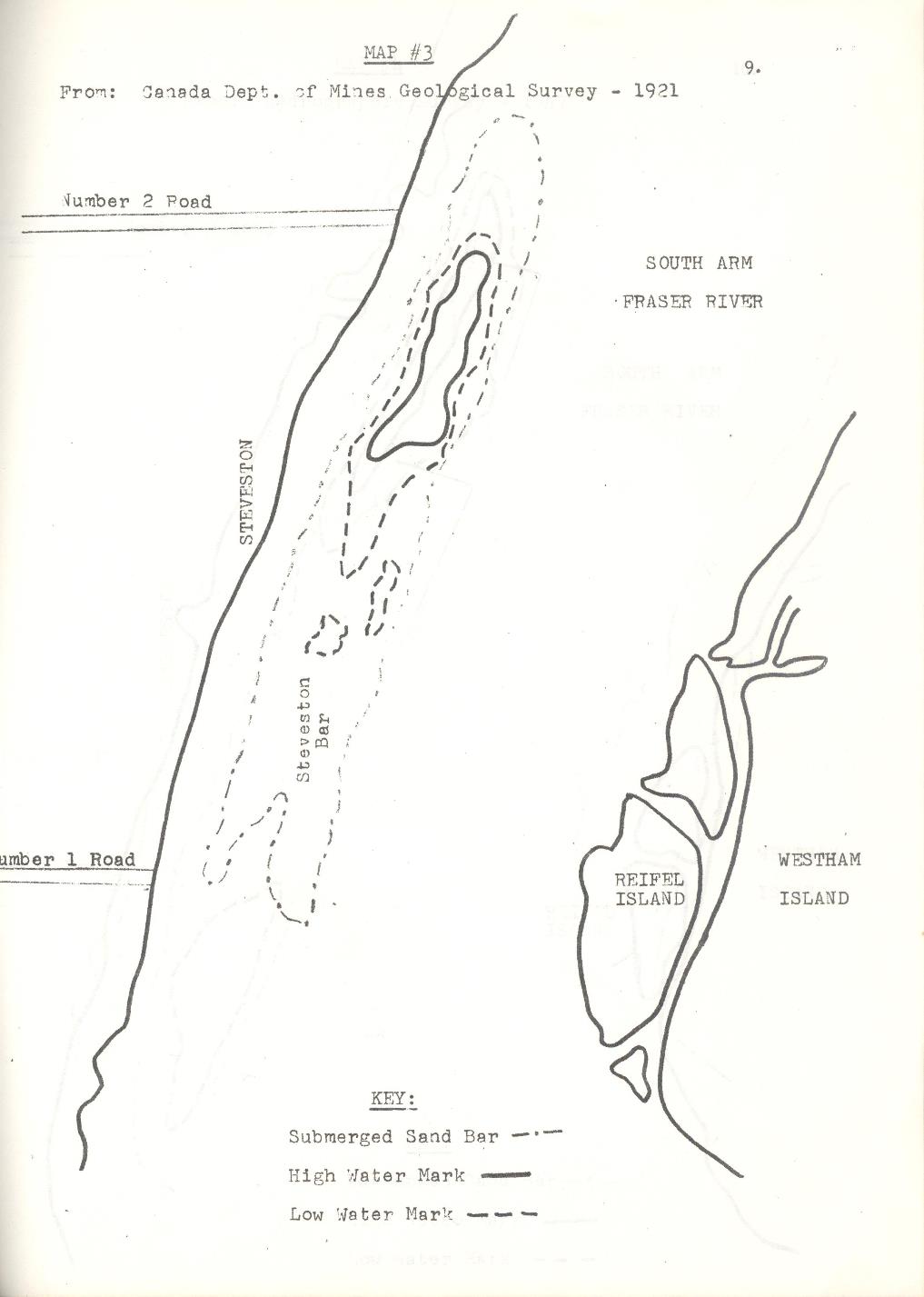
A 1921 map based on a Dept. of Mines geographical survey shows the natural shape of Steveston/Shady Island at the time. A small, permanently dry island near the end of No.2 Road existed, along with a couple of small bars that showed at low tide. A submerged bar extended as far as No.1 Road. City of Richmond Archives, Reference Files.

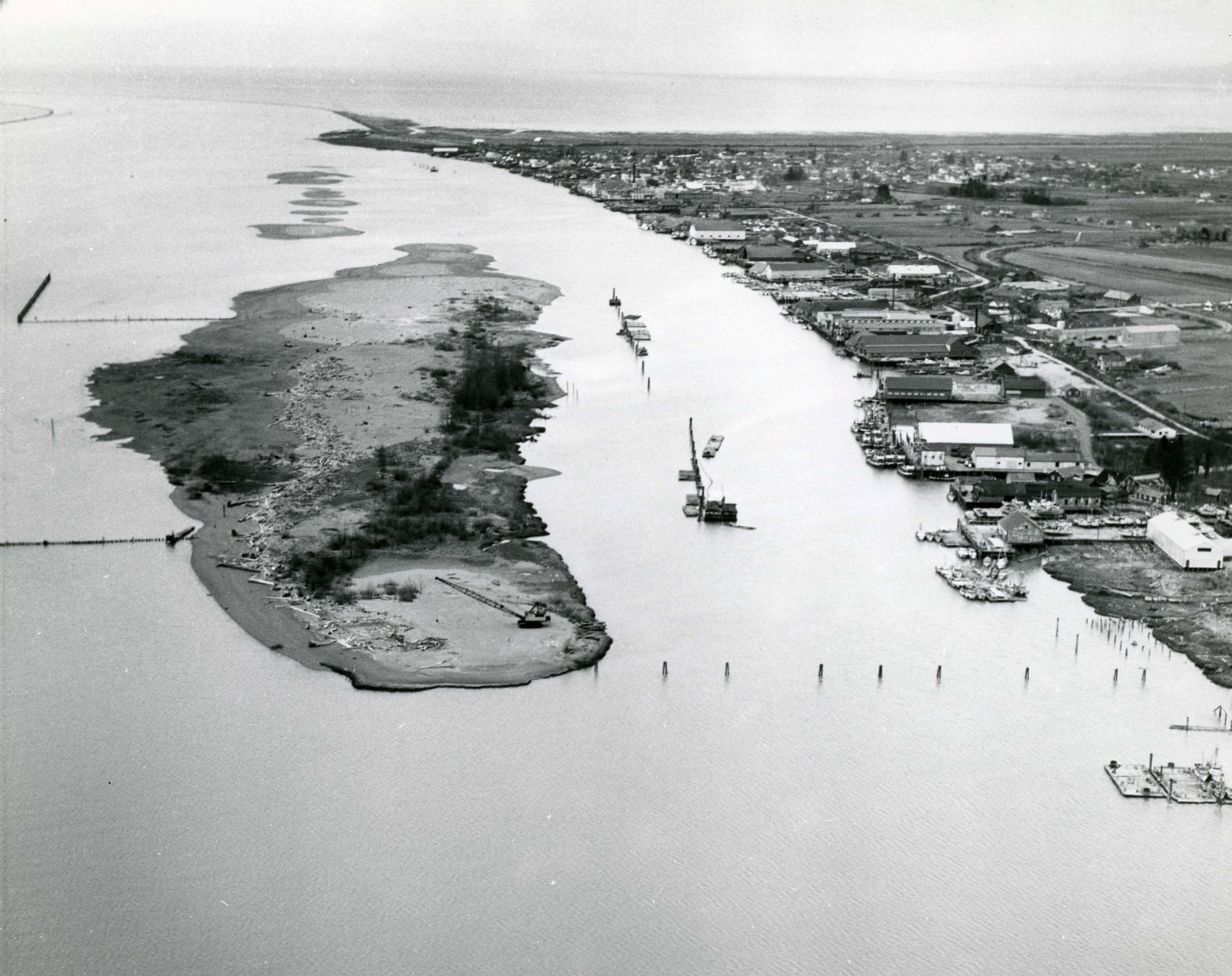
As European immigration increased, swelling New Westminster’s population and increasing the size and amount of traffic on the river, it was necessary to keep the main river channel navigable by regular dredging. Spoils from dredging were dumped on the Steveston bar forming two distinct parts which were exposed at low tide and were connected by the submerged part of the bar. At high tide, smaller boats could still be taken across that part of the bar, although the route became closed after further dredging and natural build-up closed the gap.

002

By 1947 the addition of wing dams and dredging spoils have begun the process of building the island we know today. City of Richmond Archives, Reference Files.

In the 1930s two wing dams were built on the south side of the island to keep sand from being washed back into the channel. Later, a long training wall was built just upstream. The effect of the wing dams and training wall were to divert the river’s water toward the main channel, increasing its rate of flow and helping to keep the channel clear. This also increased the rate of natural silt build-up on the island. The island now had an important function other than a place to deposit dredging spoils. It formed a well protected harbour along the Steveston waterfront.

1977 1 14

The island before the installation of the rock dam or the breakwater. The western end of the island is still little more than a sandbar. City of Richmond Archives, photograph # 1977 1 14.

In order to to prevent the infill of the harbour channel and to provide access to the island for potential moorage facilities, a high rock dam was built across the upstream entrance to the channel. While the dam was effective, it eliminated flow through the channel, allowing effluent from the canneries to settle, creating a foul smelling basin that infiltrated the whole area with the stench of rotting fish. Within two years the top part of the dam was removed, allowing the channel to flush with each high tide.

1977 1 15

The rock breakwater can be seen in this image, shortly after its completion, ca. 1953. Also visible are the wing dams and the rock dam at the east end of the channel. City of Richmond Archives, photograph # 1977 1 15.

The island’s form was further changed when a long rock breakwater was built. It extends along the length of the island like a spine and gives it the geographical profile it has today.

1988 10 136

This image looking west over Steveston Island, ca. 1976, shows the two wing dams on the left, the training wall at bottom and the rock dam at the entrance to the channel. The photo shows how water can flow through the channel at high tide, flushing clean water through while preventing silt from entering. The end of the rock breakwater, now mostly buried, can be seen extending past the western tip of the island. City of Richmond Archives, photograph # 1988 10 136.

Steveston Island today is a gem on the waterfront of the village. Having resisted development proposals that have arisen over the years, it remains undomesticated and accessible only at low tide across the rock dam, a fact that many people learn each year when they lose track of time and are stranded by the incoming tide. As other parts of Steveston and Richmond change under the pressure of development, let’s hope this little piece of man made nature remains the same.