Focus on the Record – Records of Early Land Use Regulation

The City of Richmond Archives holds records created by Council, its committees, and municipal departments involved in guiding land use in Richmond from the very earliest town planning discussions to recent zoning bylaws. Before the post World War II growth of suburban development, the local government role in guiding land use was largely carried out through building and subdivision approval. In Richmond, the first subdivision plans approval bylaw was passed in 1908. The Archives holds a variety of early subdivision plans.
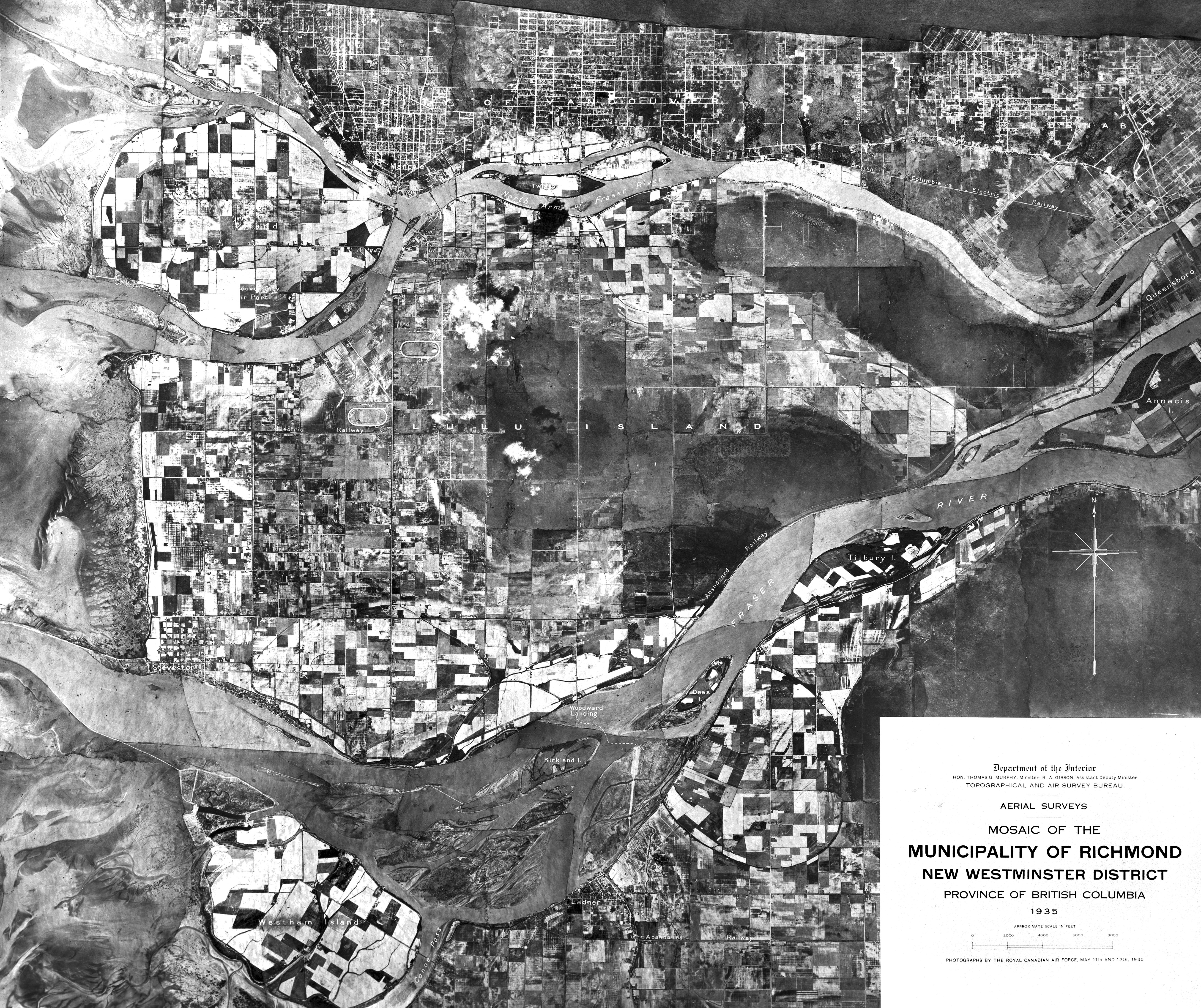
Aerial view of Richmond (population 8,000) in the 1930s, before the establishment of zoning bylaws. City of Richmond Archives Photograph 1985 154 1

Aerial view of Richmond (population 8,000) in the 1930s, before the establishment of zoning bylaws. City of Richmond Archives Photograph 1985 154 1

After World War II the need for formal planning and building control became more pressing; land was being subdivided and buildings were being constructed at an increasing rate. In 1947, Bylaw 1071 was adopted establishing a Town Planning Commission to advise Council in carrying out the powers and provisions of the provincial “Town Planning Act” (1925).

The Archives holds the original minutes and reports of the Town Planning Commission (1948-1957), and its successor body, the Advisory Planning Commission (1958-1991).

Minutes of first meeting of Town Planning Commission

Minutes of first meeting of the Town Planning Commission. City of Richmond Archives MR402, APC1-1


As evidenced in the early meeting minutes, the Town Planning Commission was empowered to issue or deny building permits and to make decisions relating to permissible activities on specific properties. The Commission was assisted in its decision making by the Municipal Engineer and the Municipal Clerk.


With the help of the provincial government’s Regional Planning Division, a comprehensive planning tool was developed in 1949. This was the first zoning bylaw, Bylaw 1134 (1949), for the regulation of land use and building, in 7 types of districts, known as the Town Plan. The bylaw was officially described as: “A bylaw to divide the Corporation of the Township of Richmond into districts and to make regulations in relation thereto, regulating the location, use and height of buildings, size of yards and other open spaces, and the use of land, pursuant to the ‘Town Planning Act’ and the ‘Municipal Act’”.

1949 Zoning Map as Schedule A to Bylaw 1134. City of Richmond Archives Bylaws

Until 1957, when Richmond’s first Town Planner was hired, Council’s oversight of the planning process was carried out through the Town Planning Commission and outside consultants. This mechanism proved inadequate to manage growth. In 1955 consultants presented a report which became the basis for the next zoning bylaw, to replace the 1949 bylaw.

First page of Zoning Bylaw 1430 (1956), with amendment bylaw number annotations in pencil. City of Richmond  Archives Bylaws

First page of Zoning Bylaw 1430 (1956), with amendment bylaw number annotations in pencil. City of Richmond Archives Bylaws

Zoning Bylaw 1430 (1956) created 11 use classifications. With multiple amendments (over 1000), it served to guide land use control in Richmond until a new Zoning Bylaw was adopted in 1989. The new 1989 bylaw (Bylaw 5300) was established in association with Richmond’s Official Community Plan, first adopted in 1986. Bylaw 5300 was repealed with the adoption of the present Zoning Bylaw 8500 in November, 2009.

The Archives holds extensive municipal government records of planning functions carried out since the creation of the Planning Department, including those relating to community planning and zoning administration.

[Note – this is an updated version of an article first published in the Spring 2012 issue of the Archives News]

From the Archives Kitchen – Clover Leaf Salmon Bread Pie

Recipe Book Centre Spread

Various products sold under the Clover Leaf brand, ca. 1955. City of Richmond Archives RL258

British Columbia Packers Limited was at one time the largest and most diverse fishing company in Canada. For many years, the company operated out of headquarters in Steveston, a major centre for the British Columbia fishing industry for much of the last century.

CloverLeafTradeMarkRenewal1915

Renewal of Clover Leaf trade mark, 1915. City of Richmond Archives, BC Packers fonds, Series 5 , Sub-series 1, File 17

Of the many brand names and trademarks owned by BC Packers, “Clover Leaf” was one of its most well established.

The trademark was first registered in 1890 by a New York City company before being transferred to the British Columbia Packers Association, the forerunner to British Columbia Packers Limited.

The brand was registered to be used for a wide-range of canned products, including fruits, vegetables, soups and fish. The Clover Leaf brand over time, however, became synonymous with quality seafood canned in Steveston and at other BC Packers canneries up and down the BC coast.


Clover Leaf Sockeye Salmon, by appointment to the Governor General and the Lady Tweedsmuir, 1939

Clover Leaf Salmon, By Appointment to their Excellencies the Governor General and the Lady Tweedsmuir, 1939. City of Richmond Archives, BC Packers fonds, Series 5, Sub-series 1, File 17

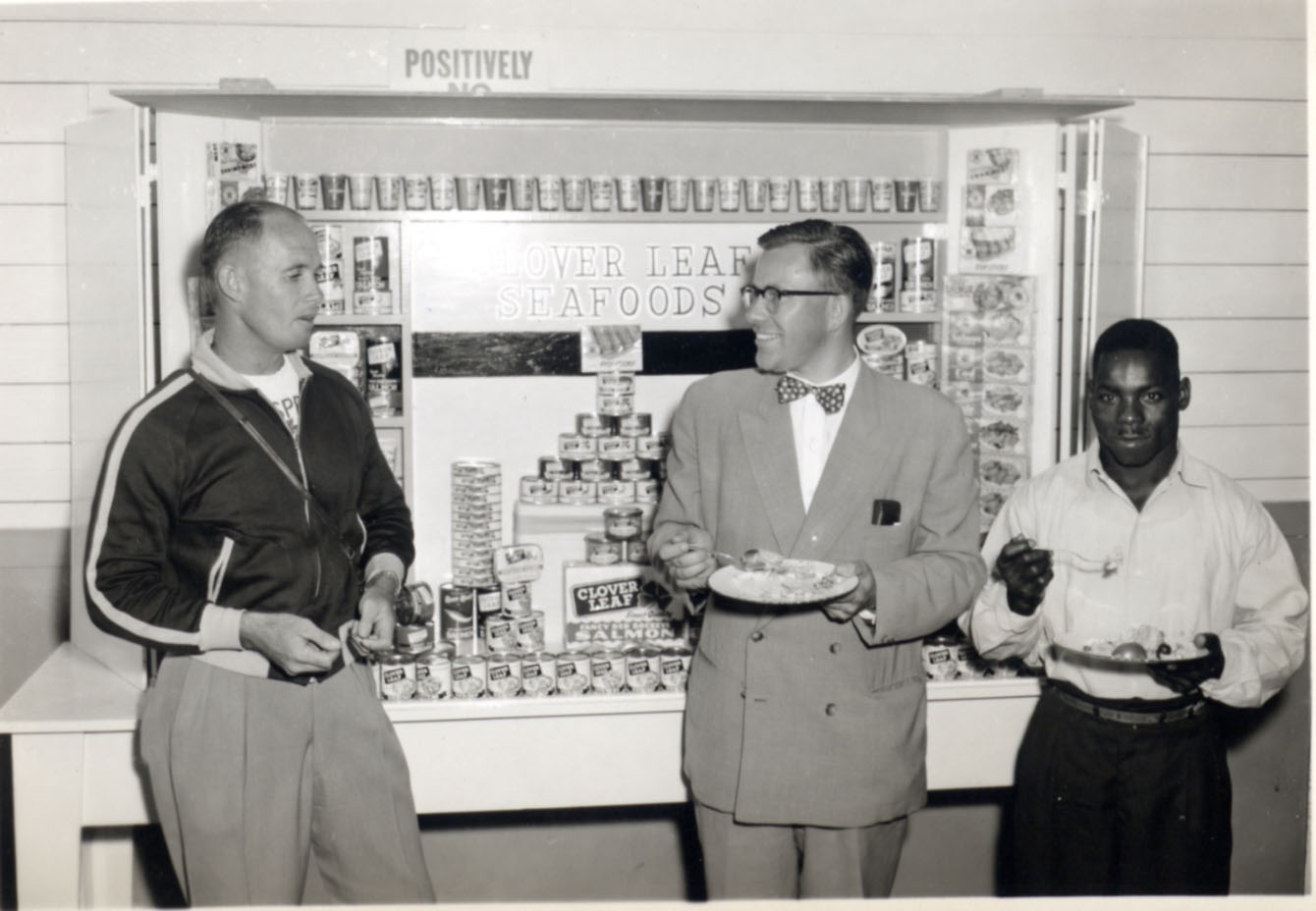
Clover Leaf Display, 1954. City of Richmond Archives Photograph 2001 34 9-93

Clover Leaf Display, 1954. City of Richmond Archives Photograph 2001 34 9-93

BC Packers marketed its “Clover Leaf” salmon locally, throughout the British Empire, and around the world.  In the 1950s, its marketing campaigns often included displays at various exhibitions and shopping outlets, radio advertisements with catchy jingles, and the publication of pamphlets containing recipes for easy-to-make meals.

"Sea Food Recipes", ca. 1955. City of Richmond Archives RL258

“Sea Food Recipes”, ca. 1955. City of Richmond Archives RL258

One pamphlet produced by BC Packers around 1955, “Sea Food Recipes”, was recently consulted at the Archives in the course of historical research on food preparation. In the interest of accurate research, we thought we should try one of the recipes, the “Salmon Bread Pie,” a kind of poor man’s Salmon Wellington.

Recipe for Salmon Bread Pie in "Sea Food Recipes", City of Richmond Archives RL 258

Recipe for Salmon Bread Pie in “Sea Food Recipes”, City of Richmond Archives RL 258

The surprisingly tasty result of our research , thanks to professional chef and Friends of the Richmond Archives’ Board Director Precilla Huang. (Bill Purver photograph)

“Never on Sunday” – the Holiday Shopping Referendum

Never on Sunday front page

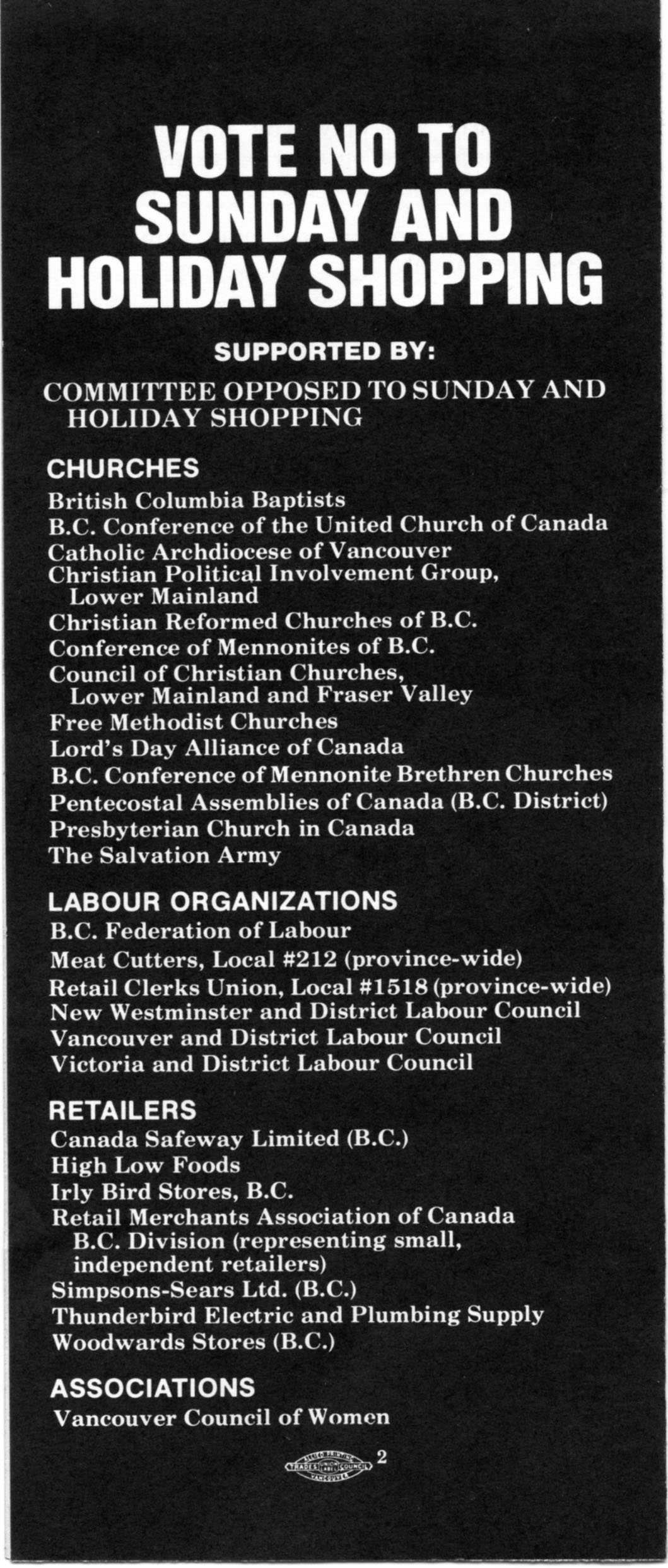
Election brochure. City of Richmond Archives, MR 35, File 4569 (1981)

Many people today are surprised to learn that prior to 1981, most stores in Richmond were prohibited from opening on Sundays and holidays.  Provincial legislation, namely the Holiday Shopping Regulation Act, was enacted in 1980, and provided a means by which an individual municipality could ask its citizens whether they wished to remove restrictions on Sunday and holiday shopping.

As a result, Richmond Municipal Council decided to add to the November 21, 1981 municipal election ballot the following referendum question:

“Are you in favour of Richmond By-law No. 4016 which in summary would permit all retail businesses to carry on business on a Sunday and any other holiday as defined by the ‘Holiday Shopping Regulations Act’?”

Two groups emerged in the community to promote each side of the referendum question, a question that was being asked on a number of municipal election ballots throughout the province.

Back page of election brochure. City of Richmond Archives, SE 35, File 4569 (1981)

Back page of brochure. City of Richmond Archives, MR 35, File 4569 (1981)

The “Committee Opposed to Sunday and Holiday Shopping” was formed as an unusual alliance of church groups, labour unions, major retail stores, and women’s groups.  Using the slogans “Never on Sunday” and the “Price of Convenience”, the committee urged that Sunday should be “a day of rest” for church goers and workers, the latter comprised of a large number of women who worked as retail store clerks.  The Committee warned that if shopping was allowed, “Sundays and holidays would soon become another rat race like any other day of the week, with traffic jams, noise, congestion and frustration for everyone.”

On the other side, some larger, newly-established stores along with a wide-range of citizens argued for the right to shop on Sunday, listing various benefits including convenience, emergency needs, rights of consumers, and promotion of local shopping rather than cross-border shopping or shopping in municipalities which had already adopted Sunday and holiday shopping bylaws.

Lumberland Brochure

Election advertising. City of Richmond Archives, MR 35, File 4569 (1981)

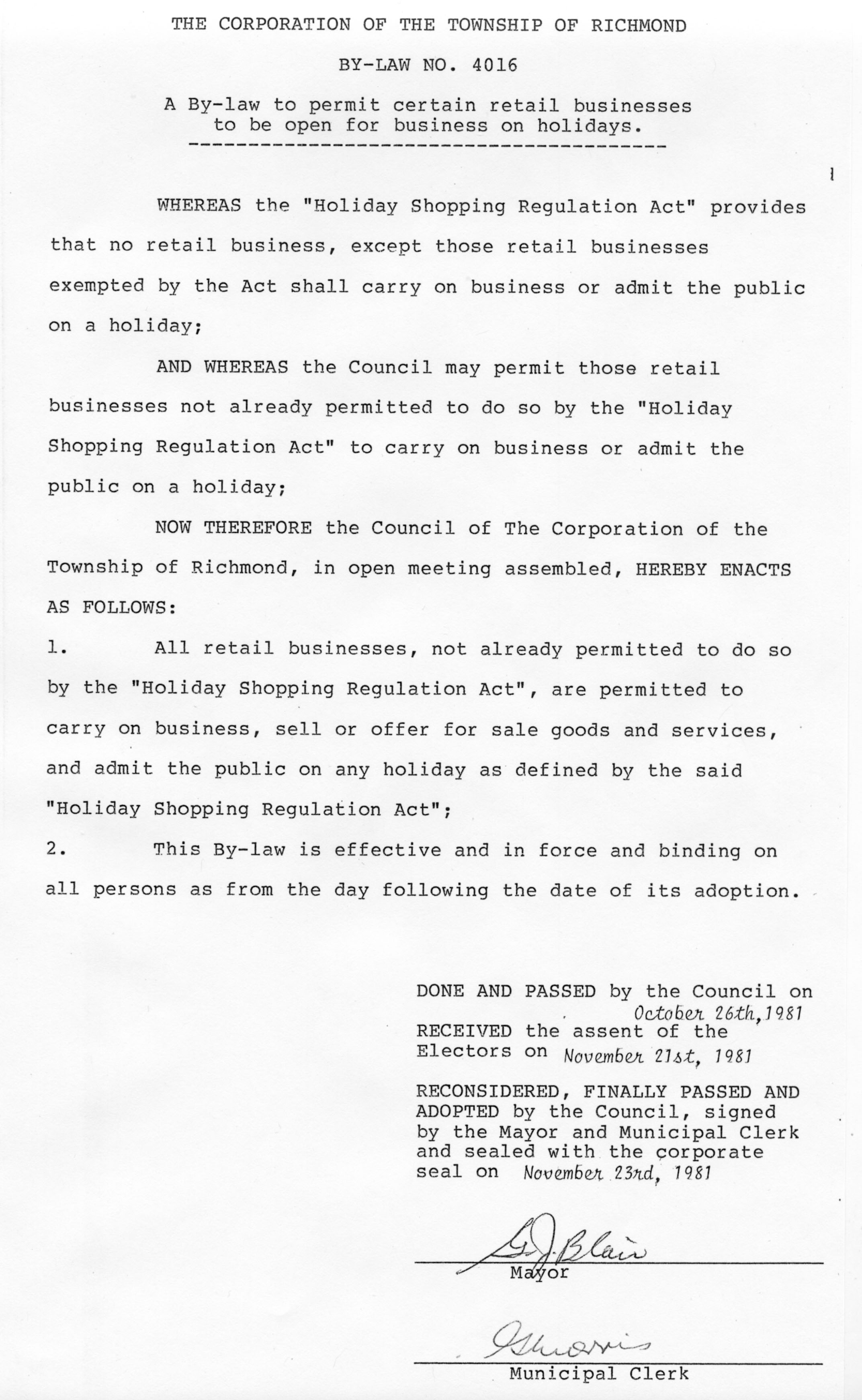
By a margin of 14,434 “Yes” votes to 8,265 “No” votes, Bylaw 4016 received the assent of electors and was adopted by Council on November 23, 1981.  Retail shopping on Sundays and holidays was here to stay.

Bylaw 4016 as adopted. City of Richmond Archives Bylaws

Bylaw 4016 as adopted. City of Richmond Archives Bylaws

From the Archives Kitchen – An Old-Fashioned Roly Poly

slice of roly poly

A slice of mouthwatering roly poly. (Graham Turnbull photograph)

Have you tried a roly poly lately? Research at the City of Richmond Archives recently uncovered a WW II “ration guide” containing a recipe for this mouthwatering dessert.

Ration Book Cover

Cover of WW II ration book. City of Richmond Archives Accession 2011 24

The ration guide was produced as a result of the need to control the distribution of staple food products during World War II. A rationing program was implemented in Canada in 1942 to ensure adequate food supplies for the armed forces and for citizens through the balance of the war. Foods such as meat, butter, sugar, coffee and tea could be purchased only with the redemption of an appropriate coupon from a ration book.

Ration Book coupons

WW II ration book coupons. City of Richmond Archives Accession 2011 24

Home Canning Ration Guide Cover

Cover of WW II Home Canning Ration Guide. City of Richmond Archives Reference Files

In addition to rationing, citizens were encouraged to augment the food supply by activities such as making their own butter from milk, and by preserving fruits and vegetables.

“Here’s Your Home Canning Ration Guide” was published in 1943 “in the interests of maximum results in home canning with available sugar.” Inside, instructions were given for methods of canning without sugar, and how to use the preserved fruits or vegetables in the form of recipes.

On page 8 of the guide is a recipe for “Sweet Cherry Roly Poly,” a jelly roll-like confectionery. We thought we should try out this recipe in the interests of historical research and appetite.

Roly Poly Recipe

Roly Poly Recipe from Home Canning Ration Guide. City of Richmond Archives Reference Files

Here’s the result of our research into wartime cooking:

Wartime Roly Poly

The end result of our research, thanks to pastry chef and Friends of the Richmond Archives’ Board Director Precilla Huang. (Graham Turnbull photograph)

Focus on the Record – “Letters Patent”

A number of letters patent have been issued which have defined Richmond as a municipality. These letters patent have demarcated Richmond’s geographic boundaries and have specified the nature, composition, and powers of its governing Council.

“Letters patent”, as a documentary form, date back to medieval England. Initially, they were created by the monarch to be read aloud as a proclamation granting status to an entity. Letters patent were in contrast to “letters close”, which were documents from the king directed privately to particular recipients. By the late middle ages, letters patent were often written to grant petitions from citizens, a use which is still prevalent today.

“The Corporation of Richmond” was incorporated as a municipality by means of letters patent, issued on November 10, 1879, in the name of the Queen under the Public Seal of the Province, in response to a petition of residents submitted to the provincial government. In addition to defining the first geographic boundaries of the municipality, these letters patent mandated the date of the first municipal election (January 5, 1880) and the date of the first Council meeting (January 12, 1880). The contents of the letters patent were subsequently published in the British Columbia Gazette as required by statute.

1879 Letters Patent

1879 letters patent as published in the BC Gazette. City of Richmond Archives MR 300, File LP1

These first letters patent were revoked in 1885 in order to change Richmond’s boundaries. New letters patent gave the municipality all of the islands in the North Arm of the Fraser River and some islands in the South Arm, and ceded the east end of Lulu Island (Queensborough) to New Westminster. They also renamed the municipality “The Corporation of the Township of Richmond” and reduced the size of Council from seven councillors to five, in addition to a reeve.

In 1892, the second letters patent were suspended due to irregularities occurring during the conduct of the municipal election for the Council of 1892. New letters patent re-established the municipality and mandated a new election date, but were written in a manner that caused some confusion as to the municipal boundaries. An amendment was made to these letters patent in 1896 to redefine the boundaries to correspond exactly with those of the letters patent of 1885.

Top of first page of new letters patent of 1892, with 1896 annotations. City of Richmond Archives MR 300, File LP3

Supplementary letters patent were issued in 1910 which reduced the municipal limits of Richmond by extending the boundaries of the municipality of South Vancouver. In 1957, supplementary letters patent increased the number of councillors from five to six. Similarly in 1966, supplementary letters patent increased the number of councillors from six to eight.

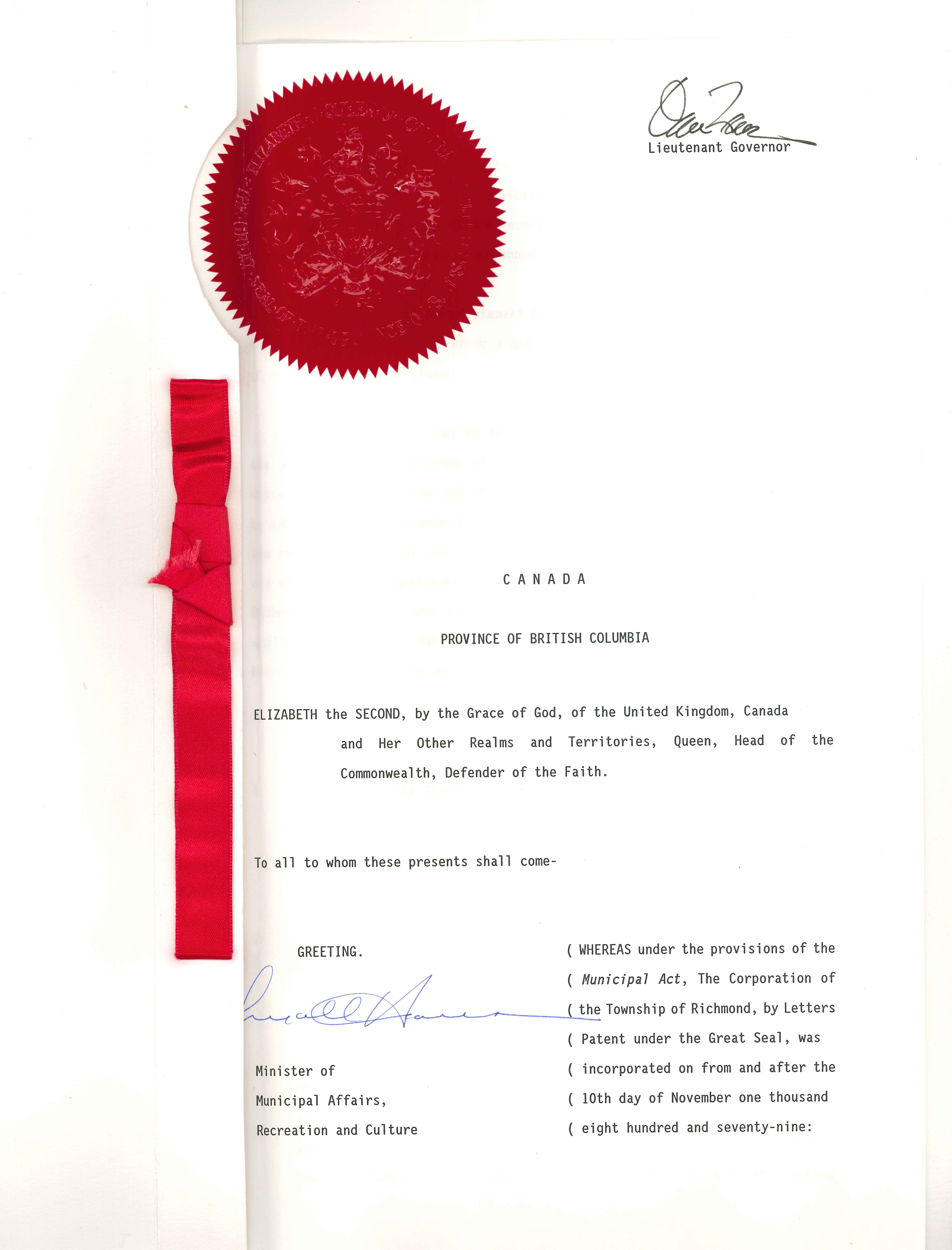
First page of 1990 letters patent. City of Richmond Archives MR 300, File LP8

1990 marked the issuing of new letters patent reincorporating the “Corporation of the Township of Richmond” as the “City of Richmond”, an action that was celebrated as a coming of age for the municipality. In 1996, supplementary letters patent extended municipal boundaries to include Sturgeon Bank.

The holdings of the City of Richmond Archives include some of the original, sealed letters patent, along with copies of the contents of the other letters patent as published in the BC Gazette.

[Note – this is an updated version of an article first published in the Spring 2011 issue of the Archives News]