Moving Pictures – Movie Theatres in Richmond

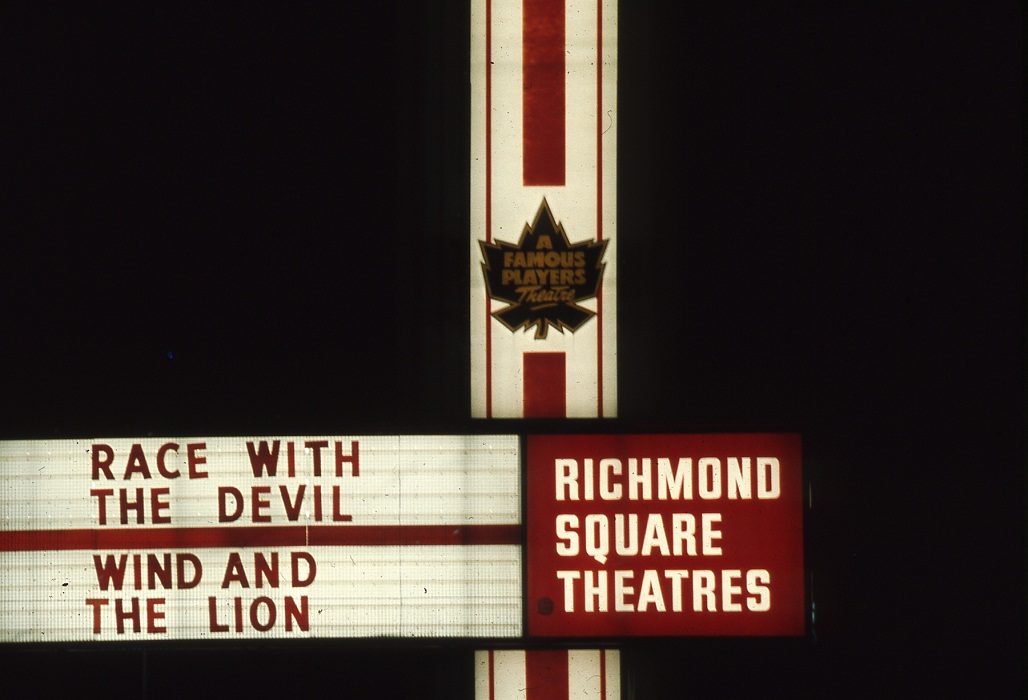
Movie theatres are usually marked by a well lit marquee to attract the eye and advertise the features playing there. This example is from the Richmond Square Twin Theatres. City of Richmond Archives photograph 2008 39 2 16.

Motion Pictures have been entertaining people since the first public showings in the 1890s. In 1898, Vancouver’s first motion picture was played in a warehouse on Cordova Street by John A. Shuberg, a Swedish immigrant who had purchased one of Edison’s Kinetograph machines, the first commercially available projector. The show featured moving images from the Spanish-American War with Shuberg adding sound effects from behind the screen by banging sheets of tin and shooting guns. After a two-week sold out run he took the show on the road, building a portable tent theatre and touring around Canada and the United States. Upon returning to Vancouver in 1902 Shuberg opened the “Edison Electric Theatre” on Cordova Street, converting the Central Hotel into Canada’s first movie house. The movie industry has grown exponentially since those days, surviving the Great Depression, World Wars and predictions of its impending doom because of influences like television, home movie rentals and streaming services. Richmond has had a number of venues where locals could enjoy a the latest Hollywood release without leaving the community. Here are the places that they could go to enjoy a movie over the years.
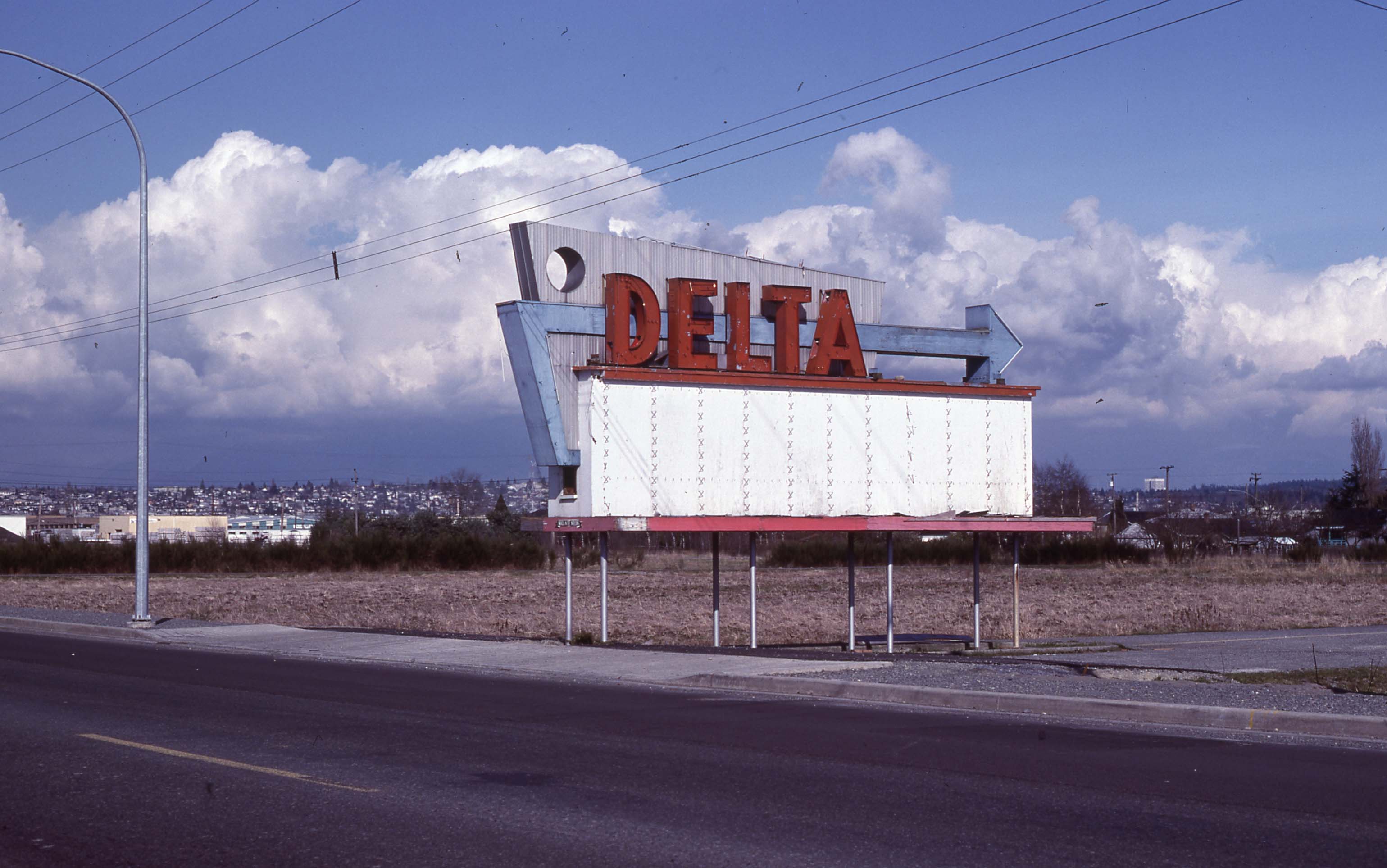
This marquee pointed the way to Richmond’s Delta Drive-In Theatre. City of Richmond Archives, George Bergson photograph 2016 19 18217.

The Richmond Theatre

Eugene Greczmiel was a well-known and respected resident of Richmond whose life story is filled with tales of entrepreneurial determination and success. In 1929 he opened the Richmond Theatre, the first one in town. The theatre was located on Moncton Street in a building which survived the 1918 Steveston Fire and still stands today. Greczmiel played silent movies twice a week at the picture show and included imported Japanese films to attract moviegoers from the large Japanese Canadian population in Steveston.

This image of athletes participating in the first Kendo tournament held in Steveston is believed to have been taken inside the Richmond Theatre. City of Richmond Archives photograph 1977 7 4.

When “talkies” became the latest thing he built his own sound head for the projector for a cost of $175, saving thousands on the cost of buying one. In his own words, “It worked, but it wasn’t very good.” “Lots of music, little speech.” Around 1932 Mr. Greczmiel opened the Marpole Theatre on the Vancouver side of the River and the Richmond Theatre was closed. The building at 3700 Moncton Street was the location of the Redden Net Company for many years and at present is a dental office.

This building at 3700 Moncton Street was the location of Richmond’s first moving picture show. City of Richmond Archives, Graham Turnbull photograph.

The Steva Theatre

Richmond’s next movie theatre was also located in Steveston. In 1945, Washington Thorne moved to Richmond from Saskatchewan, along with his wife Helen and son Brian. Bemoaning the fact that Richmondites had to travel all the way to Vancouver to go to a movie, in 1946 he began the transformation of the former Japanese Buddhist Temple on First Avenue into a 420 seat movie house.

The Steva Theatre is shown here, ca. 1950. Playing the week the picture was taken were “The Flame and the Arrow” (1950) with Burt Lancaster and Virginia Mayo, “The White Tower” (1950) with Claude Rains and Glenn Ford and “Road Show” (1941) with Adolphe Menjou and Carole Landis. City of Richmond Archives photograph 2010 51 1.

The building was rewired and a decorative façade added to the front. Red leather seating with wooden arm rests were installed, a stage was erected and “teaser” curtains hung on either side to frame the twelve by sixteen foot, glass beaded movie screen.

A pair of reupholstered seats from the Steva Theatre are preserved in the Richmond Museum’s artefact collection. City of Richmond Collection 020.15.1

Restrooms, a concession stand and projection room were constructed. The Steva Theatre opened for business on October 3, 1947 with a sold-out showing of “Black Beauty” starring Mona Freeman and Richard Denning.
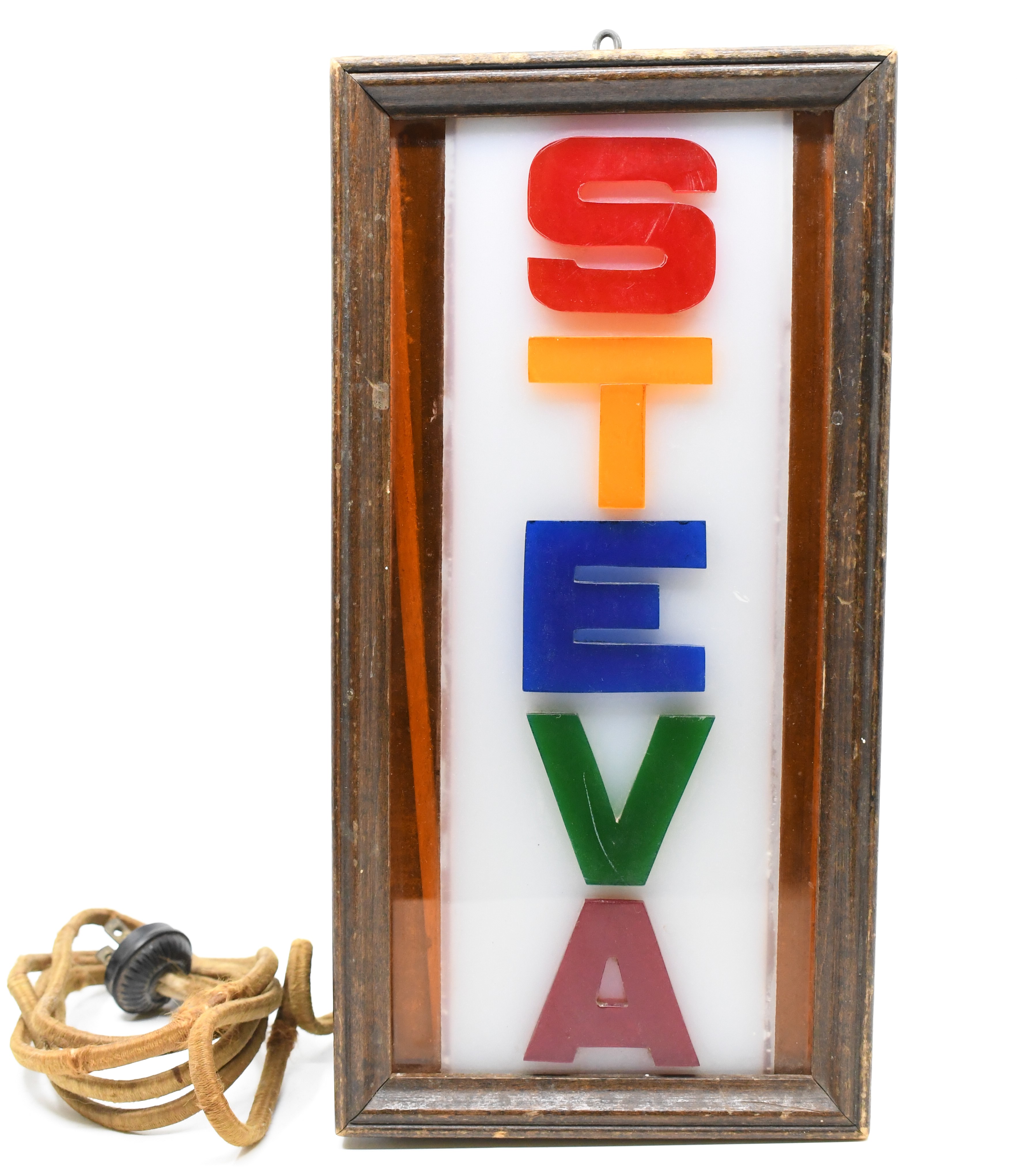
A light box sign from the Steva Theatre ticket office window. City of Richmond Collection 023.23.2

There were living quarters in the back of the theatre that the Thorne family occupied. The family also made up most of the theatre’s staff, Wash Thorne doing promotional work as well as operating one of the two projectors along with a hired projectionist, Helen and a friend took care of the ticket booth and concession stand and Brian sold popcorn outside to the people lined up on the sidewalk. Janitorial duties were shared by everyone. Three different movies were played each week and matinees for the kids were played on Saturdays. Even with a busy showing schedule like this, there was seldom an empty theatre. Mr. Thorne’s prowess at bidding for movies often resulted in new releases being shown at the Steva before they hit the theatres in Vancouver. Admission in the late 1940s was ten cents for features and five cents for matinees.

Special events to attract movie goers were another factor in the Steva’s success. “Foto Nites” were one event used by theatres around North America. Audience members and participants in an amateur contest would be given numbers. The winner of the contest would reveal their number and if an member of the audience had the same number they would have their “Foto” taken and be awarded the prize of $200, a nice sum in the 1950s! The “Foto” would be posted at the theatre, the whole procedure necessary to avoid breaking any laws about gambling or lotteries.

A program for movies showing at the Steva in February and March 1951. City of Richmond Collection S980.59.1

To take advantage of the 1950s 3-D movie craze, Mr. Thorne upgraded the theatre, installing a 20 HP generator, a new sound system and a polarized screen. In August 1953 Paramount’s first 3-D picture, “Sangaree,” played for a full week, followed by “House Of Wax” with Vincent Price in September. Cardboard 3-D glasses were included in the price of admission.

Ad for the first 3-D movie in August 1953. City of Richmond Archives Reference Files.

The Steva Theatre closed in 1960 and the building was sold in 1972. Today in the building where excited children filled the seats to see the latest Western, other children attend a daycare and children’s learning centre.

The Lulu Theatre

The March 5, 1947 issue of the Richmond Review announced the granting of two licenses for “Two New Theatres For Richmond – One at Steveston, One at Brighouse.” The one at Steveston was of course the Steva Theatre. The second, the “Brighouse Theatre” proposed by Peter Barnes of the Photo Night Company and backed by Harry Reifel, required the construction of a new building. There were many delays that affected the building of this theatre. Another company had already been granted a license in 1946 to build a theatre in the Brighouse area which stipulated that no other theatre could be built within two and one half miles. The failure of this company to show any progress on the project resulted in the withdrawal of their license allowing construction to begin. The building at 608 No. 3 Road was put up by Alex Mudry, A.G. Silverton and William Thomson who then sold it to Peter Barnes, “an expert at the business” who owned and operated theatres around the lower mainland and in Ontario.

The Lulu Theatre, shown here in 1958, was in the heart of Brighouse at 608 No.3 Road. City of Richmond Archives photograph 1988 18 31.

Barnes changed the theatre’s name to The Lulu Theatre and outfitted it with the “very newest of equipment.” The front of the building featured a neon lit marquee topped by a tall vertical floodlit structure with three foot tall red letters spelling the word “LULU”.

The interior of the theatre was decorated in shades of red and blue. Seating for 449 people was provided, upholstered in wine coloured fabric with wood arms. Carpeting was wine coloured and the draw curtain in front of the screen was in magenta with gold satin trim.
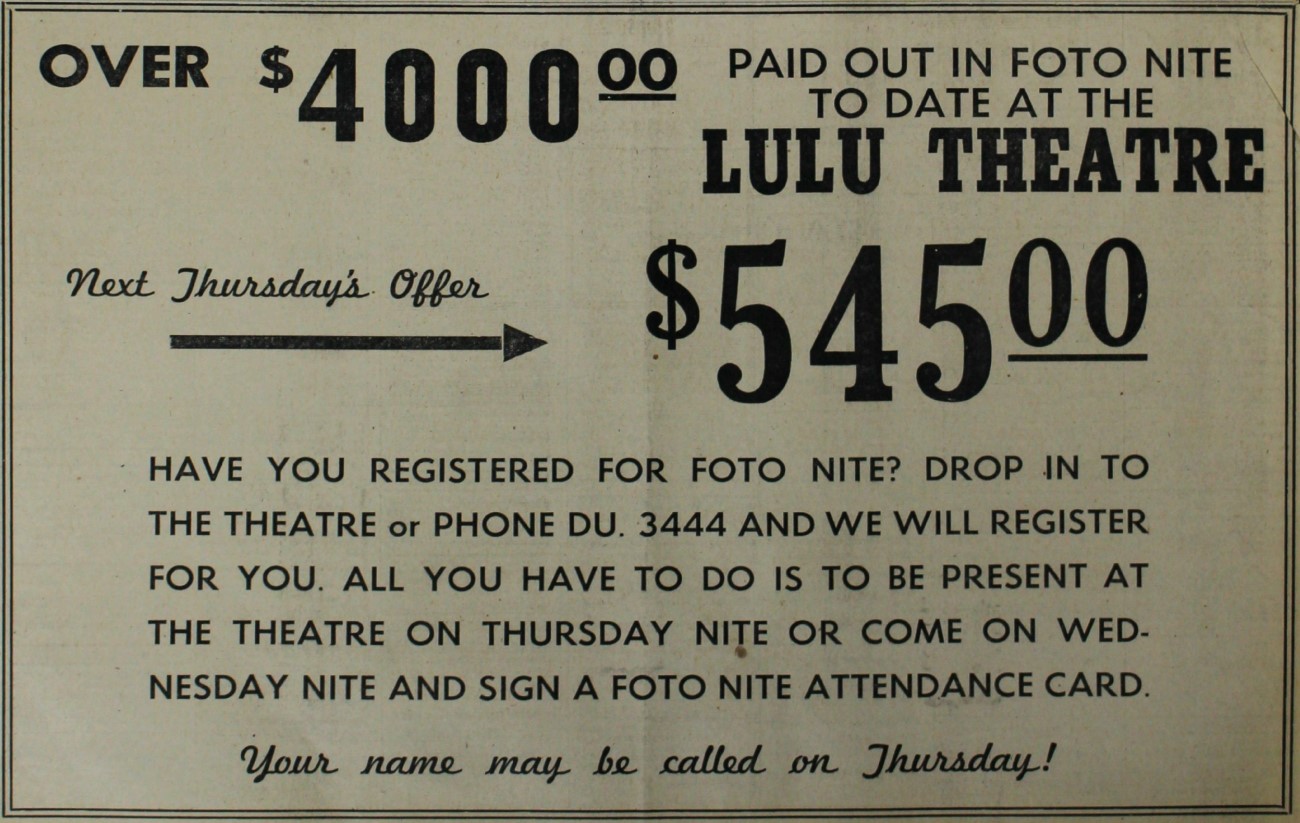
This January 4, 1956 ad from the Richmond Review shows the Thursday night prize for “Foto Nite” at the Lulu. “Foto Nite” promotions were used to attract patrons to theatres on normally low attendance nights in the 50s.

The Lulu had its first showing on May 12, 1948 with “Blue Skies” starring Bing Crosby, Fred Astaire and Joan Caulfield, a musical comedy based on a story by Irving Berlin. Opening night was attended by Reeve R.M. Grauer who congratulated Alex Mudry, A.G. Silverton and William Thomson on the accomplishment of having the theatre built and ready in only four months, introduced the owner and operator Peter Barnes and declared the theatre open. The Lulu played three different movies a week, featured “Foto-Nite” contests on Wednesday and Thursday and Saturday matinees. Admission for adults was 40 cents, children 20 cents, matinees were 25 cents for adults and children 5 cents.
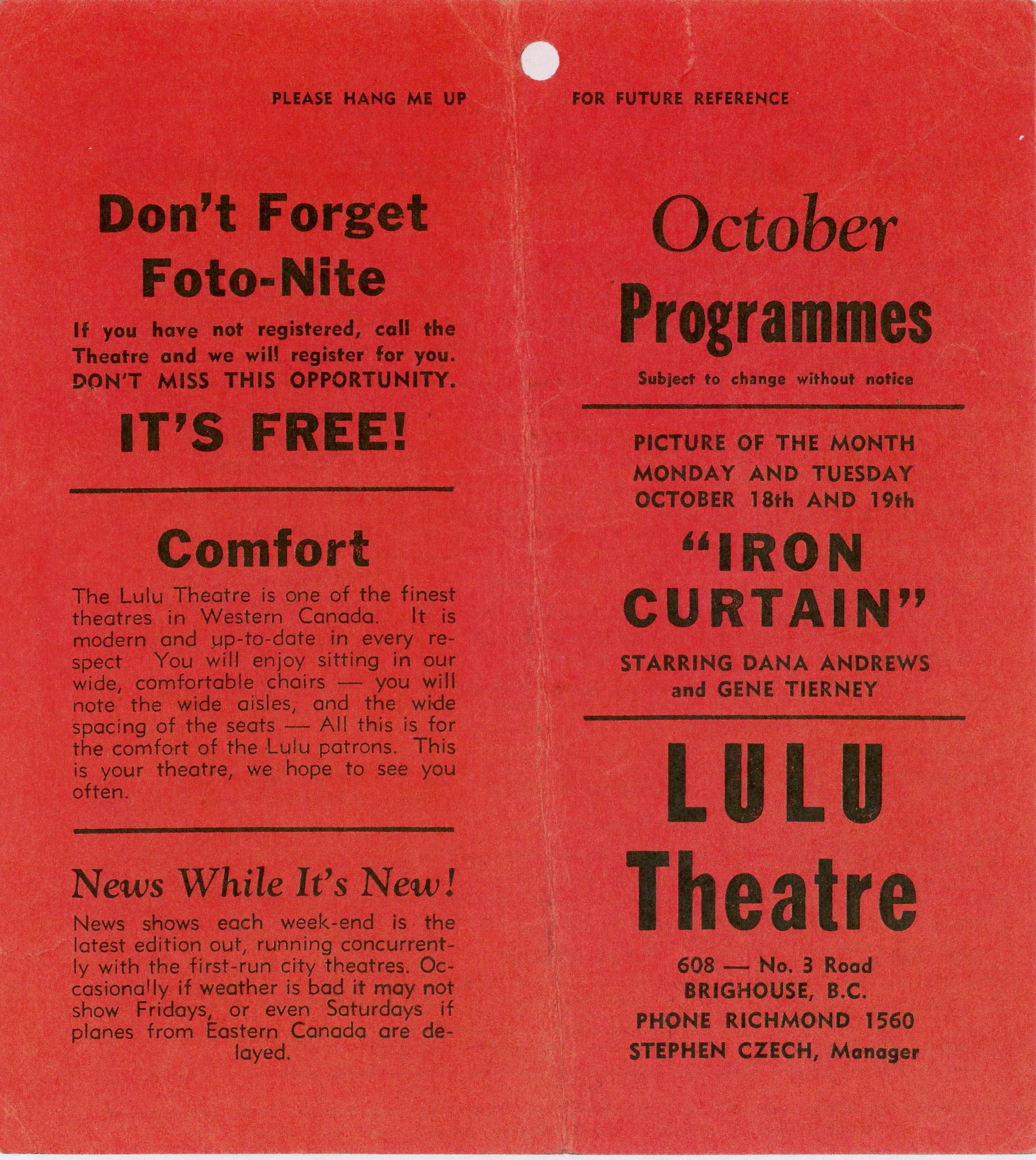
This Lulu Theatre program advertises what’s on in October 1956. City of Richmond Reference Files.

It is not known exactly when movies stopped being shown at the Lulu Theatre but advertising for coming features in the Richmond Review newspaper stopped after the March 26, 1958 edition. The building remained in use as the home for a variety of businesses until it was demolished in the late 1990s.

The Delta Drive-In

The headline in the January 21, 1953 Richmond Review read, “Richmond to Have Drive-in Theatre For This Summer.” The Chechik Brothers from Mayer Enterprises had requested to Municipal Council that 40 acres of land purchased from L.F. Mitchell on No.5 Road, just north of Mitchell School, be rezoned to allow the construction of the “Fraser Drive-In Theatre.” The brothers were well prepared for their presentation to Council, with plans for dealing with traffic and noise and with references and photos from other communities where Mayer Enterprises had set up and operated other Drive-ins, proving that the development would be a “credit to the community.” The rezoning was granted after the obligatory waiting period and construction began.

An article in the Richmond Review announces the proposed Drive-In.

It only took ten weeks for construction to be completed. This included the laying of forty thousand yards of sand, twelve thousand yards of gravel and the driving of 20 piles to support the 50 foot wide screen. A building was erected to house the cafeteria style snack bar and projection room equipped with a 100 amp water cooled projector powered by a 20 horsepower generator. A playground was installed to keep the kids occupied while Mom and Dad enjoyed the movie with sound track provided by speakers which hooked inside the window of the car. The name of the drive-in had also been changed to the “Delta Drive-In”

This artist’s conception printed in the Richmond Review shows the plan for the proposed Drive-In Theatre.

In March a request to council was made on behalf of the owner of the Lulu Theatre for the rezoning of land next to the unfinished Delta Drive-In for the building of a second drive-in. This request was objected to by the RCMP, Public Works and community groups and was subsequently rejected.

The opening night announcement published in the Richmond Review on May 13, 1953.

The Delta Drive-In opened for business on Wednesday, May 13, 1953 with a showing of “Ten Tall Men,” a French Foreign Legion Action, Adventure movie starring Burt Lancaster. Also shown was the Walt Disney live animal Feature “Beaver Valley” and a cartoon. Admission for adults was 60 cents on weekdays, 75 cents on Saturdays and holidays, students (12 to 18 years) 40 cents on weekdays and 50 cents Saturdays and holidays. Children under 12 got in free.

This 1977 aerial view shows the Delta Drive-In with No.5 Road running diagonally behind the screen. City of Richmond Archives, George McNutt photograph.

The Delta Drive-In operated until 1980, featuring films of every genre and offering space for well attended “Swap Meets” on Sundays. By 1984 the land was being redeveloped for townhouse complexes and single family dwellings and the old entrance to the Delta Drive-In was replaced by Greenland Drive.

This 1981 image shows the Delta Drive-In sign, the speaker stands and the snack bar and projection building being torn down in the background. City of Richmond Archives, George Bergson photograph 2016 19 18218.

The Famous Players Richmond Square Twin Theatres

The Richmond Square Twin Theatres were located in the west parking lot at the Richmond Square Shopping Centre in a stand alone concrete building. It was Richmond’s first multi-screen cinema.

This image from the January 17, 1968 Richmond review shows the beginnings of construction on the Twin Theatres.
The Famous Players Richmond Square Twin Theatres. City of Richmond Archives photograph 1983 7 1.

The theatre opened on June 27, 1968 with the features “The Odd Couple,” starring Jack Lemmon and Walter Matthau and a Disney feature, “The One and Only, Genuine, Original Family Band” with Walter Brennan, Buddy Ebsen, Disney staple Kurt Russell and the film debut of his future wife, Goldie Hawn.

An opening night advertisement from the Vancouver Sun newspaper.

The theatre expanded to three screens in 1980 and had seats for 1126 people. In 1990 the theatres were closed and the building was demolished to make room for the construction of the Richmond Centre Mall parkade.
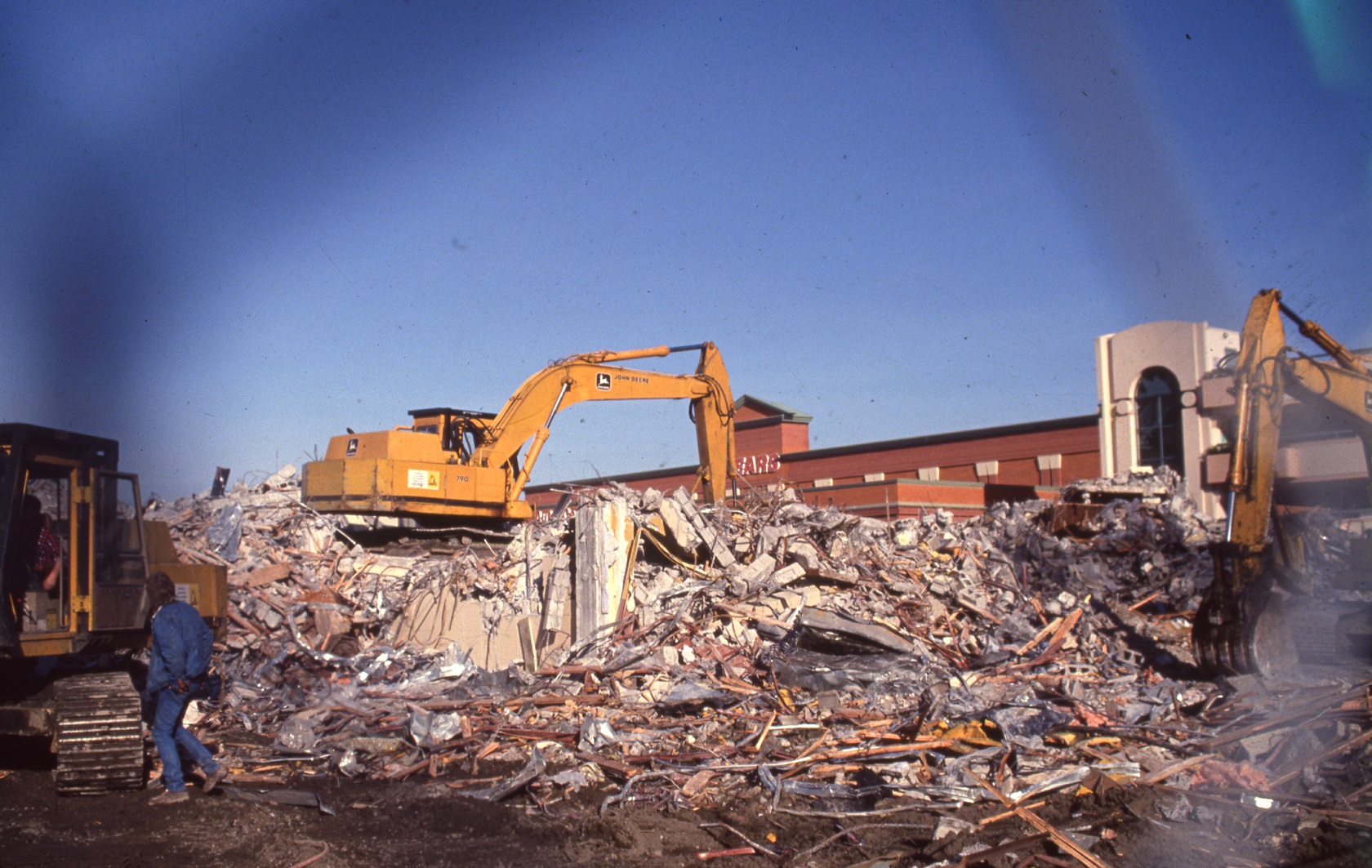
The demolition of the Richmond Square Theatres in 1990. City of Richmond Archives photograph 2008 39 4 591.

The Famous Players Richport Cinemas

Famous Players opened the Richport Cinemas on December 13,1985 at the Richport Centre at the intersection of No.3 Road and Ackroyd Road.

The Famous players Richport Cinemas in 1989. City of Richmond Archives photograph 2008 39 2 68.

The Cinemas had two screens, each seating 398 for a total of 796 seats. The feature attractions on opening night were “Rocky IV,” starring Sylvester Stallone and Talia Shire and “Spies Like Us” with Chevy Chase and Dan Aykroyd.

A December 10, 1985 Vancouver Province opening night advertisement for the Richport Cinemas.

Richport Cinemas were taken over by Cineplex Odeon following the opening of the Richmond Centre 6 by Famous Players. Due to competition from the SilverCity Riverport, the Richport was closed in 1999 and was renovated for use as retail space.

Famous Players Richmond Centre 6 Cinemas

Famous Players opened the Richmond Centre 6 Cinemas in the Richmond Centre Shopping Mall on November 23, 1990. Famous players President and CEO Ronald Emilio said, “We have created a completely new complex in the Richmond Centre to replace a triple screen theatre. The new complex will bring back a sense of occasion to moviegoing in Richmond.”

The Famous Players Richmond Centre 6 Cinemas marquee outside the west entrance of Richmond Centre Mall. City of Richmond Archives photograph, Accession 2009 16.

The entrance to the theatres was closest to the west entrance of Richmond Centre Mall. The lobby was designed to resemble a night time streetscape with marquees showing theatre names and movie titles. Each of the six screens at the theatre complex had an individual name, Century had 466 seats, Metro had 370, Rialto had 358, Majestic had 285, Olympia had 266 and Regent had 234 for a total of 1979 seats, including 28 wheelchair accessible ones. The theatres were equipped with large screens, Dolby SR sound systems, 70mm film capability and luxurious seating with plenty of legroom.

An opening night newspaper ad.

The feature films played on opening night were “Rocky V” starring Sylvester Stallone and Talia Shire, the Disney animated feature “Rescuers Down Under,” “Ghost” with Patrick Swayze, Demi Moore and Whoopi Goldberg, the World War Two bomber drama “Memphis Belle,” “Jacob’s Ladder” with Tim Robbins and “Three Men and a Little Lady” with Ted Danson, Tom Selleck and Steve Guttenburg. Cineplex Odeon took over operations of the Richmond Centre 6 in 2005 and the Famous Players Richmond Centre 6 Cinemas closed on March 27, 2011.
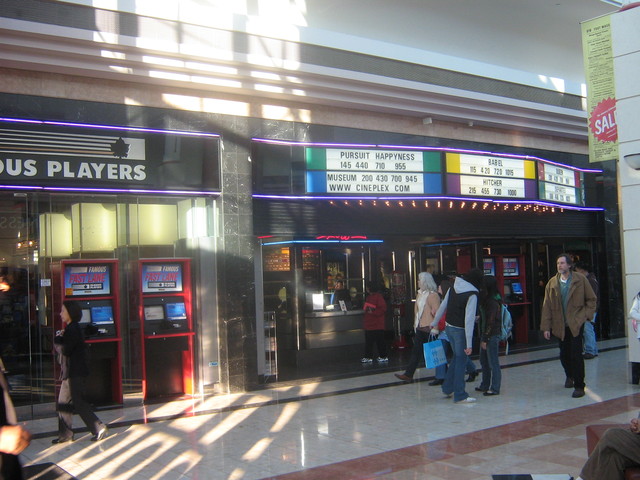
The Richmond Centre 6 Marquee inside the mall. Photo from Cinema Treasures website.https://cinematreasures.org/theaters/34887/photos/24666

Riverport SilverCity

The Famous Players Silvercity Riverport complex was built during a huge expansion of the company’s business, taking advantage of the latest advances in cinema and sound technology. The theatre was built at the massive Riverport Sports and Entertainment complex which included attractions like the Richmond Ice Centre, the Watermania Aquatic Centre, a bowling alley, brew pub, White Spot Restaurant, etc.

This image from the November 12, 1997 Richmond News shows the Silvercity Riverport still under construction.
An opening night ad from the December 17, 1997 Richmond News.

Famous Players Director of Public Relations, Dennis Kucherawy stated, “We’re building state-of-the-art theatres that will allow people to see motion pictures as they’re meant to be seen by directors, which is larger than life on a big screen with big sound.”

The $12.7-million, 7200 square metre, 12 screen complex opened on Wednesday December 17, 1997 with a special benefit night. Attendees were treated to the best movies of 1997 for a $2.00 admittance fee and half price food. All proceeds from the night were to benefit Ronald McDonald House. An additional six screens and an IMAX theater were opened on December 18, 1998 bringing the total number of theatres to 19 with seating for a total of 4,508, with the smallest theatre seating 168 and the largest 446.

Cineplex Odeon took over operations in 2005. The Cineplex Odeon Silvercity Riverport remains today as Richmond’s only remaining movie business, but offers more individual screens than all the its predecessors combined.
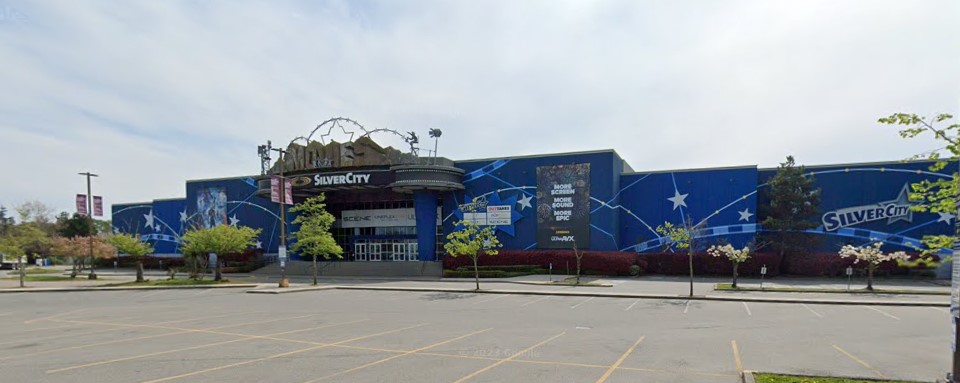
The Riverport Silvercity Cinemas, 2023. Google Maps photo.

Who knows what the future of the movie theatre will be? In spite of the easy availability of movies, streamed straight to big screen televisions in the comfort of your own home, the experience of going out to the movies with other people still remains popular. Theatres have evolved to entice modern audiences with comfortable seating, amazing sound systems and high definition projection. Concession sales make up a large portion of the profits earned by theatres today and while traditional theatre snacks like popcorn, soft drinks and candy are still there, wraps, sandwiches, hot dogs and nachos are now available, along with a side of fries or poutine. Other features like arcades, bowling alleys and even bars offer other activities for moviegoers. It seems like the days of going to the movies in Richmond will be with us into the foreseeable future.

Japan Town – Steveston in the 1930s

Richmond has a long and rich history of Japanese immigration and settlement. Various places around Richmond, Sea Island, Don Island and, in particular, Steveston were areas where Japanese immigrants lived, worked, raised families and contributed to the diverse cultural blend of our city.

Steveston looking west along Moncton Street from No.1 Road around 1940. The majority of the businesses along this street were operated by Japanese-Canadian entrepreneurs at the time. City of Richmond Archives photograph RCF 274.

Japanese immigrants (Nikkei) arrived in Steveston around the time that the English Cannery opened in 1882 and by the 1900s made up a large portion of the Steveston population. Mostly male and mostly fishermen, they were accommodated in bunkhouses built by the canneries. During the fishing season Japanese “Bosses,” who had control of twenty or thirty boats, would negotiate contracts with the canneries for them and take care of their needs such as food, clothing and other services in return for a percentage of their wages.

This image taken on November 22, 1936 shows members of the Japanese community gathered outside the Japanese Buddhist Mission on First Avenue to commemorate the ceremony of “Putting in the Buddha.” City of Richmond Archives photograph 1995 3 1.

Although the original intention of many of the men was to return to Japan after working in Canada, many decided to stay permanently. Some returned to Japan to find wives, others had their families back home arrange marriages with suitable women, the so-called “Picture Brides”. Bunkhouses were unsuitable for married couples, so canneries built small houses to accommodate families.

A group of Japanese girls pose for a picture in traditional May Day dress outside the Steveston Japanese School ca. 1926. City of Richmond Archives photograph 1978 1 36.

The Nikkei population grew, the men fishing and their wives working in the canneries and raising families. They diversified, expanding into boatbuilding, buying property, farming and starting businesses. People joined Faith communities, formed sports teams and created a rich community life.

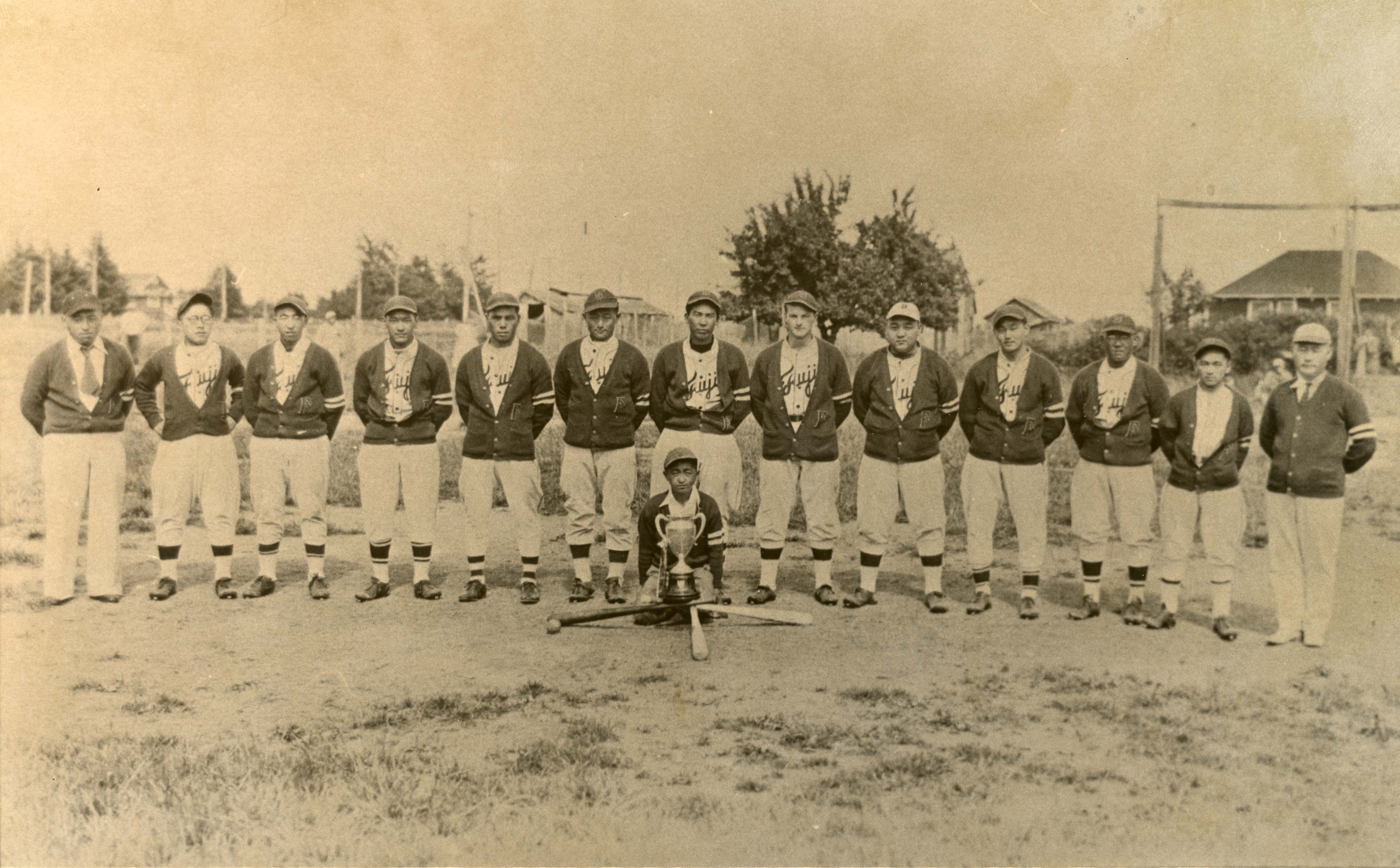
The Steveston Fuji baseball team played in the Vancouver Japanese League with the Asahi Giants, Powell Drugs and Union Fish teams. City of Richmond Archives photograph 1977 7 12.

Contending with discrimination and exclusion, The Japanese Fishermen’s Benevolent Society was formed in 1897 to protect the interests of the Nikkei fishermen and the community, A 1906 decision by the Richmond School Board to ban children of non-property owners effectively deprived most of the Nikkei children of an education and resulted in the construction of the Steveston Japanese School. To ensure that the health needs of the community were met, the Japanese Fishermen’s Hospital was built, Richmond’s first.

The Japanese Fishermen’s Hospital on No.1 Road in Steveston, ca. 1915. City of Richmond Archives photograph 2006 39 47.

By the 1930s the Japanese population had grown to account for two-thirds to three quarters of the total population of Steveston, approximately 3500 people. Nikkei owned businesses and stores of every description lined Moncton Street from No.1 Road to Third Avenue. Grocery stores, meat and fish markets, hardware and general stores, a bicycle shop, the River Garage, a billiard hall and clothing stores operated by Nikkei entrepreneurs could be found on both sides of the street. Five confectioneries (candy and chocolate shops) satisfied those with a craving for sweets.

The Mukai Confectionary stood at the corner of Moncton Street and No.1 Road and had a confectionary in the front, a pool hall in the back and ten bedrooms upstairs. It also housed a taxi business and had space used by a dentist who came to Steveston once a week. The building was lost in a fire sometime between 1942 and 1951 but the location is still known as Mukai Corner. City of Richmond Archives photograph RCF 272.

The density of the Japanese Canadian population in Steveston is very obvious when looking at the meticulous research done by Haruji (Harry) Mizuta who, using maps from the 1936 Waterworks Atlas of Richmond, marked the locations of Nikkei homes and businesses from the Scottish Canadian Cannery in what is now Garry Point Park to the Winch Cannery at the foot of No.2 Road. This is especially true with the map he marked as #30-2 1930s – Gulf of Georgia Cannery and Old Steveston Town – Steveston BC.

This map, created by Haruji (Harry) Mizuta illustrates the quantity of Nikkei homes and businesses, marked by blue and red dots, in Steveston during the Thirties. City of Richmond Archives Reference Files.

The growth of “Japan Town” came to a sudden halt with the forced relocation of Japanese Canadians from the Coast of British Columbia. Families were uprooted, stripped of their property and moved to areas where they had to start over and rebuild their lives, often in harsh circumstances. Steveston became a virtual ghost town with so many of its residents suddenly gone. In 1949 when Nikkei families were permitted to come back to the coast, those who decided to return rebuilt their lives and community again. Today the legacy of Japan Town is a cherished and honoured part of Steveston’s and Richmond’s history.

Haruji (Harry) Mizuta’s research shows some of the businesses and business owners along Moncton Street during the 1930s. City of Richmond Archives Reference files.

Keeping an Industry Afloat – Thomas Goulding’s Cork Mill

Anyone who has lived along the water in areas where the fishing industry operates is familiar with fish net floats. Picked up on beaches while beachcombing, strung on ropes to make ornamental fencing or to decorate the verandas of beach cabins, floats are an instantly recognizable symbol of life on the beach.

A man hauls in a gillnet fitted with cedar corks in this image ca. 1960. City of Richmond Archives photograph 1985 4 134.

Plastic floats have taken over the market since the 1950s, but before then fishing floats were almost exclusively made of cork or wood. The wooden ones were known as “cedar corks” and the only commercial supplier of them on the West Coast was Thomas Goulding who produced them in his Cork Mill at the Acme Cannery on Sea Island.

Surrounded by cannery housing, these three canneries dominated the south-west shore of Sea Island. At the bottom is the Fraser River Cannery, in the middle is the Vancouver Cannery and at top is the Acme Cannery where the Cork Mill was located. City of Richmond Archives photograph 1985 166 10.

The Acme Cannery was built in 1899, part of the boom in cannery construction during the late 19th and early 20th centuries to take advantage of the seemingly unlimited supply of salmon available in the Fraser River. In 1902 it was absorbed into the British Columbia Packers amalgamation. In 1918 it closed, but the buildings, net racks and moorage were maintained for the community of fishermen, mostly Japanese, who lived around it. In a small building on the west side of the cannery Mr. Goulding set up the cork mill. The building and all the equipment for the mill, the saws, the lathes, the reamer, the stringer and the tar vat were all hand-built by him with help from his Japanese neighbours.

Framed in red in this image, the cork mill is the small building visible next to the white wall of the Acme Cannery. Next to it are the net racks where the bundles of corks were hung to dry. Image cropped from City of Richmond Archives photograph 1985 166 10.

Work at the Cork Mill was seasonal. It sat idle during the fishing and canning season, operating only during the winter and spring. Western red cedar logs were supplied by coastal fishermen, found floating free or onshore in the Gulf of Georgia or possibly “liberated” from booms. The logs were cut into “cork bolts,” about four inches by four inches by four feet long.

Making the corks was fairly straightforward. The cork bolts were cut into blocks of either six or eight inches. A hole was bored through the centre of the cork which was smoothed and chamfered to prevent damaging the fishing net’s rope. The corks were then turned into their oval shapes on the mill’s lathes. A good day’s work could produce 2000 corks, ready for the next step in their production.

This map from the 1936 Waterworks Atlas shows the layout of buildings around the Acme Cannery. City of Richmond Archives image

Tom Goulding’s granddaughter, Doreen Montgomery Braverman, worked at her grandfather’s cork mill occasionally after school and described her part in the process. “The next step was to thread them onto twine in lots of ten. That was the job they sometimes let me do. A reef knot tied the twine together so the floats could be dipped into a vat of hot tar to preserve them. They dried on net racks next to the vat.”

Completed cedar corks were likely shipped out by boat, there being no road access to the mill. Distribution of the product was carried out by the various fishing companies, BC Packers, Nelson Brothers, J.H. Todd, Canadian Fishing Company, etc. The users of the corks were gillnet fishermen who would attach the floats to their nets using a crochet stitch. This was another job which could be done by young people, earning $15 per net, a job that could take several days.

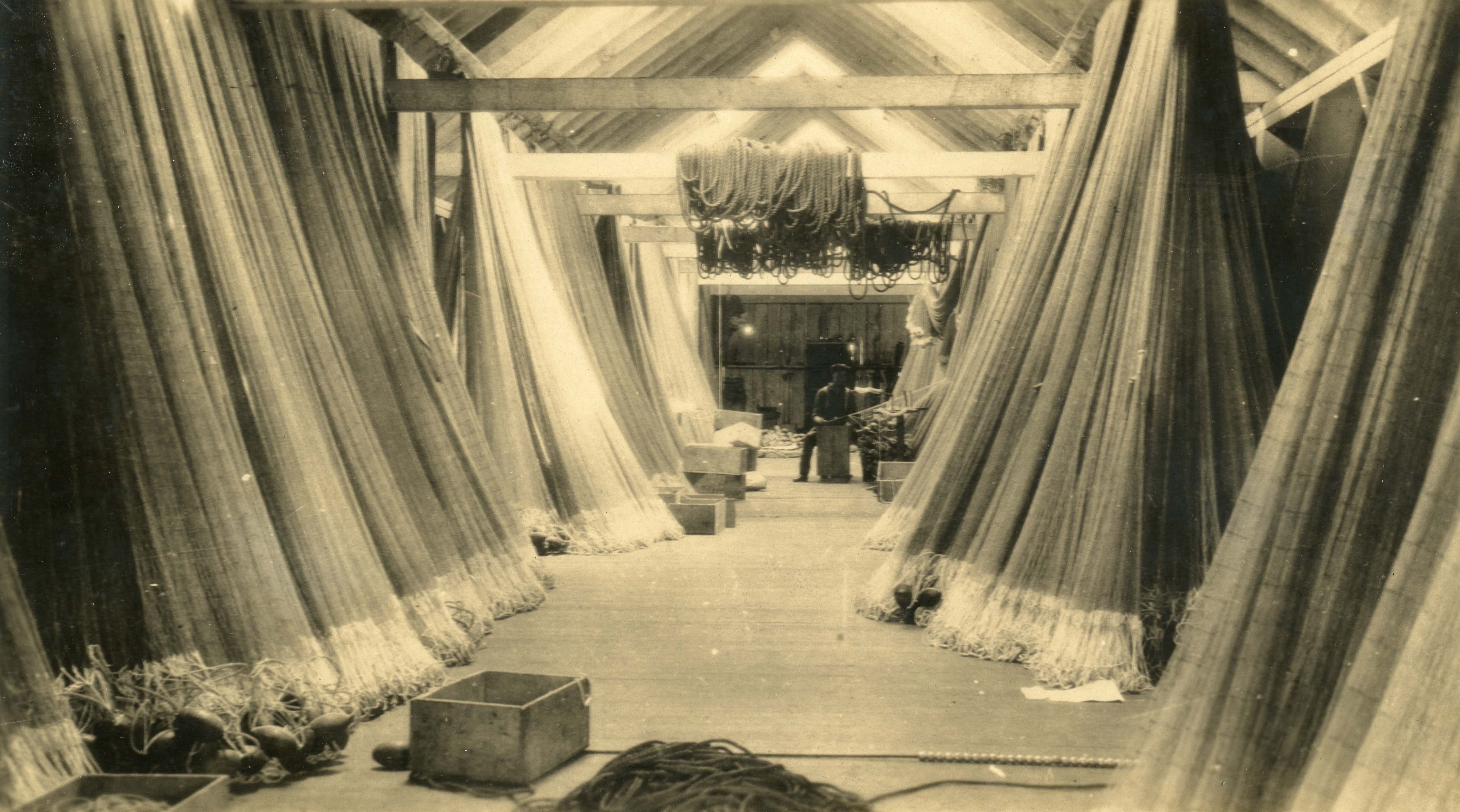
Nets hung in a net loft are fitted with cedar corks in preparation for the upcoming fishing season in this image, ca. 1930. City of Richmond Archives photograph 1985 4 124.

Running the mill required a number of workers. Fishermen, both Japanese and European, found and delivered cork bolts. The mill itself had a core group of workers. Gordy Bicknell was second in command at the mill. Alice Gillespie, Francie Edwards, family members, neighbours and friends rounded out the workforce. When the Japanese families were forcibly removed from the West Coast in 1942, the loss of the work provided by those neighbours caused difficulty in supplying cork bolts for the mill, but work continued.

By the 1950s the use of plastic foam corks was cutting into demand for the ones produced at the mill. Around 1954 an expansion of the Vancouver Airport resulted in a runway extension into south-west Sea Island signaling the doom of the small community and industries there. The land was expropriated by Crown Assets, houses were torn down or moved and the canneries were razed, along with the cork mill. The only evidence of their existence that remains are old pilings that once supported the canneries.

A salmon gillnet is supported by a net rack on a Steveston dock, its corkline fitted with modern plastic foam corks. City of Richmond Archives photograph 1985 4 2436.

See also https://richmondarchives.ca/2015/01/06/japanese-canadians-on-sea-island/

Carhops and Nineteen-Cent Burgers: Richmond Cruises the Drive-in

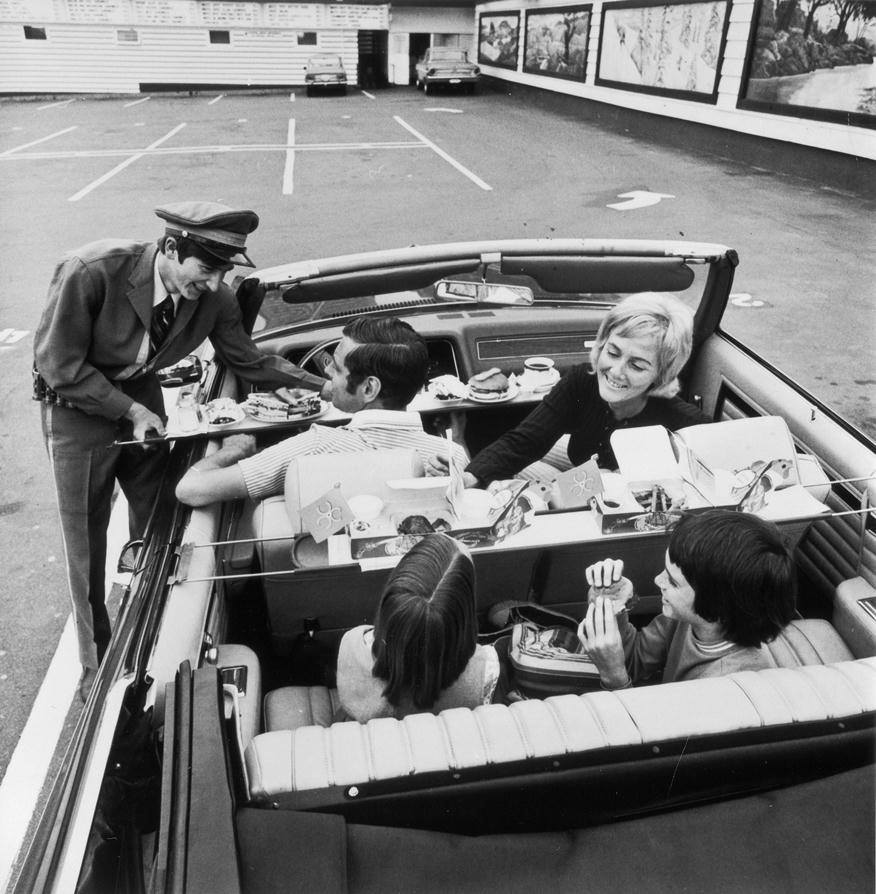
An iconic symbol of youth and car culture during the ’50s, ’60s and ’70s was the drive-in restaurant. Popularized during a thriving post-war economy, the baby boom and the rapid growth of car ownership, drive-ins typically featured large parking areas and little or no indoor seating. Menus, visible from your car, displayed inexpensive meals which included burgers, chicken and fries. In contrast to the modern “drive-thru” concept, many drive-ins were self serve, where you walked to a window, ordered and picked up your food and took it back to your car. Others provided car service, your order taken and food delivered to your car by staff known as “carhops” who would attach a tray to your window with your meal on it. “Lights On For Service!”

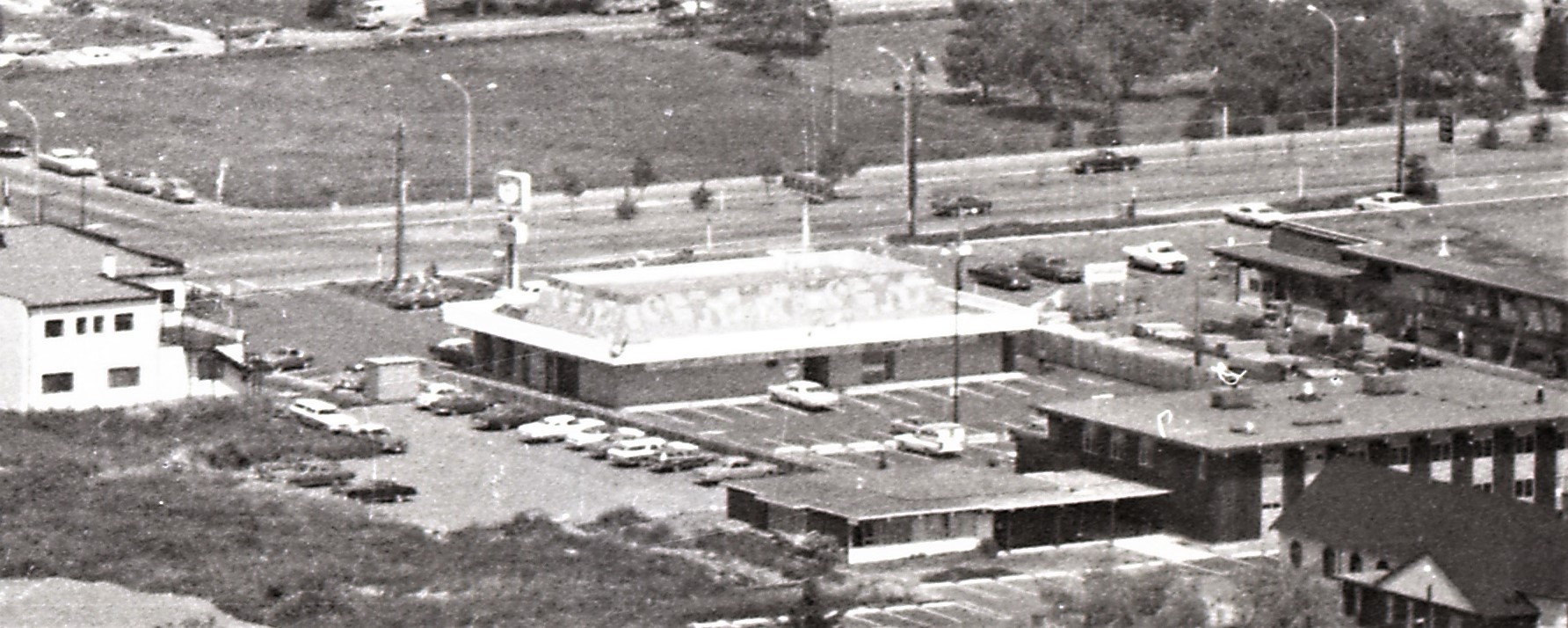
The first McDonald’s outside the United States was this one on No.3 Road in Richmond. A great example of fast food architecture, this standardized McDonald’s design featured an eye-catching “Golden Arches” sign at the entrance and a distinctly shaped yellow, red and white building with an angled roof supported by two arches. The building design is carried over to the logo on the sign with its two arches and angled line across them, replicating the building when viewed at an angle from the street. City of Richmond Archives photograph 1987 61 3.

The first known drive-in, Kirby’s Pig Stand, was built in Dallas, Texas in 1921 and was described by critics as for people who were “too lazy to get out of their car and enter the restaurant.” In British Columbia, the first White Spot drive-in opened in Marpole in 1928, a brand which pioneered the use of carhops and window trays. Drive in architecture often featured round or polygonal buildings which allowed vehicles to park around the building giving easy access to cars. Some buildings would include eye-catching features or rooflines and large colourful signs to entice customers into their lots. Kitchens were usually laid out in an efficient manner allowing quick production of meals and were sometimes visible from inside or outside the restaurant. Drive-ins could be single small businesses or larger regional chains with multiple locations. Some evolved into huge national and international brands which are still around today.

The Seabright

Richmond’s first drive-in style restaurant/snack bar was the Seabright. It was built and run by the Doherty family, owners of the Seabright Dairy on Sea Island and was positioned to give customers a good view of aircraft landing and leaving from the new Vancouver Airport, a popular attraction in the 1930s. The building was about 40 feet by 24 feet in size and an eight-foot wide veranda gave customers some covered space. Soft drinks, homemade ice cream and milkshakes, tea, coffee and sandwiches were offered for sale at the building on Buckingham Road and plenty of parking was available in the 240 by 70 foot parking lot.

The Seabright is shown here ca. 1936. City of Richmond Archives photograph 2000 3.

The Garden City Drive-In

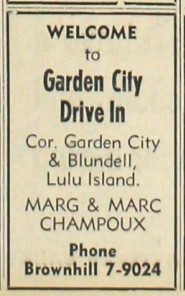
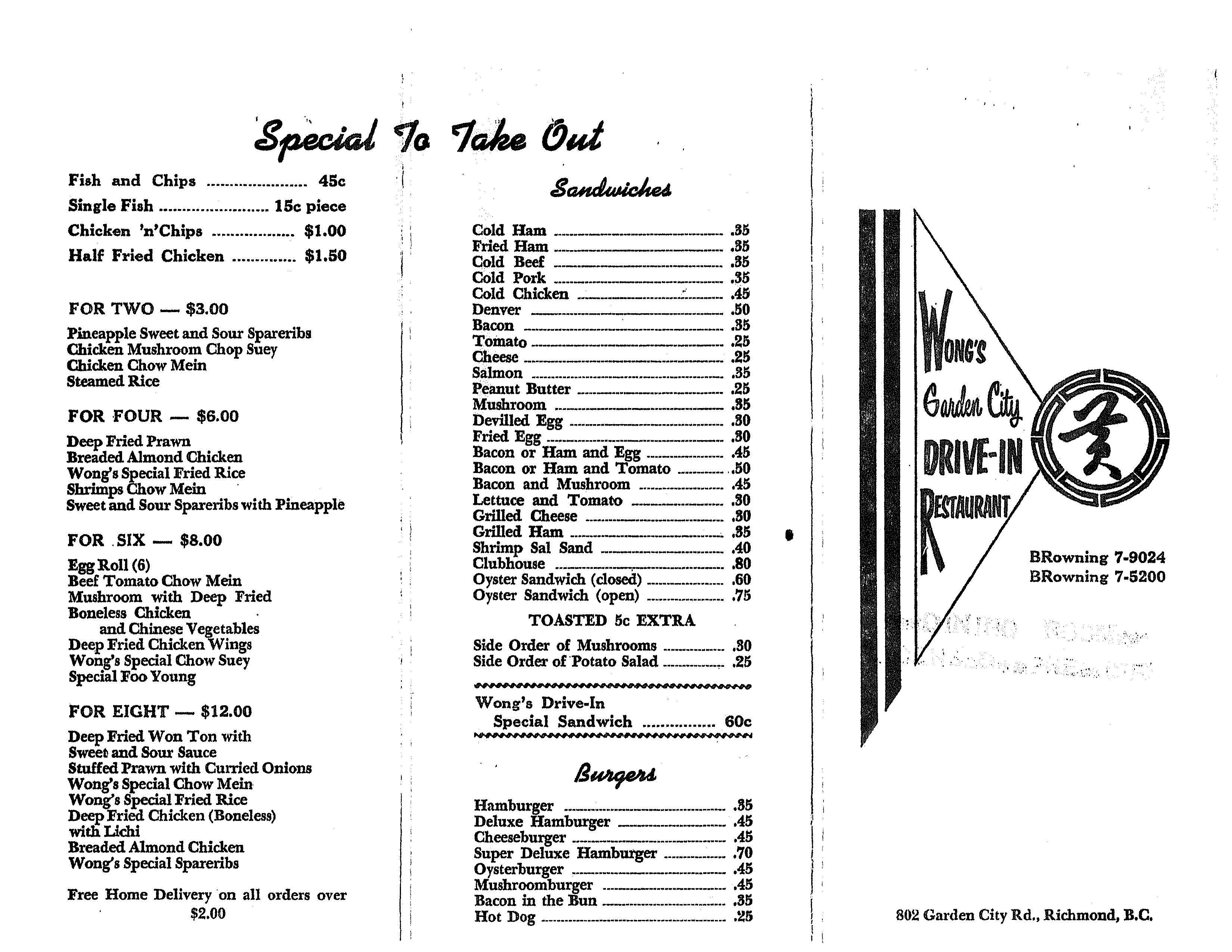
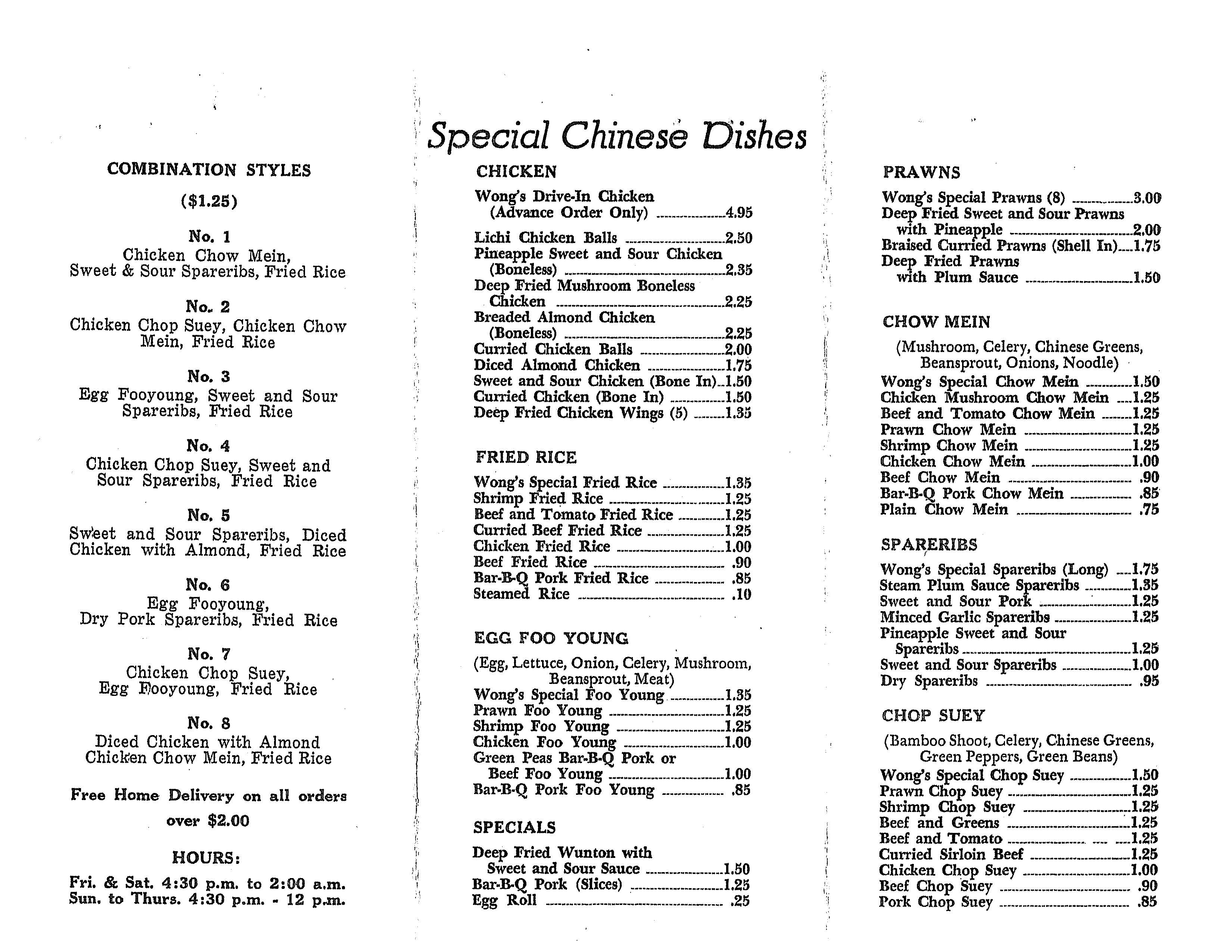
Around 1954 a restaurant opened at 802 Garden City Road (8020 today), near the intersection with Blundell Road. The Garden City Drive-In was owned by Marg and Marc Champoux and offered dining room or car service. By 1960 it had become Wong’s Garden City Drive-In, offering a selection of Chinese and Western dishes with dining room, car service or free delivery.

A Richmond Review ad for the Garden City Drive-In from January 15, 1958.
Richmond Review ad for Wong’s Garden City Drive-In from 1960.

Sometime during the 1960s the drive-in was renamed the Richmond Drive-In, a name it had until about 1973 when it became Wah Do Restaurant.

The Garden City Drive-In can be seen in the centre of this photo beside the garage on the corner of Garden City and Blundell Roads. Cropped from City of Richmond Archives photograph 1978 37 11.
A menu from Wong’s Garden City Drive-In. City of Richmond Archives Accession 2019 49.

Around 1975 the restaurant was closed and demolished to make way for construction of the Garden City Shopping Centre.

The Dairy Queen

On September 5, 1958, Ray Van Humbeck opened his new Dairy Queen ice cream business at 633 No.3 Road (6331 today), a standard drive-in design with a large parking lot and free standing sign featuring an ice cream cone to attract customers. He offered a free sundae, milk shake or malt with every one purchased at regular price on opening day. Dairy Queen products were “favourites for people like you in 2500 cities throughout Canada, the Commonwealth and the United States. They enjoy it as a treat for taste – a food for health!”, stated his ad in the Richmond Review.

Ray Van Humbeck’s Dairy Queen is shown in the centre of this image with a car entering from No.3 Road. Cropped from City of Richmond Archives photograph 1984 17 58.
Grand Opening advertisement from the Richmond Review, 1958.

Ray Van Humbeck was a local businessman who believed in giving back to his community. He supported many community initiatives, including sporting events and sponsored a softball team for many years.

The 1969 Dairy Queen softball team. City of Richmond Archives photograph 2017 45 5.

Starting out as a business selling soft frozen dairy products in Joliet, Illinois in 1940, the Dairy Queen brand grew and spread; the first Canadian store opening in Estevan Saskatchewan in 1953. The product line evolved and expanded from sundaes, shakes, malts and banana splits to include such favourites as the “Dilly Bar,” “Buster Bar,” the “Scrumpdillyishus Peanut Buster Parfait” and the “Blizzard.” The franchise’s menu made a significant change when hot “Brazier Foods” became available, cooked in the trademark “Sizzle Kitchen.” Mr. Van Humbeck’s No.3 Road Dairy Queen changed along with the times, receiving new signage and a raised red roof along the way.

Taken in 1971, this photograph shows the Dairy Queen building after being modified and equipped with equipment for the serving of hot “Brazier” foods. City of Richmond Archives photograph 1983 7 9.

Around 1974, Ray Van Humbeck closed the business on No.3 Road and relocated to the Anderson Square Shopping Centre, occupying three units where Anderson Road met Buswell Road. The business became a fixture there until it closed in 2016. Today there are three Dairy Queen stores in Richmond, one at No.3 Road and Francis Road, which was relocated from the Buswell and Anderson location, one at the Minato Village at Steveston Highway and No.1 Road and one located in the food fair in Richmond Centre Mall, not far from the location where Mr. Van Humbeck opened the first one in 1958.

Chipper’s Drive-In

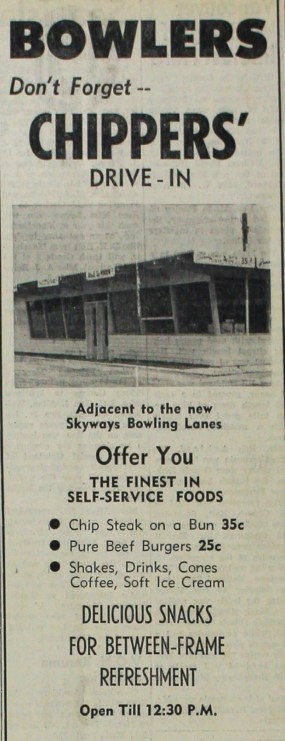
In January 1957 an application was made for the sub-division and rezoning of a property on No.3 Road to allow the construction of a meat packing plant for the B.C. Chip Steak Co. Ltd. and a drive-in restaurant. The application was approved and the plant and drive-in, known as Chipper’s, opened at 331 (3311 today) No.3 Road in July 1958.

Chippers’ announced their opening in this July 30, 1958 ad in the Richmond Review.

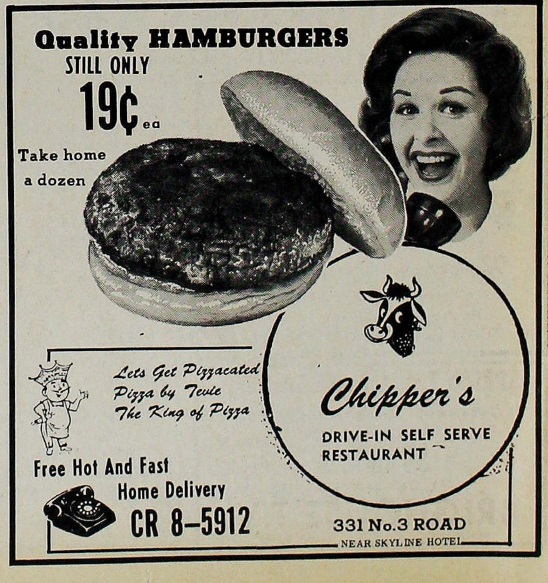
Chipper’s was the first “American Graffiti” style drive-in in Richmond. It was very popular meeting place with the young crowd, frequented by hot rodders and drag racers and was the terminus/turn around point for people cruising the No.3 Road strip. Chipper’s advertised a variety of food, from chipped steak on a bun and beef burgers (Made in our own factory from government inspected beef), all you can eat waffles for seventy-five cents (the ones they had in mind when they invented syrup), nineteen cent burgers (Take home a dozen!) and pizza by Tevie (The King of Pizza). Owner/operator Tevie Smith promoted his business actively, using advertising space in the Richmond Review frequently and by sponsoring bowling teams at the Skyway Lanes next door while offering ice cream and burgers as prizes.

Chipper’s took advantage of its proximity to the Skyway Lanes bowling alley, building business by associating themselves with the sport. Richmond Review ad 1965.
Chipper’s was a self-service drive-in but also offered fast home delivery. Richmond Review 1965.
Chipper’s ads usually pointed out that the drive-in was close to the Skyline Hotel, Richmond Review 1965.

Not all of the advertising for Chipper’s was good. In April of 1962 reports of bad behavior and hooliganism by unruly customers were common and led to the Municipal Licensing Committee and the RCMP meeting with one of the owners of the restaurant regarding disturbances at the drive-in. The owner promised the Committee that he would clear up the problem immediately and the Committee in turn promised that they would “keep in close touch with the situation.”

This 1970 aerial view shows the location of Chipper’s in relation to No.3 Road, the Skyway Lanes Bowling Alley and the BC Chip Steak Co. meat packing plant. Immediately to the left of the restaurant is a tire shop. Cropped from City of Richmond Archives photograph 1983 6 90.

The warnings must have had an effect because the drive-in remained in business until the early 1970s and remains a nostalgic memory in the minds of folks who were young during that era.

Kings Burgers

An article in the January 25,1962 Richmond Review announced “Two new drive-ins to be built here”. One of the new facilities was Kings Burgers to be built on Westminster Highway near the intersection with No.3 Road. Kings Drive-In Ltd. was a successful Lower Mainland chain that opened six locations around Vancouver, North Vancouver, Burnaby, Surrey and Richmond. The property that the Richmond location was built on first had to be rezoned from agricultural district to general commercial, with a special use permit as drive-ins were not included in that category.

A car enters the parking lot of Kings Burgers from Westminster Highway in this aerial photograph from 1964. The building was typical of drive-ins of the period. Just above Kings is the Super Valu store which faces on to No.3 Road. Cropped from City of Richmond Archives photograph 1984 17 61.

Like Chipper’s, Kings Burgers became a well loved and popular drive-in, especially with younger people. Driving by the restaurant gave a view of hot rods, sport cars and modified vehicles, hoods up in the parking lot. No doubt many strips of rubber marked the exit from the drive-in’s parking area.

A menu for Kings Burgers, printed in the Richmond Review.

Kings’ menu was also typical of drive-ins of the period. Burgers, fries, fish and chips with an apple turnover for dessert pretty much covered it. The restaurant’s “Kingburger”, prepared in advance and kept in a heated drawer, was its most popular item at 19 cents each.

Kings Burgers in December 1976 as renovations begin. City of Richmond Archives photograph 2021 29 32.

Kings did not escape the stigma of having young people as a large part of its customer base. In June 1966 the Richmond Review reported “HOODLUM VICTIMS PROTEST,” detailing complaints from the Royal Canadian Legion, located across the street from the drive-in, about willful damage caused by the “young element”. The Legion claimed that groups gathering outside the restaurant would move across to the Legion and break into cars and destroy property. “They have no regard for private property,” the Legion protested. The Municipality’s Licensing Committee agreed to seek the cooperation of the drive-in’s management to combat the problem.

Kings Burgers in April 1977 after renovations. City of Richmond Archives photograph 2021 29 33.

From late 1976 to early 1977 the Kings underwent renovations and began to look less like a drive-in and more like a regular restaurant. Around 1981 the name was changed to “Big B” Burgers and later around 1986 it became Umbertino’s Pasta Palace. In 1987 the location is listed as “Vacant” in the street directory.

The A&W

The other restaurant mentioned in the January 25, 1962 Richmond Review was an A&W drive-in, to be built on the west side of No.3 Road just south of Capstan Way. The A&W did not have an easy start in Richmond. The first hurdle encountered were delays in rezoning the property where it was to be built. Although announced in January, by April rezoning was still being squabbled about by the Municipal Planning Committee with some wanting to delay for another year. Representatives for the A&W were upset, saying that they had been all but guaranteed of the rezoning eight months earlier. The delay was partly in response to a public outcry over perceived problems arising from the project. Under a headline which read “Rootbeering teens bring angry protest,” an article in the Richmond Review said that Council had been petitioned by an angry group of homeowners who claimed that allowing another drive-in to open in their neighbourhood would affect property values, add to litter problems, attract undesirable types of teenagers and keep residents awake at night. Most of these problems already exist to some extent because of the existing drive-in (Chippers). “It’s not an environment that I want for my boys”, said one protester. “Young hot rodders and young fellows and girls acting in an unbecoming manner. We see enough of this already”. Despite protests and zoning application issues the restaurant opened at its location at 359 No.3 Road (3591 today) and became another popular location for youth and car enthusiasts. The drive-in provided full carhop service, occasionally with the servers on roller skates, delivering food on the iconic window trays with tall, frosty mugs of root beer.

Carhop Linda Billwiller, carries trays of root beer to a customer at the No.3 Road A&W, ca. 1969. Photo from Facebook post, link here.

Like many large drive-in chains, A&W got its start in the United States in 1919 when Roy W. Allen set up a stand selling root beer at a parade in Lodi, California. In 1923 he and his partner Frank Wright opened the first A&W restaurant in Sacramento. A&W grew their business, selling franchises throughout the United States and expanded into Canada in 1956. By 1960 there were 2000 A&Ws in operation. In 1972 the Canadian side of the business split from the American chain and became its own corporate entity. The No.3 Road A&W Drive-in closed around 1982 but today there are nine A&W outlets in Richmond.

Ernie’s Take Home – Kentucky Fried Chicken

Harland David Sanders began selling chicken dishes from a restaurant in Kentucky during the Great Depression. By 1940 he had developed his patented “secret recipe” for cooking chicken in a pressure fryer, allowing faster cooking than regular frying. In 1952 Sanders, by now a “Kentucky Colonel” commissioned by the Governor of Kentucky, began offering franchises for his “Kentucky Fried Chicken”. In the 1950s Nat Bailey was offered the British Columbia franchise for Kentucky Fried Chicken. While he was worried that the brand might compete with his White Spot chain, which also offered chicken dishes on the menu, his partners convinced him that the product was different enough to not cause any issues. Bailey and his partners formed a separate company called Ernie’s Fine Foods which was named after Ernie M. Creamer, Bailey’s friend and partner who was to head the new enterprise. Six stores were opened in Vancouver, Victoria, New Westminster, North Vancouver, Penticton and Richmond under the name Ernie’s Take Home. The Richmond store opened in a unit at the Hyland Park Shopping Centre at 632 (6320 today) No.3 Road.

This ad from a 1965 Richmond Review invites customers to pick up a bucket or two of Colonel Sanders’ “Finger-Licken’ Good” chicken from Ernie’s Take Home at the Hyland Park location.

Colonel Sanders came to Vancouver to meet his new business partners after they had opened three of their franchises. He was described as a “real southern gentleman”, wearing his trademarked white suit, string tie, goatee and cane and kissing all the ladies’ hands. Unlike other Kentucky Fried Chicken franchises, Bailey and his partners served their own style of potato salad, macaroni salad, coleslaw and biscuits, apparently with the Colonel’s approval.

Nat Bailey sold his restaurant businesses to General Foods in 1968, including the company’s six Ernie’s Take Home locations. By the early 1970s they had closed the Hyland Park location, reopening in a red and white striped drive-in style restaurant at 810 (8100 today) Anderson Road, on a lot that spanned the area between Anderson Road and Granville Avenue. In 1984 the restaurant had changed its address to 8111 Granville Avenue, rebranded as Kentucky Fried Chicken, without the Ernie’s Take Home name, and had installed the iconic bucket of chicken signpost to attract customers driving down busy Granville Avenue. A second location at the Seafair Shopping Centre opened the same year. Today there are four KFC outlets in Richmond.

McDonald’s

In 1960 Ray Kroc took over a restaurant run by the McDonald Brothers in Sacramento California and the rest is history. Over the next five years Kroc transformed the business, opening hundreds of locations featuring unique architecture and high efficiency kitchens serving inexpensive meals, and turning McDonald’s into a public company listed on the New York Stock Exchange. In 1967 Kroc took his business outside of the United States for the first time, opening a restaurant at 712 (7120 today) No.3 Road in Richmond on June 1. George Tidball was in charge of the Canadian inaugural operation, and Richmond was chosen because, according to Kroc, it was a community of many young adults in the middle income bracket. The chain was distinguished by its 18 cent hamburger, ” formula boneless chuck and plate beef, 10 hamburgers to the pound,” and a “Triple thick” 25 cent milkshake.

The McDonald’s Drive-In on No.3 Road on July 21, 1974. City of Richmond Archives photograph 2021 29 4.

McDonald’s was notable, not only for its unique architecture and cheap meals, but also for its lack of some other things. There were no juke boxes or cigarette machines, “They don’t enhance the image we want,” said Kroc. Also, there were no telephone booths or female employees, “Girls and telephones are distractions.” Ray Kroc explained, “We are not interested in motorcyclists, hot rodders or rock and rollers unless they come on our terms. We run a clean place that welcomes families, boy scouts, church and civic groups.”

Ad from Richmond Review July 2, 1967.

George Tidball stated that the Richmond restaurant provided fulltime employment for 36 young people, adding that one out of every five applicants passed the rigid requirements for the job, a much higher amount than in the United States: “Richmond seems to have a greater number of neat-appearing, responsible, clean-cut type of youth.”

Ray Kroc, behind the counter of the Richmond McDonald’s, serves a meal to his wife during their visit. Photograph from the July 26,1967 Richmond Review.

Ray Kroc made a whirlwind trip to the Richmond McDonald’s the month after it was opened, staying for about a half hour to look over the operation, speak to the press and have a photo-op. Then he was gone, planning the opening of other restaurants around Canada.

The original McDonald’s, ready to be torn down, stands beside its replacement in this image from March 2, 1975. The Golden Arches remained there and are still there today in front of the third restaurant to occupy the site. City of Richmond Archives photograph 2021 29 8.

In 1975 the original drive-in was replaced by a larger, more modern building with room for indoor seating, a play area, and eventually, a drive-thru window ending its state as a drive-in. The restaurant has since been replaced by a third building on the property but the original 1967 Golden Arches are still there attracting drivers into the the place. Today there are seven McDonald’s locations in Richmond, but only one can claim to be the location of the first outside the United States. There are still no cigarette machines or juke boxes, but everyone has a telephone in their pocket and women are allowed to work there now.

The second McDonald’s on No.3 Road, ca. 1975. City of Richmond Archives photograph 1987 61 1.

White Spot

Nat Bailey got his start selling hot dogs and ice cream from a converted Model T Ford truck in Stanley Park, probably Vancouver’s first food truck. He opened the first White Spot Restaurant in Marpole in 1928, a place which was probably the first drive-in restaurant in Canada. Bailey and his partner Bob Stout are also credited with developing the world’s first drive-in food tray, originally a white-painted cedar plank which was placed across the space between the driver’s and passenger windows, modernized later using plastic and steel. White Spot was also probably the first drive-in to employ carhops to serve customers in their cars.

The trays used by carhops at White Spot were an early innovation in the history of drive-in restaurants. Photograph from White Spot Facebook page, link here.

Bailey retired from the restaurant business in 1968 after building and expanding the chain into one of the best-loved restaurant/drive-in chains in BC. When he retired he sold the business, which included 13 White Spot Drive-In/Dining Room Restaurants, six Kentucky Fried Chicken franchises and other assets such as BC’s largest chicken farm, to General Foods. General Foods was based in New York State with a Canadian office in Toronto. The company immediately started to expand the business building new restaurants. Around 1975 they built Richmond’s last true drive-in at 814 Granville Avenue.

The White Spot on Granville Avenue, across the road from the end of Buswell Street, ca. 1975. Cropped from City of Richmond Archives photograph 1987 23 313.

The restaurant offered both dining room and carhop service, with all the favourite White Spot menu items available. Around 1999 the Granville Avenue restaurant closed, replaced by other non-drive-in locations around town. Today there are three White Spot Restaurants in Richmond with an additional two Triple O’s franchise locations.

A view down Granville Avenue, ca.1995, shows signs for two drive-ins, Kentucky Fried Chicken on the left and White Spot farther down on the right. City of Richmond Archives photograph 2008 39 7 248.

By the 1970s drive-ins were being replaced by drive-thru restaurants which didn’t require as much parking space and, as carhops became obsolete, could be run by fewer employees. There are a few old style drive-ins remaining, but they have become a thing of the past for the most part.

Peace Together – Ling Lam and the Hong Wo Store (同和)

Ling Lam 林德調 (City of Richmond Archives accession 2013 52.)

In 1890, a 17 year old boy arrived in Vancouver from China on the ship SS Abyssinia. In Vancouver, Chung Ling Lam* 林德調 studied English at the Chinese Methodist Church and worked in the canneries in Steveston. He started out in business by teaching himself how to bake bread and peddled buns door-to-door around Steveston. In 1895 he bought property and opened a store which became one of those places that embeds itself into a community’s collective memory.

Translating as “Peace Together” or “Living in Harmony”, this sign (to be read from right to left) was located on the wall inside the Hong Wo Store (同和) and is now one of four signs from the store in the Richmond Museum’s collection. (City of Richmond Collection 006.23.20)

Ling Lam named his business Hong Wo, meaning “Peace Together” or “Living in Harmony”. Located outside the dyke near the foot of Trites Road and near the Nelson Brothers Cannery, the place was a true General Store. If you couldn’t get what you needed at the Hong Wo Store, you probably couldn’t get it anywhere. The building was located adjacent to a wharf where fishboats could tie up and get supplies before the next fisheries opening. To streamline the process an order form was developed and issued to the fisherman who could check off the items they needed and the order would be ready for pickup at the specified time. He sold provisions to fishermen, canneries, boatbuilders, farmers and the general public.

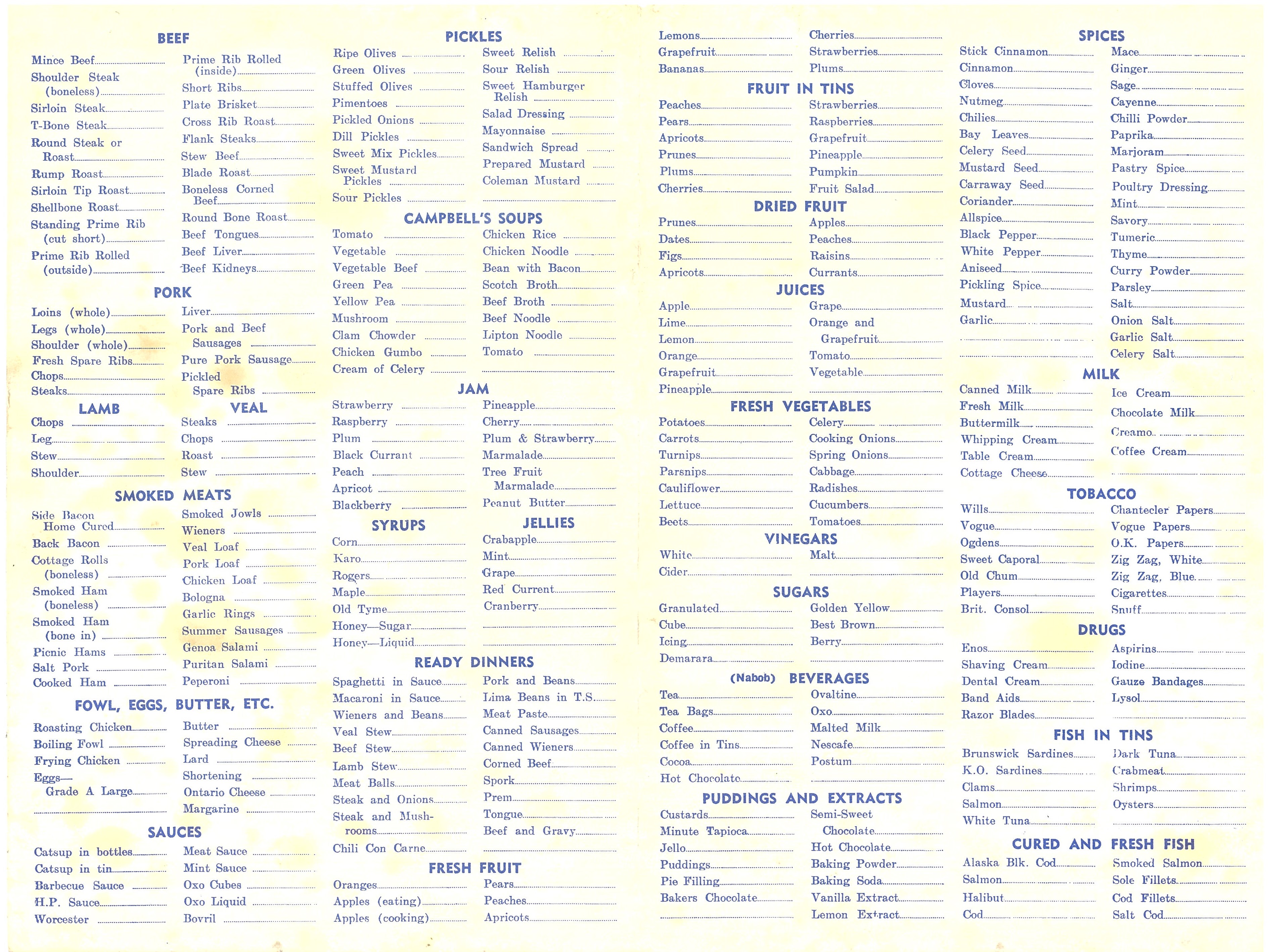
Filling out this order form would ensure that your order would be ready and waiting for you to pick up at the wharf behind the Hong Wo Store. (City of Richmond Archives accession 2013 46.)

The lot that Mr. Lam had built his store on was approximately 235 feet wide by 425 feet long (2.27 acres), and extended over the dyke to the high water line. Mr. Lam also acquired acreage north of that lot which was bordered on the north side by the CN Railway right-of-way and on the east by Trites Road (1.3 acres). Open fields to the north of the railway line (11.03 acres) became his farmlands, another arm of his business.

Property owned by the Hong Wo Company is outlined in red in this image cut from the 1936 Waterworks Atlas. Buildings are identified in the image including the pickle factory, greenhouses, bunkhouses and the store at the lower left. City of Richmond Archives image 1991 40 23 – Waterworks Atlas.
Nestled between cannery buildings, the Hong Wo property can be seen near the centre of this image from 1952. The roofs of Mr. Lam’s greenhouses can be seen near the CN Rail line and the pickle factory near Trites Road. Hong Wo and Company farmland is above the rail line. (City of Richmond Archives photograph 1997 16 92.)

Once Ling Lam had his retail and farming businesses running, he returned to China to get married. His wife, Chew Shee Lam 趙氏, arrived in Canada in 1899 and they lived in an apartment above the store. Around 1908 the store was destroyed by fire and the family moved into a cannery house until the new store was built. The Lam children walked three miles along the dyke into Steveston to go to school. With the business and farm prospering, Mr. Lam moved the family into a house in East Vancouver around 1914.

The Lam Family home in East Vancouver with the family standing on the front porch, ca. 1914. (City of Richmond Archives photograph 1986 17 1.)

To order stock for the store in the early days, Mr. Lam would ride a bike to New Westminster to his supplier’s offices. The order for the season would be delivered by boat to the wharf and shed behind the store. The bicycle was eventually retired when a telephone was hooked up in the store, one of the first in Richmond, and orders could be phoned in.

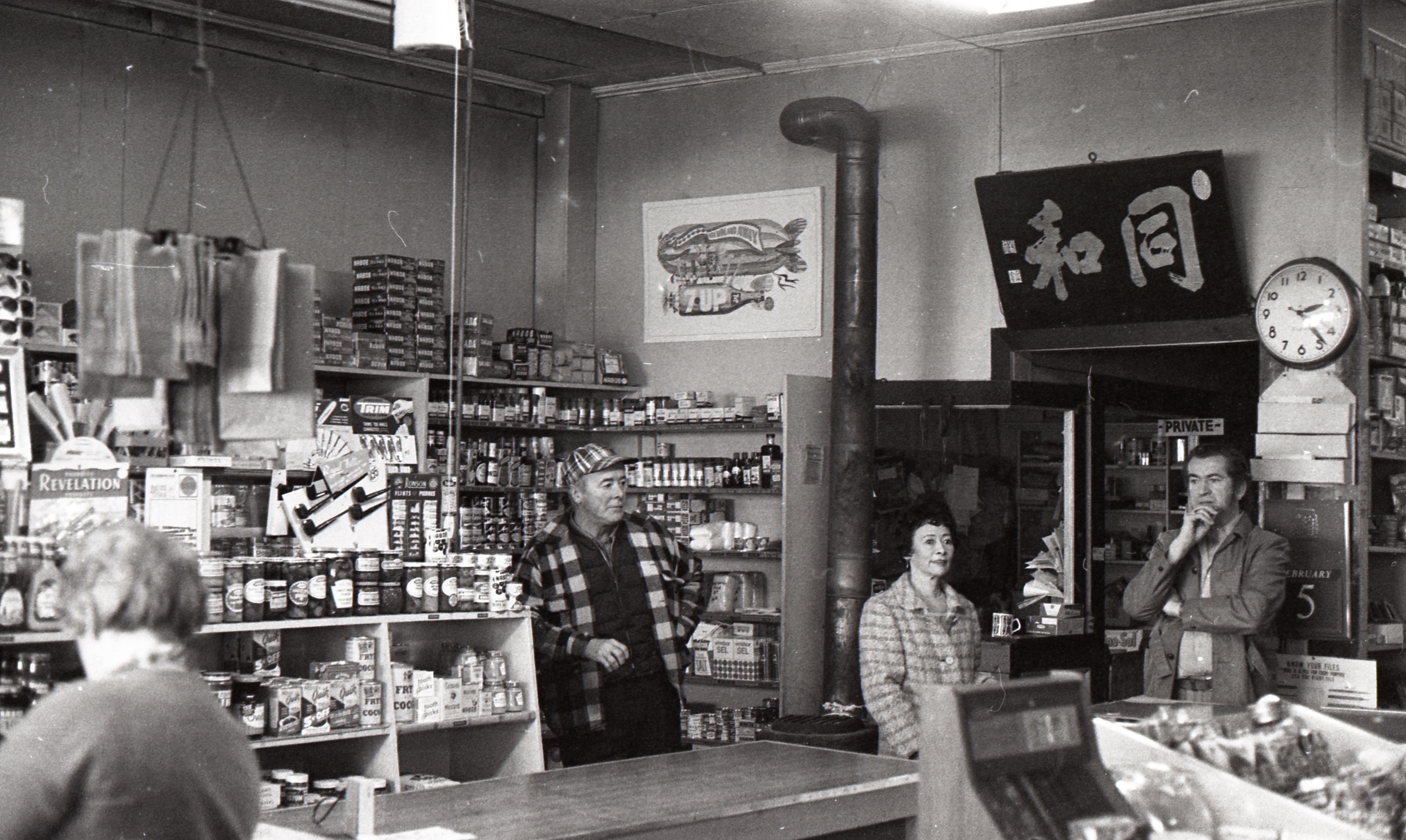
The Hong Wo Store was a place for people to drop by, have a chat and pick up what they needed. In this photo Jessie Lam Ross, the daughter of Ling Lam, visits with customers under the sign reading “Peace Together” or “Living in Harmony”. (City of Richmond Archives photograph 1987 22 179.)

Around 1914 Mr. Lam began to act as a labour contractor to two canneries, providing seasonal Chinese workers. He also employed the workers on his farms, supplying accommodations, food and a cook for a temporary crew of about 30 during the growing season and harvest. A full time foreman, assistant and truck driver were also employed.

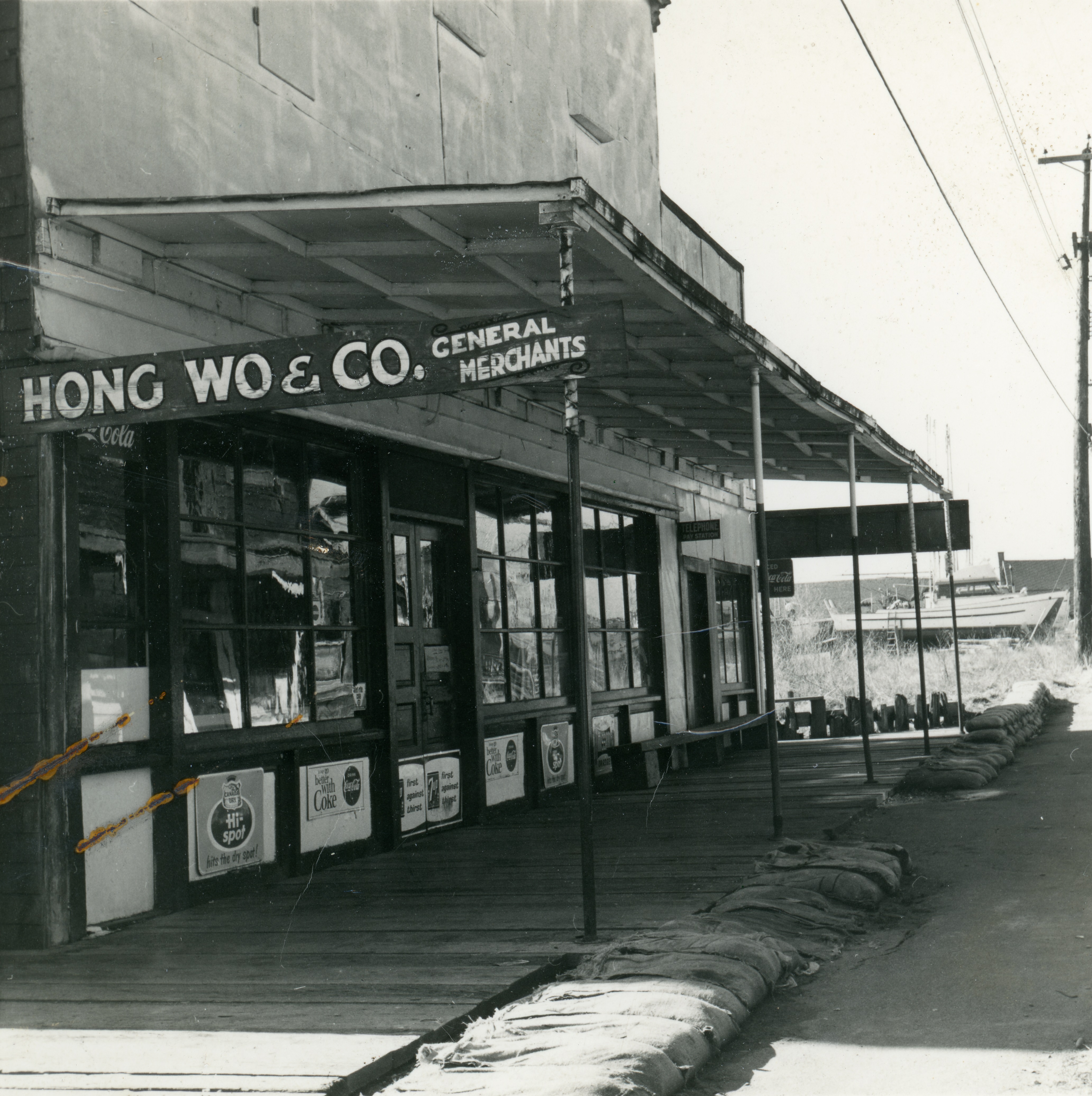
The entrance to the Hong Wo General Store in 1969. The fishboat and cannery buildings in the background show its proximity to the water. (City of Richmond Archives photograph 2006 13 13.)
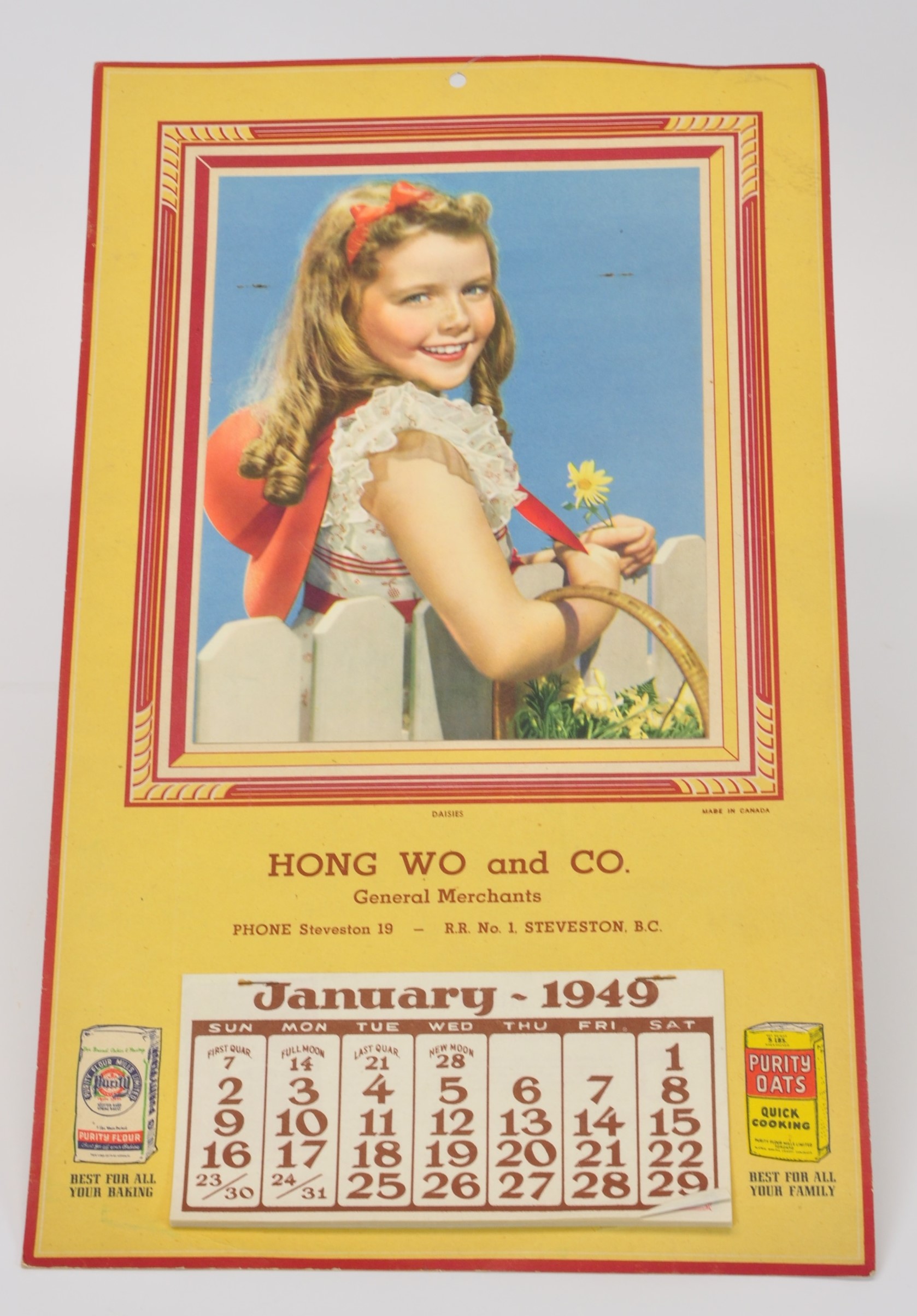
Like many businesses Hong Wo and Co. distributed calendars, like this 1949 example, to their good customers. (City of Richmond Collection 008.4.2)

During its peak, the farms owned by Mr. Lam produced tomatoes from about 30 greenhouses. Potatoes and beans were grown in the open fields along with a large crop of cucumbers for pickles. A complex of buildings was built on the lots south of the rail line. These included a pickle factory, complete with at least 20 eight-foot deep concrete vats for brining, storage buildings and greenhouses. Several bunkhouses were located on the property as well as a cookhouse with a large brick and metal wok and a building where barrels were assembled. Mr. Lam also invented a machine to sort cucumbers for dill pickles, a product which formed a large part of his farming business.

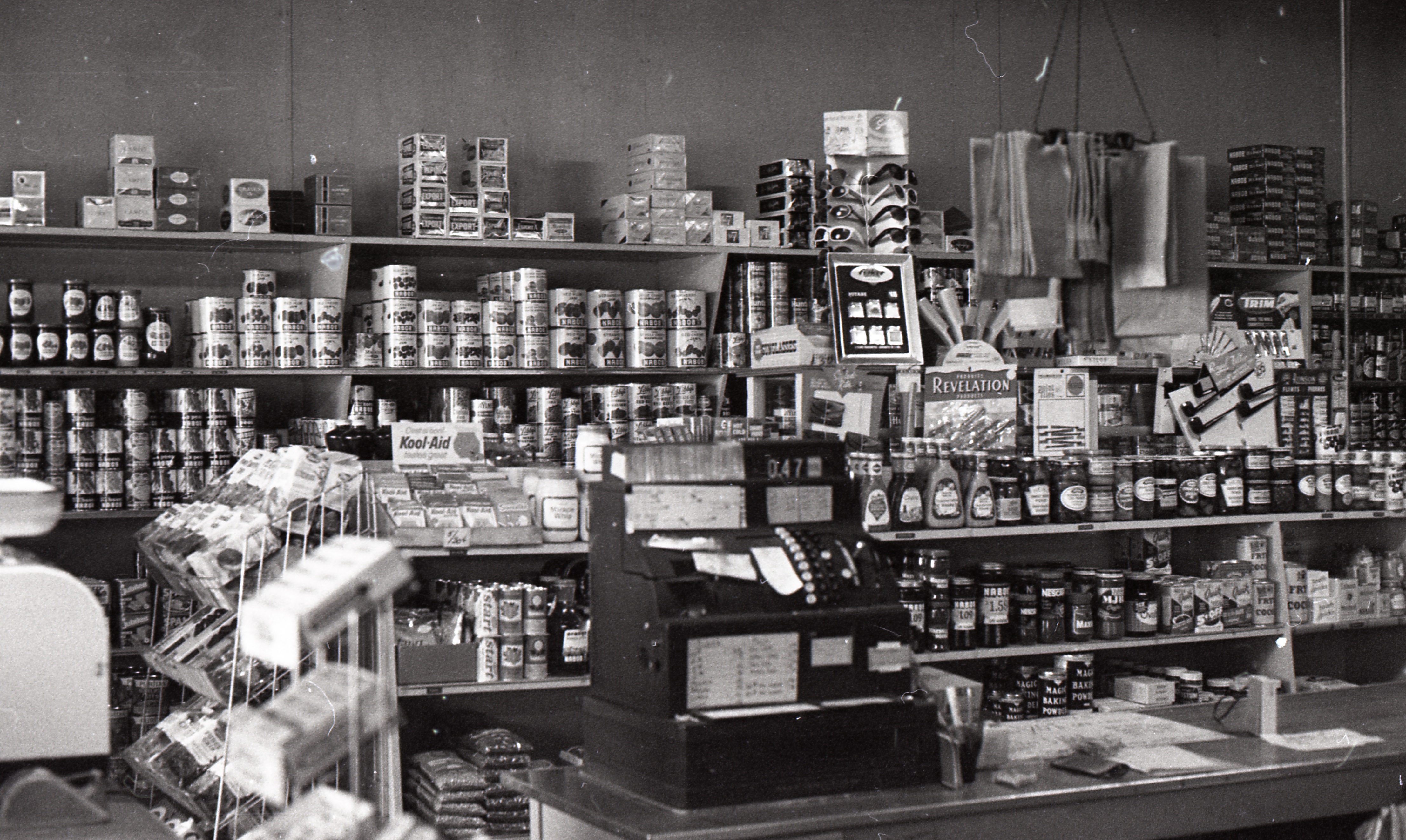
Work clothes, ice cream, instant mashed potatoes, Seven-Up and marine enamel all vie for space on the shelves of the Hong Wo Store. (City of Richmond Archives photograph 1987 22 171B.)

As reported by his daughter Jessie Lam Ross in a 1968 Richmond Review newspaper article, “He was a big name among the Chinese growers. He contracted with Empress, Royal City, Nalley’s, and other companies, and kept about 250 acres under cultivation in Steveston. Day and night he was on the go. He used to haul cukes in and pile them in huge stacks for the dill pickles.”

Looking west along the dyke path between the buildings on the Hong Wo and Co. property in 1967. The store is the last building on the left. (City of Richmond Archives photograph 1994 22 1.)

Ling Lam was also very active in Vancouver’s Chinese community, acting as the chairman of the Chinese Merchant’s Association, serving as an Elder in the Chinese United Church and starting the Chinese Farmer’s Association. He was known as a dedicated, principled, hard working man.

Some of Ling Lam’s buildings were still standing when this photo was taken in 1970. The pickle factory is the building on the far right. (City of Richmond Archives photograph 1987 22 152B.)

“I never saw him in work clothes,” his daughter Jessie remembered,” He always wore a blue serge suit and, in the summer, a shirt and tie and blue serge pants. He only took two holidays in his life, and then it was to go to California to look for seeds.”

Stock on the shelves at the Hong Wo Store. At its peak the store employed as many as 9 clerks. (City of Richmond Archives photograph 1987 22 180.)

After Mr. Lam’s death in 1939, his son George Lam and daughter Jessie Lam Ross took over his business, operating his store until 1971. With the store’s closure the property and buildings on it began to deteriorate, causing concern for the owners of nearby cannery buildings after several fires had been extinguished by the Richmond Fire Department. Efforts by the Steveston Historical Society to have the Hong Wo buildings declared a heritage site proved to be in vain and the store and surrounding buildings were destroyed in 1977.

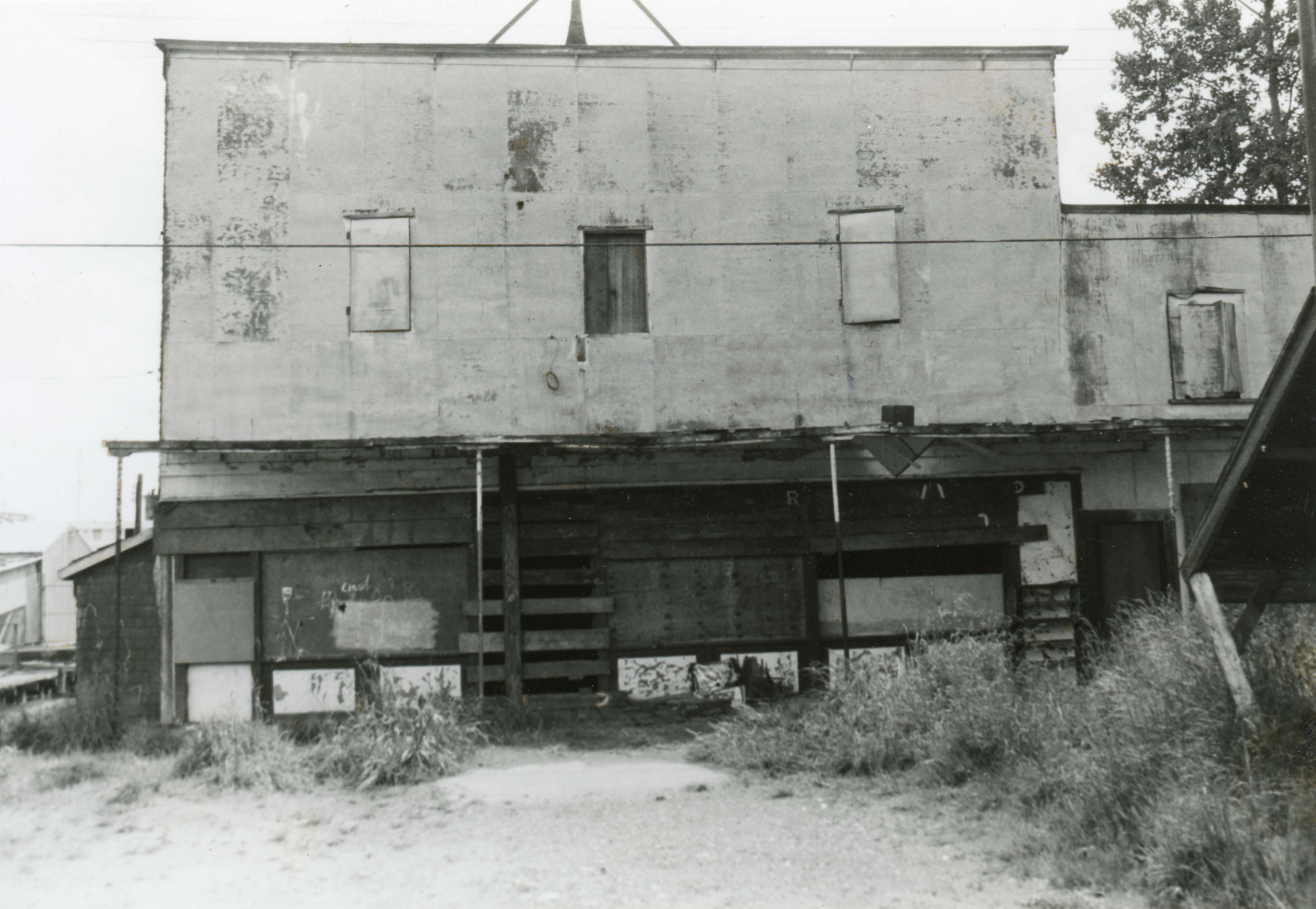
The Hong Wo Store in 1977, boarded up and nearing its demolition. (City of Richmond Archives photograph 1978 37 22.)

While the Hong Wo Store has been gone for nearly half a century its 75 years of service to industry and community make it one of the unique components of Richmond’s history. The store’s story and that of Ling Lam, a self-made man who built a thriving business from humble beginnings, are memorialized in a sign at the corner of Trites Road and Westwater Drive near the location of his pickle factory.

*This blog post follows Western conventions of naming with the given name preceding the surname.