“No Better Than a Duck Pond” – Richmond’s Historic Floods

The City of Richmond is built on islands located on the flood plain of the Fraser River, surrounded by the river and exposed to the Strait of Georgia on the west. With an average elevation of just one metre above the present mean sea level, Richmond faces flooding from extreme storm surges, intense rainfall, high tides and seasonal rises in river flows and levels. It was not until the arrival of non-Indigenous settlers in the Lower Mainland that textual records of floods and the damage they caused to dykes, crops, livestock and structures were made, most often in the newspapers of the day. Early landowners in Richmond began the process of dyking the land, usually their own properties, and building flood boxes to allow drainage at low tide and blocking the ingress of water at high tide. Soon, dyking districts were formed which provided funds for dyking and drainage projects through taxation and by the mid 1930s these were amalgamated under the control of the Richmond Municipality. The improvements made by Richmond over the years, ditches, canals, electric pump stations, box culverts and dyke upgrades, have greatly lessened the impact of floods on the city. This post describes some of the floods that occurred through Richmond’s history and some of the steps taken to reduce their consequences.

Several men watch from what is probably the flood box at the north end of No.2 Road while children appear to swim in the outflow, ca. 1930. The No.2 Road flood box was the first in Richmond, built before incorporation. Flood boxes have a balanced gate that allows water to flow out during low tides but blocks water from flowing back in when the tide is high. City of Richmond Archives photograph 1987 104 38.

November 1871 – An intense storm blowing up the river combined with a high tide and storm surge caused dykes to be washed away in Ladner and flooding to occur. While Richmond, which was not incorporated until 1879, was not mentioned in reports, the storm did cause significant damage to the Sand Heads Light Ship, dismasting it and tearing up parts of its deck. It was towed to New Westminster for repairs.

May to June 1894 – The “Great Flood of 1894” caused extensive flooding and damage all through the Fraser Valley. An extreme spring runoff brought on by a cool summer of 1893 which failed to melt snow in the mountains, a record snowfall through the winter of 1893-94 and rain and a heat wave at the end of May raised river levels to the highest ever recorded, 25.75 feet at the Mission Bridge. Dykes were destroyed, bridges and wharves washed away and farms were inundated destroying crops and drowning cattle and causing substantial loss of human life. In Richmond by June 1st, the flood had scoured out the fill around the pilings on the newly completed North Arm (Fraser Street) Bridge, causing about 200 feet of it to be carried away a few days later. Lulu Island was reported to be seriously flooded due to breaks in the dyke at Scott’s Mill at the Queensborough end of the Island and then over the main dykes at high tide. Damage in Richmond Municipality was estimated to be $2000 to the North Arm Bridge and a further $7000 in crop loss due to the flooding.

Steveston, shown here in 1891, was flooded several times in its early history. Cannery floors were awash in water and the plank roads shown here were floated up and washed away. City of Richmond Archives photograph 1984 17 75.

January 1895 – Six months after the 1894 flood, Lulu Island was again hit by flooding, this time by a combination of high river flows and extreme high tides with a strong west wind. Dykes on Lulu Island were washed away in many places, flooding large areas of farmland. Root crops stored in pits were destroyed along with large quantities of potatoes. Houses and barns were flooded and bridges over ditches and canals were washed away. Sea Island was reported to be under as much as three and a half feet of water. In Steveston water flooded over the floors of canneries and some residents had to leave their houses. Steveston’s plank roads floated and were swept away by the water.

1900 – The first of Richmond dyking districts was formed when landowners petitioned the Provincial Government to allow taxation for the construction of dykes and drainage systems under the authority of the Drainage, Dyking and Development Act. The New Lulu Island Slough Dyking District was responsible for the land encompassing the slough complex from Francis Road south to the river. Before this time landowners dyked their own property with other areas being handled by the Township. Commissioners were elected to administer the district and an engineer was hired to draw up technical plans and assessments of the land.

Headlines in the December 27, 1901 Vancouver Daily Province describe some of the damage to Richmond in the 1901 flood.

December 26-27 1901 – Richmond was hammered by a severe gale directed squarely at the mouth of the Fraser combined with very high tides. This was the most extensive and damaging flood in Richmond since 1894. Several canneries were heavily damaged and one, the Labrador Cannery at Terra Nova, was completely destroyed. Miles of dykes were lost along the North and Middle Arms of the river, fishing boats were swept as far as half a mile into farmer’s fields and smashed up. The Japanese boarding house at Terra Nova collapsed with people trapped inside who were rescued by neighborhood residents. Another boarding house with nine men inside was swept into the river. They managed to get on to the roof of the building where they were rescued by men who braved the storm in two boats. Sea Island and the greater part of Lulu Island were reported to be flooded by two to four feet of water. Steveston was under water and the floors in the Gulf of Georgia cannery were completely covered. Outbuildings at the Colonial Cannery were washed away and the plank roads in Steveston and around Lulu Island floated away.

1905 – The second of the dyking districts was formed. The Lulu Island West Dyking District was formed with responsibility for the area west of No. 3 Road.

November 1913 – The highest tides in ten years combined with a storm surge and high winds caused dykes to give way in many places flooding hundreds of acres of farmland. On Lulu Island, the Bridgeport area was inundated. Water covered roads and fields up to two feet deep, while Bridgeport School was surrounded with about three feet of water. Sea Island was similarly affected with about 500 acres of land flooded after the North Arm dyke was breached at the Cooney property on No.13 (Miller) Road. Damage was fairly light at the north-east corner of Sea Island, although the store and meat market sustained significant damage.

January 1914 – Through January 1914 heavy rains and high tides rendered the municipal drainage systems useless causing high water all along No.20 (Cambie) Road from Bridgeport to No.5 Road. The Bridgeport, Cambie and Alexandra areas were flooded with up to two feet of water. Later in the month, the same conditions, worsened by a gale force wind, washed away 150 feet of the dyke on Sea Island, completely flooding the island. Mitchell island, along with smaller islands in the river were also completely flooded. At a ratepayer’s meeting after the flood, keynote speaker John Tilton stated that “…well dyked and well drained, this island would be a beauty spot of Canada. As it is, it is no better than a duck pond.”

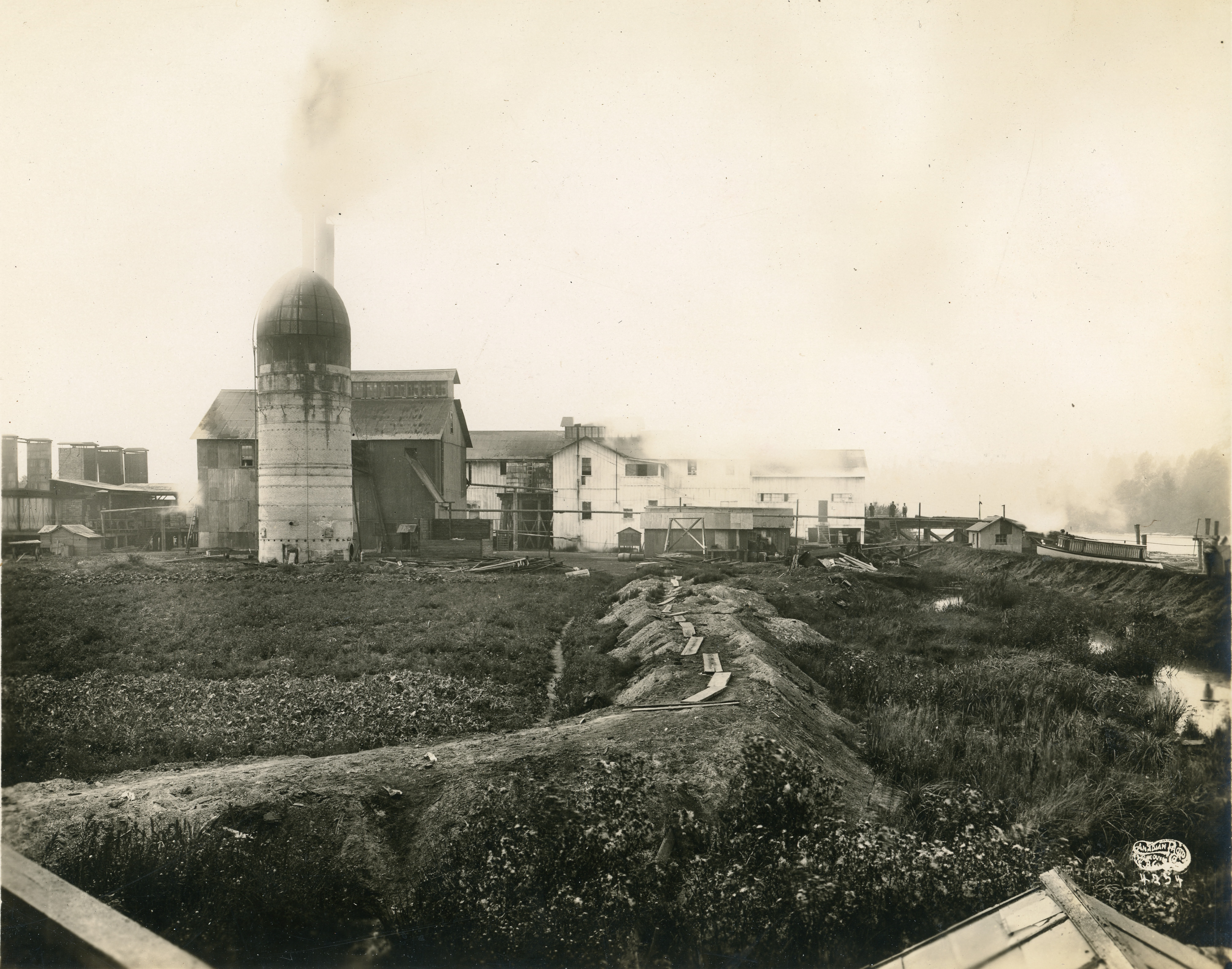
Ditches were excavated along most roads in Richmond to help drain the land and gave rise to the municipality’s nickname of “Ditchmond,” As shown in this photograph, ca. 1920, they could pose a hazard to careless drivers as well. City of Richmond Archives photograph 1978 30 2.

January 1921 – Once again the double hit of heavy rain and high tides caused flooding in Richmond. The flood box on Twigg Island was washed away, resulting in the island being completely inundated every time the tide came in. On Mitchell Island a poorly reconstructed dyke, built after the construction of Union Cedar Mills, allowed tide water to surge over and flood the island. On Lulu Island unfinished dykes on the North Arm and on the South Arm at the London property allowed the water to wash over. Large parts of the Alexandra and Garden City areas were flooded. A public meeting held at Richmond Townhall saw citizens, who had already willingly taxed themselves for dyking and drainage to an amount equal to half the general taxes of the municipality, advocating for the installation of powerful electric pumps to drain the island.

January 1933 – The New Lulu Island Slough Dyking District installed the first electric pump in the dyking and drainage system on the South Arm between No. 3 and No. 4 Roads. The 60 horsepower pump would operate automatically only during the highest tides when the flood boxes become ineffective. The pump was expected to remove 16000 gallons per minute and would drain about 4300 acres of land.

People pose in front of the first electric pump in Richmond’s dyking and drainage system, located between No. 3 and 4 Roads on the South Arm. City of Richmond Archives photograph 1988 17 112.

January 1935 – Heavy snowfall followed by higher than normal temperatures and heavy rain caused flooding in the Fraser River Valley and drainage problems in Richmond. Lulu Island was reported to be a series of small lakes and Lansdowne and Brighouse Racetracks were completely flooded.

Water flows onto Lulu Island through a breach in the dyke in 1953. Tire tracks indicate attempts to block the flow by pushing mud into the break. City of Richmond Archives photograph 1977 1 4.

1936 – The Township of Richmond amalgamated its own works with the other two dyking districts, assuming control of all dyking and drainage activities within its boundaries. The work done on the dyking and drainage system was beginning to have a positive effect on flooding problems in Richmond. While some flooding due to high rainfall was still problematic at times, residents did not seem too concerned about the occasional time when one had to wear gumboots to go into their yards. The Richmond Review boasted in the October 6, 1936 edition, “Richmond the Dryest Place in the Valley.” “Richmond should let the world know that it is about the safest place in time of flood from Winnipeg west. Richmond is so near the sea that excess water can readily escape if given half a chance.” The attention given to improving and upgrading dyking and drainage systems was to continue up to the present day.

February 1945 – “The Great Storm of February 7, 1945” was claimed to have caused the worst flood in ten years. Vancouver newspaper reports said that Burkeville was a chain of lakes with about 25 houses surrounded by water, stranding the residents inside. Acres of Lulu Island were under water. However, the Richmond Review reported, “Flood of Short Duration Here.” The rain which caused ditches to fill and property to flood on Wednesday had all run off by Friday.

1948 – In January high tides and storm surge burst through the dykes on Twigg Island. On Lulu Island a few houses were subject to flooding. Then, in May and June the Fraser Valley was hit by the worst flood since 1894. The 1948 flood was one of the most destructive in BC history, causing widespread damage throughout the Fraser Valley. Richmond, however, got off relatively easily because of the the tremendous organization and mobilization of every available resource led by Reeve (Mayor) R.M. Grauer. With help from the military, volunteer labour from Richmond and other cities in the Lower Mainland and some paid labour, the dykes were monitored 24 hours a day, thousands of sandbags were filled, brush along the dykes was cleared and weak spots in the dykes were shored up. Organizing and supervising the workers on the dykes were Ken Fraser, who took care of Steveston to No.2 Road, Archie Blair, the area between No.2 Road and No. 4 Road, Leslie Gilmore, No. 4 to No.6 Roads, Matthew McNair, No.6 to No.7 Roads, Andy Gilmore, No.7 to No.9 Roads, E. Carncross, No.9 Road to Hamilton, Bob Ransford, Hamilton to the eastern boundary, and Doug and John Savage, the northern boundary to No.8 Road. G. Crosby monitored the Middle Arm dyke on Lulu Island and on Sea Island the Grauers watched the North Arm dyke to Cora Brown, Doug Gilmore, the rest of the North Arm Dyke, Cline Hoggard, the Middle Arm to the Airport and the rest was watched by the Airport Authorities.

Mrs. A. E. Vigar sits on a row of sandbags along the Fraser River in Richmond during the 1948 flood. City of Richmond Archives photograph 1987 30 29.

The logistics involved in the “Battle of the Dykes” were akin to a military operation. Hundreds of workers were mobilized and directed to their stations. Canteens were set up at the various command posts, supplied with coffee, sandwiches, soup, cigarettes, donuts, cases of pop and cookies provided by the Municipality, the Red Cross or donated by Lower Mainland businesses and churches. Drivers were busy delivering supplies to the dykes and the canteens. Businesses and private citizens donated the use of cars, trucks and tractors to the effort. The military provided manpower, vehicles, boats and powerful tugs, able to pull barges of rock and earth against the strong current in the river. To help with communications the BC Forest Service provided two mobile radio units, The BC Telephone Company installed temporary telephones at command posts and BC Electric provided power where necessary. All movement of deep sea vessels was suspended on the river. Towing companies were instructed to use only more powerful tugs, speed limits were imposed to prevent damage to dykes and the size of tows was restricted to single barges and booms with an assisting tug. Bridges were closed to traffic from two hours before until two hours after high tide slack.

A group of students from Richmond High School pose atop a stack of sandbags during the 1948 flood. Male students were excused from classes to help fill sandbags and work at the dykes. City of Richmond Archives photograph 2010 35 5.

To make sure that workers remained focused on the job at hand, the liquor licenses at the Steveston Hotel, the Steveston and Sea Island ANAFs and the Royal Canadian Legion were temporarily suspended. In the event that the worst happened, a train was stationed at New Westminster to assist in evacuating people from Richmond.

A notice published in the June 9, 1948 Richmond Review.

The constant monitoring, shoring up of low spots and reinforcing dykes that began to weep paid off in a minimum of damage in the Municipality. There was only one significant problem reported when a “geyser” erupted on the dyke at the Rice Mill resulting in a breach. About 100 yards of the dyke had collapsed into the river at high tide. Fortunately, as the tide receded the flooding stopped and the gap was filled using the Municipal dragline. Repair work was completed before the tide came back in and flooding didn’t penetrate past the CN Rail line.

A Universal Bren Carrier delivers sandbags to the dyke in this clip from a film taken during the 1948 flood in Richmond. To see the whole video visit https://www.youtube.com/watch?v=pR0czKKsehM .

November/December 1951 – In late November a near hurricane storm system and high tidal surge hit the Lower Mainland. At Richmond, River Road near the Sea Island bridge was under about 6 inches of water. Workers from the Lulu Island Canning Company were set to work packing the dykes with sandbags. In nearby low lying areas houses were surrounded by water up to 10 inches deep. The high tides and strong winds breached a low dyke at the end of No.2 Road in Steveston but the water was held back by a higher inside dyke. The ferry to Ladner was put out of service when a pontoon at the Richmond ferry terminal sank.

Strong winds and high tides wash against the dyke at the end of No.1 Road in Steveston during the November/December 1951 storm. City of Richmond Archives photograph 1977 1 24.

January 1953 – Dirt fill around the new $15000 flood box at Finn Slough washed away resulting in the destruction of the flood box. About 50 yards of the dyke near the foot of No.4 Road washed out “as if cut by a knife.” The location of the break was such that trucks could not be brought in so Councillor Archie Blair used his farm tractor to bring in sandbags and to push mud into the breach and a scow delivered a load of soil. Flooding caused significant damage to the Gilmore farm buildings and the family home. It was discovered that wing dams and modifications made by the Federal Government to the south shore of the river in an attempt to increase the water velocity and make the river “self-dredging,” redirected the flow, causing it to scour the area between Woodward’s Landing and Steveston and undermine the dyke. High seasonal tides then ended up breaching the dyke. The dyke was subsequently repaired and armoured with rock.

The brand new Finn Slough flood box was destroyed when soil around it was washed away in 1953. City of Richmond Archives photograph 1977 1 8.
The Gilmore house is surrounded by water in this image from the 1953 flood. The area around Finn Slough could be problematic during high drainage loads and dyke breaches. City of Richmond Archives photograph 1977 1 10.

November 1954 – Very heavy rainfall overwhelmed the drainage system causing an accumulation of water in Richmond that filled ditches and backed up onto the surface of the land. The No.3 Road pump had lost a top main bearing making the situation worse. The most affected area was in the Grauer subdivision and the rest of the area drained by the No.4 Road canal. Crown Zellerbach helped out by placing nine large pumps at Finn Slough which assisted the municipality’s pumps by drawing an additional 22,000 gallons a minute.

Kids wearing gumboots wade in their yards on Dixon Avenue during the 1954 flooding. City of Richmond Archives photograph 1977 1 118.

November 1955 – Heavy rainfalls caused flooding around the Lower Mainland but, according to reports in the Vancouver Sun, flooding in Richmond was “much less than expected.” While some ditches overflowed onto roads, fields and lawns, the municipality’s canal drainage system speeded up the runoff significantly.

The use of natural drainage channels forms part of the strategy of removing water from Richmond. This aerial view, ca. 1980, shows Woodwards Slough which drains into the South Arm near Finn Slough. A flood box and pump station ensure efficient water removal. Horseshoe Slough and Bath Slough are also part of the drainage system. City of Richmond Archives photograph 1988 123 745.

December 1957, January 1958 – High tides, wind and heavy rain caused water to go over the dykes on Mitchell Island. About 100 homes in Richmond were surrounded by water due to blocked drains in the drainage system.

Drainage canals have been an effective way of moving large amounts of water out of Richmond. This image shows the north end of the Gilbert Road canal and pump station. The canal has since been replaced by a box culvert. City of Richmond Archives photograph 1988 123 689.

December 25-26 1972 – Water from rain melting snow caused flooding around Richmond, and damage at the municipal offices.

February 1976 – An exceptionally high tide caused flooding one foot deep around about fifty homes in the Cambie and River Road area when a temporary rock dam was breached where a new pumping station was being installed on the Middle Arm.

The large open drainage canals have been replaced for the most part by enormous box culverts like this one on Gilbert Road which replaced the canal shown in the previous photograph. City of Richmond Archives photograph 1988 123 445.

December 1979 – Once again, extremely heavy rainfall caused drainage problems around Richmond. The flooding caused sanitary sewers to back up at London Junior Secondary School, flooding the gym and closing the school. Wet cables caused the loss of telephone service to about 1000 customers.

To the present- The improvements made to Richmond’s dyking and drainage system have been continuous since the first hand built dykes in the 1800s. Today, around 49 km of dykes hold back water from the sea and the river. 598 km of drainage piping, 61 km of culverts and 151 km of open watercourses move water out of the city. Thirty-nine pump stations, capable of removing 5.3 million litres of water per minute, are ready to discharge rainwater to the river and ocean. Sensors provide real-time information about river levels, rainfall and the drainage of storm water and analysis of weather patterns, snowpack and predicted runoff warn of potential risks to the city. Regular inspection and maintenance of the whole dyking and drainage system takes place with increased patrols during higher risk periods. Richmond’s dyking and drainage system is designed to withstand a one in 500 year flooding event, something that has a 0.2% chance of occurring in any given year. A case in point is the 2021 atmospheric river event, which broke rainfall records around the Pacific Northwest and caused extensive damage in many places, was handled well by Richmond’s system although localized drainage problems did occur.

Many of Richmond’s upgraded pump stations feature public art displays. This image shows the Shell Road North Drainage Pump Station which was upgraded in 2020. The walls show large maps of Richmond with bridges, roads and highways, as well as the paths of some of the City’s historic slough waterways. City of Richmond Engineering and Public Works: Richmond’s Drainage Pump Stations, July 26, 2024. https://corportal1.richmond.ca/portal/apps/storymaps/stories/c4d06a030aa845c981117f95727a4e26

To the future- To prepare for climate change induced sea level rise and increased rainfall the City’s Engineering and Public Works Department has developed a flood protection strategy to prepare for emergencies. To ensure Richmond and its residents remain safe, the City has one of the most comprehensive flood protection systems in BC. To learn about it, visit the City of Richmond’s website at https://www.richmond.ca/services/water-sewer-flood/dikes.htm

What’s in a Name – Richmond

The place now known as the City of Richmond is located in the traditional and unceded territory of the hən̓q̓əmin̓əm̓ (Hunquminum) speaking people. They lived on and moved throughout the area using the many natural resources available to support themselves and their culture.

The arrival of non-Indigenous settlers in the 1800s began changing the land into what we know today. Mostly farmers, they began the process of dyking and draining and the construction of roads. Eventually they organized and submitted a petition to the Lieutenant-Governor in Council requesting the incorporation of a municipality under the name of the Township of Richmond, allowing them to collect taxes to help pay for continued development.

Richmond, North Yorkshire was the first place to have the name. It was founded about 800 years before Richmond, British Columbia. Photograph from https://www.richmond.org/Visit.

Richmond is believed to be the most common place name in the world. There are at least 105 locations on the planet called Richmond, six in Canada including this one. The original Richmond was founded in 1071 in what is now Yorkshire by Count Alan Rufus on lands granted to him by William the Conqueror after the Norman Invasion of Britain in 1066. The name comes from Norman French, “Richemonte,” meaning “Strong Hill.” Count Alan built a Norman Castle on the banks of the River Swale and the town grew up around it. The area became the seat of the Dukes of Richmond whose descendants travelled around the world naming the places they found after themselves. Other places were named Richmond by people who had a connection with older Richmonds, spreading the name even further.

The naming of Richmond, British Columbia is one of those historic events in which the reason for choosing the name was not officially documented. We know when it took place and who the participants were but not the motive behind it. This is further complicated by there being a number of people involved who had a connection to other places named “Richmond.”

Hugh and Jennie McRoberts – Richmond, New South Wales, Australia

Hugh McRoberts is acknowledged to be the first non-Indigenous settler in what is now Richmond. He was born in Belfast, Ireland in 1814 and emigrated to Australia with his wife in the 1840s where his daughter Jennie was born. In 1849 he set off for North America and made unsuccessful attempts at gold mining in California and at Yale on the Fraser River.

Hugh McRoberts, BC pioneer and Richmond’s first farmer.
City of Richmond Archives photograph 1978 2 29.

After failing to make his fortune gold mining, he was awarded a contract from the Colonial Government to build a road between Yale and Boston Bar and a trail from New Westminster to the river mouth, earning enough to bring Jennie to British Columbia and to buy some land. Around 1860 McRoberts pre-empted 1600 acres on the Vancouver side of the North Arm and on Sea Island where he built a house and established a farm, built the first dykes in what is now Richmond and raised crops such as wheat, apples, plums, cherries, pears and potatoes and raised cattle.

A sketch of “Richmond View” by an admirer of Jennie McRoberts done in 1863. He described it as “a poor attempt to represent on paper one of the most lovely spots in B.C.”
City of Richmond Archives photograph 1987 30 6.

Before long he owned nearly half of Sea Island, which people of the day referred to as “McRoberts’ Island.” His daughter Jenny named the house he built at the farm “Richmond Place” and their farm “Richmond View” because it reminded her of “Richmond” New South Wales, near where she grew up. This was the first time that the name “Richmond” was associated with the place we now call Richmond.

Hugh McRoberts’ house on his Sea Island Farm, Richmond View. By 1862 Richmond View Farm was harvesting wheat and other crops for sale in New Westminster. The farm was acquired by Thomas Laing in 1894. City of Richmond Archives photograph RCF 23.

Hugh McRoberts had sold his farm by the early 1870s and moved to New Westminster where he had a dairy business. He passed away in 1883, “Leaving a long and interesting record as a pioneer, a good sturdy man of the best type,” in the words of early Richmond historian, Thomas Kidd. Jennie had married and moved to Victoria in 1864 so neither she or her father could be credited with influencing the original petitioners to name the new municipality Richmond, although they and their farm were well known, which may have had some bearing.

Hugh and Mary Boyd – Richmond, Yorkshire, England

Hugh Boyd was born in 1842 in the same part of Northern Ireland as Hugh McRoberts and came to British Columbia in 1862. He, like so many, made an unsuccessful attempt at gold mining in the Cariboo. Returning to New Westminster, he worked building the trail from New Westminster to the mouth of the Fraser River in association with Hugh McRoberts, the McCleery Brothers, Alexander Kilgour and J. Mackie. In 1866 he partnered with Alexander Kilgour and they homesteaded on Sea Island on property abutting Hugh McRoberts’ Richmond View Farm. The property was known as Rosebrook Farm.

This map of McRoberts (Sea) Island shows the locations of Hugh McRoberts’ Richmond View Farm and Hugh Boyd and Alexander Kilgour’s Rosebrook Farm.
City of Richmond Archives photograph 1997 42 4 56.

In 1873 Hugh Boyd married Mary Ann McColl, the daughter of Sgt. William McColl of the Royal Engineers in New Westminster. Miss McColl was born in the original Richmond in Yorkshire, England. On November 10, 1879, when Hugh Boyd and the 24 other petitioners signed the request for the incorporation of the Township of Richmond, they did so in the dining room of the Boyd’s house at Rosebrook Farm. Hugh Boyd was selected as the first “Warden” (Reeve) of the new Municipality and Council meetings were held in the Boyd’s dining room for the next year until the first Town Hall could be built.

Hugh Boyd, the first Reeve of the Township of Richmond. City of Richmond Archives photograph 1978 2 5.

The Boyds left British Columbia and returned to Ireland in 1887 where they lived until their deaths, he in October 1931 and she in January 1952 at the age of 97 years. They named their home in Bangor, Northern Ireland, “Richmond.” Mrs. Boyd maintained that Richmond was named in her honour. In a letter to Major Matthews, the City of Vancouver Archivist, in 1944 she said, “The name of Richmond was decided on as an honour to me, and the name of the town I was born in somewhere in Yorkshire; also for allowing my dining room as Council Chamber until a hall was built.”

Mrs. Hugh Boyd, nee Mary Ann McColl, whose dining room was used as Richmond’s Council Chamber for a year before the first Town Hall was built. Image cropped from City of Richmond Archives photograph 1987 49 1.

W.D. Ferris- Richmond, Surrey, England

William Douglas Ferris was born in Richmond, Surrey, England and immigrated to Eastern Canada where he lived for many years before moving west to British Columbia, settling in New Westminster. As Thomas Kidd said in his book History of Richmond Municipality, Ferris had “all the spirit of a pioneer” and in 1866 at the age of 51 years he took a farm on Lulu Island, moving there with his wife and family. In 1877, now in his sixties and feeling too old to continue farming, he sold his farm to J.W. Sexsmith and moved back to New Westminster where he served as a Justice of the Peace and was elected as Mayor in 1879.

The petition, handwritten by W.D. Ferris, asking the Lieutenant Governor in Council to incorporate the Township of Richmond. City of Richmond Archives image RCF 39.

He maintained an interest and friendships with the settlers on Lulu and Sea Islands and, although he was not eligible to sign the document, he drew up the hand-written petition urging the Lieutenant Governor in Council to incorporate the Township of Richmond. Thomas Kidd related that he “has a dim remembrance of being told at the time of circulation that Mr. Ferris had chosen the name of Richmond for the Municipality to commemorate the name of his own native place in England.”

W.D. Ferris in 1879 when he was Mayor of New Westminster. New Westminster Archives Item IHP 1874.

John Wesley SexsmithRichmond Township, Lennox County, (Upper Canada, Canada West) Ontario

John Wesley Sexsmith was one of the most influential people in Richmond’s early history. He was born on May 10, 1830 in Richmond Township, Lennox County, Upper Canada where he grew up, attended school and worked on the family farm. At age 25 he went into business, opening a dry goods, grocery and hardware store in the Hamlet of Selby with his brother and brother-in-law and running a cheese factory with a partner. He also became active in public affairs and was the Treasurer of the Township of Richmond, Lennox and Addington for 18 years. In 1876 he and his family moved from Ontario to British Columbia and purchased 160 acres from W.D Ferris on the North Arm of the Fraser in 1877.

John Wesley Sexsmith, Richmond Reeve, farmer, businessman and community leader. City of Richmond Archives photograph 1994 18 1.

In 1879, he and his son, Charles Garret Sexsmith, signed the petition for incorporation. There is little doubt that J.W. Sexsmith’s experience and leadership had a great bearing on the formation of Richmond. As a rural area with small pockets of population here and there under a single administration, Richmond certainly followed the Ontario model of the Township Municipality from the 1800s. Mr. Sexsmith’s 18 years of experience in the municipal government of Richmond Township before moving to BC must have made him a leader in the discussions around incorporation.

The Sexsmith family home on River Road with family members standing in front, ca. 1890. J.W. Sexsmith and his wife Alice Mary Tuttle Sexsmith on the right. City of Richmond Archives photograph 1999 8 6.

J.W. Sexsmith was the only one of the aforementioned people who stayed in Richmond and took a lifelong part in community and business life here. He served as the Reeve of the Municipality for four terms and was the first Postmaster. He helped build, support and preached at the Richmond Methodist Church (now Minoru Chapel). He was one of the first School Board Trustees and founded the North Arm School District in 1877, the Lower Mainland’s first, and founded and was first president of the Richmond Agricultural Society. In business he built and operated a cheese factory on his farm, was one of the partners in the construction and operation of the Provincial Cannery, operated a steamboat service between Richmond and New Westminster, and was a financial backer of the Easterbrook Flour Mill. As Reeve and as a private citizen Mr. Sexsmith led and supported many of the significant developments in Richmond’s history, including the first telephone, bridges connecting Lulu and Sea Islands to the mainland across the North and Middle Arms, the railway to Steveston and the supply of electricity. He retired in 1908 and lived the rest of his life in his home on River Road, passing away in 1920 after a long and productive life. Descendants of Mr. Sexsmith maintain he that named our Richmond after his birthplace.

The first Richmond Town Hall, located near the intersection of Cambie and River Roads, ca. 1888. As a School Trustee J.W. Sexsmith applied for use of the hall for school purposes. This image shows school children playing outside, including four Sexsmith family members.
City of Richmond Archives photograph 1984 17 77.

The Corporation of the Township of Richmond, British Columbia

It is difficult to conclude that any one person can be said to have named Richmond. There are twenty-five signatures on the petition requesting incorporation so, obviously, a suggestion was made and a consensus was reached and, ironically, these flat, boggy islands were given a name that means “Strong Hill”. On December 3, 1990, Richmond lost its longtime designation as a Township and became the City of Richmond, having grown from a small farming district of 200 to 400 people into a diverse, multicultural city of over 200,000.

Reach for the Sky – The Dawn of the High-Rise in Richmond

Up until the 1960s  Richmond was a “low-rise” community, the tallest buildings being the grandstands at the two thoroughbred racetracks in the municipality and the industrial buildings like canneries and mills. Richmond’s Zoning Bylaw had restricted building height to no more than three storeys above natural grade before the late 1950s. However, the increasing rates of population growth, brought on by the completion of the Oak Street Bridge in 1957, spurred the construction of residential subdivisions and the Municipal Government began to change Richmond’s Zoning Bylaw 1430 to permit higher density housing.

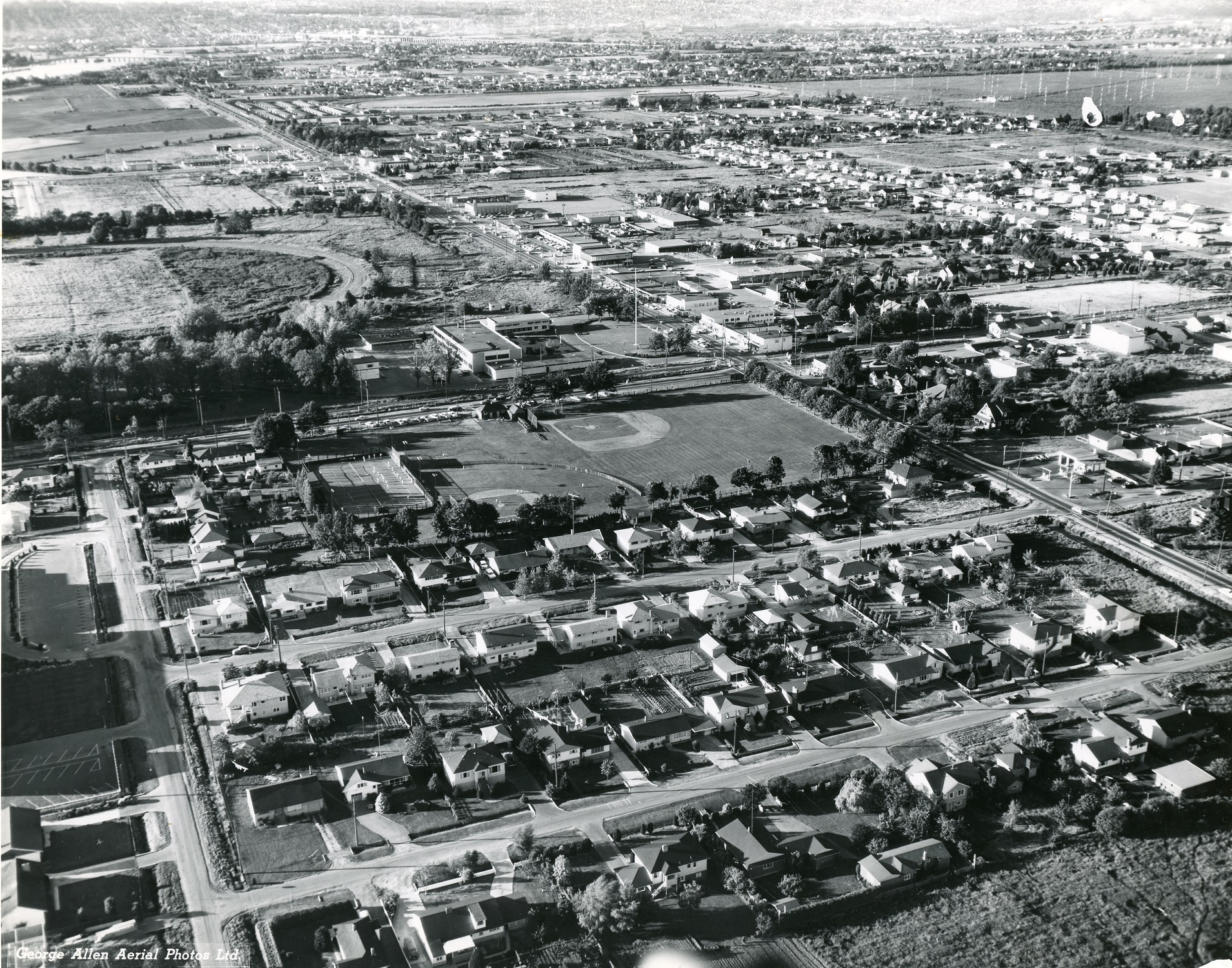
An aerial view of the Brighouse area in 1963 shows no buildings over three floors. City of Richmond Archives photograph 1984 17 65.

Richmond’s surface soil profiles have been studied and show that most of the land west of No. 3 Road has a clay cap about 3 metres in depth with sand or silty sand below. East of No. 3 Road there is typically a layer of peat up to 7 metres deep, then a 3 metre deep layer of clay underlain by sand. In the event of a major earthquake studies have shown that the most likely place for liquefaction (the loss of strength of soils due to vibration) to occur will probably be in a limited zone below the clay layer. As better understanding was reached of Richmond’s underlying soil conditions and how its soils react to supporting buildings in varying conditions, including earthquakes, site preparation and foundation construction techniques were adopted allowing taller structures to be built. Buildings in Richmond have to be built stronger and with greater attention to foundation design than similar buildings in Metro Vancouver which can be fastened to bedrock.

The first step in any construction is the provision of a soils report which addresses structural foundation support and the liquefaction potential of the soils in the building site. Structural drawings approved by a Professional Engineer deal with seismic design and the details of the soils report. Preparation of building sites for construction involves the densification of the soils with a preload of sand to a predetermined height and for a specified length of time. This compresses the soil and removes ground water to increase its load bearing capabilities. Various types of compaction using vibration are also commonly employed to increase the removal of ground water from the soil.

This photo shows concrete pilings which support the weight of buildings on soil below the liquefaction zone, in this case at the construction site of Richmond City Hall. City of Richmond Archives photograph.

Most buildings over three storeys high are placed on pile foundations which support the building on soil below the liquefaction layer. Concrete “Franki” piles, reinforced concrete pilings forced down a metal tube and which expand out the bottom in a large bulge, provide structural support. Stone columns and timber “compaction piles” are often placed in a pattern around support pilings to further eliminate water from the soil supporting the building. All of the methods of supporting the building structure and compacting the soil create a large block of dense soil beneath the building site, essentially an artificial bedrock.

Richmond General Hospital was Richmond’s tallest building for many years. At six storeys it did not quite make the height required to be called a high rise. City of Richmond Archives photograph, accession 2004 11.

The first building to exceed the three-storey limit was the new Richmond General Hospital. At six storeys it did not quite qualify as a high-rise building, the standard being seven storeys or more, but it had been designed with the ability to be expanded to nine storeys and for years it was the tallest building in Richmond. The hospital opened on February 26, 1966. Plans to add an additional three storeys to the building in 1972 were quashed, however, due to changes in the National Building Code for 1970 which dramatically increased the specifications for earthquake building loads.

With the new changes in the building code the stage was now set for the construction of true high-rise buildings in Richmond. Through the early 1970s the Richmond Review newspaper announced the planned construction of the first buildings, a seven-storey seniors’ residence, two hotel towers, and three seventeen-storey apartment buildings.

Public opinion about the changing Richmond skyline was mixed, with very vocal opponents to the flat terrain of the community being “splattered with 200 foot towers”. Residents around the 1000 block of Ryan Road were so outraged at the plans for the construction of a fourteen-storey tower as part of an apartment development in their neighborhood that 150 of them showed up at a Municipal Council meeting to protest. Citing a complete lack of consultation they managed to have the proposed development cancelled.

The March 18, 1970 Richmond Review showed this photo of the proposed Lions Manor building. At the time it was published, the location of the building had still not been settled.

The Richmond Review newspaper announced the construction of a $1.2 million apartment block for seniors on March 19, 1970. The seven-storey concrete building, planned since 1968, would fill a need for affordable senior’s housing with room for 144 people living in single suites. Occupancy would be limited to persons having an income of $150 per month or less and rent would be $110. The project had been in planning for many years by the Richmond Lions Club. The location chosen to build the residence was on Aquila Road, but opposition from neighbours forced a change of location. Seventh Avenue in Steveston was suggested as an alternate site, but eventually a property at 1177 Fentiman Place in Steveston was approved for its construction.

By December 8, 1971 the building structure was almost complete. Richmond Review.

Described as “like a hotel for old people – all they have to do is dress themselves and come to the dining room to eat”, the rooms each had a bed, chair, clothes closet, dresser, desk and wash stand. Each floor had a lounge and a washroom with four private tubs. The top floor featured a library and the main resident lounge while the main floor housed the kitchen and dining room as well as a crafts room, laundry and visitor’s lounge. Construction began on the manor in 1970 and the first 15 guests had moved in by November 1972.

In this aerial view looking over Steveston the Lions Manor is clearly visible at the centre left. City of Richmond Archives photograph 1977 22 2

On April 12, 1971 the Review announced the Municipality’s “first high rise complex” to be built on Minoru Boulevard. Expected to cost $8.25 Million, it consisted of three seventeen-storey towers, two to be built in the first phase of construction with the third to follow later.

An artist’s drawing of the Park Towers complex from a brochure at the City of Richmond Archives.

The entire complex was to provide 561 dwellings. Foundations for the towers used Franki concrete pilings about every four feet on centre with concrete beams on top to support the buildings.

The first two towers of the Park Towers development near completion in this photo. City of Richmond Archives photograph 2019 24 1.

The project was proposed in 1969 by well-known developer Ben Dayson of Highgate holdings who had previously built the three-storey Minoru Garden Apartments next door to the high rise building site. The first two towers (“Towers C and B”) were ready for rentals by November 1972. Apartments in the third tower (“Tower A”), completed the following year, were sold as condominiums.

The three buildings of the Park Towers, Richmond’s first high rise apartment complex, dominate the skyline of downtown Richmond, ca. 1976. City of Richmond Archives photograph 2008 36 3 75.

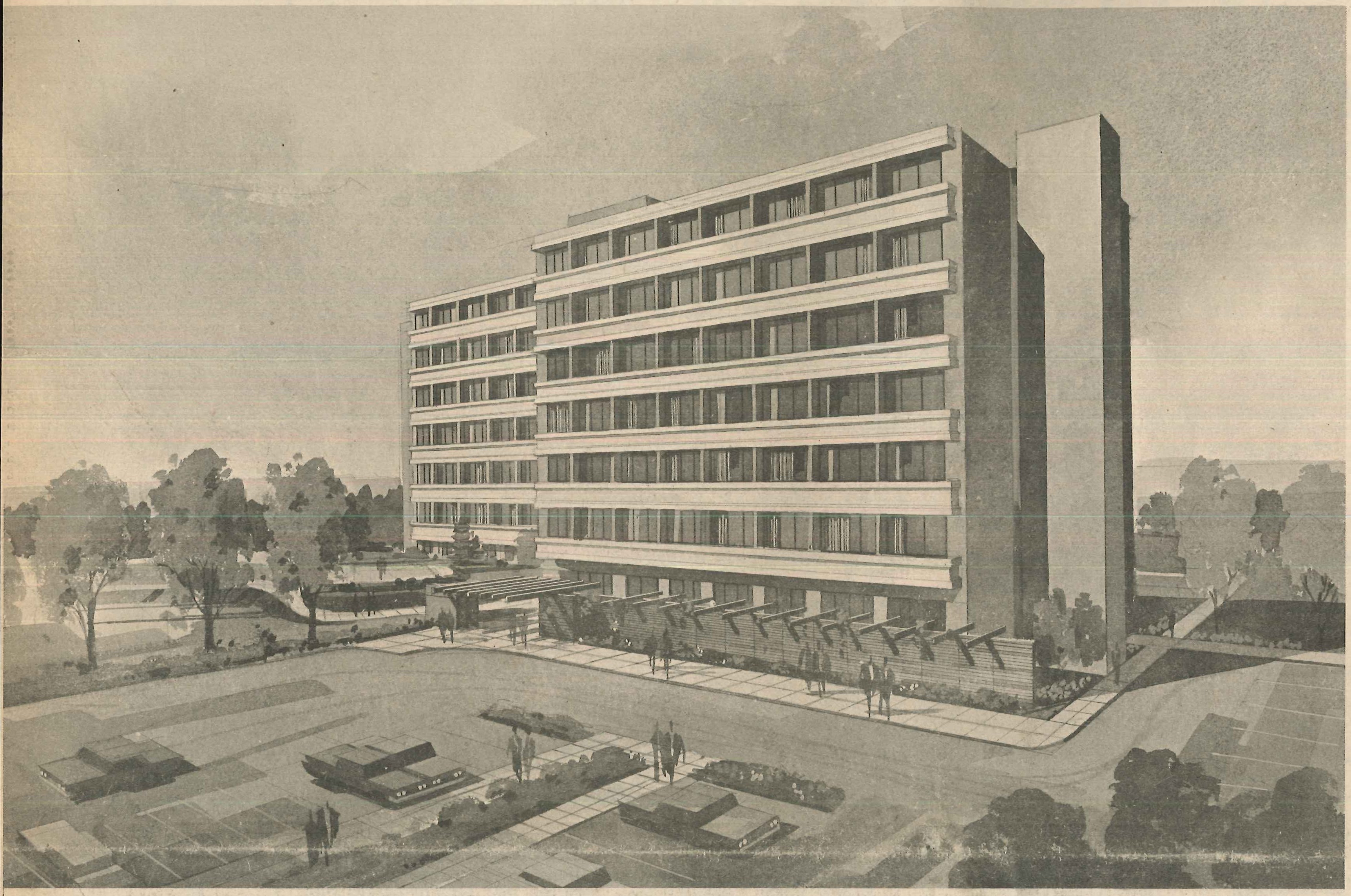
In May of 1971 the construction of the Vancouver Airport Hyatt House hotel complex was reported. The hotel was to include a 10-storey tower, 431 rooms, ballroom and meeting rooms, a 200 boat marina, and three restaurants (one on “stilts” over the Fraser River), all built on a seven acre site on Sea Island.

This architectural drawing shows the proposed Airport Hyatt on the bank of the Middle Arm of the Fraser River. City of Richmond Archives photograph.

The building height had been restricted to 135 feet above ground level because of its proximity to the airport and had to have non-metallic roof sheathing so as not to interfere with navigational signals.

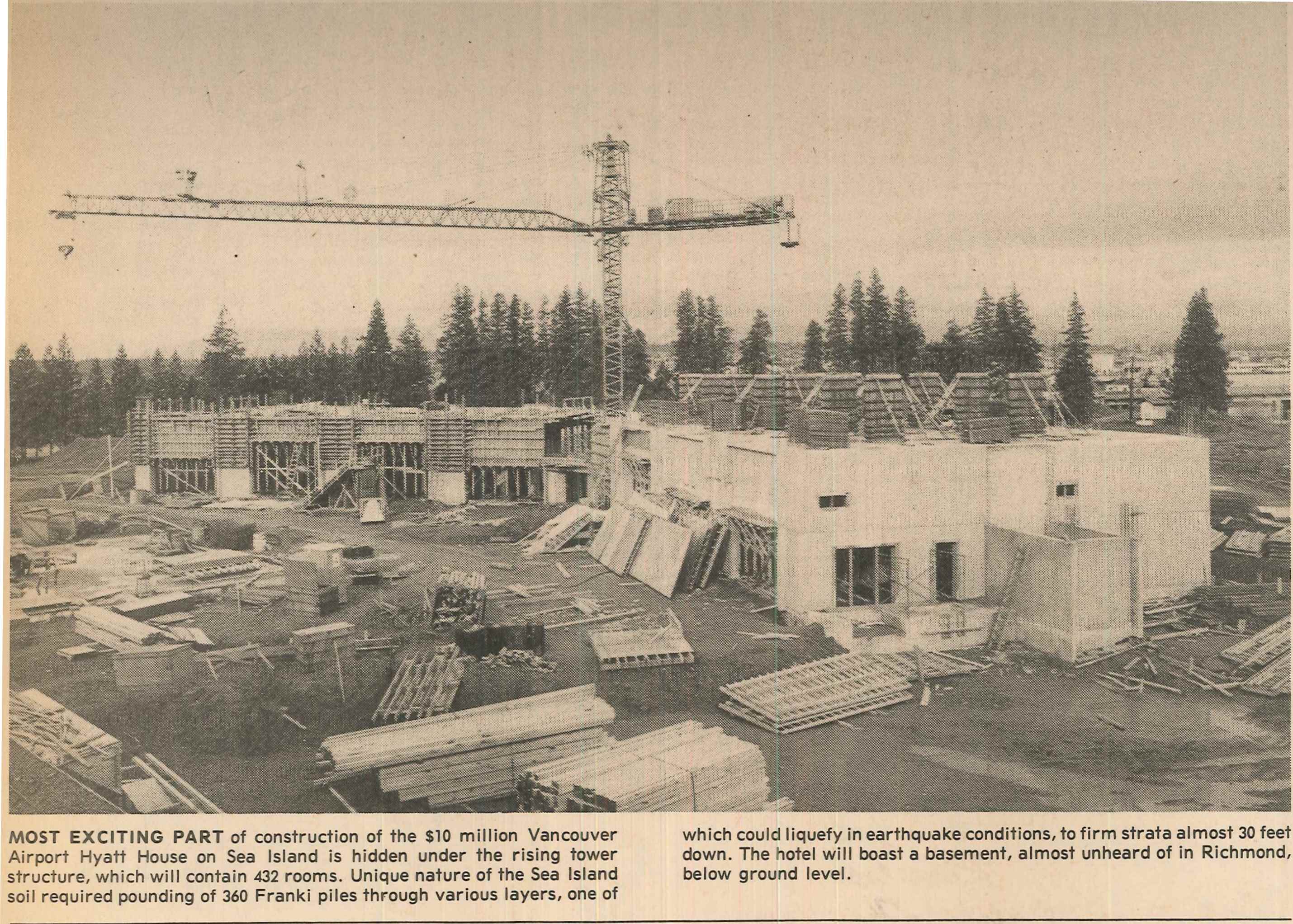
Construction is underway at the site of the new Airport Hyatt in this Richmond Review clipping from January 12, 1972.

The site was prepared with an 18 foot high preload of sand which sat for one year before construction began, compacting the soil 60 to 70 feet down. Three hundred and sixty Franki piles were spanned by two-foot by three-foot concrete beams which are in turn supporting a 3 1/2-foot concrete slab. Rising above the slab is the Y-shaped tower of the main structure. The Hotel opened for business in early June 1973.

The Delta Airport Inn before the construction of the first tower. City of Richmond Archives photograph 1988 18 77.

In June 1971, construction began on an expansion of the Delta Airport Inn on St. Edwards Drive which would involve the erection of a fourteen-storey tower with 144 suites and the renovation and expansion of the existing hotel amenities. The upgrade to the hotel, in the planning stages since 1969, was expected to cost $2.5 Million.

This architect’s drawing shows the planned expansion of the Airport Inn. A second, taller tower has been added since. Photo from January 14, 1972 Richmond Review.

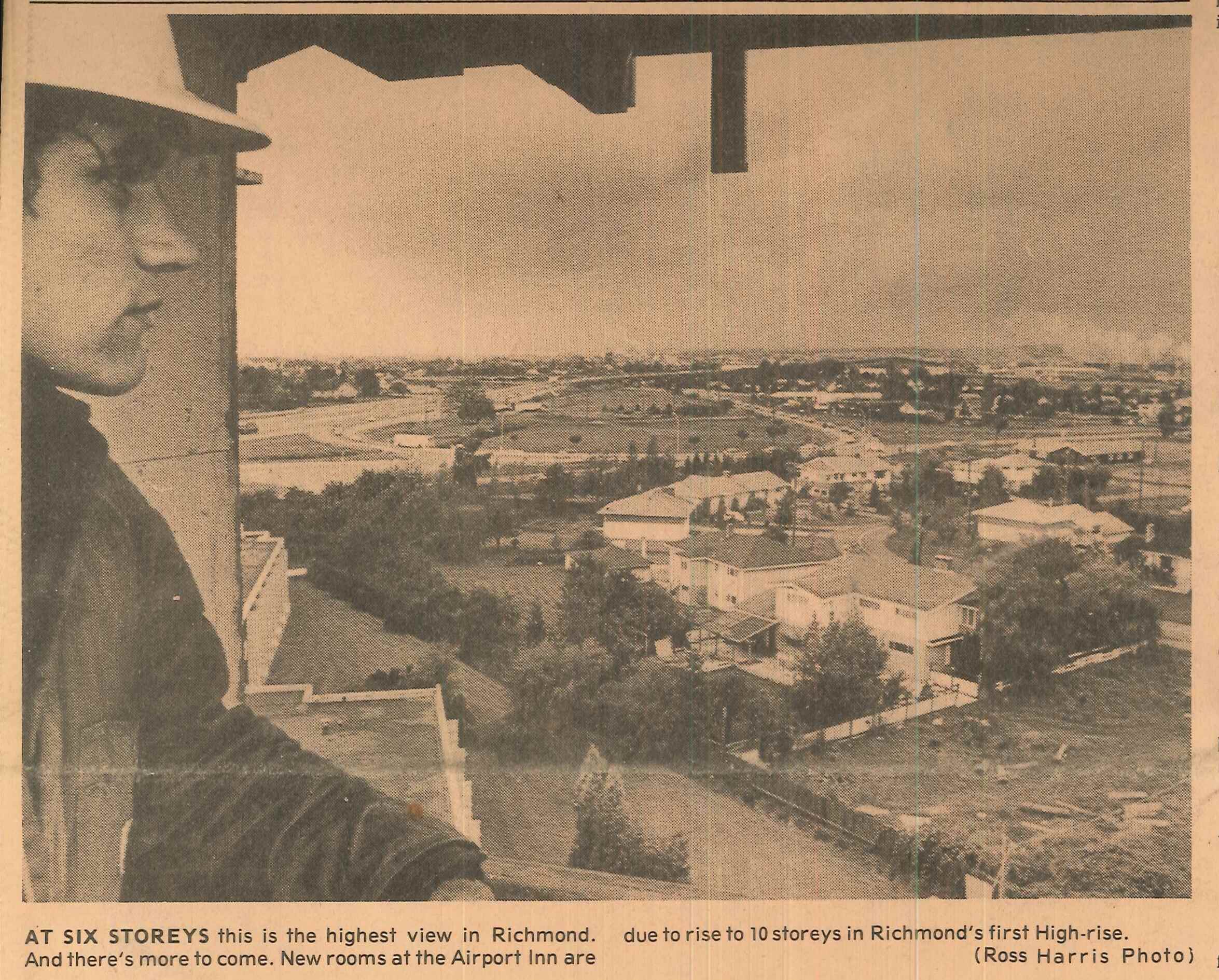
A preload of 25,000 yards of sand had already been in place before the project was announced in the June 9, 1971 Richmond Review and 126 piles had been driven 40 feet into the ground at the site to compact the soil and support the building. It was expected that after the completion of the first floor, each floor would only take one week to build. The tower had been completed by March 1972 and the rooms ready for guests by April.

By October 15, 1971 the Airport Inn claimed to have the highest view in Richmond. Richmond Review photograph.

These first four high rise building projects began a trend which continues today, and high rise buildings have come to dominate the city’s skyline, especially in the City Centre area. Which was Richmond’s first high rise? All four were under construction at the same time but by opening date, the Delta Airport Inn’s tower (now the Sandman Signature Airport Hotel) was the first in March 1972, followed closely by the Lion’s Manor and the first phase of the Park Towers in November 1972. The Airport Hyatt House Hotel (now the Pacific Gateway Hotel) on Sea Island was opened fourth, the following March. All of the buildings are still in use except for the Lion’s Manor which was demolished in 2014.

Richmond’s high rises are dwarfed by other buildings in the Metro Vancouver area. Transport Canada  mandates through the Vancouver Airport International Zoning Regulations that buildings in Richmond not exceed 47 meters (150 feet). There has been a study around the possibility of an increase in allowable building heights in the Brighouse area, something that is still ongoing, and it is possible that someday we may see buildings in Richmond that rival some of the “skyscrapers” seen in other cities.

Centres of Government – Richmond’s Town Halls – Part Four

Part Four – The Modern Tower

The City of Richmond was incorporated in 1990 and by then it was already obvious that the 1957 City Hall, even with its additions and improvements, was becoming unsuitable for the rapidly growing city. Staff reports detailed the inadequacy of the office space and the inefficiencies of operation in the existing facility. Council and senior city staff identified issues with the existing building and began studies to determine what was needed to meet the city’s requirements for the foreseeable future.

This image has an empty alt attribute; its file name is OldCityHallstaff.jpg
The third Richmond City Hall had been outgrown by the Municipality it had been designed to serve, even with nearly continuous upgrades and additions. Staff at the hall pose outside before the building was shut down and demolished. City of Richmond photograph.

In 1991 a Task Force was formed to explore the space requirements, cost benefits, and feasibility of the construction of a new City Hall. Many considerations were made regarding the construction of a new building over the modification of the existing one, the suitability of the location, and the design of a potential replacement. Detailed analysis found that the cost of upgrading the existing building would be at least 75% of the cost of a new facility. City owned and privately owned properties were considered as potential sites for a new hall but the location of the existing City Hall with its proximity to the School Board offices, RCMP Station and the new Cultural Centre, Senior’s Centre, Minoru Park, Arenas, and Brighouse Park, all fit in with the concept of a “Civic Centre” at the heart of Richmond’s City Centre. The Task Force also identified the opportunity to create an landmark building for the community.

After demolition of the old hall, site preparation and construction began. The under-building parking is a few feet below the water table and features a pump system to keep it dry. City of Richmond photograph.

By 1996 work on the project had progressed to the point where project management and architectural services, provided by KPMB Architects of Toronto, had been settled on. Mayor and Council formed a building committee and in 1997 city operations were moved from City Hall to another city owned property on Elmbridge Way to allow demolition of the old building to take place  and site preparation and construction of the new one to begin.

A public art project decorated the wall around the construction site on Granville Avenue. Two hundred plywood puzzle pieces were painted by more than 600 residents during the 1998 spring break at Lansdowne Park Mall. City of Richmond photograph.

The new building, unlike its predecessor, returned to the practice of the first two Town Halls, making space available for community events and public use. The award winning design featured four major building components.

Photo Collection 1999 City Hall Construction June 1999 In 1999 construction of the new City Hall was underway. City of Richmond Archives photograph.

The eight storey administrative tower includes the first floor “Front of House” area which clusters representatives from various City Departments in one area to provide one-stop-shopping and improve customer service.

The Administrative Tower, shown here looking south east, rises eight storeys at the corner of No.3 Road and Granville Avenue. City of Richmond photograph.

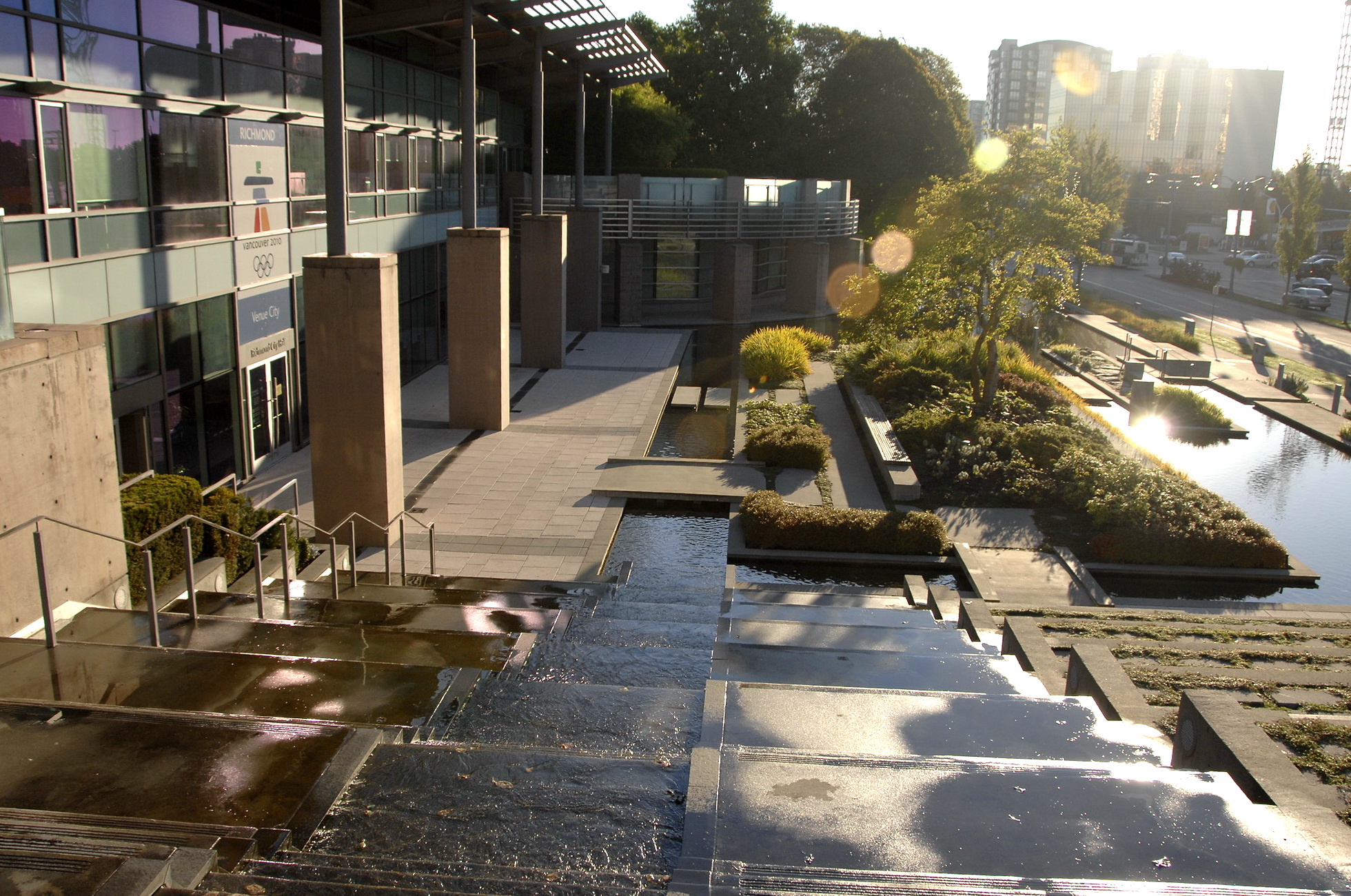
The circular council chamber over looks the southern terrace water garden which features an island to represent Richmond’s status as an Island City and is landscaped with native plant species.

Looking over the Water Garden toward the Council Chambers in the background. City of Richmond photograph.

The light filled, two storey Meeting House wing houses a variety of open public spaces and multi-purpose rooms and offices and extends to the west of the tower.

_KO19497 The two storey Meeting House features natural light, natural wood finishes, a mix of office and meeting spaces, public areas and a cafe. City of Richmond photograph.

The west terraces and civic square feature an outdoor stage, gardens, public art and access to the administrative tower and the Meeting House from the public parking area.

The West Terraces and Civic Square were an integral part of the O Zone during the 2010 Olympic Winter Games providing a large screen for watching events. Russ Bueker – City of Richmond Archives photograph.

The new Richmond City Hall was one of the first public buildings in the country to adopt the principles of Feng Shui in its design, consulting with a Feng Shui Master in the early planning stages of the project and throughout the construction phase. To quote Richmond Mayor Greg Halsey-Brandt who was in office for the duration of the project, ” Virtually every opening of a new building that I go to will have a Feng Shui master’s input. They do this all the time in the private sector because they are concerned about their customers, and the way I see it, we are no different. If we build a building that makes it uncomfortable for say, 20 per cent of our population, then that is not in the interest of the community we are trying to serve.”

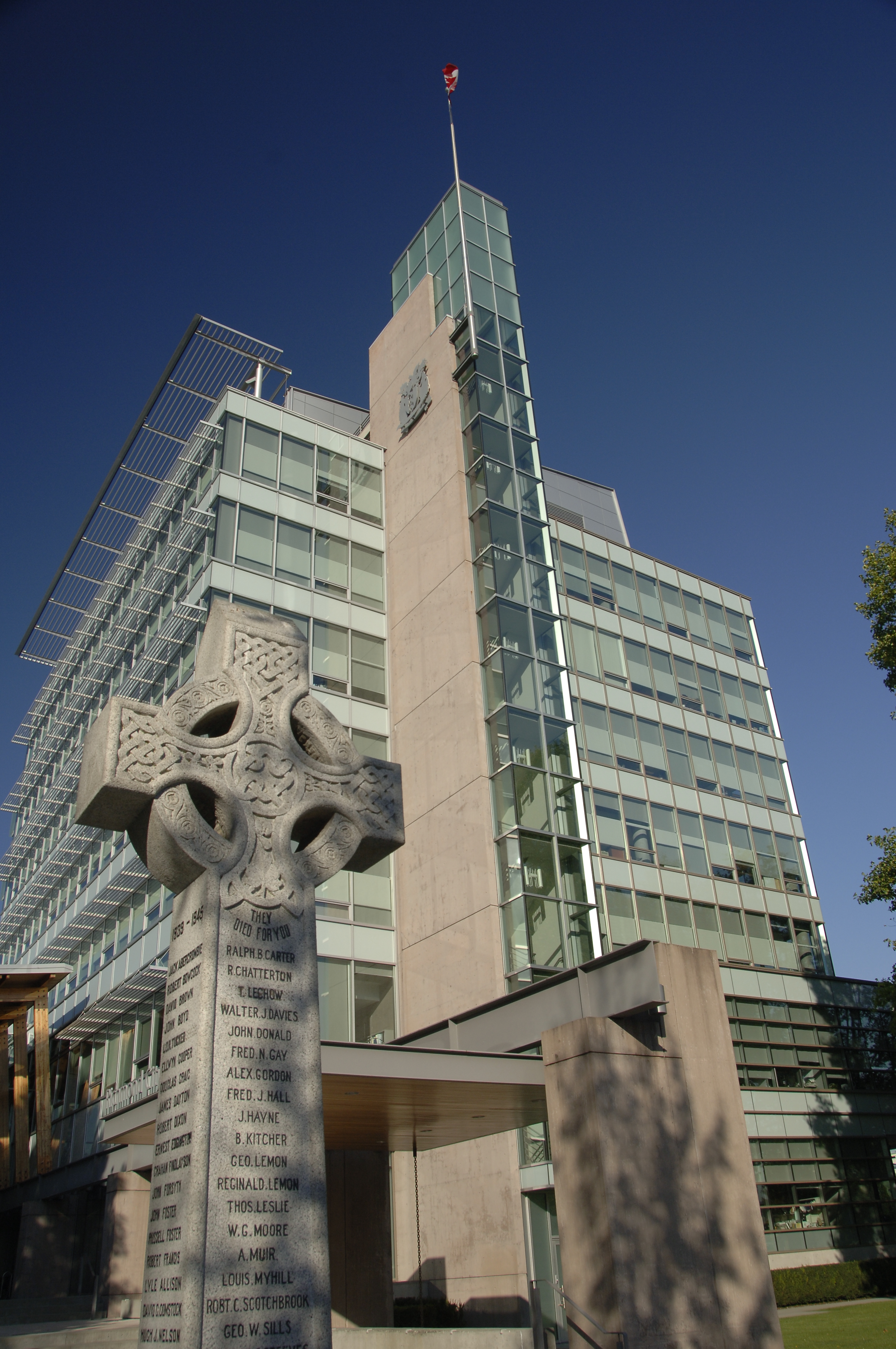
The reconditioned Cenotaph was replaced within feet of where it was originally sited in 1922. City of Richmond photograph.

The building, which cost around $39 Million to build, is designed with the best available technology to withstand earthquakes, provides good public accessibility and an effective, pleasant and safe workplace for employees.

The new City Hall opened for business on May 15, 2000 and several celebratory events were held afterwards. On May 20 an Official Opening Ceremony took place. This was followed by a Charity Gala on May 26, attended by more than 1200 guests. On June 6 the cenotaph, which had been refurbished while in storage during the construction project, was rededicated. It was installed very close to its original location on No.3 Road near the main entrance to the building. On June 12 a Recognition Social was held, attended by more than 1000 residents who had lived in Richmond for 50 years or more.

bphillips_Cityhall Crans 1_3824 During the 2010 Olympic Winter Games the Water Garden at City Hall was filled with cranberries from the local harvest. Brian Phillips – City of Richmond Archives photograph 1_3824.

In the nearly 140 years since the opening of the first Richmond Town Hall, Richmond has grown dramatically, a trend which continues. The first hall served a population of 250 to 300 people at a time when Richmond could still be considered a frontier settlement. By 1919 when the second hall was opened, the population had soared to 3110. In 1957 the third hall was built to provide services for a community of around 26,000 people. The present City Hall was built when the population was around 150,000, a number which is estimated to have swelled to 222,945 today. With the growing service requirements needed to operate our expanding city, space has again become tight at the hall. Some city departments have moved from the main hall to the City Hall Annex, the former Public Safety building vacated by the RCMP in 2011, which has alleviated crowding for, so for the foreseeable future, our fourth City Hall will continue to serve as our Centre of Government.

Back: Part Three – The 1950s Office Building.

https://richmondarchives.ca/2018/08/23/centres-of-government-richmonds-town-halls-part-three/

The North Arm of the Fraser – Industry in 1918

In October 1918, with the First World War nearly over, a group known as “The Joint Committee of the Boards of Trade of South Vancouver, Richmond and Point Grey” began to lobby the Federal Government to dredge the twelve miles of the North Arm of the Fraser between the river mouth and New Westminster. The shallow water in the North Arm at low tide caused fishing vessels, tugs and other vessels with a greater than three foot draft to run aground, stopping traffic to industries along its banks until higher water. This limited the amount of raw materials and product the industries could ship and discouraged new industry from building in the area. In an effort to motivate the government to their ends, the Joint Committee published a “memorial” for the attention of the Hon. F.B. Carvell, Minister of Public Works for the Conservative Government of the time, titled “The North Arm of the Fraser: Its Industries, Its Possibilities: A Plea for its Development”.

1987 91 1-5

The panoramic cover photo of the “memorial” shows some businesses in Marpole, which had changed its name from Eburne two years earlier. Shown are the Eburne Gravel Company and Eburne Sash, Door and Lumber, both at the foot of Hudson Street. City of Richmond Archives photograph 1987 91 1-5.

The document was signed by a diverse collection of politicians, industrialists, business owners, mariners and other citizens, all of them putting forth their justification for the dredging of the river. It also included a wonderful collection of photographs showing the North Arm and the industries along its shores in the early twentieth century.

1987 91 6-10

The first photo in the body of the memorial is this one of the North Arm Jetty. City of Richmond Archives photograph 1987 91 6-10.

The North Arm Jetty had been built and the mouth dredged some years before allowing vessels to enter the river on any stage of the tide and be protected from wind as they did so. Since then it was felt that the greater outflow caused lower levels farther up the North Arm and several shallow spots in the river preventing vessels with a deeper draft from proceeding up river until high tide. Logs would have to be placed into booming grounds down river where they could be picked up by smaller tugs rather than be delivered straight to the mills, increasing towing costs.

1987 91 19

The Huntting-Merritt Lumber Co. mill. City of Richmond Archives photograph 1987 91 19.

The Huntting-Merritt Lumber Company shingle mill was located at the foot of Granville Street on the Vancouver side of the river. They operated eleven shingle machines, day and night, and employed 100 men. Next door, the Eburne Sawmills Limited mill was having a difficult time handling logs and had to dredge their booming ground to allow the mill to keep employing 125 men at their mill.

1987 91 20

Logs bound for the Canadian Western Lumber Company are towed upstream toward the CP Railroad bridge. City of Richmond Archives photograph 1987 91 20.

1987 91 21

The Eburne Gravel Company Plant. City of Richmond Archives photograph 1987 91 21.

The Eburne Gravel Company sold builders’ supplies and coal and claimed that the difficulty of towing on the river cost them an additional 25 to 30 cents per ton for coal and 10 to 15 cents per yard of sand or gravel.

1987 91 22

The Graham Evaporating Plant at Marpole. City of Richmond Archives photograph 1987 91 22.

The Graham Evaporating Plant produced desiccated vegetables and green, dried, evaporated and canned apples, employing about 100 people. They handled about 25 to 30 tons of vegetables a day and employed 100 people. Most of their product was transported by “team” or rail but they felt that dredging the river would give them the opportunity to ship product by water, reducing costs.

1987 91 23

The Eburne Steel Company. City of Richmond Archives photograph 1987 91 23.

The Eburne Steel Company produced bar iron and steel ingots as well as other wartime necessities. They employed about 80 men. They were entirely dependent on rail transportation to receive their iron ore and ship out their products and said they would require tug and scow facilities to fully realize their business goals.

1987 91 24

The Dominion Creosoting and Lumber Limited lumber mill. City of Richmond Archives photograph 1987 91 24.

1987 91 25-27

The Dominion Creosoting and Lumber Limited creosoting plant. City of Richmond Archives photograph 1987 91 25-27.

The Dominion Creosoting and Lumber Limited operation in South Vancouver was also hampered by the problems of shipping their product to market. Their lumber mill employed 120 men. The creosoting operation had been idled because of a lack of creosote which was shipped from England. It was expected that when the war was over, this part of the plant would reopen and employ another 30 men. Their plant had the use of 1200 feet of river frontage. An improvement in shipping ability would greatly improve the profitability of their business. They claimed that theirs was only one of forty or fifty available industrial sites on the North Arm which could be developed if only the shipping issue could be rectified.

1987 91 36-40

The Canadian Western Lumber Company Limited mill at Fraser Mills is shown here with their fleet of tugs Joyful, Fearful, Cheerful, Gleeful and Dreadful. The Stern wheeler Senator Jansen is on the right and an unidentified small freighter loads on the left. City of Richmond Archives photograph 1987 91 36-40.

The Canadian Western Lumber Company Limited had a large operation at Fraser Mills, upriver from New Westminster. In their submission to the request for dredging they described the difficulty experienced by vessels going to their plant:

If the vessel and their tow enter the river at the beginning of the flood they can make it as far as Eburne as the force of the tide is spent and have enough water remaining to carry them through the Eburne Bridge, the Railway Bridge and Mitchell’s Bridge at Fraser Avenue. They then have to stay with their tows for 24 hours before being able to move again on the flood tide. On this flood they can make it as far as the New Westminster City Limits where they have to wait another 24 hours before proceeding to the mills past New Westminster.

1987 91 11

The Small and Bucklin Lumber Company Limited mill, New Westminster. City of Richmond Archives photograph 1987 91 11.

1987 91 12

The Brunette Saw Mill Company mill. In the background is the Iowa Lumber and Timber Company mill. City of Richmond Archives photo 1987 91 12.

The Small and Bucklin Lumber Company and the Brunette Sawmill Company each employed more than 200 men and both reiterated the complaints of other industries along the North Arm. Both plants were in New Westminster and had to wait for a couple of tides for logs to be delivered to their mills.

1987 91 13

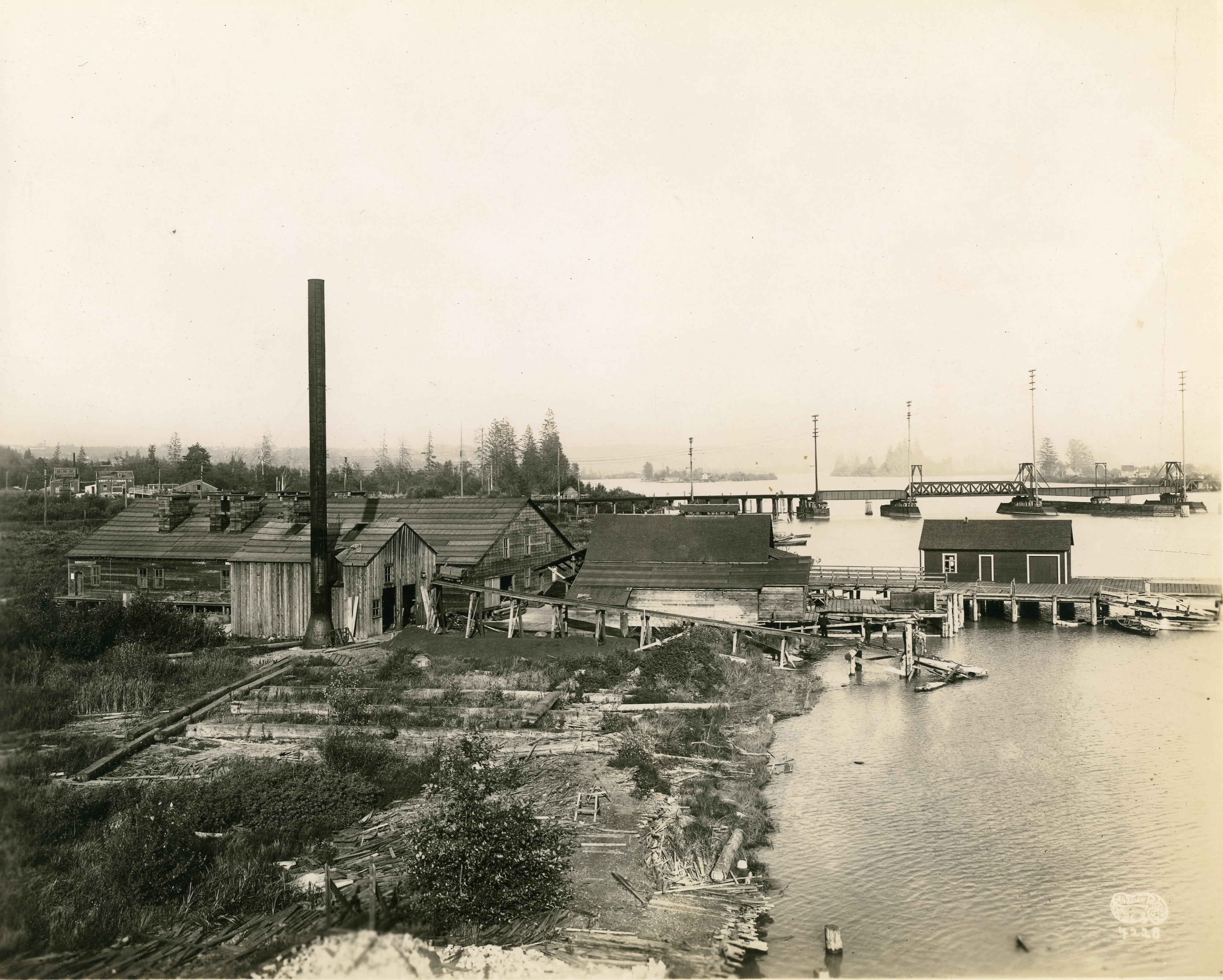
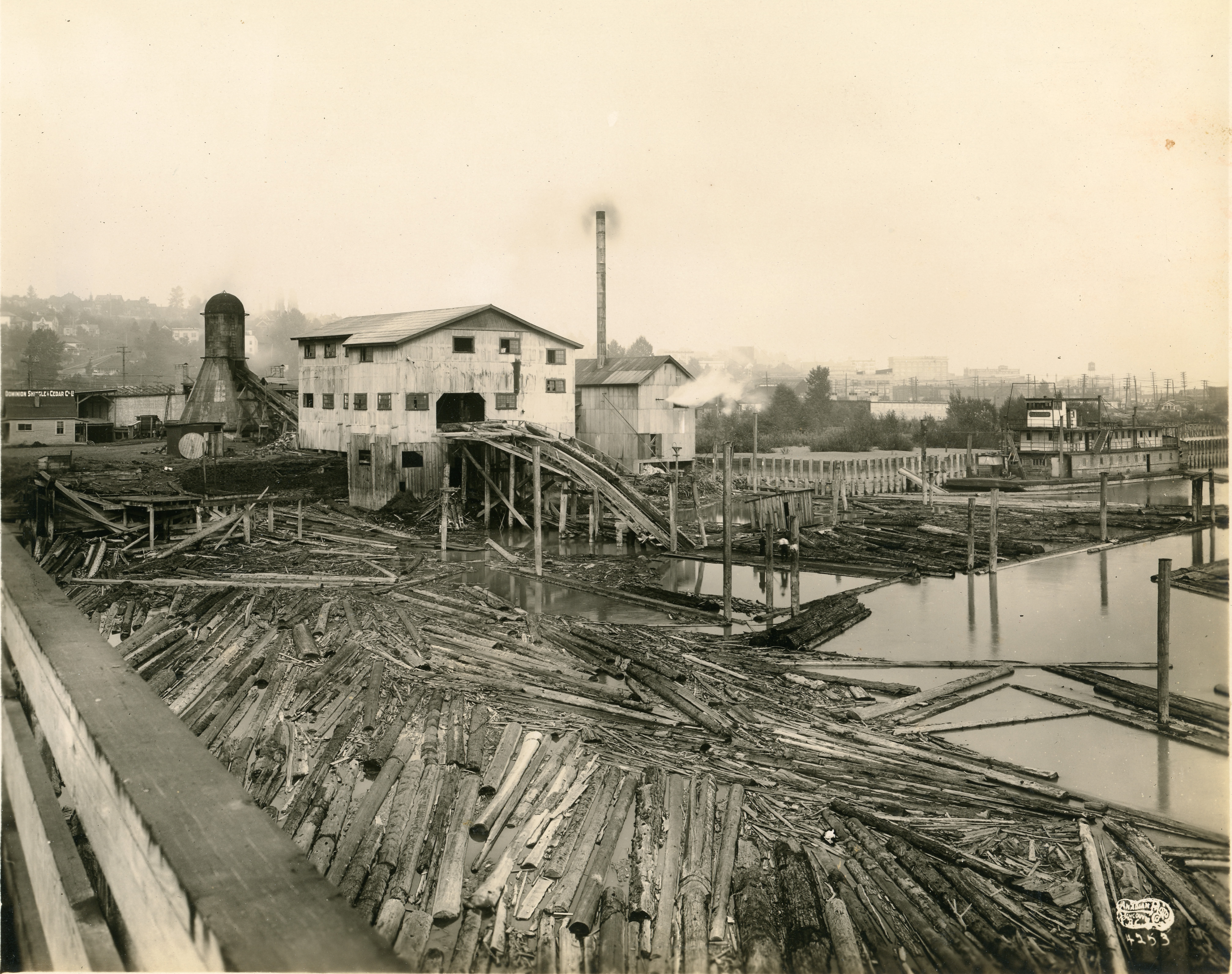
The Dominion Shingle and Cedar Co. is shown here in a photo taken from the old Queensborough Bridge. The skyline of New Westminster can be seen behind. City of Richmond Archives photograph 1987 19 13.

The Dominion Shingle and Cedar Company was located “at Lulu Island Bridge” (the old Queensborough Bridge) and employed about 50 men.

1987 91 14

The Westminster Mill Company plant at New Westminster. City of Richmond Archives photograph 1987 91 14.

The Westminster Mill Company, manufacturers of red cedar shingles, operated two mills just below New Westminster which employed 200 men. Most of the logs used in the mill were brought up the river and delays in delivery due to low water levels seriously impacted their bottom line.

The arguments must have had some effect as dredging did take place on the North Arm in 1918. Reports indicate that a dredge tore out a two inch steel waterline that Jacob Grauer had installed from the mainland to supply water to his store and butcher shop as well as his neighbors at Eburne on Sea Island.

1987 91 15-18

The final image in the document shows a tug towing a boom up river and another tug bringing a barge down river past the wooded tip of Eburne Island as a BC Electric Railway Interurban Tram heads to New Westminster. City of Richmond Archives photograph 1987 91 15-18.