What’s in a Name – Minoru Park

An oasis in Richmond’s City Centre, Minoru Park is home to a wide range of recreational and cultural facilities. Areas set up for a variety of field sports, a walking and running track, ice rinks and swimming pools, as well as museums, a library, archives, spaces for arts and crafts, senior’s facilities, etc. make the park a popular and well used part of life in our city. With the Japanese origin of the name Minoru, one might think that it connects to Richmond’s history of Japanese immigration, but in fact, the name comes to us from across the Atlantic Ocean.

Eida family-1

The Eida Family, clockwise from left, Tassa, Charlie, Claire, Kaiji and Minoru. (City of Richmond Archives photograph 2009 23)

Between 1906 and 1910, Colonel William Hall Walker, a wealthy Scotsman, was having a Japanese garden built at his estate, the Tully Stud near Kildare in Ireland. The gardens were laid out and built by Japanese master gardener Tassa Eida, who did such a magnificent job that the gardens remain a popular tourist attraction today. A successful breeder of race horses, Walker named one of his colts Minoru after the son of his gardener. In 1907, Col. Walker leased a half-dozen yearlings to King Edward VII, including Minoru.

The horse Minoru had a profitable career in the King’s colours, winning at Epsom as a two-year-old and, ridden by jockey Bertie Jones, winning the Greenham Stakes and the 2000 Guineas as a three-year-old. His greatest triumph was in winning the 1909 Epsom Derby for the King, the first time a reigning monarch had won the coveted prize. The horse came in fourth at the Doncaster St.Leger Stakes, missing a chance to win the British Triple Crown. Two more wins that year finished his year with five wins in seven starts.
2014 26 1

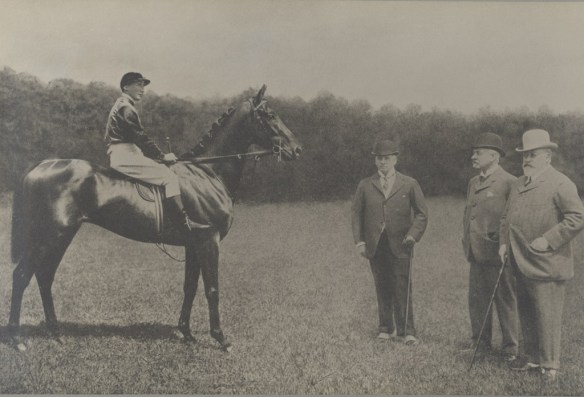
King Edward VII (R) with Minoru after winning the Epsom Derby in 1909. Bertie Jones is the jockey. (City of Richmond Archives photograph 2014 26 1)

In Richmond in 1909 a group of businessmen, Messrs. H. & T. Springer, Suckling, Lewis and Marpole, were building the Township’s first thoroughbred horseracing track on land they had purchased from Samuel Brighouse. In 90 days a mile-long oval, a grandstand, a clubhouse and a mile of barns were built at a cost of $75,000. In choosing a name for the track, they settled on the name of the horse that had just won the Derby for the King and Minoru Park Racetrack was born. Opening day at Minoru Park was attended by 7000 race fans.
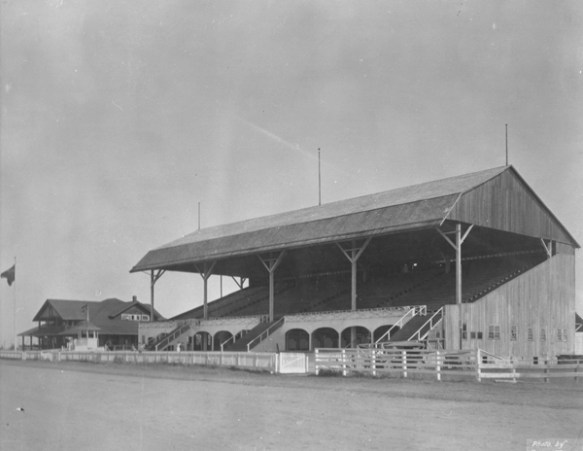
2001 09 24

The Minoru Park Racetrack grandstand and clubhouse in 1909. (City of Richmond Archives photograph 2001 9 24)

The track was used for many events in addition to horse racing. Minoru Park was used as a landing strip for aircraft, and was the location of the first flight by an airplane in Western Canada on March 25, 1910, the starting point for the first flight across the Rocky Mountains and the venue for air shows hosted by the Aerial League of Canada.
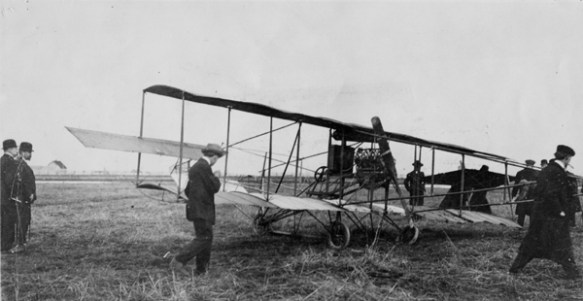
1978 15 18

On March 25, 1910 Mr. Charles K. Hamilton made the first aircraft flight in Western Canada, taking off in front of 3500 spectators at Minoru Racetrack. (City of Richmond Archives photograph 1978 15 18)

Automobile racing exhibitions were also held at the track, hosting well-known drivers like Barney Oldfield, Bob Burman and “Terrible” Teddy Tetzlaff and cars like the famous “Blitzen Benz” and the “Romano Special”. Polo matches were held in the middle of the track, temporary boxing rings were set up for fans of the pugilistic arts and community events, such as May Day celebrations, were held there as well.

1984 17 69

Racing driver Harry Hooper in the “Vulcan Kewpie” Stutz, accompanied by silent film star Priscilla Dean, raced against an airplane piloted by Lieut. G.K. Trim at Minoru in an event hosted by the Aerial League of Canada on Dominion Day, 1919. The event included lots of aerial stunts and wing walking. A house was erected in the middle of the track so it could be blown up by bombs dropped from aircraft, but exploded on its own, much to the amusement of the crowd. (City of Richmond Archives photograph 1984 17 69)

With the outbreak of World War I in 1914, Minoru Park closed until 1920 when it reopened and was renamed Brighouse Park. Brighouse Park Racetrack operated until 1941 when it closed for racing permanently, although it continued to be used as a training and boarding facility. The land was purchased by the British Columbia Turf and Country Club in 1945 and in 1958 the Municipality of Richmond purchased the property. The park reclaimed the name Minoru in 1960 to honour the long history of horse racing at the site. In 1962 the Mayor and Council purchased the Brighouse Estate, allowing the park to expand to its present size and develop into today’s complex of recreational parkland, buildings and services, a complex which is presently being upgraded with the construction of a new aquatic centre, sports facility and seniors facility.

This 1951 aerial view over the intersection of Granville Avenue and No.3 Road shows Brighouse (Minoru) Racetrack while under the ownership of the BC Turf and Country Club. Richmond Municipal Hall is on the corner in the same location as City Hall Today. (City of Richmond Archives photograph 1984 17 5)

This 1951 aerial view over the intersection of Granville Avenue and No.3 Road shows Brighouse (Minoru) Racetrack while under the ownership of the BC Turf and Country Club. Richmond Municipal Hall is on the corner in the same location as City Hall Today. (City of Richmond Archives photograph 1984 17 5)

Minoru the racehorse was retired to the Tully Stud in 1910 and in 1913 was sold to a Russian stud farm. The horse’s history after that is lost in the chaos of the Russian Revolution, although stories are told of Minoru being shot by an English officer to prevent him being abused by the Bolsheviks, or of a possible escape across Ukraine and Russia to the Black Sea and by ship to Turkey.
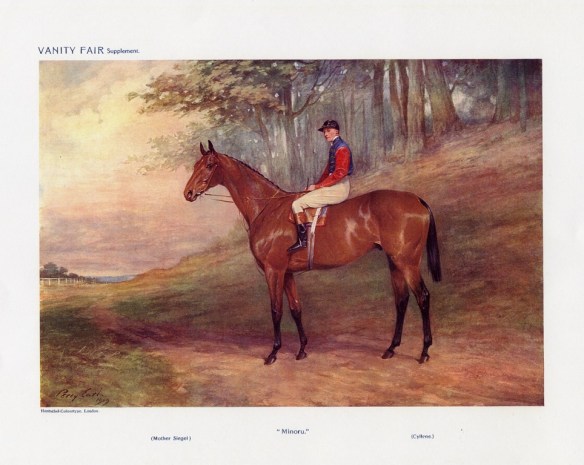
A print of Minoru from Vanity Fair, 1909. (City of Richmond Archives accession 2009 23)

A print of Minoru from Vanity Fair, 1909. (City of Richmond Archives accession 2009 23)

In 2009, in commemoration of the 100th Anniversary of the opening of Minoru Park, a bronze statue of Minoru was unveiled near the Richmond Cultural Centre. Created by artist Sergei Traschenko and donated to the City of Richmond by the Milan & Maureen Ilich Foundation, the statue was dedicated to the winning spirit of Richmond’s early pioneers of both Eastern and Western cultures and the men and women of the early thoroughbred racing industry in Richmond. The unveiling event was attended by many citizens and dignitaries, including Brian Eida, the son of Minoru (Jack) Eida who gave his name to a horse, which gave its name to a racetrack, which gave its name to a park.

The bronze statue of Minoru in Minoru Park. (City of Richmond Archives photograph)

The bronze statue of Minoru in Minoru Park. (City of Richmond Archives photograph)
 

Focus on the Record – Early Records of the Municipal Waterworks System

The importance of a municipal waterworks system to the daily lives of residents is often overlooked.  In Richmond, it wasn’t until 1910 that a system for piping drinking water was established.  Prior to this date, drinking water was normally available only through the use of rain barrels or by delivery, often in milk cans, by water wagon or train.

The development of Richmond’s waterworks system is well documented in records held at the City of Richmond Archives.  City bylaws, Council minutes and reports, and files relating to the building, regulation and taxation of the water system provide an accurate picture of its installation, maintenance, expansion and continual modernization.

First page of 1930 agreement whereby Richmond joined the Greater Vancouver Water District. City of Richmond Archives MR 66, File 548 First page of 1930 agreement whereby Richmond joined the Greater Vancouver Water District. City of Richmond Archives MR 66, File 548

Records at the Archives speak to the importance of the 1909 bylaw authorizing an agreement with the City of New Westminster to supply piped water to Richmond and the 1930 agreement to join the Greater Vancouver Water District and the implications of that to the present day.

Charles Jones, Waterworks Superintendent. City of Richmond Archives Photograph 1986 19 1 Charles Jones, Waterworks Superintendent. City of Richmond Archives Photograph 1986 19 1

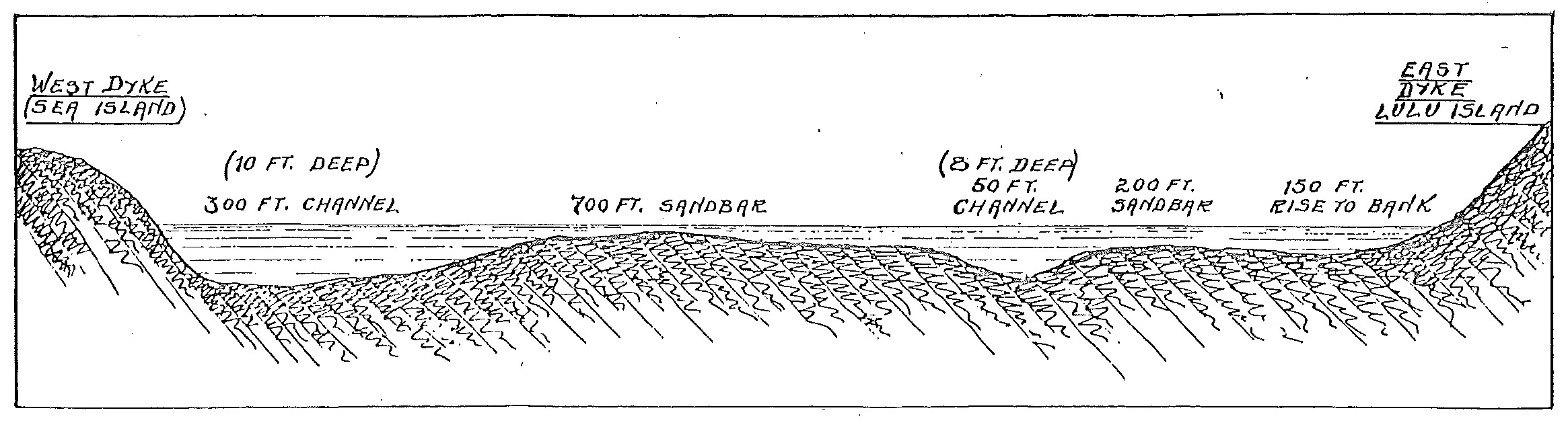
In addition to City government records, the private papers at the City of Richmond Archives of Charles Jones, the waterworks superintendent for the municipality from 1913 to 1952, enable researchers to understand the complexity of the work performed and the challenges facing a municipality situated on islands at the mouth of the Fraser River.  The manner in which Jones laid the watermain on the river bed to supply water from Lulu Island to Sea Island in 1937 was celebrated as a technical feat never before seen in the province.

Laying of Watermain to Sea Island. Diagram of the laying of the watermain to Sea Island, 1937. City of Richmond Archives Accession 2011 25

City records such as the 1936 Waterworks Atlas, which mapped all built structures in the municipality and their proximity to connections to watermains, are consulted on a regular basis today by environmental and property researchers studying land use and development in Richmond.

Waterworks atlas map for area near Alexandra Station, 1936. City of Richmond Archives Map 1991 40 75 Waterworks atlas map for area near Alexandra Station, 1936. City of Richmond Archives Map 1991 40 75

In total, the early records of waterworks tell the story of the growth of the municipality through the building of an infrastructure which many people now take for granted.

[Note – this is an updated version of an article first published in the Spring 2015 issue of the Archives News]

Registered Trademark – Commercial Art from the B.C. Packers Collection

The City of Richmond Archives acquired a large number of records of British Columbia Packers Ltd. at the time of the closure of its head office in Steveston. Among the records transferred to the Archives were an extensive series of files relating to the application for, registration, and maintenance of trademarks used and administered by the company and its predecessor and related companies. The records include trademark registrations, correspondence, product packaging, and hundreds of different labels that were in use from 1890 to 1999. Shown in this posting are a few of the trademarked labels owned by BC Packers which illustrate some of the themes used in marketing salmon.

Alexander Ewen was a pioneer in the canning industry on the Fraser River. In 1902 he became the president and largest shareholder of a new firm, The British Columbia Packers' Association. Shown here Ewen Brand Sockeye Salmon label from that era.

Alexander Ewen was a pioneer in the canning industry on the Fraser River. In 1902 he became the president and largest shareholder of a new firm, The British Columbia Packers’ Association. Shown here is an Ewen Brand Sockeye Salmon label from that era.

From the earliest years of salmon canning, the graphics used on the labels tended to be colourful and eye-grabbing to attract the consumer. Some of the earliest labels were printed in Victoria by the Colonist.

An 1891 Excelsior Brand salmon label. The cannery using this label was at Ladner's Landing, owned by E.A. Wadhams. The company shipped its product through its agents in San Francisco, D.L. Beck & Sons.

An 1891 Excelsior Brand salmon label. The cannery using this label was at Ladner’s Landing, owned by E.A. Wadhams. The company shipped its product through its agents in San Francisco, D.L. Beck & Sons.

Labels were sometimes printed and applied closer to the final market of the product, the cans being shipped “bright”, ie. without labels.

This label, also from 1891, was printed by the Canada Bank Note Co. in Montreal and included handling instructions in English and in French.

This label, also from 1891, was printed by the Canada Bank Note Co. in Montreal and included handling instructions in English and in French.

Trademarks had to be registered with the appropriate government department, in the case of Flagship Brand, the Department of Agriculture, Trade Mark and Copyright Branch in Ottawa. The registration document included a complete description of the label as shown below.

The trademark registration document for Flagship Brand Salmon, 1893.

The trademark registration document for Flagship Brand Salmon, 1893.

The Flagship Brand label was enticing on a number of levels. The “Flagship of modern pattern” and the Ensign and Union Jack made a patriotic connection to the British Motherland. The beautiful, wild British Columbia scenery showed the beauty of the land where the fish was caught, a wilderness tamed by the modern steam train on the right, all surrounded by a bright, eye-catching orange.

Flagship Brand, 1893.

Flagship Brand, 1893.

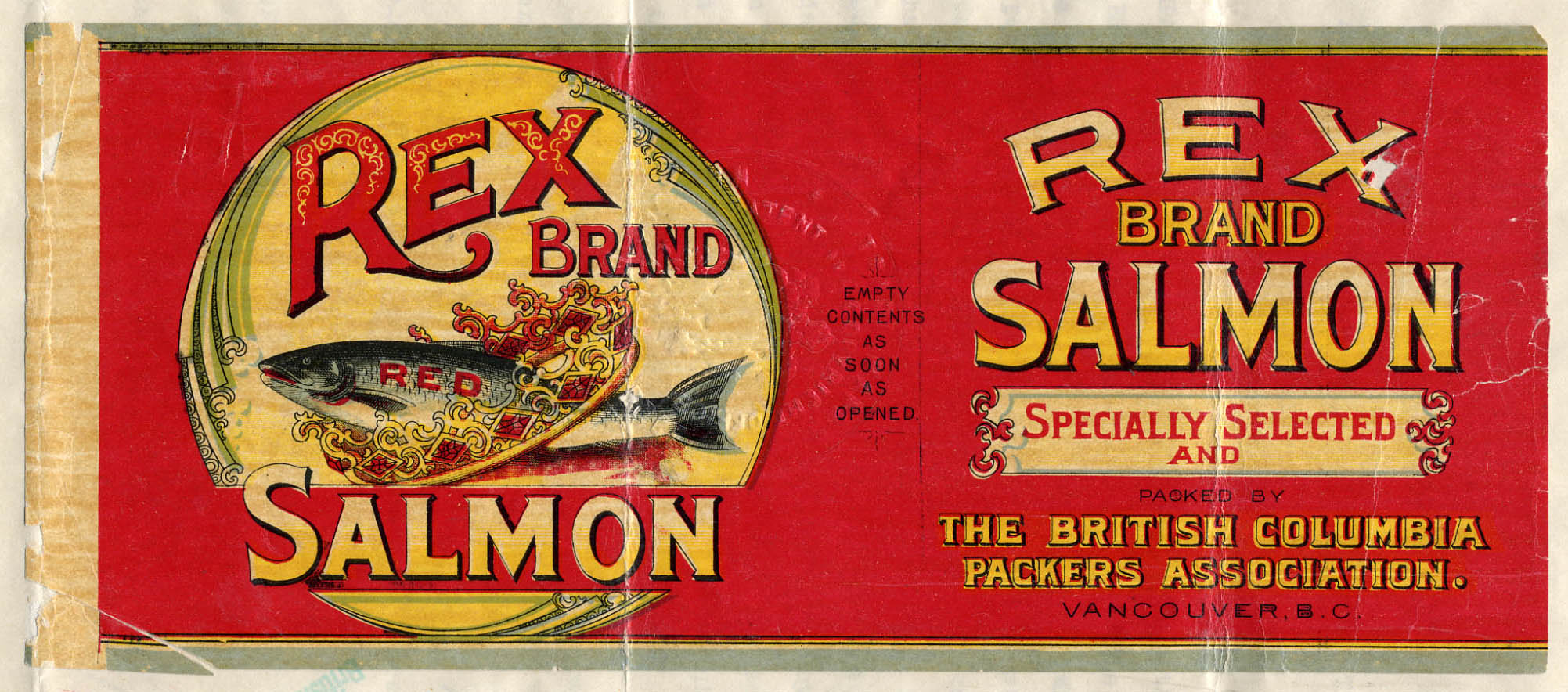
The majority of the BC fishery’s output was shipped for sale in Britain and nations of the British Empire, and as such, labels often carried some reference to the Monarchy or the Empire to encourage sale to patriotic shoppers. This could be done symbolically, as in Rex Brand, or directly with the words “British Empire Product” on the label, or in both ways.

Rex Brand Salmon's trademark showed a salmon leaping through a crown.

Rex Brand Salmon’s trademark, ca. 1906, showed a salmon leaping through a crown. The brand was registered in Australia and New Zealand starting in 1905.

Dominion Brand Salmon labels bore the image of the British Lion with

Dominion Brand Salmon labels bore the image of the British Lion with “British Empire Product” written in a banner below. This image was seen on many BC Packers labels.

Emblem

Emblem Brand, first registered in 1903, also bore the British Empire Lion Logo, as well as a Union Jack and the floral emblems of the United Kingdom. Emblem Brand was registered in Canada, Australia, New Zealand, South Africa, India and France.

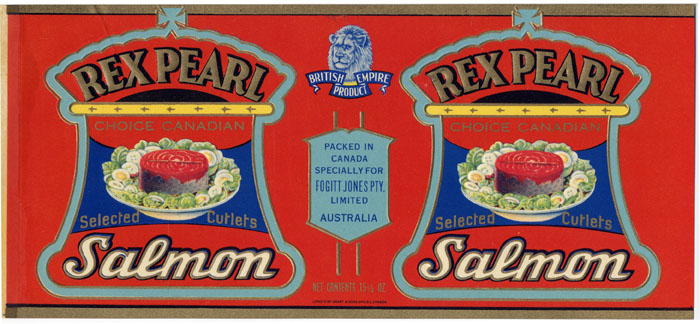
Products sold in other countries often had distinct labeling. Rex Pearl was a brand registered in Australia.

An Australian label for Rex Pearl Choice Canadian Salmon.

An Australian label for Rex Pearl Choice Canadian Salmon.

Trademarks had to be registered in all the countries where the products were sold. Cascade Brand was a registered trade mark in many countries, including the Netherlands, as shown below.

A Dutch Trademark Registration Certificate for Cascade Brand Salmon, 1947

A Dutch Trademark Registration Certificate for Cascade Brand Salmon, 1927

Labels were often thematic, trying to reach the consumer by appealing to their aesthetics. Many gave colourful representations of the magnificent scenery of British Columbia, sure to catch the discerning housewife’s eye as she did her shopping.

Sunset Brand Chum Salmon, with beautiful scenery.

Sunset Brand Chum Salmon, Trademark first registered in 1907, showing beautiful British Columbia scenery.

Canyon Brand

Canyon Brand Canadian Red Salmon, from the 1930s.

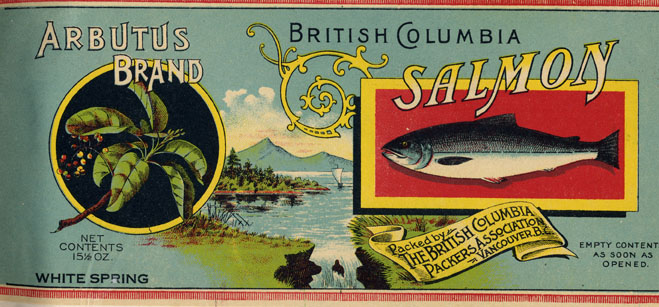
Arbutus Brand

Arbutus Brand White Spring salmon. Arbutus was first registered in 1906.

Occasionally, Canadian stereotypes were used to sell salmon. Nansen Brand in particular used scenes of ice and snow to represent the wild country that the fish came from. The brand was registered in Australia, New Zealand and Canada starting around 1918.

Nansen Brand with a polar bear on an ice floe.

Nansen Brand with a polar bear on an ice floe.

Nansen Brand with dog sled and trapper

Nansen Brand with snowy scenery and a dog sled and trapper on skis.

Some labels attempted to evoke feelings of hearth and home and good times with friends. Examples include Dinner Bell, Household and Table Talk brands.

Dinner Bell Brand

Dinner Bell Brand Fancy Pink Canadian Salmon. Dinner Bell was registered in New Zealand from 1938 to 1951.

Household Brand Salmon

Household Brand Fancy Canadian Red Salmon, registered in Canada from 1919 to 1969.

Table Talk Brand

Table Talk Brand Choice Red Cutlets.

Others used sports and other popular modern activities to promote the sales of their products.

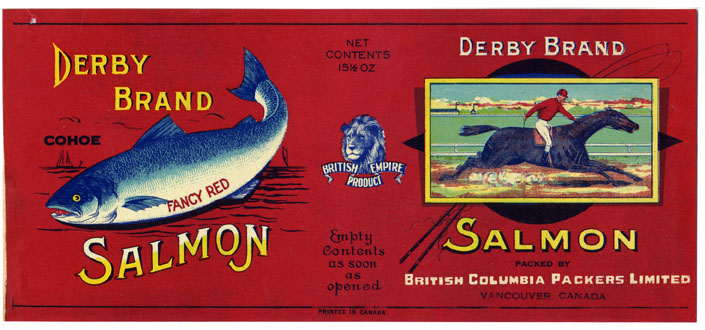
Derby brand for the horse racing fan

Derby brand for the horse racing fan, first registered in 1906.

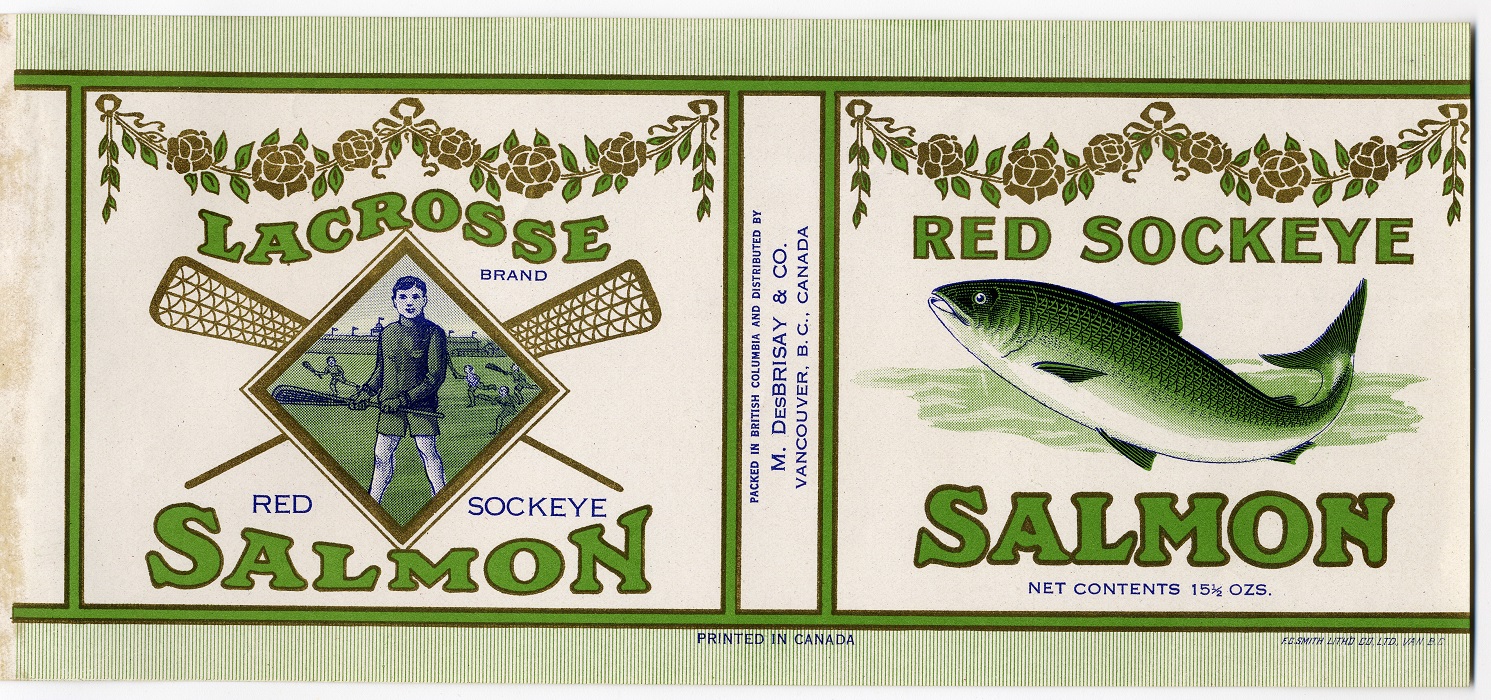
Lacrosse brand

Lacrosse brand.

Aviator Brand

Aviator Brand.

Of all the labels used to market salmon, the one with the longest history must be Clover Leaf. One of the best known brands, it was originally registered by a New York company in 1890, being transferred to the British Columbia Packers Association around 1908. The Brand was used on many varieties of canned goods such as vegetables and soups as well as the seafood products that it is best known for. The brand is still in use today, passed on from BC Packers, and can be seen in just about any supermarket.

The Clover Leaf Brand is perhaps one of the best known and longest used trademarks from BC Packers.

The Clover Leaf Brand is perhaps one of the best known and longest used trademarks from BC Packers.

So, while BC Packers has gone and most of the trademarks controlled by it have vanished, one at least remains to remind us of the company’s long history of quality seafood production and its long connection to Richmond.

New at the Archives – Engineering Richmond

Part of an ongoing program to digitize historical images at the City of Richmond Archives are 980 slides taken by Richmond’s Engineering Department documenting a variety of major infrastructure projects in the municipality between 1969 and 1977. Highlighted here are just two projects from 1969: the construction of the Dinsmore Bridge and the Gilbert Trunk Sewer.

Dinsmore Bridge under Construction

Dinsmore Bridge under Construction, February 1969. (City of Richmond Archives Photograph 1988 123 461)

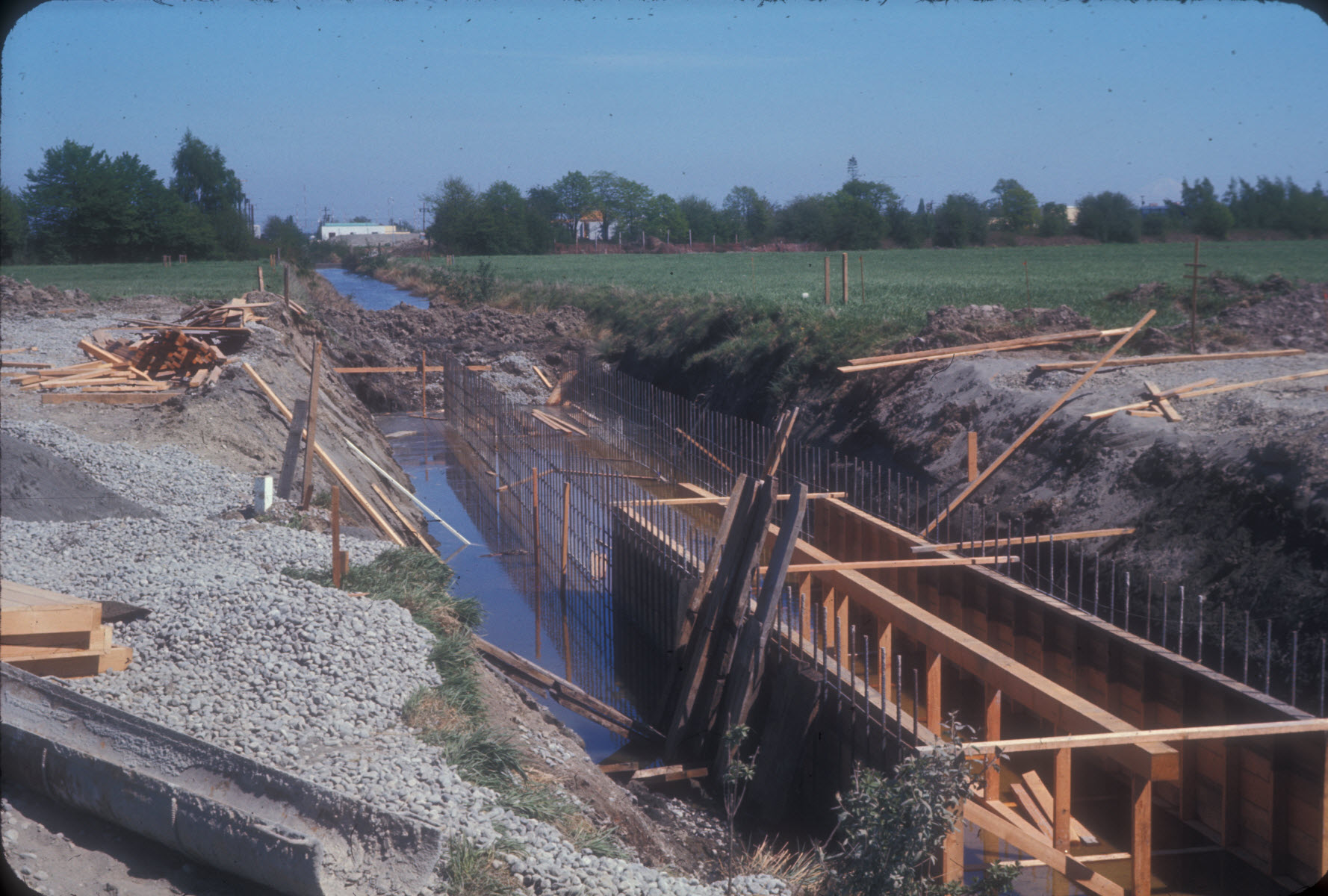
Before the opening of the bridge in 1969, the only connection between Sea Island and Lulu Island was the Moray Channel Bridge, built in 1957 to replace the old Middle Arm span of the Marpole Bridge. While the Dinsmore Bridge itself was built with funding from the Federal government, the approaches to the new bridge connecting Gilbert Road to Russ Baker Way were the responsibility of the municipal government. Part of the construction of the bridge approaches required the crossing of some of Richmond’s existing infrastructure, such as the Lansdowne Canal, as shown below.

Crossing for Lansdowne Canal

Construction of the Crossing for Lansdowne Canal from the Dinsmore Bridge. (City of Richmond Archives Photograph 1988 123 472)

Another major construction project in 1969 was the Gilbert Road Trunk sewer, designed to collect sewage from lateral feeder pipes extending east and west to transport raw sewage south to an outfall in the South Arm of the Fraser.

Gilbert Road Trunk Sewer - Laying  Pipe

Gilbert Road Trunk Sewer – Laying Pipe near Westminster Highway, March 1969. (City of Richmond Archives Photograph 1988 123 431)

The new sewage system was designed to replace an older patchwork of collectors and outfalls. Today, the Gilbert Road Trunk Sewer No. 2, a parallel system,  is under construction by Metro Vancouver.

Gilbert Road Trunk Sewer

The Gilbert Road Trunk Sewer – Looking North from Westminster Highway. (City of Richmond Archives Photograph 1988 123 430)

Before 1973, when the Lulu Island Wastewater Treatment Plant at the south end of Gilbert Road became operational, the pipe discharged untreated sewage directly into the south arm of the Fraser River near the foot of Gilbert Road.

Sewer Outfall - the launch

The Placement of the Gilbert Road Sewer Outfall at the South Arm. (City of Richmond Archives Photograph 1988 123 401)

Other Engineering Department activities documented by the recently-digitized group of photographs include dyking and drainage projects, traffic and intersection studies, and aerial surveying of fire halls, municipal buildings and parks and recreation areas.

From the Archives Kitchen – Hermit Cookies

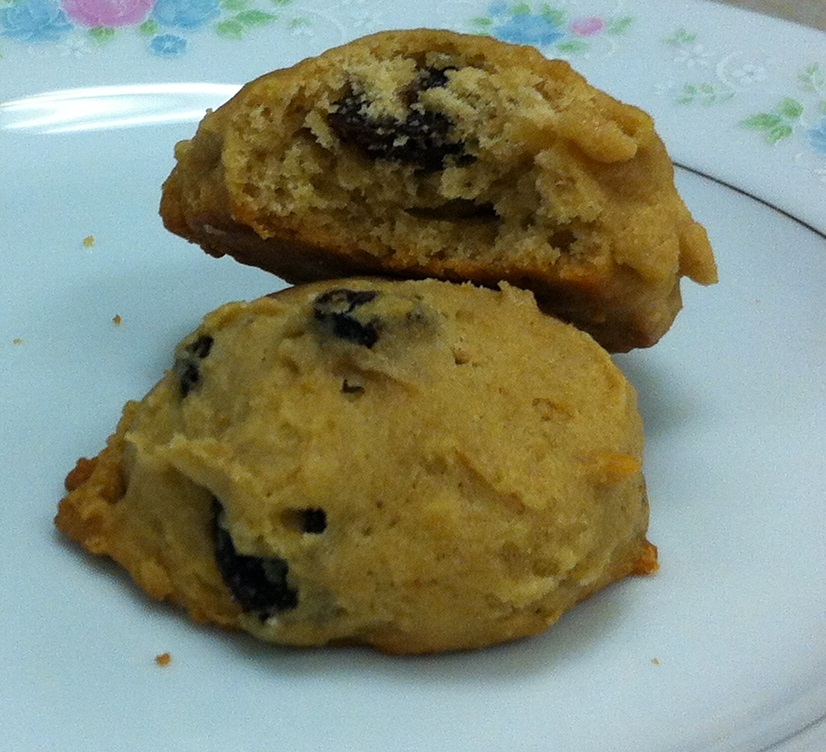
Freshly-baked hermits, using Hettie London's 1902 cookbook. John Campbell photograph

Freshly-baked hermits, using Mrs. Charles London’s 1902 cookbook. (John Campbell photograph)
Imagine yourself in the kitchen of the farmhouse at London Farm in the early part of the last century, thinking about a nice treat for your cook to bake for the family. You go through your favourite cookbook and voila, you find a healthy, yet simple recipe for hermit cookies.

Cover of "Woman's Favorite Cook Book," published in 1902 and used by the London family. City of Richmond Archives reference file

Cover of “Woman’s Favorite Cook Book,” published in 1902 and used by the London family. City of Richmond Archives reference files

This is what Hetty London, wife of pioneer farmer Charles London, might have done using her “Woman’s Favorite Cook Book”, published in 1902, and found with old records of the London family now in the holdings of the City of Richmond Archives.

London Farmhouse, 1908. City of Richmond Archives Photograph 2009 16 75

London Farmhouse, 1908. City of Richmond Archives Photograph 2009 16 75

Charles London and his brother William purchased land in the South Arm district of Richmond in the 1880s, the area taking on the name of “London”. After their marriage, Charles and his wife Henrietta (Hetty) built their farmhouse, where they raised a family of eight children (three of whom died as infants.)  In 1978, the farmhouse was designated as a heritage site and the next year was purchased by the municipality to be restored as a heritage property.

London Farmhouse after restoration by the municipality. City of Richmond Archives Photograph 2009 16 13-4-3-1

London Farmhouse after restoration by the municipality. City of Richmond Archives Photograph 2009 16 13-4-3-1

The recipe for “hermits” found in Mrs. London’s old cookbook was particularly appealing to Precilla Huang, professional pastry chef and Board member of the Friends of the Richmond Archives, because it represented simpler times and the use of wholesome ingredients.

Recipe for Hermits from "Woman's Favorite Cook Book." City of Richmond Archives reference files

Recipe for Hermits from “Woman’s Favorite Cook Book.” City of Richmond Archives reference files

The result of Precilla’s baking was a tasty drop cookie, not too sweet but rich with buttermilk and lightly spiced with a hint of nutmeg.

A plate of hermit cookies hot out of the oven. (John Campbell photograph)

A plate of hermit cookies hot out of the oven. (John Campbell photograph)

Imagine the fragrance of the batch of cookies coming out of the oven, and the enjoyment they would have brought to the London family and guests.