Motion Pictures have been entertaining people since the first public showings in the 1890s. In 1898, Vancouver’s first motion picture was played in a warehouse on Cordova Street by John A. Shuberg, a Swedish immigrant who had purchased one of Edison’s Kinetograph machines, the first commercially available projector. The show featured moving images from the Spanish-American War with Shuberg adding sound effects from behind the screen by banging sheets of tin and shooting guns. After a two-week sold out run he took the show on the road, building a portable tent theatre and touring around Canada and the United States. Upon returning to Vancouver in 1902 Shuberg opened the “Edison Electric Theatre” on Cordova Street, converting the Central Hotel into Canada’s first movie house. The movie industry has grown exponentially since those days, surviving the Great Depression, World Wars and predictions of its impending doom because of influences like television, home movie rentals and streaming services. Richmond has had a number of venues where locals could enjoy a the latest Hollywood release without leaving the community. Here are the places that they could go to enjoy a movie over the years.
The Richmond Theatre
Eugene Greczmiel was a well-known and respected resident of Richmond whose life story is filled with tales of entrepreneurial determination and success. In 1929 he opened the Richmond Theatre, the first one in town. The theatre was located on Moncton Street in a building which survived the 1918 Steveston Fire and still stands today. Greczmiel played silent movies twice a week at the picture show and included imported Japanese films to attract moviegoers from the large Japanese Canadian population in Steveston.

When “talkies” became the latest thing he built his own sound head for the projector for a cost of $175, saving thousands on the cost of buying one. In his own words, “It worked, but it wasn’t very good.” “Lots of music, little speech.” Around 1932 Mr. Greczmiel opened the Marpole Theatre on the Vancouver side of the River and the Richmond Theatre was closed. The building at 3700 Moncton Street was the location of the Redden Net Company for many years and at present is a dental office.

The Steva Theatre
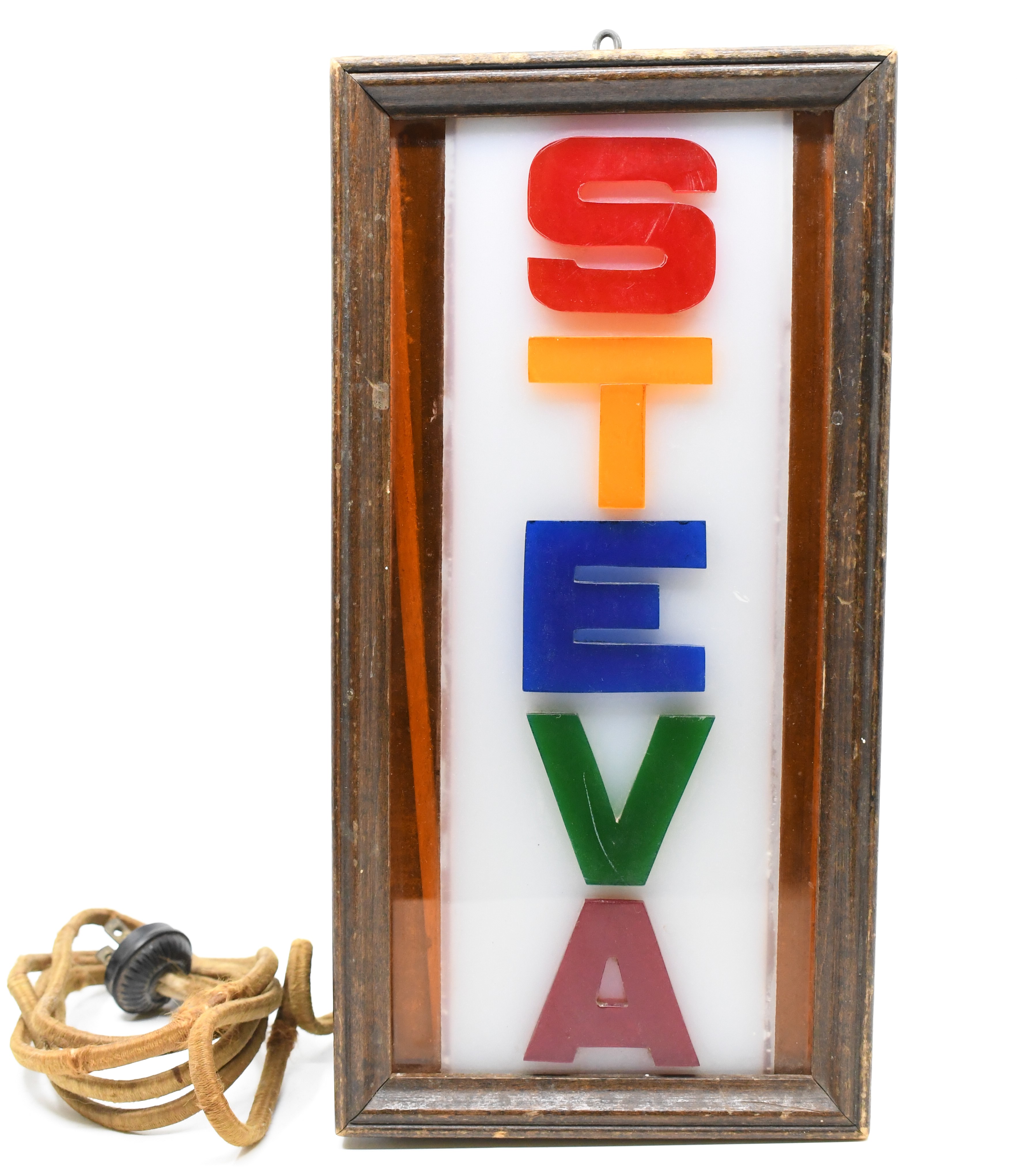
Richmond’s next movie theatre was also located in Steveston. In 1945, Washington Thorne moved to Richmond from Saskatchewan, along with his wife Helen and son Brian. Bemoaning the fact that Richmondites had to travel all the way to Vancouver to go to a movie, in 1946 he began the transformation of the former Japanese Buddhist Temple on First Avenue into a 420 seat movie house.

The building was rewired and a decorative façade added to the front. Red leather seating with wooden arm rests were installed, a stage was erected and “teaser” curtains hung on either side to frame the twelve by sixteen foot, glass beaded movie screen.

Restrooms, a concession stand and projection room were constructed. The Steva Theatre opened for business on October 3, 1947 with a sold-out showing of “Black Beauty” starring Mona Freeman and Richard Denning.
There were living quarters in the back of the theatre that the Thorne family occupied. The family also made up most of the theatre’s staff, Wash Thorne doing promotional work as well as operating one of the two projectors along with a hired projectionist, Helen and a friend took care of the ticket booth and concession stand and Brian sold popcorn outside to the people lined up on the sidewalk. Janitorial duties were shared by everyone. Three different movies were played each week and matinees for the kids were played on Saturdays. Even with a busy showing schedule like this, there was seldom an empty theatre. Mr. Thorne’s prowess at bidding for movies often resulted in new releases being shown at the Steva before they hit the theatres in Vancouver. Admission in the late 1940s was ten cents for features and five cents for matinees.
Special events to attract movie goers were another factor in the Steva’s success. “Foto Nites” were one event used by theatres around North America. Audience members and participants in an amateur contest would be given numbers. The winner of the contest would reveal their number and if an member of the audience had the same number they would have their “Foto” taken and be awarded the prize of $200, a nice sum in the 1950s! The “Foto” would be posted at the theatre, the whole procedure necessary to avoid breaking any laws about gambling or lotteries.

To take advantage of the 1950s 3-D movie craze, Mr. Thorne upgraded the theatre, installing a 20 HP generator, a new sound system and a polarized screen. In August 1953 Paramount’s first 3-D picture, “Sangaree,” played for a full week, followed by “House Of Wax” with Vincent Price in September. Cardboard 3-D glasses were included in the price of admission.

The Steva Theatre closed in 1960 and the building was sold in 1972. Today in the building where excited children filled the seats to see the latest Western, other children attend a daycare and children’s learning centre.
The Lulu Theatre
The March 5, 1947 issue of the Richmond Review announced the granting of two licenses for “Two New Theatres For Richmond – One at Steveston, One at Brighouse.” The one at Steveston was of course the Steva Theatre. The second, the “Brighouse Theatre” proposed by Peter Barnes of the Photo Night Company and backed by Harry Reifel, required the construction of a new building. There were many delays that affected the building of this theatre. Another company had already been granted a license in 1946 to build a theatre in the Brighouse area which stipulated that no other theatre could be built within two and one half miles. The failure of this company to show any progress on the project resulted in the withdrawal of their license allowing construction to begin. The building at 608 No. 3 Road was put up by Alex Mudry, A.G. Silverton and William Thomson who then sold it to Peter Barnes, “an expert at the business” who owned and operated theatres around the lower mainland and in Ontario.

Barnes changed the theatre’s name to The Lulu Theatre and outfitted it with the “very newest of equipment.” The front of the building featured a neon lit marquee topped by a tall vertical floodlit structure with three foot tall red letters spelling the word “LULU”.
The interior of the theatre was decorated in shades of red and blue. Seating for 449 people was provided, upholstered in wine coloured fabric with wood arms. Carpeting was wine coloured and the draw curtain in front of the screen was in magenta with gold satin trim.
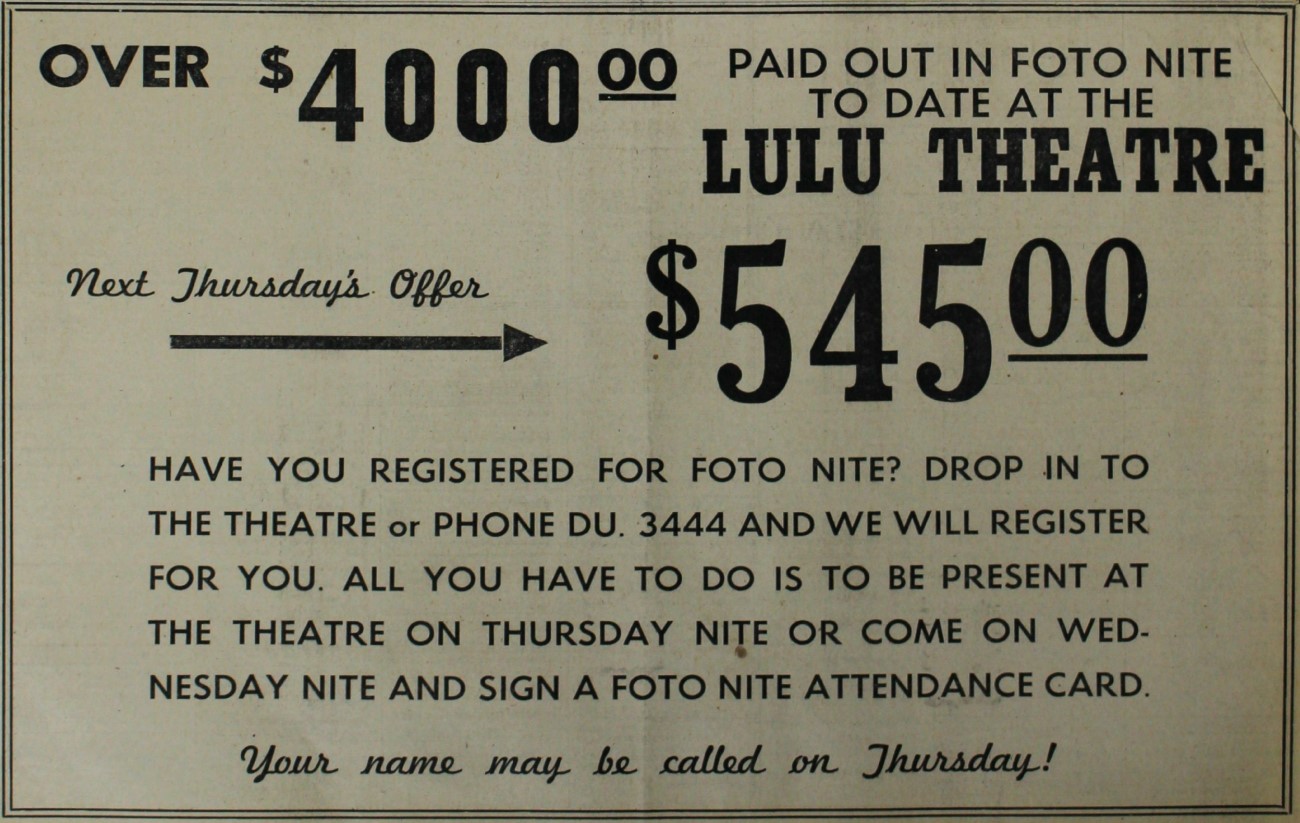
The Lulu had its first showing on May 12, 1948 with “Blue Skies” starring Bing Crosby, Fred Astaire and Joan Caulfield, a musical comedy based on a story by Irving Berlin. Opening night was attended by Reeve R.M. Grauer who congratulated Alex Mudry, A.G. Silverton and William Thomson on the accomplishment of having the theatre built and ready in only four months, introduced the owner and operator Peter Barnes and declared the theatre open. The Lulu played three different movies a week, featured “Foto-Nite” contests on Wednesday and Thursday and Saturday matinees. Admission for adults was 40 cents, children 20 cents, matinees were 25 cents for adults and children 5 cents.
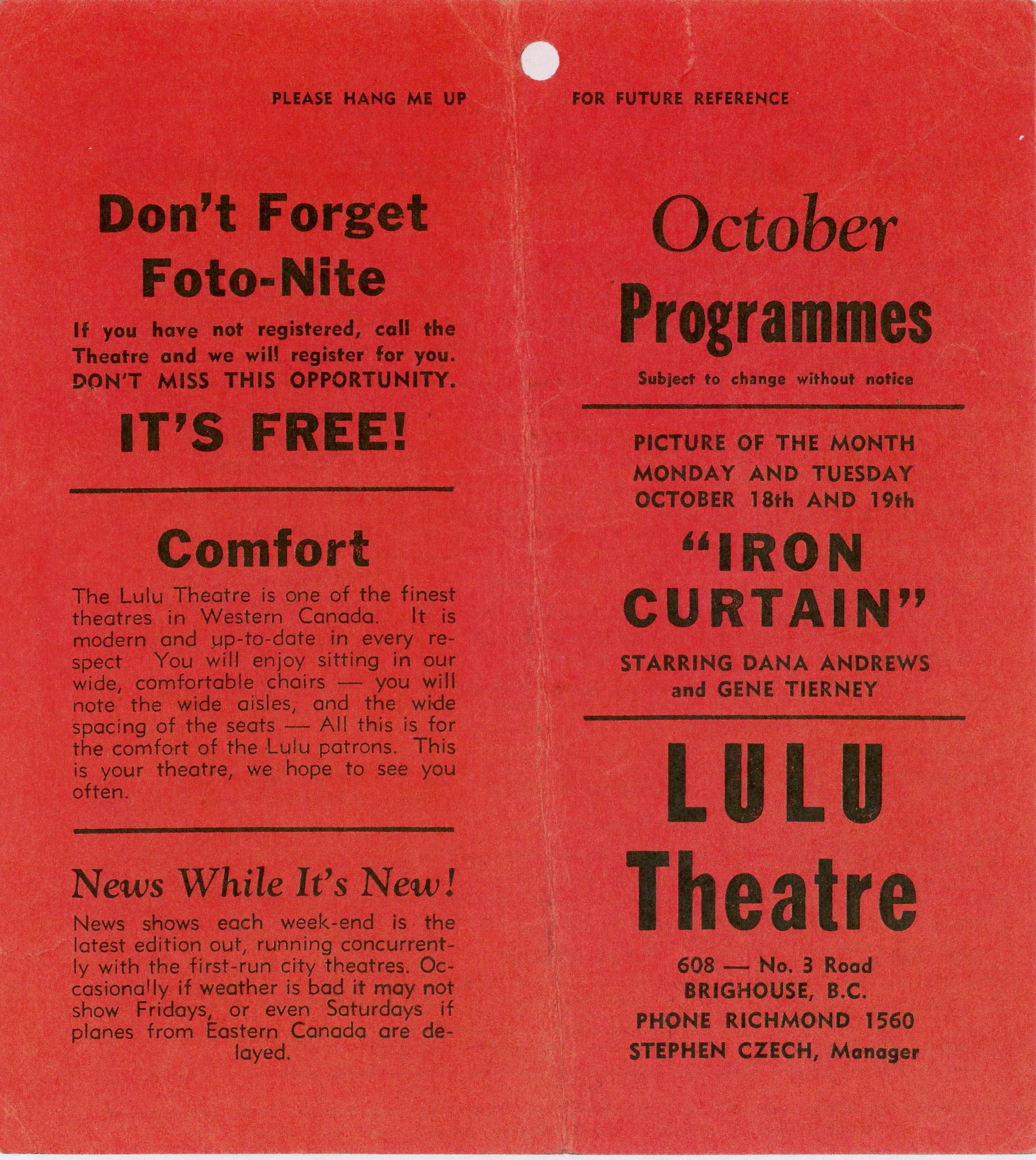

It is not known exactly when movies stopped being shown at the Lulu Theatre but advertising for coming features in the Richmond Review newspaper stopped after the March 26, 1958 edition. The building remained in use as the home for a variety of businesses until it was demolished in the late 1990s.
The Delta Drive-In
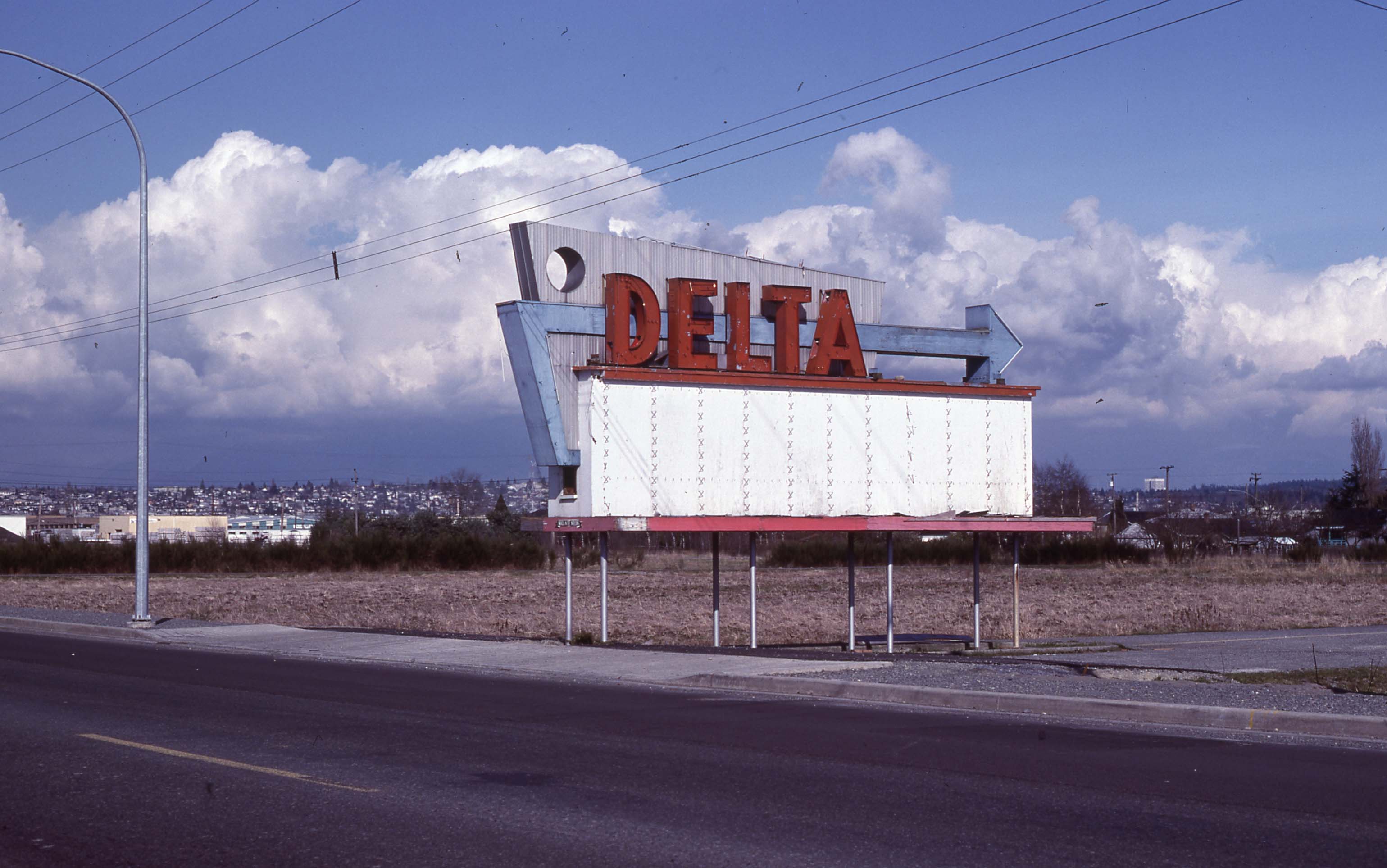
The headline in the January 21, 1953 Richmond Review read, “Richmond to Have Drive-in Theatre For This Summer.” The Chechik Brothers from Mayer Enterprises had requested to Municipal Council that 40 acres of land purchased from L.F. Mitchell on No.5 Road, just north of Mitchell School, be rezoned to allow the construction of the “Fraser Drive-In Theatre.” The brothers were well prepared for their presentation to Council, with plans for dealing with traffic and noise and with references and photos from other communities where Mayer Enterprises had set up and operated other Drive-ins, proving that the development would be a “credit to the community.” The rezoning was granted after the obligatory waiting period and construction began.

It only took ten weeks for construction to be completed. This included the laying of forty thousand yards of sand, twelve thousand yards of gravel and the driving of 20 piles to support the 50 foot wide screen. A building was erected to house the cafeteria style snack bar and projection room equipped with a 100 amp water cooled projector powered by a 20 horsepower generator. A playground was installed to keep the kids occupied while Mom and Dad enjoyed the movie with sound track provided by speakers which hooked inside the window of the car. The name of the drive-in had also been changed to the “Delta Drive-In”

In March a request to council was made on behalf of the owner of the Lulu Theatre for the rezoning of land next to the unfinished Delta Drive-In for the building of a second drive-in. This request was objected to by the RCMP, Public Works and community groups and was subsequently rejected.

The Delta Drive-In opened for business on Wednesday, May 13, 1953 with a showing of “Ten Tall Men,” a French Foreign Legion Action, Adventure movie starring Burt Lancaster. Also shown was the Walt Disney live animal Feature “Beaver Valley” and a cartoon. Admission for adults was 60 cents on weekdays, 75 cents on Saturdays and holidays, students (12 to 18 years) 40 cents on weekdays and 50 cents Saturdays and holidays. Children under 12 got in free.

The Delta Drive-In operated until 1980, featuring films of every genre and offering space for well attended “Swap Meets” on Sundays. By 1984 the land was being redeveloped for townhouse complexes and single family dwellings and the old entrance to the Delta Drive-In was replaced by Greenland Drive.

The Famous Players Richmond Square Twin Theatres
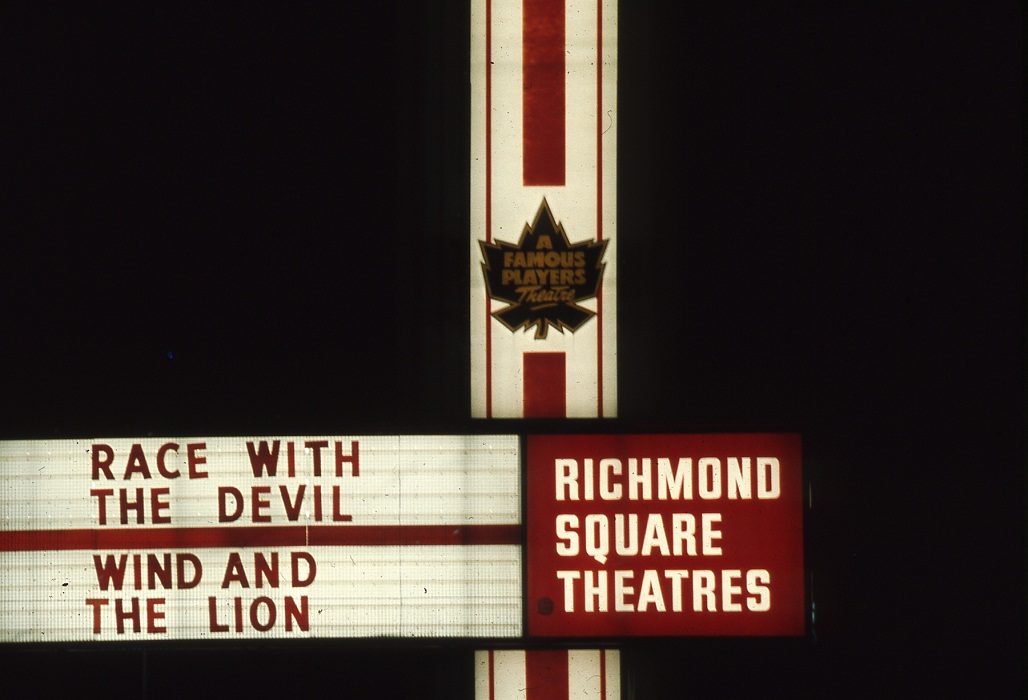
The Richmond Square Twin Theatres were located in the west parking lot at the Richmond Square Shopping Centre in a stand alone concrete building. It was Richmond’s first multi-screen cinema.


The theatre opened on June 27, 1968 with the features “The Odd Couple,” starring Jack Lemmon and Walter Matthau and a Disney feature, “The One and Only, Genuine, Original Family Band” with Walter Brennan, Buddy Ebsen, Disney staple Kurt Russell and the film debut of his future wife, Goldie Hawn.

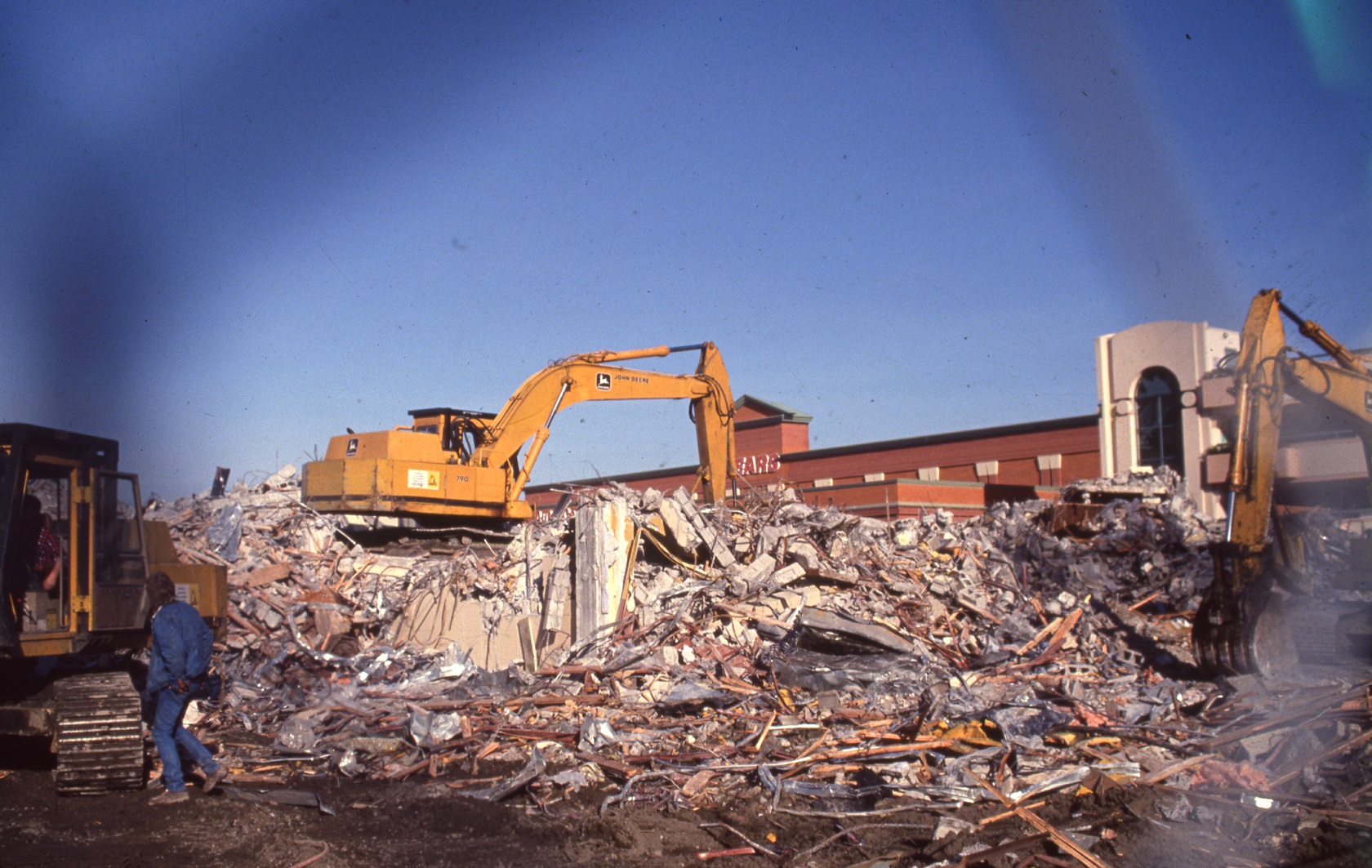
The theatre expanded to three screens in 1980 and had seats for 1126 people. In 1990 the theatres were closed and the building was demolished to make room for the construction of the Richmond Centre Mall parkade.
The Famous Players Richport Cinemas
Famous Players opened the Richport Cinemas on December 13,1985 at the Richport Centre at the intersection of No.3 Road and Ackroyd Road.

The Cinemas had two screens, each seating 398 for a total of 796 seats. The feature attractions on opening night were “Rocky IV,” starring Sylvester Stallone and Talia Shire and “Spies Like Us” with Chevy Chase and Dan Aykroyd.

Richport Cinemas were taken over by Cineplex Odeon following the opening of the Richmond Centre 6 by Famous Players. Due to competition from the SilverCity Riverport, the Richport was closed in 1999 and was renovated for use as retail space.
Famous Players Richmond Centre 6 Cinemas
Famous Players opened the Richmond Centre 6 Cinemas in the Richmond Centre Shopping Mall on November 23, 1990. Famous players President and CEO Ronald Emilio said, “We have created a completely new complex in the Richmond Centre to replace a triple screen theatre. The new complex will bring back a sense of occasion to moviegoing in Richmond.”

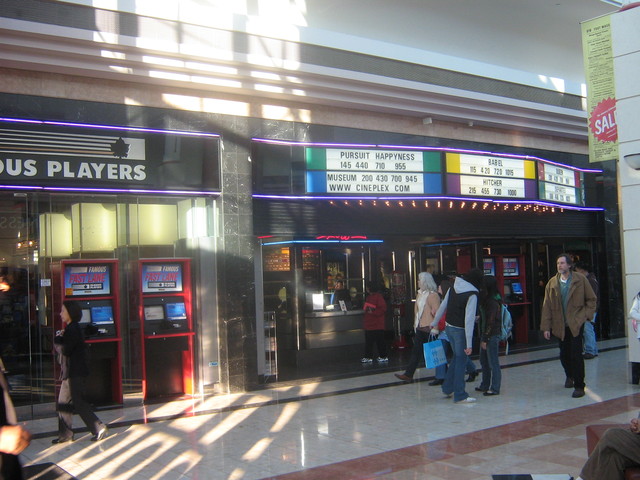
The entrance to the theatres was closest to the west entrance of Richmond Centre Mall. The lobby was designed to resemble a night time streetscape with marquees showing theatre names and movie titles. Each of the six screens at the theatre complex had an individual name, Century had 466 seats, Metro had 370, Rialto had 358, Majestic had 285, Olympia had 266 and Regent had 234 for a total of 1979 seats, including 28 wheelchair accessible ones. The theatres were equipped with large screens, Dolby SR sound systems, 70mm film capability and luxurious seating with plenty of legroom.

The feature films played on opening night were “Rocky V” starring Sylvester Stallone and Talia Shire, the Disney animated feature “Rescuers Down Under,” “Ghost” with Patrick Swayze, Demi Moore and Whoopi Goldberg, the World War Two bomber drama “Memphis Belle,” “Jacob’s Ladder” with Tim Robbins and “Three Men and a Little Lady” with Ted Danson, Tom Selleck and Steve Guttenburg. Cineplex Odeon took over operations of the Richmond Centre 6 in 2005 and the Famous Players Richmond Centre 6 Cinemas closed on March 27, 2011.
Riverport SilverCity
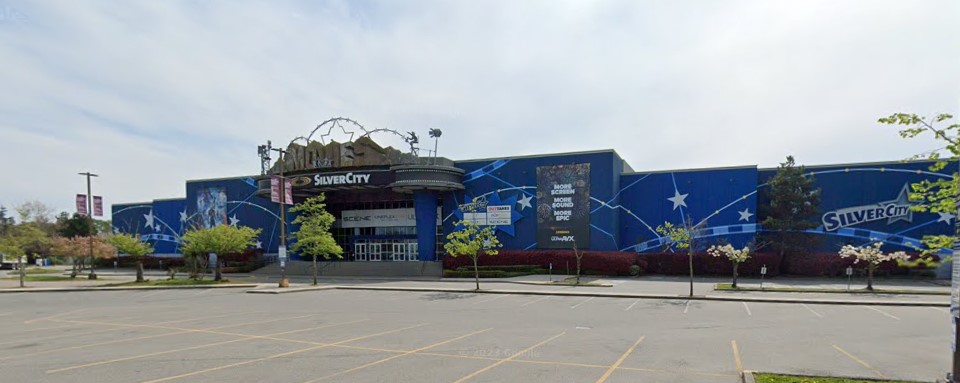
The Famous Players Silvercity Riverport complex was built during a huge expansion of the company’s business, taking advantage of the latest advances in cinema and sound technology. The theatre was built at the massive Riverport Sports and Entertainment complex which included attractions like the Richmond Ice Centre, the Watermania Aquatic Centre, a bowling alley, brew pub, White Spot Restaurant, etc.


Famous Players Director of Public Relations, Dennis Kucherawy stated, “We’re building state-of-the-art theatres that will allow people to see motion pictures as they’re meant to be seen by directors, which is larger than life on a big screen with big sound.”
The $12.7-million, 7200 square metre, 12 screen complex opened on Wednesday December 17, 1997 with a special benefit night. Attendees were treated to the best movies of 1997 for a $2.00 admittance fee and half price food. All proceeds from the night were to benefit Ronald McDonald House. An additional six screens and an IMAX theater were opened on December 18, 1998 bringing the total number of theatres to 19 with seating for a total of 4,508, with the smallest theatre seating 168 and the largest 446.
Cineplex Odeon took over operations in 2005. The Cineplex Odeon Silvercity Riverport remains today as Richmond’s only remaining movie business, but offers more individual screens than all the its predecessors combined.
Who knows what the future of the movie theatre will be? In spite of the easy availability of movies, streamed straight to big screen televisions in the comfort of your own home, the experience of going out to the movies with other people still remains popular. Theatres have evolved to entice modern audiences with comfortable seating, amazing sound systems and high definition projection. Concession sales make up a large portion of the profits earned by theatres today and while traditional theatre snacks like popcorn, soft drinks and candy are still there, wraps, sandwiches, hot dogs and nachos are now available, along with a side of fries or poutine. Other features like arcades, bowling alleys and even bars offer other activities for moviegoers. It seems like the days of going to the movies in Richmond will be with us into the foreseeable future.
 Outside the Box - The Richmond Archives Blog
You must be logged in to post a comment.