The salmon canning industry in Steveston is well known and documented, with several books written detailing the history of Steveston’s Cannery Row and the more than twenty canneries which were built along the one and one half mile waterfront of the South Arm of the Fraser River to its mouth. There was, however, a lesser known stretch of canneries in Richmond. These canneries along the Middle Arm of the Fraser, while being fewer and farther removed from the boom town of Steveston, provided work and accommodation for people working in the fishing industry. Here are some of their stories.
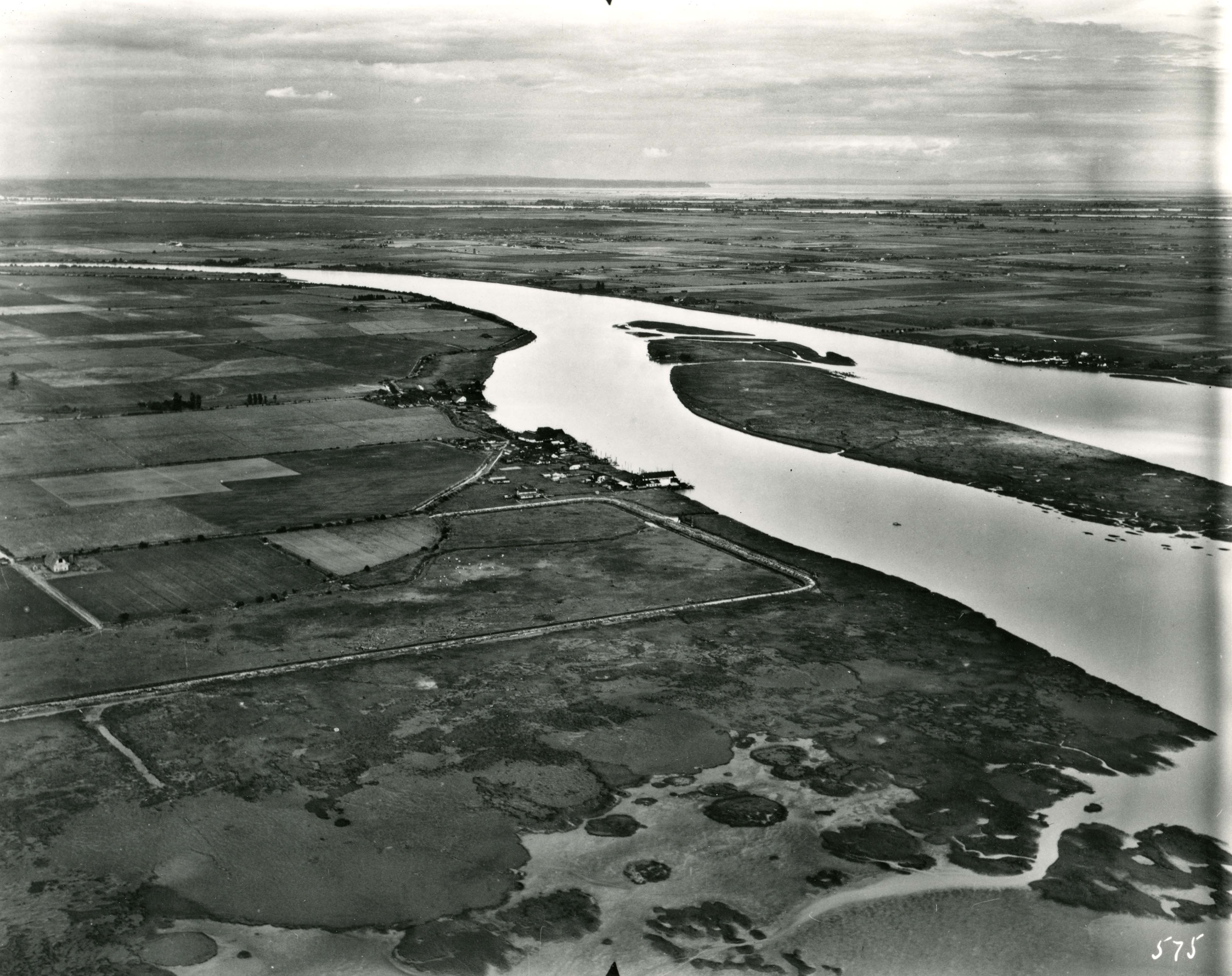
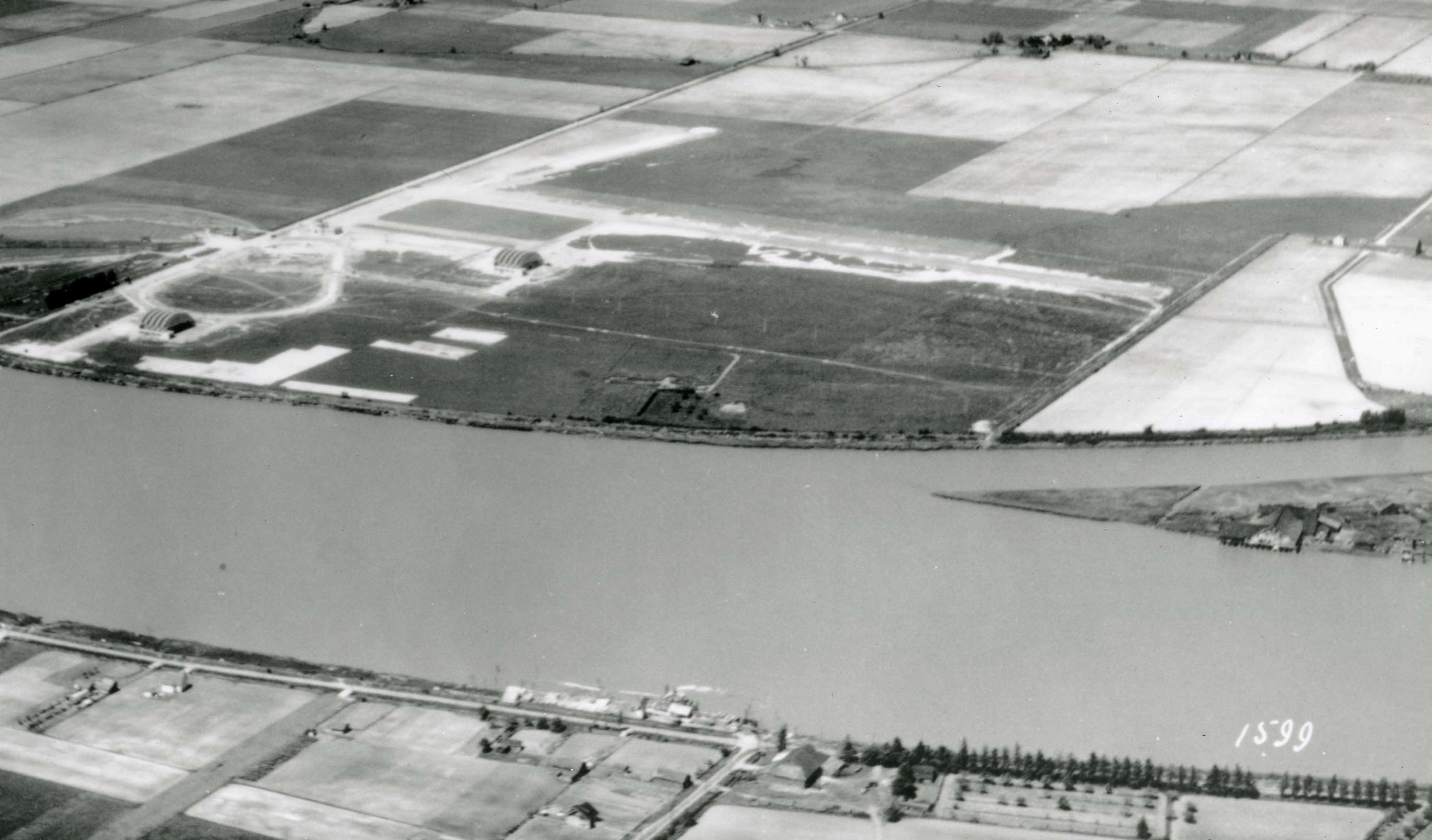
This aerial view of the Middle Arm of the Fraser River (ca. 1929) shows the south-west shore of Sea Island and, looking closely, six of the Middle Arm Canneries. On the Sea Island shore the Fraser River, Vancouver and Acme Canneries are visible. On Swishwash Island where a channel cuts through, the pilings and a building from the Sea Island Cannery can be seen. Across the river on Lulu Island is the Terra Nova Cannery and away in the distance on the tip of Dinsmore Island the roofline of the Dinsmore Cannery can just be made out. City of Richmond Archives photograph 1985 166 5.
South-west Sea Island
Three canneries stood along the south-west shore of Sea Island, and a fourth just across the channel from them. The Fraser River, Vancouver, Acme and Sea Island Canneries were all built in the 1890s. Company-owned housing for cannery workers, fishermen and their families was built along both sides of the dyke running through the cannery properties. Boarding houses for single migrant workers were provided and often temporary villages, built on the dyke close to the cannery, were established by seasonal Indigenous workers. This group of canneries became home to a large, tight knit community of mostly Japanese Canadian workers and fishermen who settled in the cannery housing and utilized the cannery docks and facilities even after salmon canning stopped in those locations. The Sea Island Japanese School, was established at Vancouver Cannery for the children of workers and resulting in community spirit, sports teams and social groups. Boat builders plied their trade and other industries connected to the fishing industry flourished. The forced relocation of Japanese Canadians in 1942 marked the end of the community and most of the buildings were razed.
Three canneries were built along the south-west shore of Sea Island, the Fraser River Cannery (bottom), the Vancouver Cannery (Middle) and the Acme Cannery (Top) (ca. 1930). The Fraser River and Vancouver Canneries were purchased by Vancouver Cannery Limited in 1914 and became known simply as the Vancouver Cannery. These canneries were all connected by a wooden boardwalk allowing easy access to all the buildings and dwellings in the community. City of Richmond Archives photograph 1985 166 10.
Fraser River Cannery
The Fraser River Cannery was located on the south west shore of Sea Island and was the closest of the Middle Arm canneries to the mouth of the river. Built in 1896 or 1897 by McPherson & Hickey, the cannery had a sockeye pack of 3500 cases for 1898, according to a report by the Vancouver Province newspaper. It was sold to the Canadian Canning Company in 1899 and was then subsequently purchased by Gosse-Millerd Packing Company (Vancouver Cannery Limited) in 1914. The facility was equipped with machinery for manufacturing cans and was capable of supplying all five of the company’s plants, located at Sea Island, Rivers Inlet, Bella Bella, Skeena River and the west coast of Vancouver Island. Having been absorbed into Vancouver Cannery Limited, the Fraser River Cannery lost its separate identity, becoming part of the Vancouver Cannery complex.
The former Fraser River Cannery in 1912, just before being absorbed into the Vancouver Cannery. The can making machinery inside could supply all five of the Gosse-Millerd Plants. Note the barrels along the roof used for fire protection. City of Richmond Archives photograph 1988 37 6
Vancouver Cannery
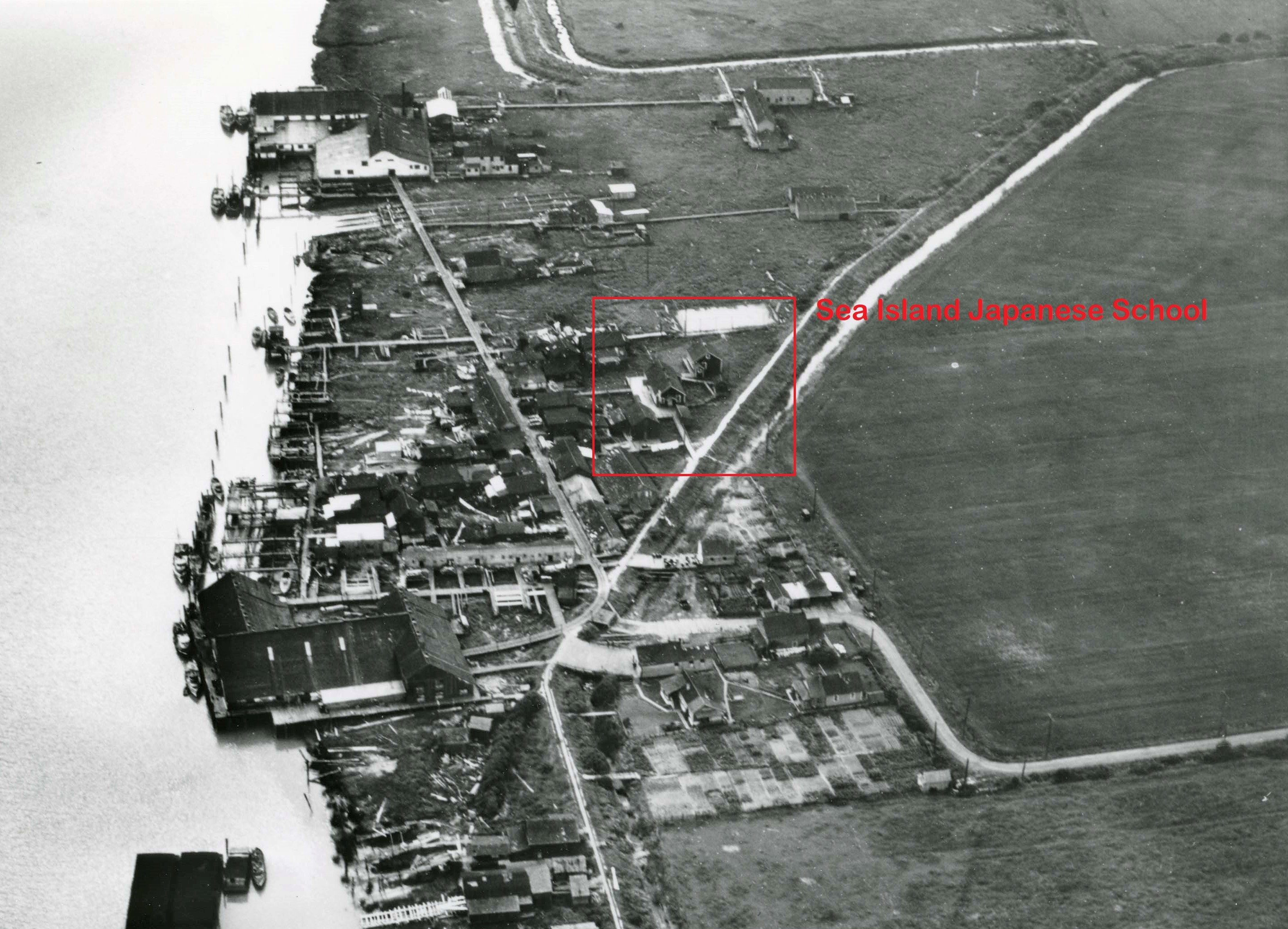
The Vancouver cannery complex is shown here, ca. 1930, showing the former Fraser River Cannery (top left), the Vancouver Cannery (bottom left) and cannery buildings and houses. The Sea Island Japanese School is shown outlined in red. City of Richmond Archives cropped photograph 1985 166 11.
The Vancouver Cannery was erected in 1896 by the Canadian Canning Company. It was purchased by Vancouver Cannery Limited in 1914, owned by R.C. Gosse and F. Millerd who had also purchased the Fraser River Cannery just to the west. It was subsequently owned by several incarnations of the Gosse – Millerd partnership until 1928 when it was absorbed into British Columbia Packers. The plant stopped operating as a cannery in 1930, but still existed as a fish camp for the Imperial Plant. The cannery equipment was dismantled in 1935-36.
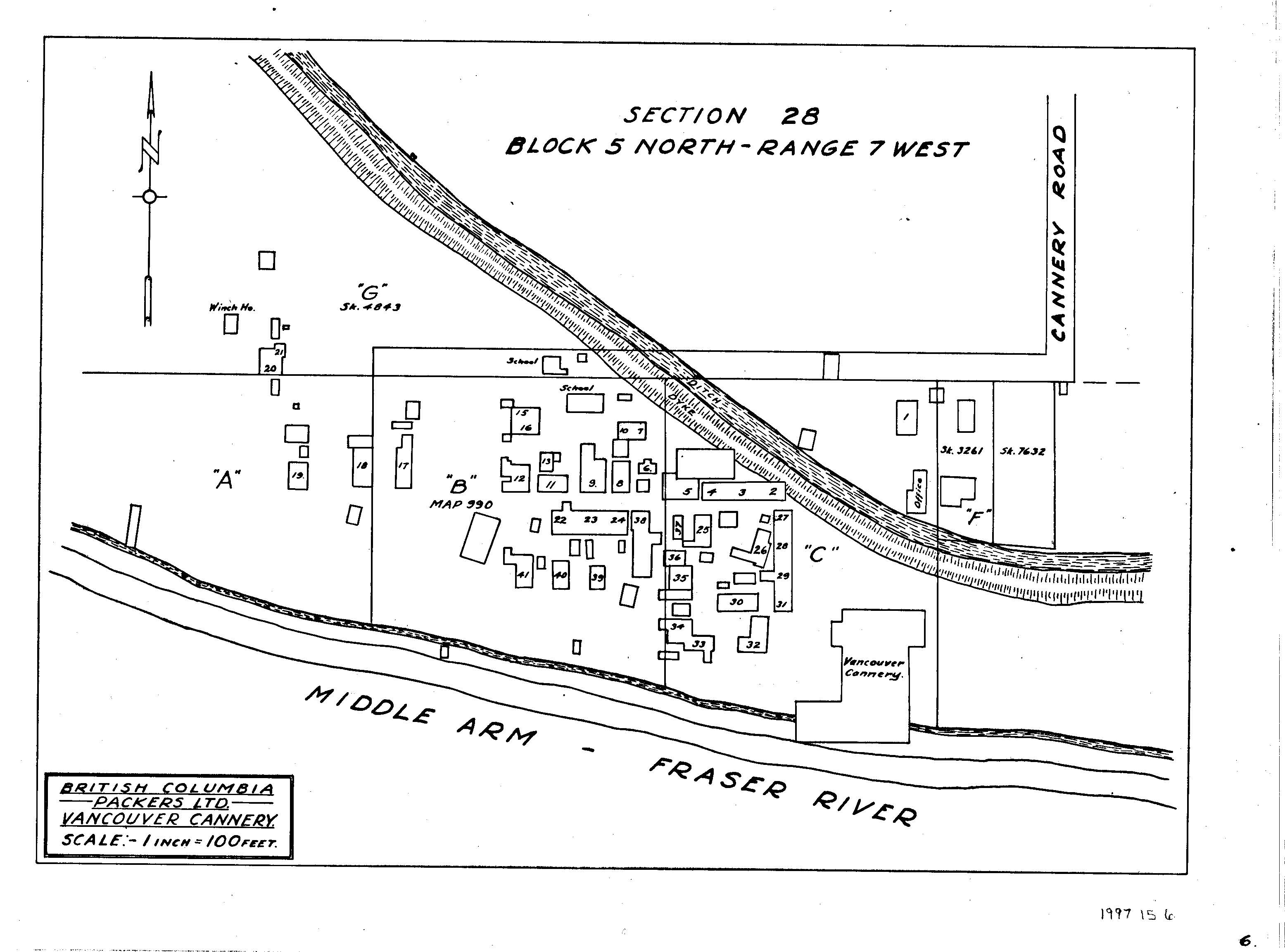
This map from the 1936 Waterworks Atlas shows the locations of buildings at the Vancouver Cannery site, including the Sea Island Japanese School. City of Richmond Archives 1997 15 6.Class picture of Division 2, Sea Island Japanese School in 1929. City of Richmond Archives photograph 1985 39 65.
Acme Cannery
The Acme Cannery was erected in 1899 by the Acme Canning Company Limited, owned by Jane R. Cassidy and Allan Cameron. In 1902 it was purchased by the British Columbia Packers Association and subsequently by the British Columbia Fishing and Packing Company Ltd. (1914) and British Columbia Packers Ltd (1928) as the company reorganized. Acme operated as a cannery until 1918 when the machinery was removed from the plant. It operated as a Fraser River Camp for the Vancouver Cannery until 1930 and as a fish camp for the Imperial Cannery afterward. It was also the location of Thomas Goulding’s cork mill, the only commercial supplier of cedar fish net floats on the West Coast. In 1946 it was sold to D. Matheson.
This 1936 image from the Waterworks Atlas shows the layout of buildings at the Acme Cannery. City of Richmond Archives 1997 15 7.
Sea Island Cannery – Bon Accord
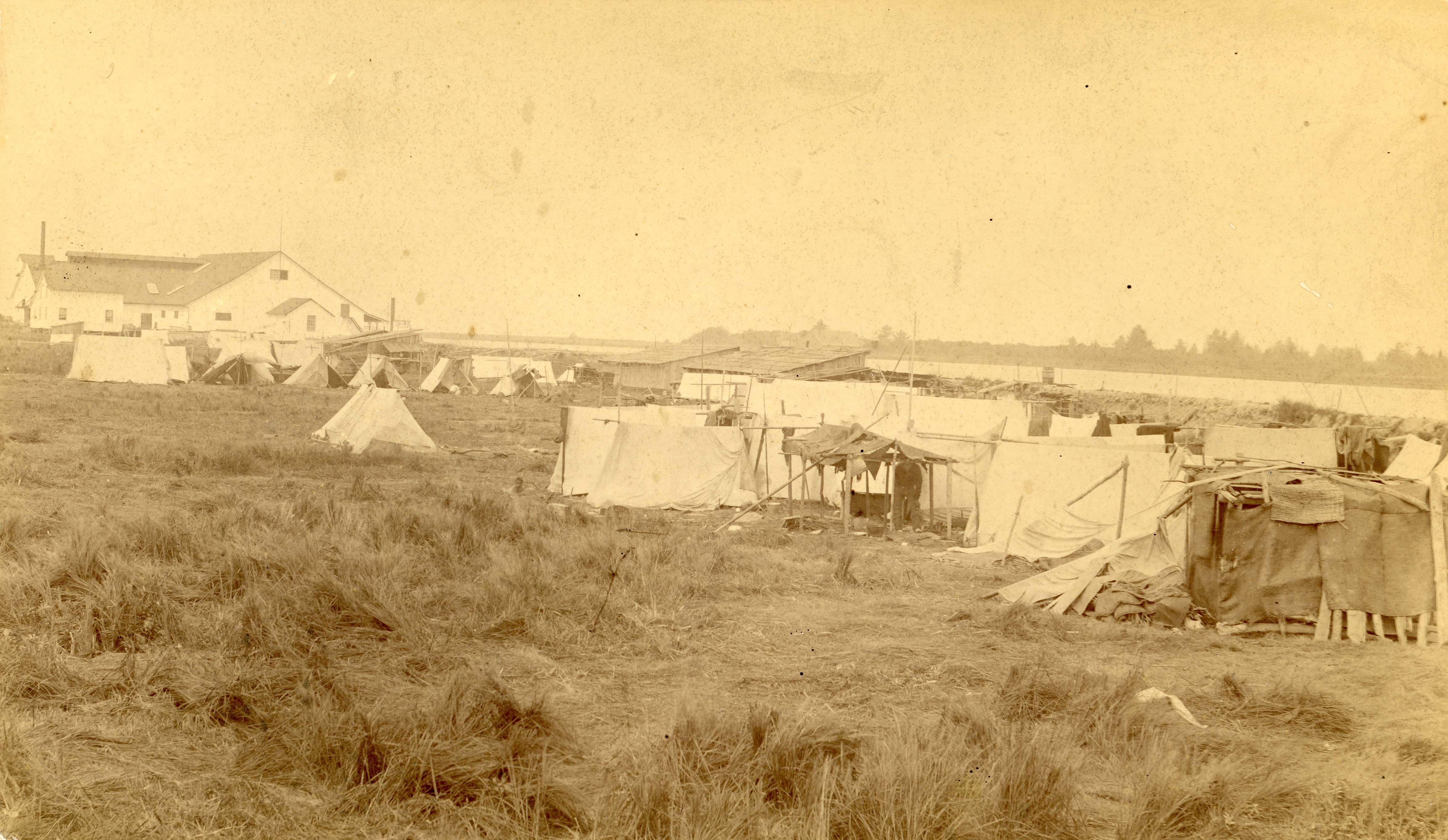
The Sea Island Cannery on Swishwash Island is shown here, ca. 1900. A temporary camp of tents and shacks for workers is set up on the low lying island. City of Richmond Archives photograph 1993 3 1.
Little more than a large sandbar, Swishwash Island was the location of the Sea Island Cannery. Originally built by Alexander Ewen and D.J. Munn in 1890 as the Bon Accord Cannery, its name was changed to avoid confusion with a hatchery of the same name at Port Mann. By all accounts this was a successful cannery, employing 225 workers and held licenses for 18 boats. In its first year of operation it packed 18,225 cases of fish. In 1898 the sockeye pack alone was 8500 cases. The Sea Island Cannery operated profitably for ten years until 1899 when it was severely damaged in a fire. In December 1901 a huge storm and flood caused massive damage to the remaining structures. The property was acquired by BC Packers who abandoned it and sold it off in 1902.
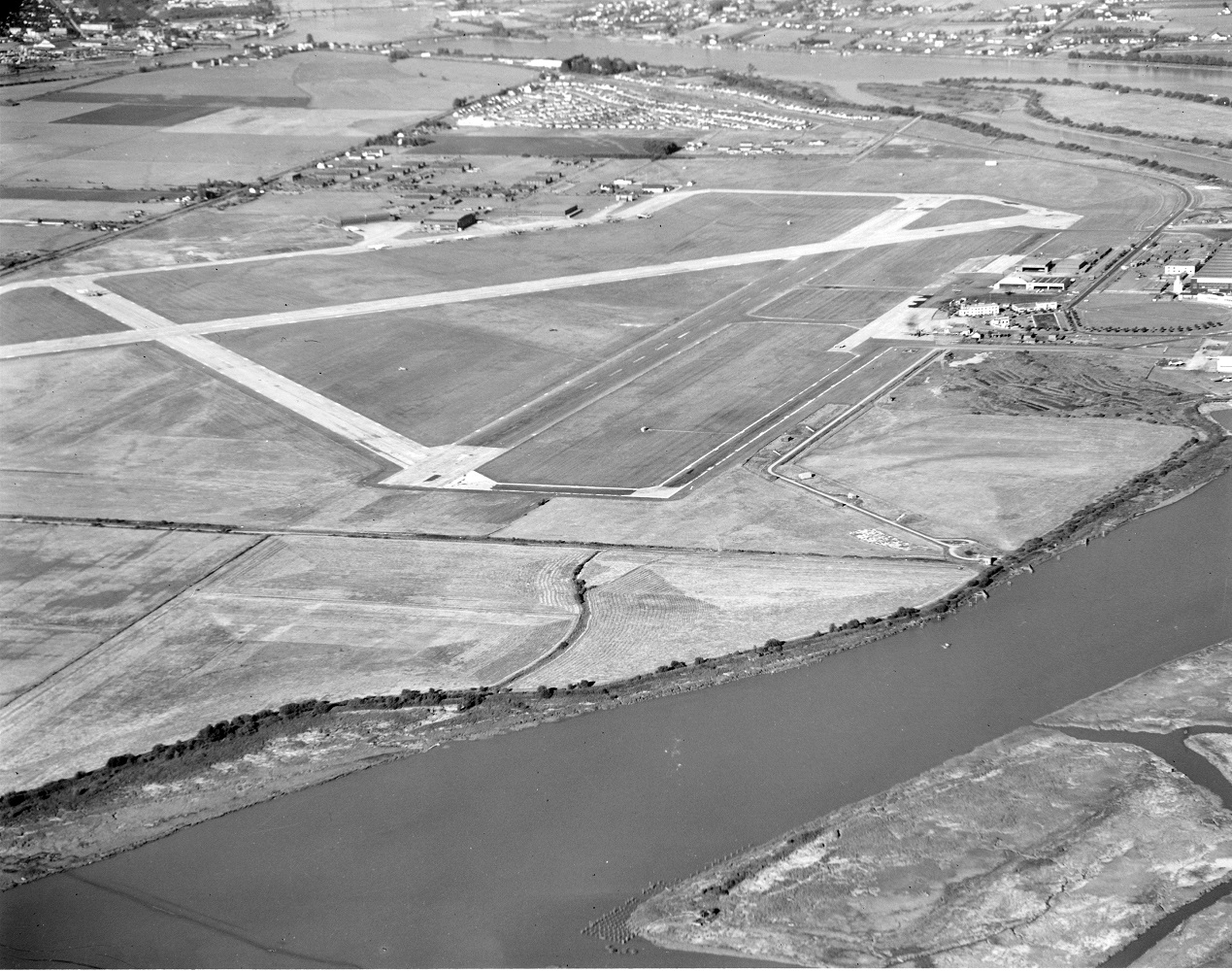
This aerial photograph, ca. 1950, gives a view of the Vancouver Airport, R.C.A.F. base and Burkeville. Pilings from the old Sea Island Cannery are visible on Swishwash Island in the foreground. City of Richmond Archives photograph 1997 5 9.
North-west Lulu Island
The north-west part of Lulu Island, known as Terra Nova, was home to three other canneries, the Labrador Cannery, the Alliance Cannery and the Terra Nova Cannery. All three of these canneries were subjected to the full force of a gale in December 1901 which caused a great deal of damage and, in one case, the complete destruction of the cannery.
Labrador Cannery
There is little information available about the Labrador Cannery. While listed as located at Terra Nova, its exact location and years of operation are not well documented. One of the smaller operations in Richmond, it reported a total pack of about 10,000 cases for the 1901 season. The Labrador Cannery was reported to have been completely destroyed in the early hours of December 26,1901, when gale force winds and extreme high tides breached the dykes along both sides of the North Arm and flooded large areas of Lulu and Sea Islands. The December 27, 1901 Vancouver Daily Province stated that, “The Labrador cannery at Terra Nova was entirely swept away.” “The buildings were smashed and piled up inside the dyke. Logs four feet thick which dashed against the buildings were also carried inside the dyke and leveled the embankment on the way. Nearly all the cannery boats were smashed and put out where dry land will appear when the tide goes out again.”
Alliance Cannery
Built in 1895 by R. Colquhoun’s Alliance Canning Company, the Alliance Cannery was sold to George Wilson in 1901. This cannery was severely damaged in the 1901 storm as well, although not so badly that it could not be restored. The water level rose enough to cover the floors of the cannery buildings, soaking the cans of salmon stored there but not ruining them. In 1902 the cannery was absorbed into the BC Packers Association, closed in 1903 and became part of the Terra Nova Cannery.
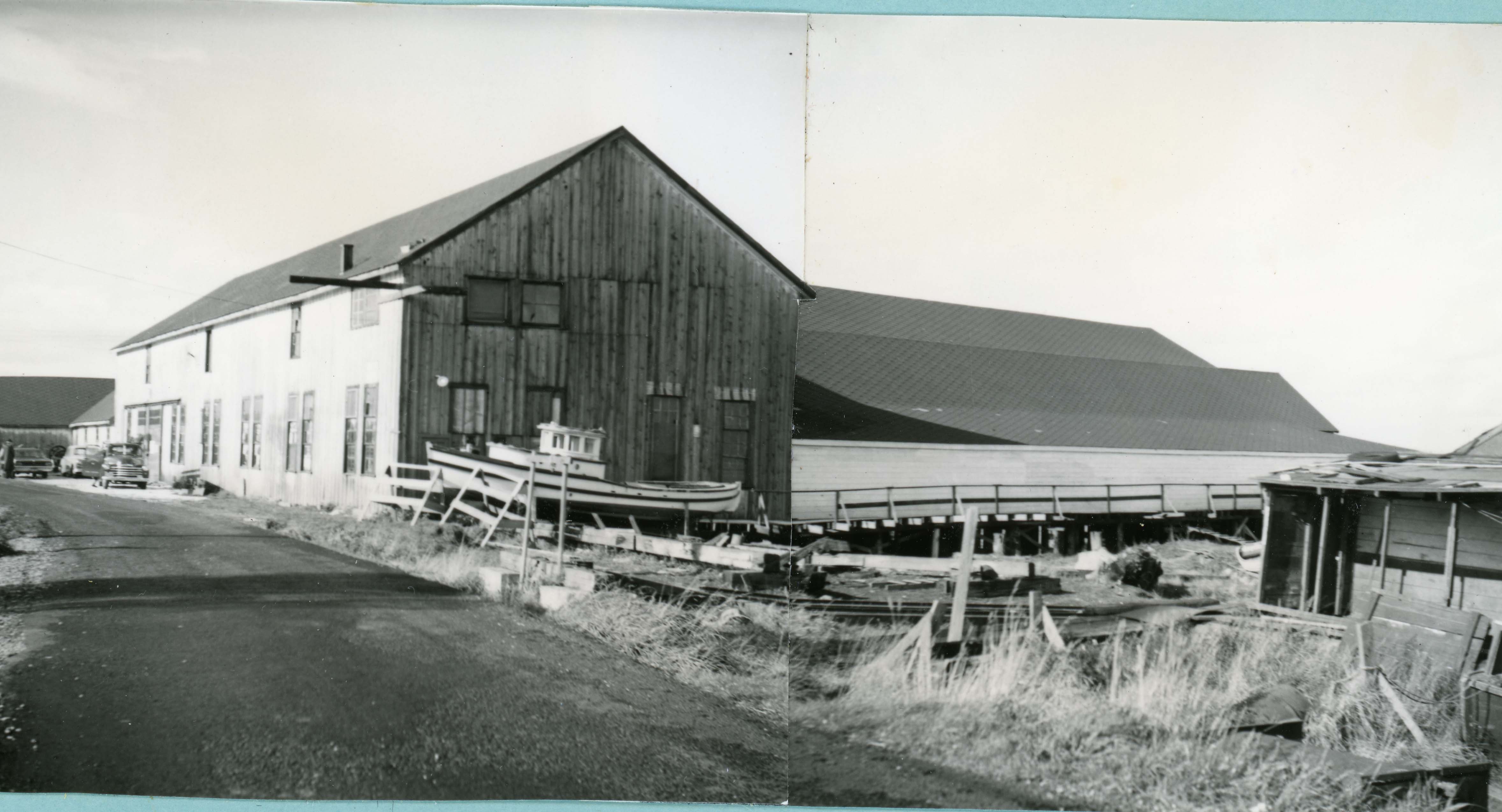
This photo from 1962 shows some of the buildings of the Terra Nova cannery from the dyke. City of Richmond Archives photograph 1985 4 840.
Terra Nova Cannery
The Terra Nova Cannery was built in 1892 by Duncan and John Rowan who formed the Terra Nova Canning Company. They operated the cannery until they sold to the BC Packers Association in 1902. During the December 1901 gale this cannery suffered less damage than the others at Terra Nova but the Japanese boarding house there collapsed trapping several men inside. They were rescued during the height of the storm by other workers and residents of the area with no loss of life. The cannery closed in 1928 but the buildings and docks continued to be used for net storage, moorage and as a fish camp for the Imperial Cannery. The cannery buildings were taken down in 1978.
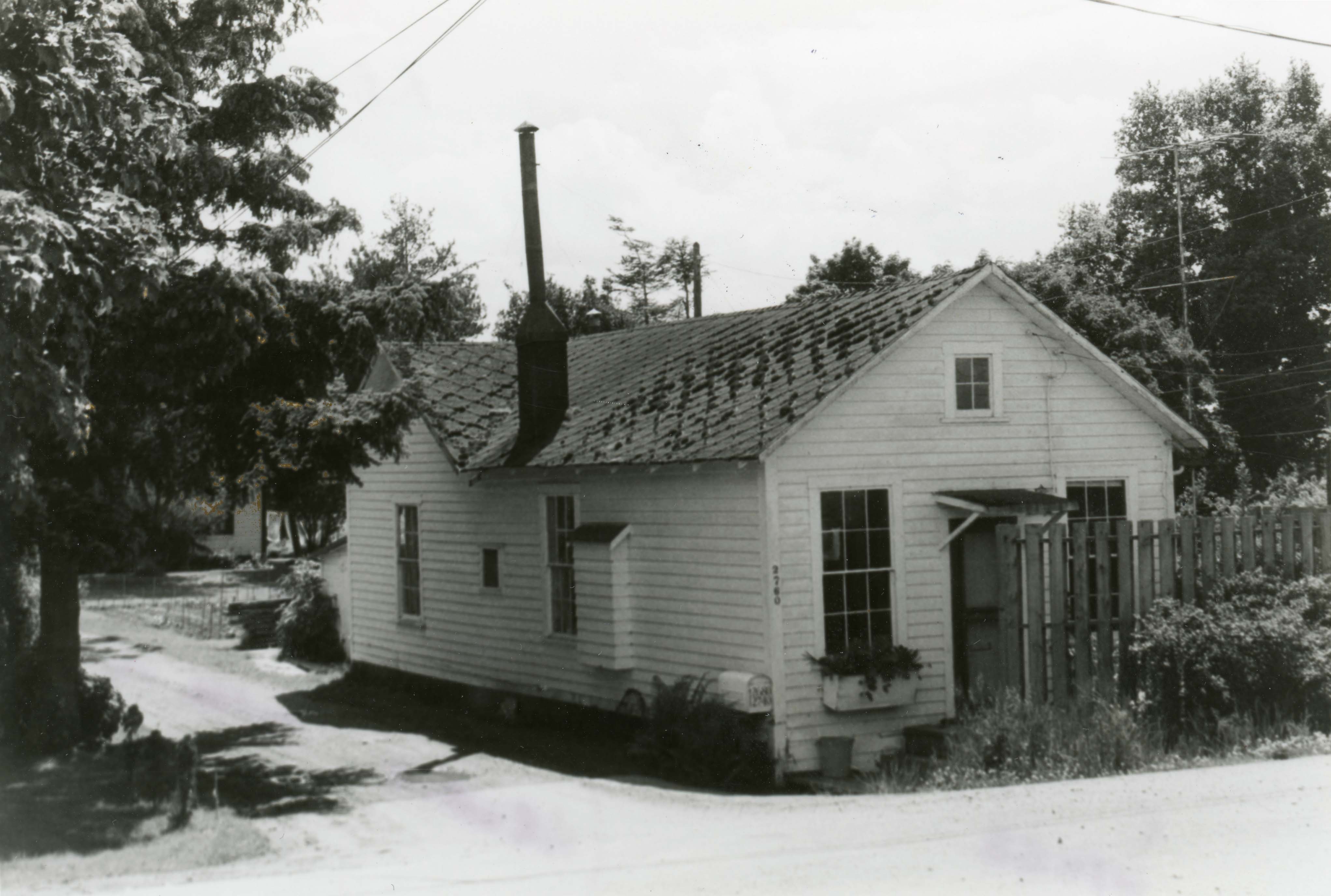
This building was built in 1912 and served as a residence and as a store for the Terra Nova Cannery. It is the last remaining building associated with the cannery. The building is included in the City of Richmond’s Heritage Inventory. City of Richmond Archives photograph 1978 37 66
The Eastern Middle Arm
The final three canneries were spread along the eastern part of the Middle Arm and into the North Arm, each on a different island.
Dinsmore Island Cannery
This 1931 aerial view shows the Vancouver Airport on Sea Island under construction and the Dinsmore Island Cannery on Dinsmore Island. City of Richmond Archives photograph 1985 166 18 (cropped)
The Dinsmore Island Cannery was built on Dinsmore Island in 1894 by Richard E. Gosse for the Dinsmore Island Canning Company, run by Michael Brighouse Wilkinson and William McPherson. The Island was named for pioneer John Dinsmore, who farmed the island and was one of the owners of the cannery. The cannery was absorbed into the BC Packers Association in 1902 and operated until 1905, after which it operated every four years during dominant sockeye runs, closing after the 1913 season. The cannery equipment was removed and the property was sold in 1934. Dinsmore Island along with Pheasant Island were absorbed by Sea Island due to infilling with dredging spoils, remembered only in the name of the bridge which connects Gilbert Road to Russ Baker Way.
Provincial Cannery
The Provincial Cannery was built in 1896 on Lulu Island south of the bridge to Sea Island and was operated by the Provincial Packing Company of Norman MacLean, J.W. Sexsmith and R.W. Harris. In 1902 it was absorbed into the BC Packers Association who removed its equipment and sold the property in 1905. In 1906 the location became the home of the Easterbrook Flour mill.
The Provincial Cannery is shown here ca. 1896. City of Richmond Archives photograph 2004 40 4.
The Richmond Cannery
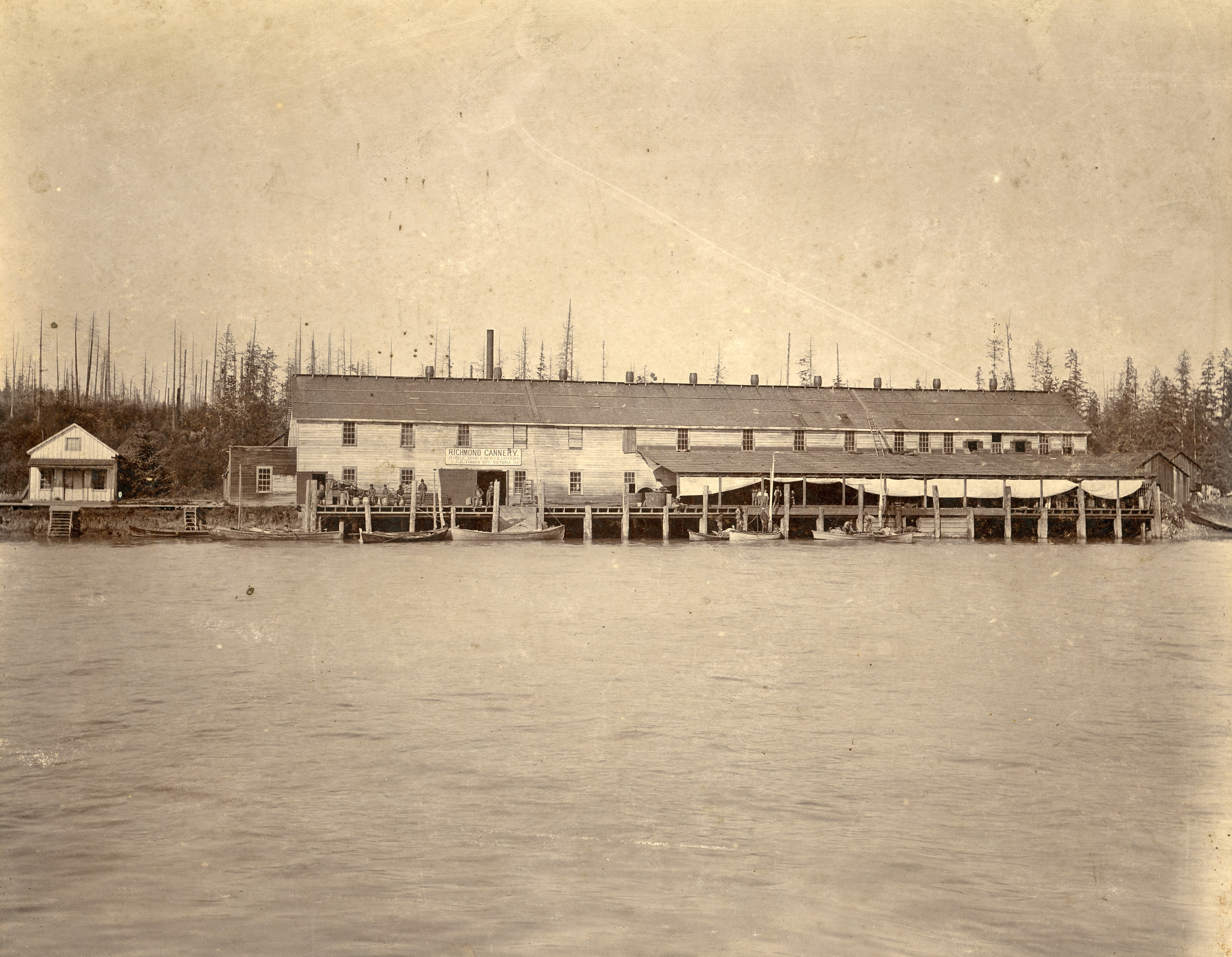
The last cannery was not technically in the Middle Arm but was in Richmond. The Richmond Cannery was located on Richmond Island, between Sea Island and the Vancouver side of the North Arm. It was built by JH Todd and Sons in 1882. The Richmond Cannery operated from 1882 to 1905 when it was shut down. JH Todd renamed their Beaver Cannery in Steveston Richmond Cannery after the original was closed.
The Richmond Cannery on Richmond Island is shown here, ca. 1900. City of Richmond Archives photograph 1986 57 3.
The canning of fish at the Middle Arm canneries did not last as long as the industry in the South Arm. Built during the rush to exploit the seemingly endless supply of fish during the late 19th Century the realities of the limits of the resource and fierce competition for it resulted in the closure of the canning operations at those locations. However, the maintenance of the facilities at Terra Nova and especially at the Vancouver and Acme Canneries resulted in the growth of a vibrant community which has added to the character of Richmond’s history.
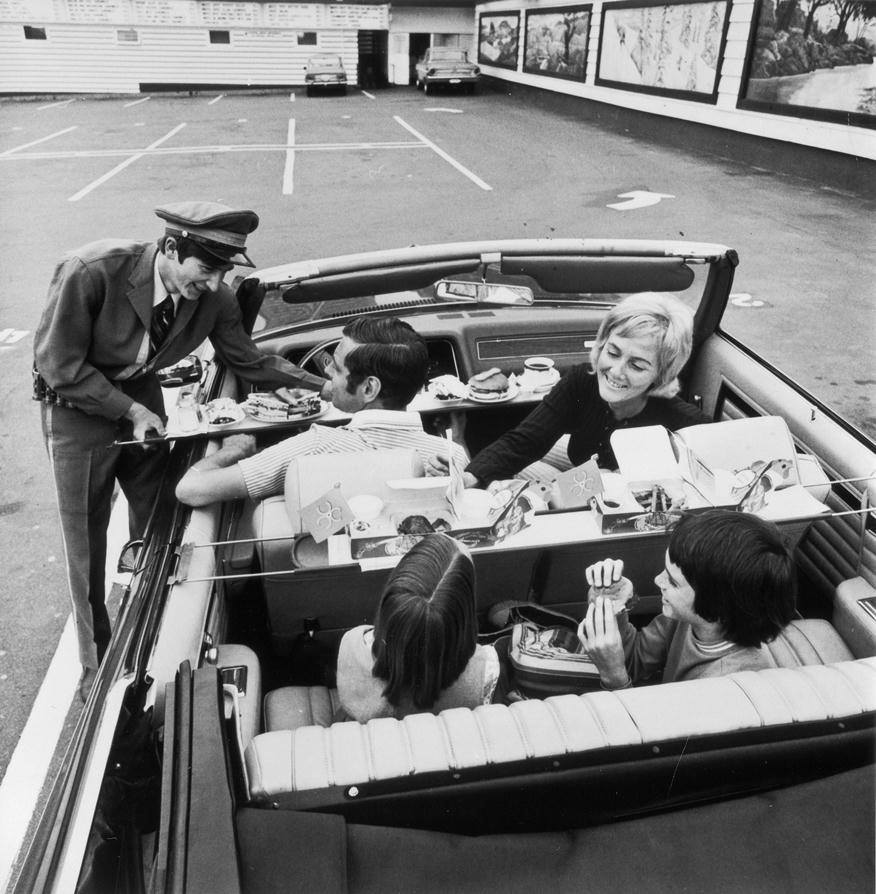
An iconic symbol of youth and car culture during the ’50s, ’60s and ’70s was the drive-in restaurant. Popularized during a thriving post-war economy, the baby boom and the rapid growth of car ownership, drive-ins typically featured large parking areas and little or no indoor seating. Menus, visible from your car, displayed inexpensive meals which included burgers, chicken and fries. In contrast to the modern “drive-thru” concept, many drive-ins were self serve, where you walked to a window, ordered and picked up your food and took it back to your car. Others provided car service, your order taken and food delivered to your car by staff known as “carhops” who would attach a tray to your window with your meal on it. “Lights On For Service!”
The first McDonald’s outside the United States was this one on No.3 Road in Richmond. A great example of fast food architecture, this standardized McDonald’s design featured an eye-catching “Golden Arches” sign at the entrance and a distinctly shaped yellow, red and white building with an angled roof supported by two arches. The building design is carried over to the logo on the sign with its two arches and angled line across them, replicating the building when viewed at an angle from the street. City of Richmond Archives photograph 1987 61 3.
The first known drive-in, Kirby’s Pig Stand, was built in Dallas, Texas in 1921 and was described by critics as for people who were “too lazy to get out of their car and enter the restaurant.” In British Columbia, the first White Spot drive-in opened in Marpole in 1928, a brand which pioneered the use of carhops and window trays. Drive in architecture often featured round or polygonal buildings which allowed vehicles to park around the building giving easy access to cars. Some buildings would include eye-catching features or rooflines and large colourful signs to entice customers into their lots. Kitchens were usually laid out in an efficient manner allowing quick production of meals and were sometimes visible from inside or outside the restaurant. Drive-ins could be single small businesses or larger regional chains with multiple locations. Some evolved into huge national and international brands which are still around today.
The Seabright
Richmond’s first drive-in style restaurant/snack bar was the Seabright. It was built and run by the Doherty family, owners of the Seabright Dairy on Sea Island and was positioned to give customers a good view of aircraft landing and leaving from the new Vancouver Airport, a popular attraction in the 1930s. The building was about 40 feet by 24 feet in size and an eight-foot wide veranda gave customers some covered space. Soft drinks, homemade ice cream and milkshakes, tea, coffee and sandwiches were offered for sale at the building on Buckingham Road and plenty of parking was available in the 240 by 70 foot parking lot.
The Seabright is shown here ca. 1936. City of Richmond Archives photograph 2000 3.
The Garden City Drive-In
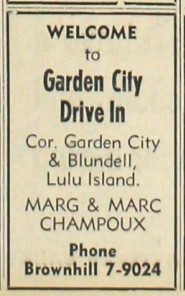
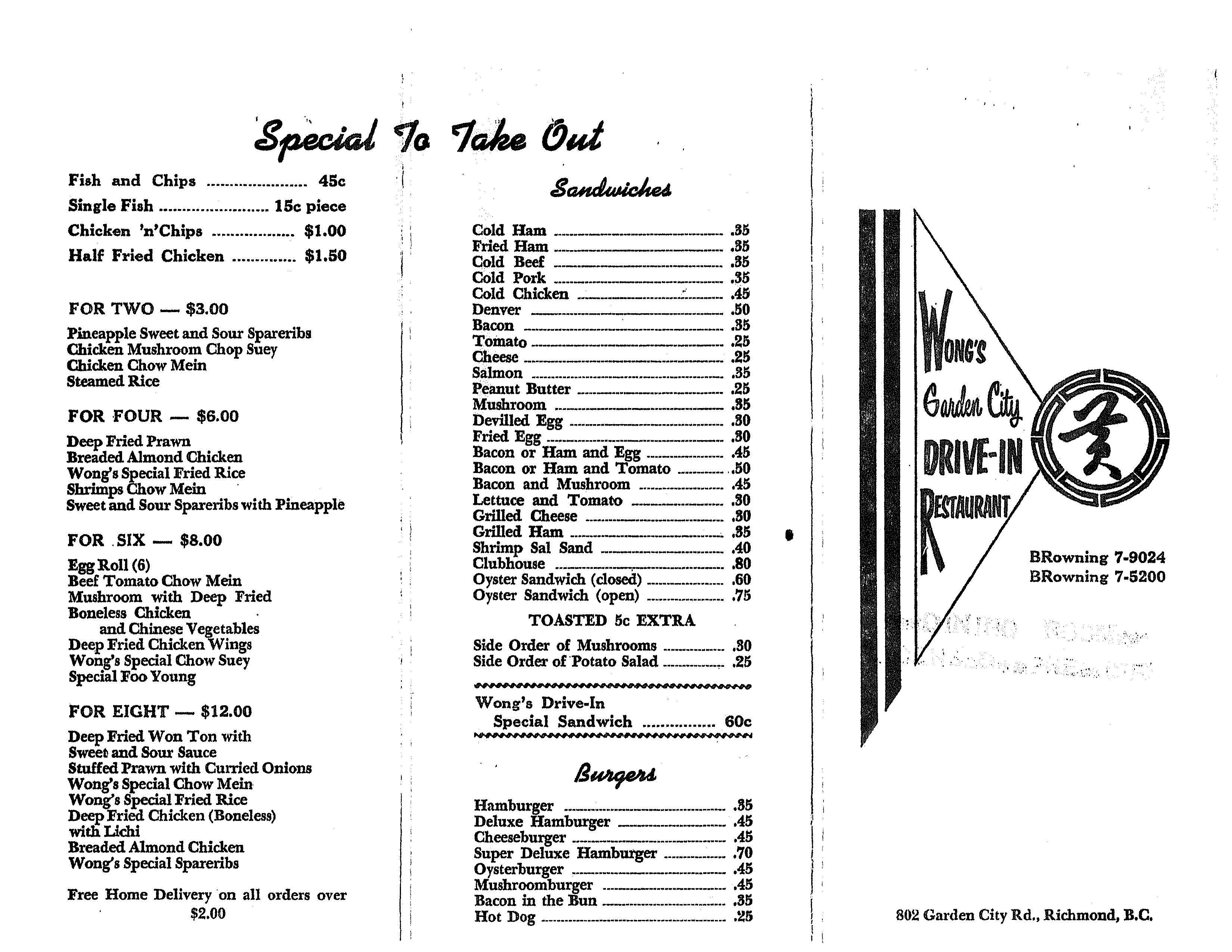
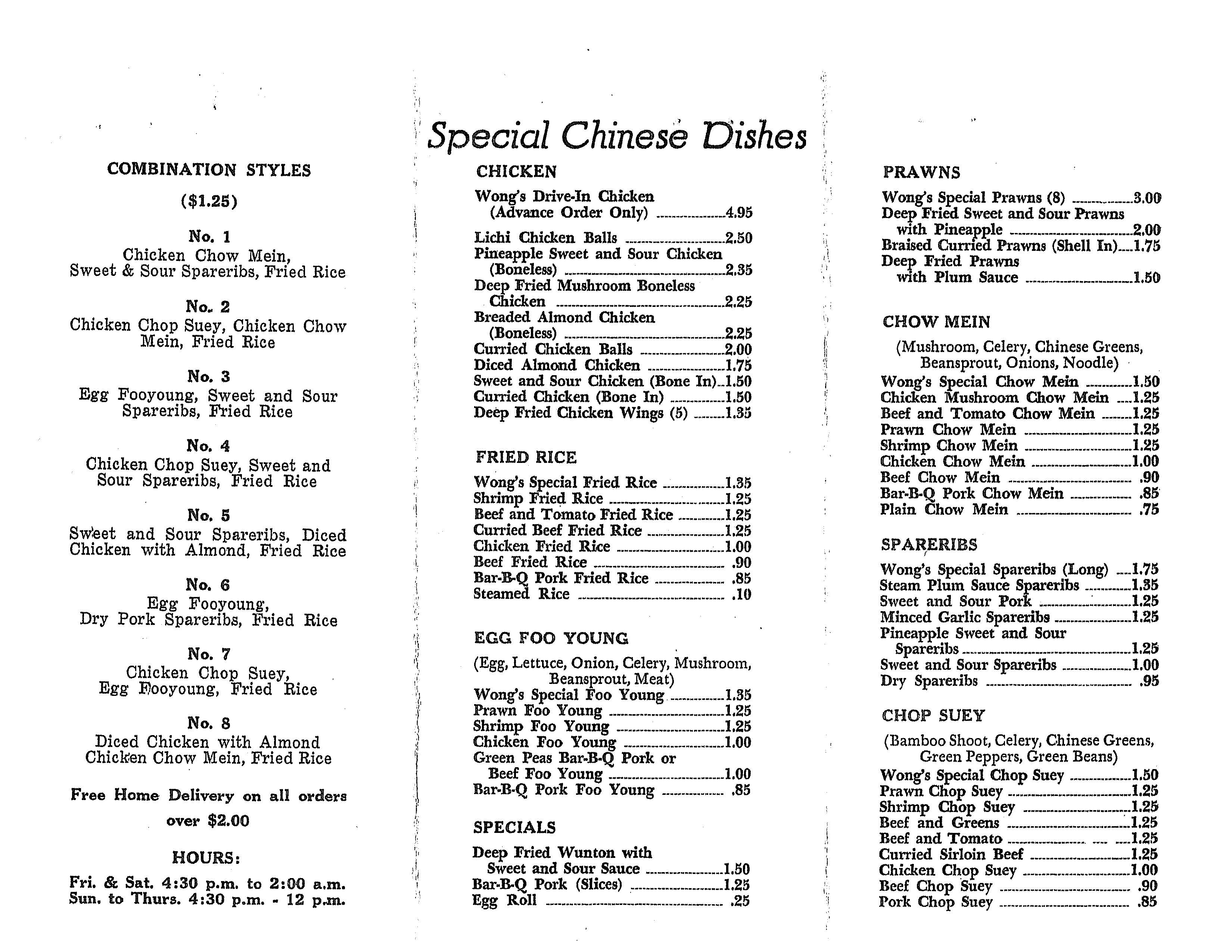
Around 1954 a restaurant opened at 802 Garden City Road (8020 today), near the intersection with Blundell Road. The Garden City Drive-In was owned by Marg and Marc Champoux and offered dining room or car service. By 1960 it had become Wong’s Garden City Drive-In, offering a selection of Chinese and Western dishes with dining room, car service or free delivery.
A Richmond Review ad for the Garden City Drive-In from January 15, 1958.
Richmond Review ad for Wong’s Garden City Drive-In from 1960.
Sometime during the 1960s the drive-in was renamed the Richmond Drive-In, a name it had until about 1973 when it became Wah Do Restaurant.
The Garden City Drive-In can be seen in the centre of this photo beside the garage on the corner of Garden City and Blundell Roads. Cropped from City of Richmond Archives photograph 1978 37 11.A menu from Wong’s Garden City Drive-In. City of Richmond Archives Accession 2019 49.
Around 1975 the restaurant was closed and demolished to make way for construction of the Garden City Shopping Centre.
The Dairy Queen
On September 5, 1958, Ray Van Humbeck opened his new Dairy Queen ice cream business at 633 No.3 Road (6331 today), a standard drive-in design with a large parking lot and free standing sign featuring an ice cream cone to attract customers. He offered a free sundae, milk shake or malt with every one purchased at regular price on opening day. Dairy Queen products were “favourites for people like you in 2500 cities throughout Canada, the Commonwealth and the United States. They enjoy it as a treat for taste – a food for health!”, stated his ad in the Richmond Review.
Ray Van Humbeck’s Dairy Queen is shown in the centre of this image with a car entering from No.3 Road. Cropped from City of Richmond Archives photograph 1984 17 58.Grand Opening advertisement from the Richmond Review, 1958.
Ray Van Humbeck was a local businessman who believed in giving back to his community. He supported many community initiatives, including sporting events and sponsored a softball team for many years.
The 1969 Dairy Queen softball team. City of Richmond Archives photograph 2017 45 5.
Starting out as a business selling soft frozen dairy products in Joliet, Illinois in 1940, the Dairy Queen brand grew and spread; the first Canadian store opening in Estevan Saskatchewan in 1953. The product line evolved and expanded from sundaes, shakes, malts and banana splits to include such favourites as the “Dilly Bar,” “Buster Bar,” the “Scrumpdillyishus Peanut Buster Parfait” and the “Blizzard.” The franchise’s menu made a significant change when hot “Brazier Foods” became available, cooked in the trademark “Sizzle Kitchen.” Mr. Van Humbeck’s No.3 Road Dairy Queen changed along with the times, receiving new signage and a raised red roof along the way.
Taken in 1971, this photograph shows the Dairy Queen building after being modified and equipped with equipment for the serving of hot “Brazier” foods. City of Richmond Archives photograph 1983 7 9.
Around 1974, Ray Van Humbeck closed the business on No.3 Road and relocated to the Anderson Square Shopping Centre, occupying three units where Anderson Road met Buswell Road. The business became a fixture there until it closed in 2016. Today there are three Dairy Queen stores in Richmond, one at No.3 Road and Francis Road, which was relocated from the Buswell and Anderson location, one at the Minato Village at Steveston Highway and No.1 Road and one located in the food fair in Richmond Centre Mall, not far from the location where Mr. Van Humbeck opened the first one in 1958.
Chipper’sDrive-In
In January 1957 an application was made for the sub-division and rezoning of a property on No.3 Road to allow the construction of a meat packing plant for the B.C. Chip Steak Co. Ltd. and a drive-in restaurant. The application was approved and the plant and drive-in, known as Chipper’s, opened at 331 (3311 today) No.3 Road in July 1958.
Chippers’ announced their opening in this July 30, 1958 ad in the Richmond Review.
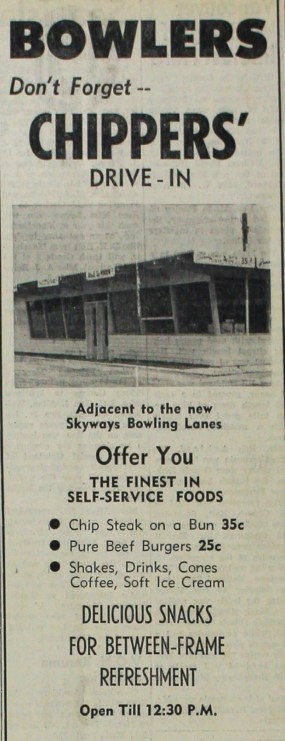
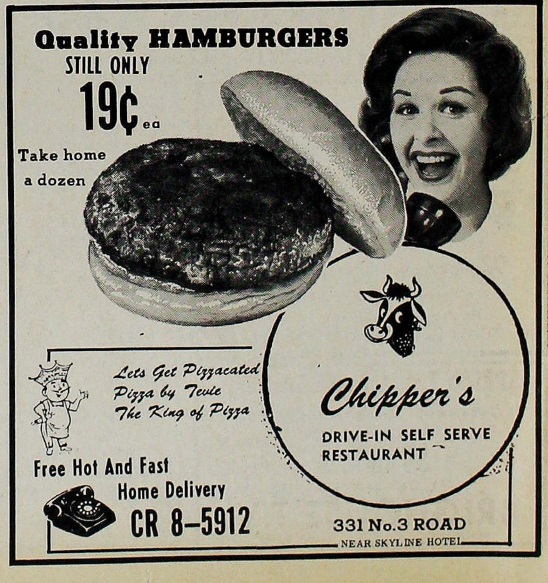
Chipper’s was the first “American Graffiti” style drive-in in Richmond. It was very popular meeting place with the young crowd, frequented by hot rodders and drag racers and was the terminus/turn around point for people cruising the No.3 Road strip. Chipper’s advertised a variety of food, from chipped steak on a bun and beef burgers (Made in our own factory from government inspected beef), all you can eat waffles for seventy-five cents (the ones they had in mind when they invented syrup), nineteen cent burgers (Take home a dozen!) and pizza by Tevie (The King of Pizza). Owner/operator Tevie Smith promoted his business actively, using advertising space in the Richmond Review frequently and by sponsoring bowling teams at the Skyway Lanes next door while offering ice cream and burgers as prizes.
Chipper’s took advantage of its proximity to the Skyway Lanes bowling alley, building business by associating themselves with the sport. Richmond Review ad 1965.
Chipper’s was a self-service drive-in but also offered fast home delivery. Richmond Review 1965.Chipper’s ads usually pointed out that the drive-in was close to the Skyline Hotel, Richmond Review 1965.
Not all of the advertising for Chipper’s was good. In April of 1962 reports of bad behavior and hooliganism by unruly customers were common and led to the Municipal Licensing Committee and the RCMP meeting with one of the owners of the restaurant regarding disturbances at the drive-in. The owner promised the Committee that he would clear up the problem immediately and the Committee in turn promised that they would “keep in close touch with the situation.”
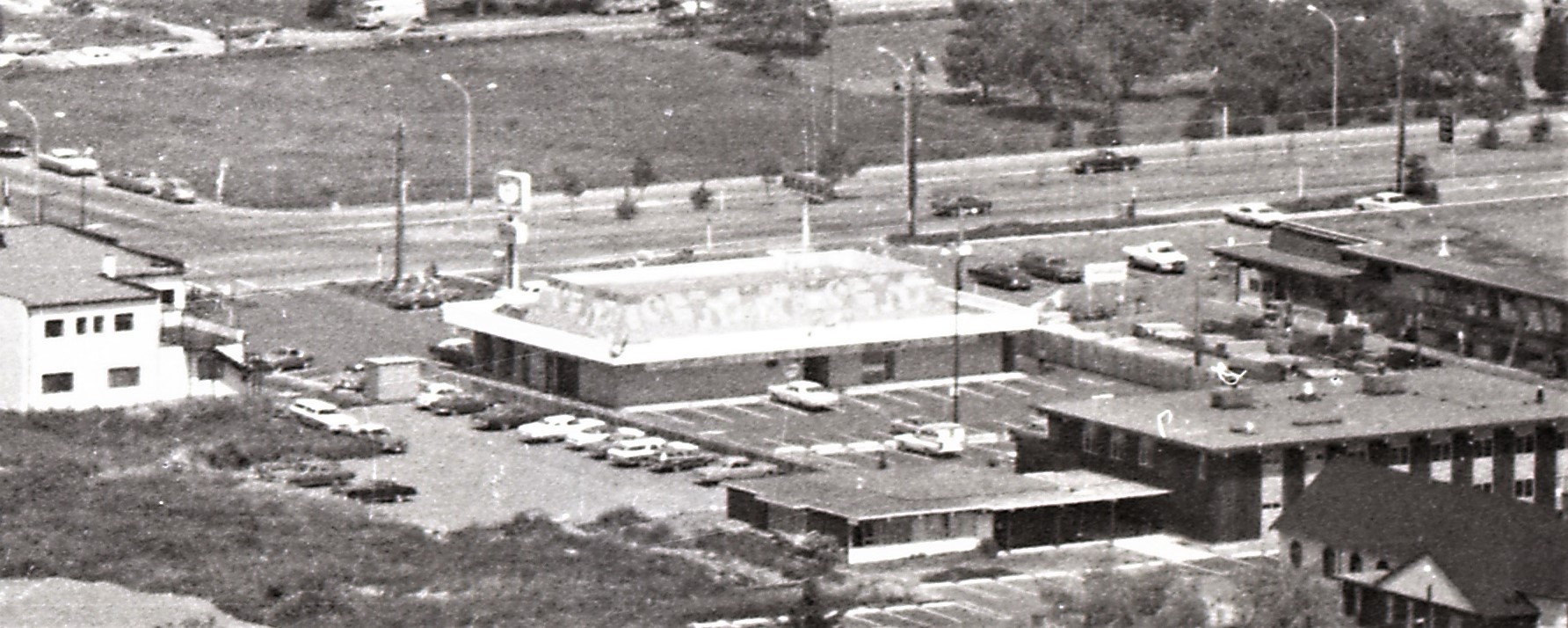
This 1970 aerial view shows the location of Chipper’s in relation to No.3 Road, the Skyway Lanes Bowling Alley and the BC Chip Steak Co. meat packing plant. Immediately to the left of the restaurant is a tire shop. Cropped from City of Richmond Archives photograph 1983 6 90.
The warnings must have had an effect because the drive-in remained in business until the early 1970s and remains a nostalgic memory in the minds of folks who were young during that era.
Kings Burgers
An article in the January 25,1962 Richmond Review announced “Two new drive-ins to be built here”. One of the new facilities was Kings Burgers to be built on Westminster Highway near the intersection with No.3 Road. Kings Drive-In Ltd. was a successful Lower Mainland chain that opened six locations around Vancouver, North Vancouver, Burnaby, Surrey and Richmond. The property that the Richmond location was built on first had to be rezoned from agricultural district to general commercial, with a special use permit as drive-ins were not included in that category.
A car enters the parking lot of Kings Burgers from Westminster Highway in this aerial photograph from 1964. The building was typical of drive-ins of the period. Just above Kings is the Super Valu store which faces on to No.3 Road. Cropped from City of Richmond Archives photograph 1984 17 61.
Like Chipper’s, Kings Burgers became a well loved and popular drive-in, especially with younger people. Driving by the restaurant gave a view of hot rods, sport cars and modified vehicles, hoods up in the parking lot. No doubt many strips of rubber marked the exit from the drive-in’s parking area.
A menu for Kings Burgers, printed in the Richmond Review.
Kings’ menu was also typical of drive-ins of the period. Burgers, fries, fish and chips with an apple turnover for dessert pretty much covered it. The restaurant’s “Kingburger”, prepared in advance and kept in a heated drawer, was its most popular item at 19 cents each.
Kings Burgers in December 1976 as renovations begin. City of Richmond Archives photograph 2021 29 32.
Kings did not escape the stigma of having young people as a large part of its customer base. In June 1966 the Richmond Review reported “HOODLUM VICTIMS PROTEST,” detailing complaints from the Royal Canadian Legion, located across the street from the drive-in, about willful damage caused by the “young element”. The Legion claimed that groups gathering outside the restaurant would move across to the Legion and break into cars and destroy property. “They have no regard for private property,” the Legion protested. The Municipality’s Licensing Committee agreed to seek the cooperation of the drive-in’s management to combat the problem.
Kings Burgers in April 1977 after renovations. City of Richmond Archives photograph 2021 29 33.
From late 1976 to early 1977 the Kings underwent renovations and began to look less like a drive-in and more like a regular restaurant. Around 1981 the name was changed to “Big B” Burgers and later around 1986 it became Umbertino’s Pasta Palace. In 1987 the location is listed as “Vacant” in the street directory.
The A&W
The other restaurant mentioned in the January 25, 1962 Richmond Review was an A&W drive-in, to be built on the west side of No.3 Road just south of Capstan Way. The A&W did not have an easy start in Richmond. The first hurdle encountered were delays in rezoning the property where it was to be built. Although announced in January, by April rezoning was still being squabbled about by the Municipal Planning Committee with some wanting to delay for another year. Representatives for the A&W were upset, saying that they had been all but guaranteed of the rezoning eight months earlier. The delay was partly in response to a public outcry over perceived problems arising from the project. Under a headline which read “Rootbeering teens bring angry protest,” an article in the Richmond Review said that Council had been petitioned by an angry group of homeowners who claimed that allowing another drive-in to open in their neighbourhood would affect property values, add to litter problems, attract undesirable types of teenagers and keep residents awake at night. Most of these problems already exist to some extent because of the existing drive-in (Chippers). “It’s not an environment that I want for my boys”, said one protester. “Young hot rodders and young fellows and girls acting in an unbecoming manner. We see enough of this already”. Despite protests and zoning application issues the restaurant opened at its location at 359 No.3 Road (3591 today) and became another popular location for youth and car enthusiasts. The drive-in provided full carhop service, occasionally with the servers on roller skates, delivering food on the iconic window trays with tall, frosty mugs of root beer.
Carhop Linda Billwiller, carries trays of root beer to a customer at the No.3 Road A&W, ca. 1969. Photo from Facebook post, link here.
Like many large drive-in chains, A&W got its start in the United States in 1919 when Roy W. Allen set up a stand selling root beer at a parade in Lodi, California. In 1923 he and his partner Frank Wright opened the first A&W restaurant in Sacramento. A&W grew their business, selling franchises throughout the United States and expanded into Canada in 1956. By 1960 there were 2000 A&Ws in operation. In 1972 the Canadian side of the business split from the American chain and became its own corporate entity. The No.3 Road A&W Drive-in closed around 1982 but today there are nine A&W outlets in Richmond.
Ernie’s Take Home – Kentucky Fried Chicken
Harland David Sanders began selling chicken dishes from a restaurant in Kentucky during the Great Depression. By 1940 he had developed his patented “secret recipe” for cooking chicken in a pressure fryer, allowing faster cooking than regular frying. In 1952 Sanders, by now a “Kentucky Colonel” commissioned by the Governor of Kentucky, began offering franchises for his “Kentucky Fried Chicken”. In the 1950s Nat Bailey was offered the British Columbia franchise for Kentucky Fried Chicken. While he was worried that the brand might compete with his White Spot chain, which also offered chicken dishes on the menu, his partners convinced him that the product was different enough to not cause any issues. Bailey and his partners formed a separate company called Ernie’s Fine Foods which was named after Ernie M. Creamer, Bailey’s friend and partner who was to head the new enterprise. Six stores were opened in Vancouver, Victoria, New Westminster, North Vancouver, Penticton and Richmond under the name Ernie’s Take Home. The Richmond store opened in a unit at the Hyland Park Shopping Centre at 632 (6320 today) No.3 Road.
This ad from a 1965 Richmond Review invites customers to pick up a bucket or two of Colonel Sanders’ “Finger-Licken’ Good” chicken from Ernie’s Take Home at the Hyland Park location.
Colonel Sanders came to Vancouver to meet his new business partners after they had opened three of their franchises. He was described as a “real southern gentleman”, wearing his trademarked white suit, string tie, goatee and cane and kissing all the ladies’ hands. Unlike other Kentucky Fried Chicken franchises, Bailey and his partners served their own style of potato salad, macaroni salad, coleslaw and biscuits, apparently with the Colonel’s approval.
Nat Bailey sold his restaurant businesses to General Foods in 1968, including the company’s six Ernie’s Take Home locations. By the early 1970s they had closed the Hyland Park location, reopening in a red and white striped drive-in style restaurant at 810 (8100 today) Anderson Road, on a lot that spanned the area between Anderson Road and Granville Avenue. In 1984 the restaurant had changed its address to 8111 Granville Avenue, rebranded as Kentucky Fried Chicken, without the Ernie’s Take Home name, and had installed the iconic bucket of chicken signpost to attract customers driving down busy Granville Avenue. A second location at the Seafair Shopping Centre opened the same year. Today there are four KFC outlets in Richmond.
McDonald’s
In 1960 Ray Kroc took over a restaurant run by the McDonald Brothers in Sacramento California and the rest is history. Over the next five years Kroc transformed the business, opening hundreds of locations featuring unique architecture and high efficiency kitchens serving inexpensive meals, and turning McDonald’s into a public company listed on the New York Stock Exchange. In 1967 Kroc took his business outside of the United States for the first time, opening a restaurant at 712 (7120 today) No.3 Road in Richmond on June 1. George Tidball was in charge of the Canadian inaugural operation, and Richmond was chosen because, according to Kroc, it was a community of many young adults in the middle income bracket. The chain was distinguished by its 18 cent hamburger, ” formula boneless chuck and plate beef, 10 hamburgers to the pound,” and a “Triple thick” 25 cent milkshake.
The McDonald’s Drive-In on No.3 Road on July 21, 1974. City of Richmond Archives photograph 2021 29 4.
McDonald’s was notable, not only for its unique architecture and cheap meals, but also for its lack of some other things. There were no juke boxes or cigarette machines, “They don’t enhance the image we want,” said Kroc. Also, there were no telephone booths or female employees, “Girls and telephones are distractions.” Ray Kroc explained, “We are not interested in motorcyclists, hot rodders or rock and rollers unless they come on our terms. We run a clean place that welcomes families, boy scouts, church and civic groups.”
Ad from Richmond Review July 2, 1967.
George Tidball stated that the Richmond restaurant provided fulltime employment for 36 young people, adding that one out of every five applicants passed the rigid requirements for the job, a much higher amount than in the United States: “Richmond seems to have a greater number of neat-appearing, responsible, clean-cut type of youth.”
Ray Kroc, behind the counter of the Richmond McDonald’s, serves a meal to his wife during their visit. Photograph from the July 26,1967 Richmond Review.
Ray Kroc made a whirlwind trip to the Richmond McDonald’s the month after it was opened, staying for about a half hour to look over the operation, speak to the press and have a photo-op. Then he was gone, planning the opening of other restaurants around Canada.
The original McDonald’s, ready to be torn down, stands beside its replacement in this image from March 2, 1975. The Golden Arches remained there and are still there today in front of the third restaurant to occupy the site. City of Richmond Archives photograph 2021 29 8.
In 1975 the original drive-in was replaced by a larger, more modern building with room for indoor seating, a play area, and eventually, a drive-thru window ending its state as a drive-in. The restaurant has since been replaced by a third building on the property but the original 1967 Golden Arches are still there attracting drivers into the the place. Today there are seven McDonald’s locations in Richmond, but only one can claim to be the location of the first outside the United States. There are still no cigarette machines or juke boxes, but everyone has a telephone in their pocket and women are allowed to work there now.
The second McDonald’s on No.3 Road, ca. 1975. City of Richmond Archives photograph 1987 61 1.
White Spot
Nat Bailey got his start selling hot dogs and ice cream from a converted Model T Ford truck in Stanley Park, probably Vancouver’s first food truck. He opened the first White Spot Restaurant in Marpole in 1928, a place which was probably the first drive-in restaurant in Canada. Bailey and his partner Bob Stout are also credited with developing the world’s first drive-in food tray, originally a white-painted cedar plank which was placed across the space between the driver’s and passenger windows, modernized later using plastic and steel. White Spot was also probably the first drive-in to employ carhops to serve customers in their cars.
The trays used by carhops at White Spot were an early innovation in the history of drive-in restaurants. Photograph from White Spot Facebook page, link here.
Bailey retired from the restaurant business in 1968 after building and expanding the chain into one of the best-loved restaurant/drive-in chains in BC. When he retired he sold the business, which included 13 White Spot Drive-In/Dining Room Restaurants, six Kentucky Fried Chicken franchises and other assets such as BC’s largest chicken farm, to General Foods. General Foods was based in New York State with a Canadian office in Toronto. The company immediately started to expand the business building new restaurants. Around 1975 they built Richmond’s last true drive-in at 814 Granville Avenue.
The White Spot on Granville Avenue, across the road from the end of Buswell Street, ca. 1975. Cropped from City of Richmond Archives photograph 1987 23 313.
The restaurant offered both dining room and carhop service, with all the favourite White Spot menu items available. Around 1999 the Granville Avenue restaurant closed, replaced by other non-drive-in locations around town. Today there are three White Spot Restaurants in Richmond with an additional two Triple O’s franchise locations.
A view down Granville Avenue, ca.1995, shows signs for two drive-ins, Kentucky Fried Chicken on the left and White Spot farther down on the right. City of Richmond Archives photograph 2008 39 7 248.
By the 1970s drive-ins were being replaced by drive-thru restaurants which didn’t require as much parking space and, as carhops became obsolete, could be run by fewer employees. There are a few old style drive-ins remaining, but they have become a thing of the past for the most part.
In the days before the big grocery store and market chains completely took over the food sales business, Richmond was served by several family owned and operated stores. The stores were conveniently located in the areas in which most of their customers lived and usually offered phone orders and free delivery. Brighouse Grocery was located, as its name suggests, in Brighouse on the corner of No.3 Road and Granville Avenue.
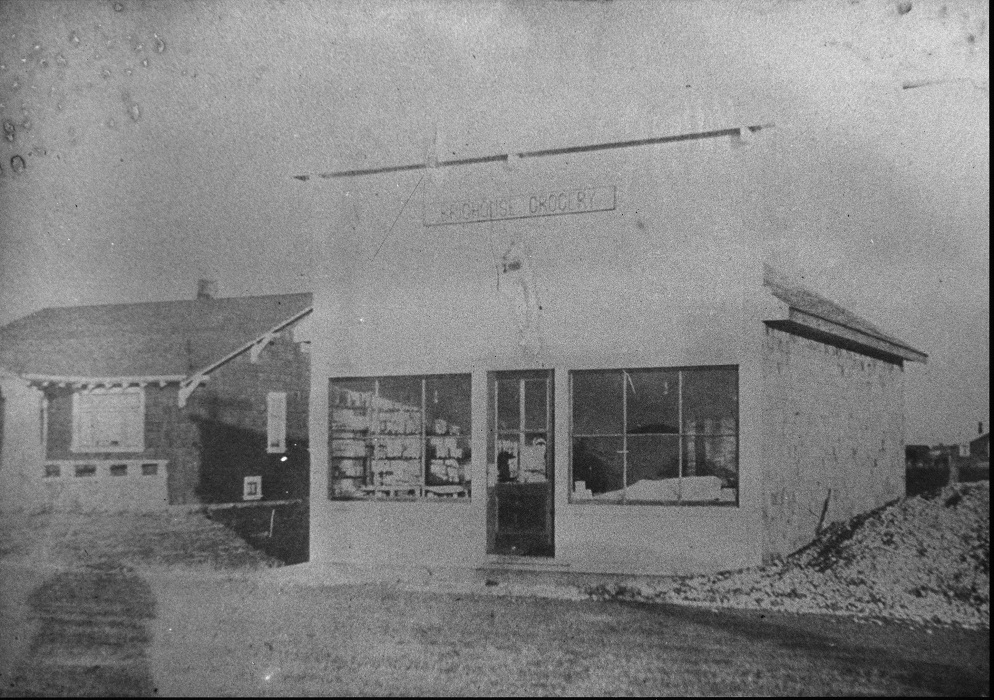
The original Brighouse Grocery store was built By Josiah Stirton in 1918 and was located at the intersection of No. 3 Road and General Currie Road. (City of Richmond Archives photograph 1984 17 83)
The original Brighouse Grocery was built by Josiah Stirton around 1918 and was located at the corner of No.3 Road and General Currie Road. It operated there for several years, but moved to the Granville – No.3 Road building after it was built.
The Brighouse Grocery Red & White Store, ca. 1955. The location was very convenient for customers arriving by tram, the tracks can be seen on the right.(City of Richmond Archives photograph 1993 29 2)
The new store, near the new Town Hall and the BC Electric Railway’s Brighouse Station was a far better location and the business thrived there for many years.
Paul Meyer and children Michael and Heather in front of his store. (City of Richmond Archives photograph 1993 29 1)
In 1949 the store was purchased and operated by the Meyer family, Paul and Bertha, who became part of the Red & White chain of independent grocery stores.
As advertised in Life Magazine, the Red & White Grocery “Trainload Sale” offered great bargains on canned food. Bertha and Paul Meyer stand in their store, ca. 1955. (City of Richmond Archives photograph 1993 29 3)
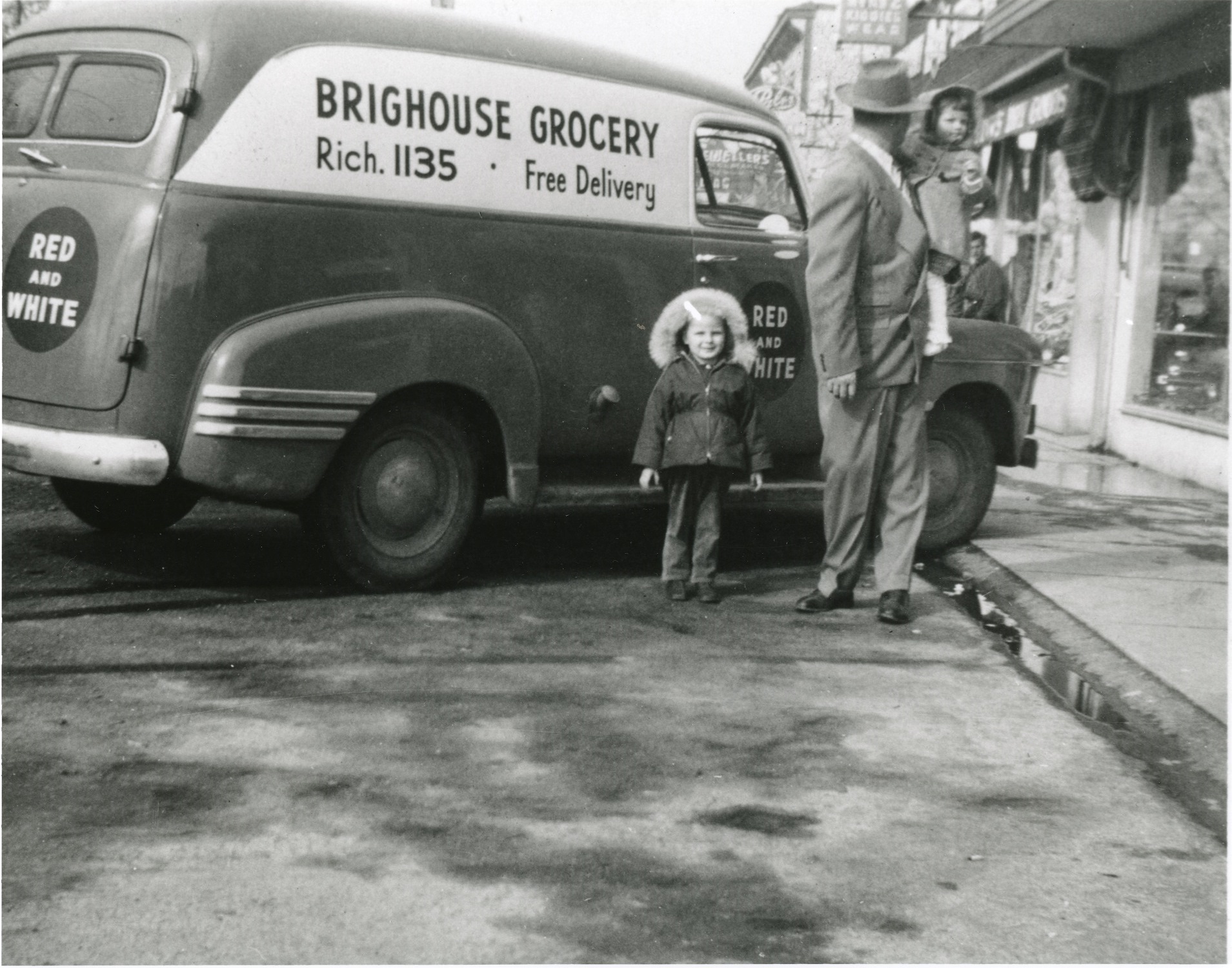
The Meyers owned the Brighouse Grocery Red & White Store from 1949 to 1963 offering telephone orders and free delivery.
A smiling Bertha Meyer stocks the shelves at the Brighouse Grocery Store, ca. 1958. (City of Richmond Archives photograph 1993 29 5)
The variety of items offered by the store made one-stop shopping a reality in what would be considered a tiny space by today’s standards.
Bertha and Paul Meyer stand in the produce section of the Brighouse Grocery, ca. 1955. (City of Richmond Archives photograph 1993 29 4)
Everything from cake mixes to produce and meat was available. If riding the tram or driving to the store was not practical, your order could be phoned in and delivered for free, a service only now being offered by many of the big grocery chains of today.
Brighouse Grocery in the sixties after the removal of the Interurban Tram tracks. (City of Richmond Archives photograph 1984 17 82)
The Interurban Tram, which would rattle the stock on the shelves when it went by, was missed by the store when the tram service was discontinued in 1958. Brighouse Station was just around the corner from the store and the reduction in business hurt the store’s bottom line. The store operated until about 1974 as the Brighouse Market. Well known photographer P.C. Lee opened his business there after it closed down.
Today most grocery purchases are made at one of the big supermarket chains or at one of the markets that specialize in produce sales, but many people have fond memories of the small neighborhood grocery stores of yesterday, run by local people who knew their customers by name.
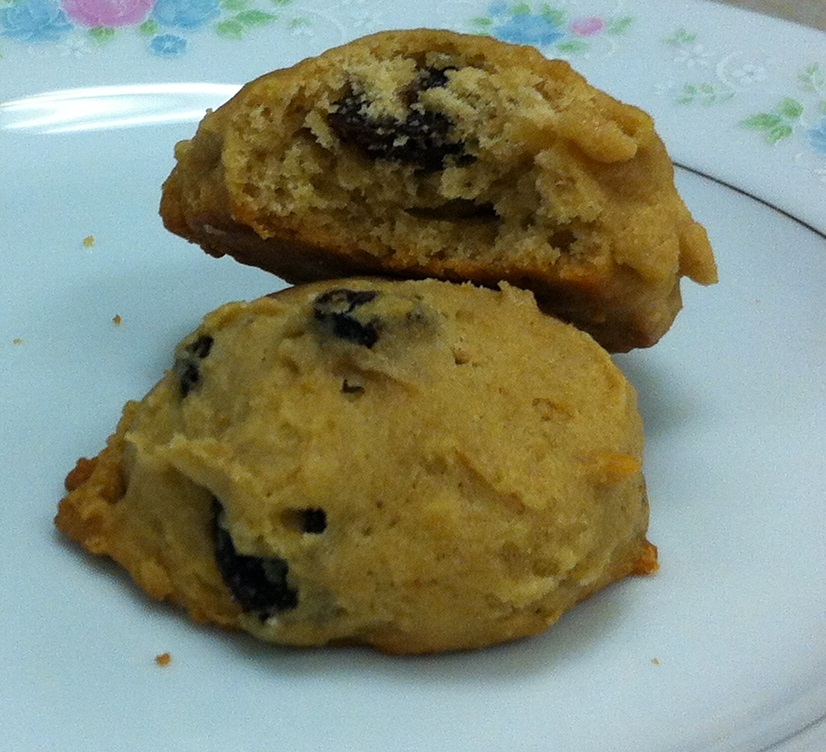
Freshly-baked hermits, using Mrs. Charles London’s 1902 cookbook. (John Campbell photograph)
Imagine yourself in the kitchen of the farmhouse at London Farm in the early part of the last century, thinking about a nice treat for your cook to bake for the family. You go through your favourite cookbook and voila, you find a healthy, yet simple recipe for hermit cookies.
Cover of “Woman’s Favorite Cook Book,” published in 1902 and used by the London family. City of Richmond Archives reference files
This is what Hetty London, wife of pioneer farmer Charles London, might have done using her “Woman’s Favorite Cook Book”, published in 1902, and found with old records of the London family now in the holdings of the City of Richmond Archives.
London Farmhouse, 1908. City of Richmond Archives Photograph 2009 16 75
Charles London and his brother William purchased land in the South Arm district of Richmond in the 1880s, the area taking on the name of “London”. After their marriage, Charles and his wife Henrietta (Hetty) built their farmhouse, where they raised a family of eight children (three of whom died as infants.) In 1978, the farmhouse was designated as a heritage site and the next year was purchased by the municipality to be restored as a heritage property.
London Farmhouse after restoration by the municipality. City of Richmond Archives Photograph 2009 16 13-4-3-1
The recipe for “hermits” found in Mrs. London’s old cookbook was particularly appealing to Precilla Huang, professional pastry chef and Board member of the Friends of the Richmond Archives, because it represented simpler times and the use of wholesome ingredients.
Recipe for Hermits from “Woman’s Favorite Cook Book.” City of Richmond Archives reference files
The result of Precilla’s baking was a tasty drop cookie, not too sweet but rich with buttermilk and lightly spiced with a hint of nutmeg.
A plate of hermit cookies hot out of the oven. (John Campbell photograph)
Imagine the fragrance of the batch of cookies coming out of the oven, and the enjoyment they would have brought to the London family and guests.
A homemade, 1930-style, sour cream doughnut. (Bill Purver photograph)
Before the proliferation of specialty bakeries and fast food chains in the latter half of the 20th century, the search for a fresh doughnut to accompany an afternoon coffee often ended up in one’s own kitchen.
An old recipe for homemade sour cream doughnuts was recently discovered at the City of Richmond Archives in records of the Ladies’ Aid of Richmond United Church.
Cover of “Tested Recipes.” City of Richmond Archives, Richmond United Church fonds, Series 5, File 3
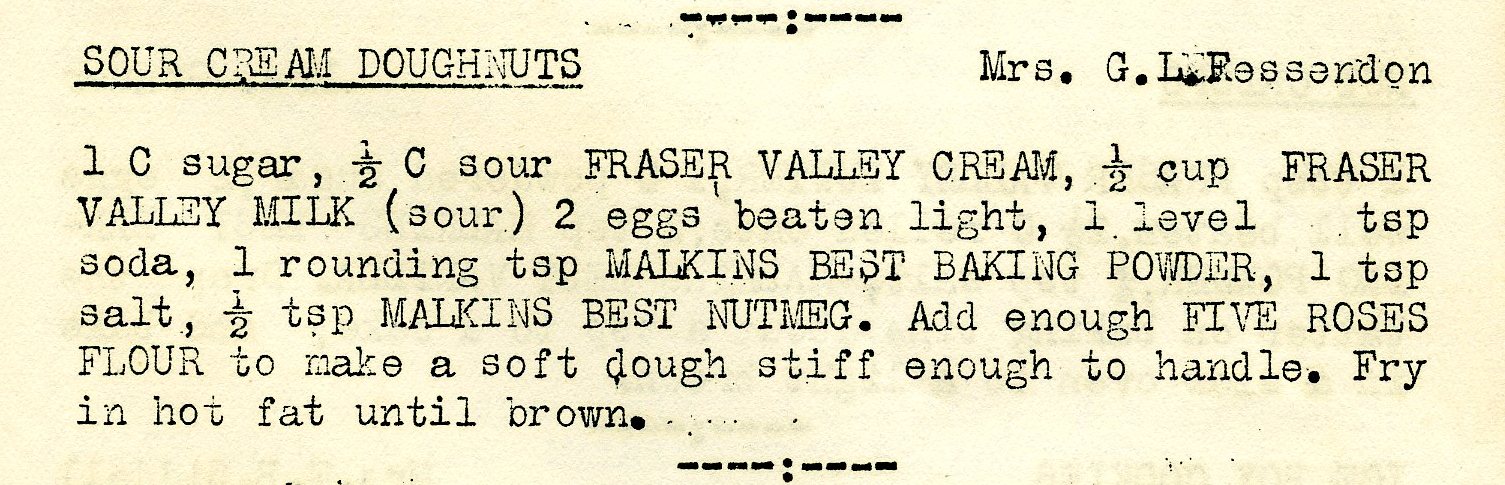
The recipe was found in “Tested Recipes”, a book published in 1930 by the women’s group as a fundraising effort on behalf of the church situated at the corner of River Road and Cambie.
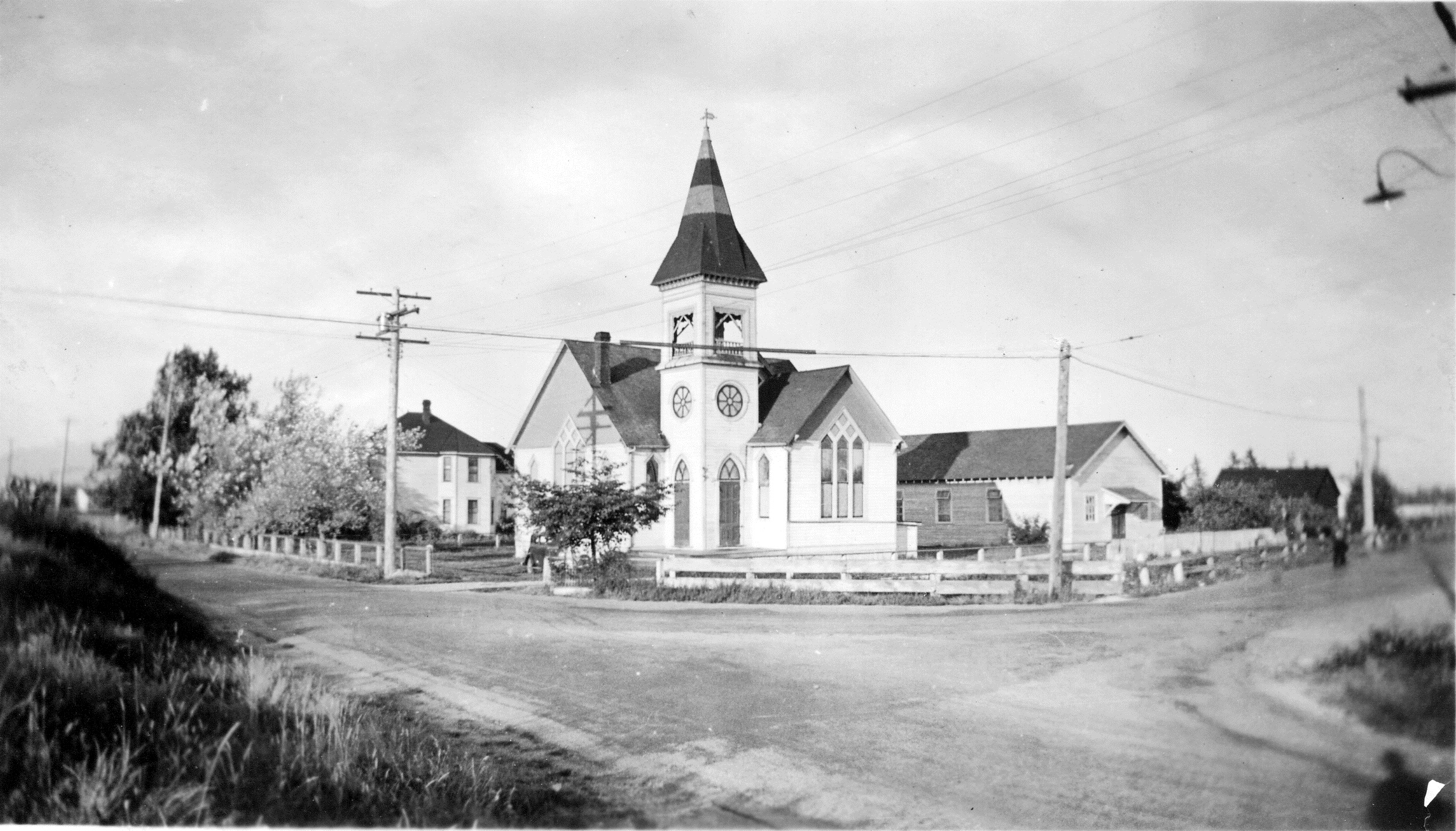
Richmond United Church at the corner of River Road and Cambie, ca. 1930. City of Richmond Archives Photograph 1985 39 104
Constructed in 1891 as the Richmond Methodist Church and renamed the Richmond United Church in 1925 after church union, the building was later purchased by the municipality, moved to Minoru Park in 1967, and renamed Minoru Chapel.
Advertisement on inside front cover of “Tested Recipes.”
The recipe book is a collection of old family recipes submitted by church members, the names of whom read like a who’s who of some of early Richmond’s most prominent residents.
Contributors included Mrs. H.A. McBurney, Mrs. R.P. Ketcheson, Mrs. E. Cooney, Mrs. W.G. Easterbrook, Mrs. J.W. Miller, Mrs. James Thompson, Mrs. Grauer, and Mrs. Mitchell among others.
The book was sponsored by various companies and includes advertisements for services and products of interest to those who would be using the recipes.
Recipe for Sour Cream Doughnuts on page 13 of “Tested Recipes.”
The Friends of the Richmond Archives’ resident pastry chef and Board Director, Precilla Huang, decided to try out the recipe to gain insight into the culinary expertise and practices of homecooking in the 1930s.
A tasty plate of homemade doughnuts, thanks to Friends of the Richmond Archives Board Director Precilla Huang and the 1930 “tested recipe.” (Graham Turnbull photograph)
The end result of Precilla’s work was delicious, a doughnut much less sweet than that of the present day, but rich in texture and taste.
(Note: “Doughnut” is the traditional spelling of the word and consistent with usage in the 1930s. “Donut” is a modern-day spelling associated with the later, large-scale commercialization of the snack.)





















 Outside the Box - The Richmond Archives Blog

You must be logged in to post a comment.