“Never on Sunday” – the Holiday Shopping Referendum

Never on Sunday front page

Election brochure. City of Richmond Archives, MR 35, File 4569 (1981)

Many people today are surprised to learn that prior to 1981, most stores in Richmond were prohibited from opening on Sundays and holidays.  Provincial legislation, namely the Holiday Shopping Regulation Act, was enacted in 1980, and provided a means by which an individual municipality could ask its citizens whether they wished to remove restrictions on Sunday and holiday shopping.

As a result, Richmond Municipal Council decided to add to the November 21, 1981 municipal election ballot the following referendum question:

“Are you in favour of Richmond By-law No. 4016 which in summary would permit all retail businesses to carry on business on a Sunday and any other holiday as defined by the ‘Holiday Shopping Regulations Act’?”

Two groups emerged in the community to promote each side of the referendum question, a question that was being asked on a number of municipal election ballots throughout the province.
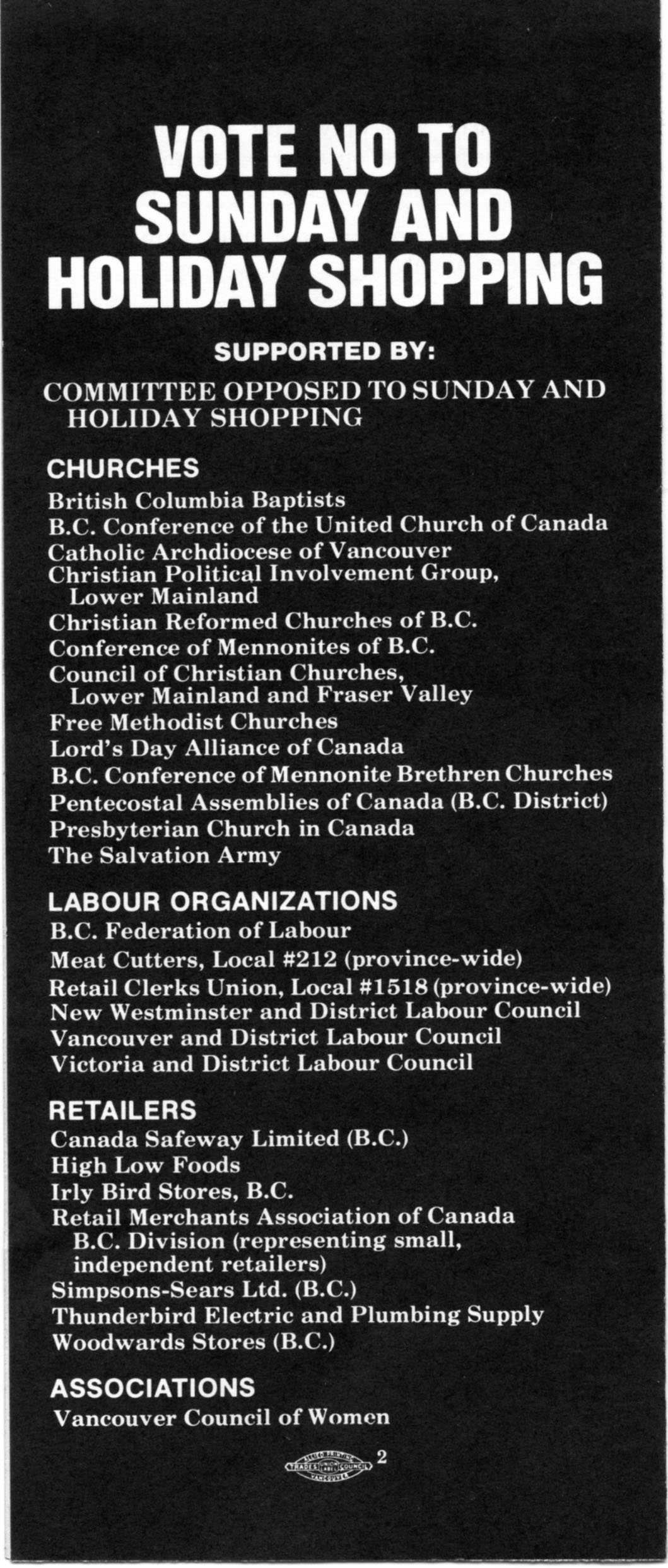
Back page of election brochure. City of Richmond Archives, SE 35, File 4569 (1981)

Back page of brochure. City of Richmond Archives, MR 35, File 4569 (1981)

The “Committee Opposed to Sunday and Holiday Shopping” was formed as an unusual alliance of church groups, labour unions, major retail stores, and women’s groups.  Using the slogans “Never on Sunday” and the “Price of Convenience”, the committee urged that Sunday should be “a day of rest” for church goers and workers, the latter comprised of a large number of women who worked as retail store clerks.  The Committee warned that if shopping was allowed, “Sundays and holidays would soon become another rat race like any other day of the week, with traffic jams, noise, congestion and frustration for everyone.”

On the other side, some larger, newly-established stores along with a wide-range of citizens argued for the right to shop on Sunday, listing various benefits including convenience, emergency needs, rights of consumers, and promotion of local shopping rather than cross-border shopping or shopping in municipalities which had already adopted Sunday and holiday shopping bylaws.

Lumberland Brochure

Election advertising. City of Richmond Archives, MR 35, File 4569 (1981)

By a margin of 14,434 “Yes” votes to 8,265 “No” votes, Bylaw 4016 received the assent of electors and was adopted by Council on November 23, 1981.  Retail shopping on Sundays and holidays was here to stay.
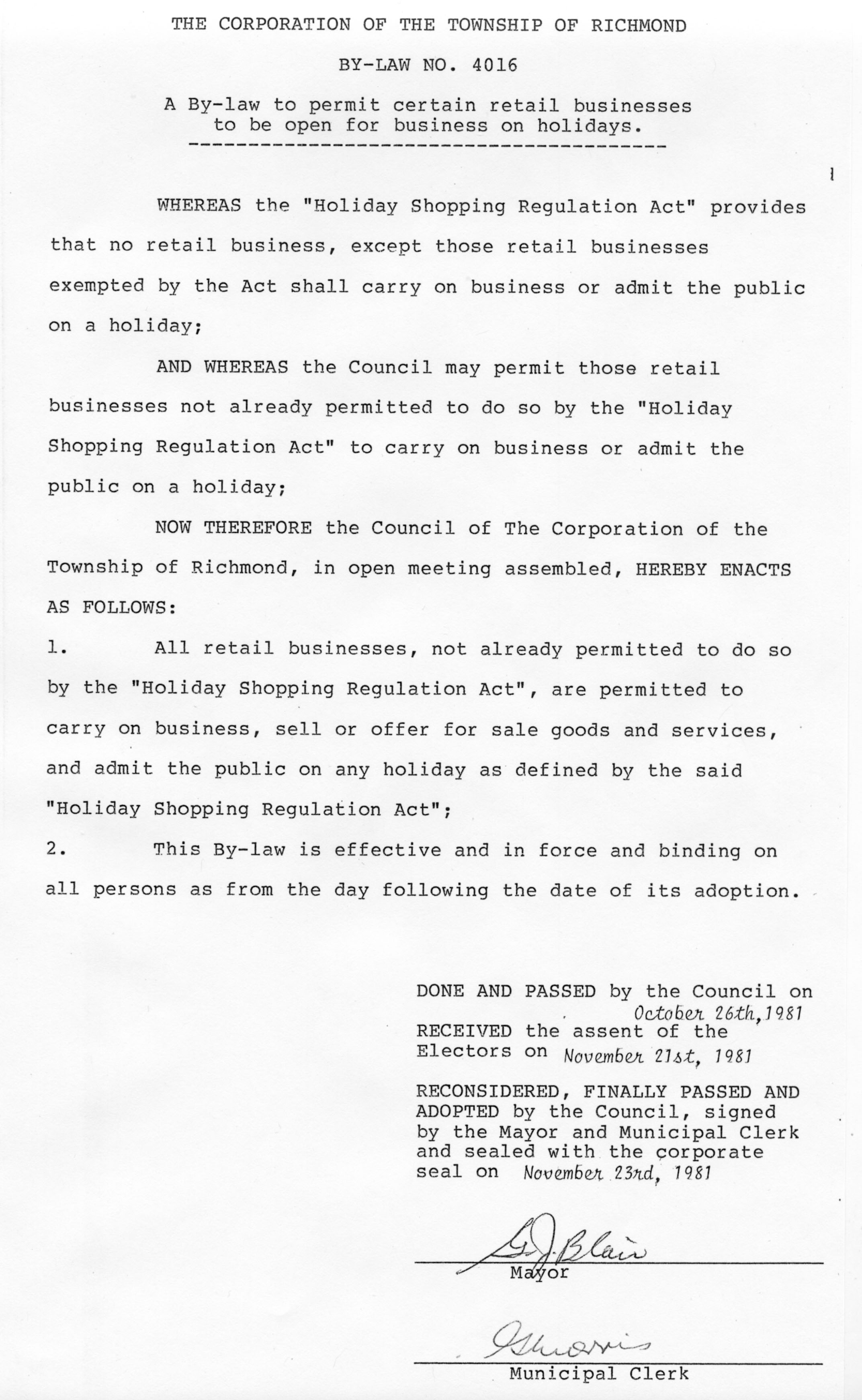
Bylaw 4016 as adopted. City of Richmond Archives Bylaws

Bylaw 4016 as adopted. City of Richmond Archives Bylaws

From the Archives Kitchen – An Old-Fashioned Roly Poly

slice of roly poly

A slice of mouthwatering roly poly. (Graham Turnbull photograph)

Have you tried a roly poly lately? Research at the City of Richmond Archives recently uncovered a WW II “ration guide” containing a recipe for this mouthwatering dessert.

Ration Book Cover

Cover of WW II ration book. City of Richmond Archives Accession 2011 24

The ration guide was produced as a result of the need to control the distribution of staple food products during World War II. A rationing program was implemented in Canada in 1942 to ensure adequate food supplies for the armed forces and for citizens through the balance of the war. Foods such as meat, butter, sugar, coffee and tea could be purchased only with the redemption of an appropriate coupon from a ration book.

Ration Book coupons

WW II ration book coupons. City of Richmond Archives Accession 2011 24

Home Canning Ration Guide Cover

Cover of WW II Home Canning Ration Guide. City of Richmond Archives Reference Files

In addition to rationing, citizens were encouraged to augment the food supply by activities such as making their own butter from milk, and by preserving fruits and vegetables.

“Here’s Your Home Canning Ration Guide” was published in 1943 “in the interests of maximum results in home canning with available sugar.” Inside, instructions were given for methods of canning without sugar, and how to use the preserved fruits or vegetables in the form of recipes.

On page 8 of the guide is a recipe for “Sweet Cherry Roly Poly,” a jelly roll-like confectionery. We thought we should try out this recipe in the interests of historical research and appetite.

Roly Poly Recipe

Roly Poly Recipe from Home Canning Ration Guide. City of Richmond Archives Reference Files

Here’s the result of our research into wartime cooking:

Wartime Roly Poly

The end result of our research, thanks to pastry chef and Friends of the Richmond Archives’ Board Director Precilla Huang. (Graham Turnbull photograph)

Focus on the Record – “Letters Patent”

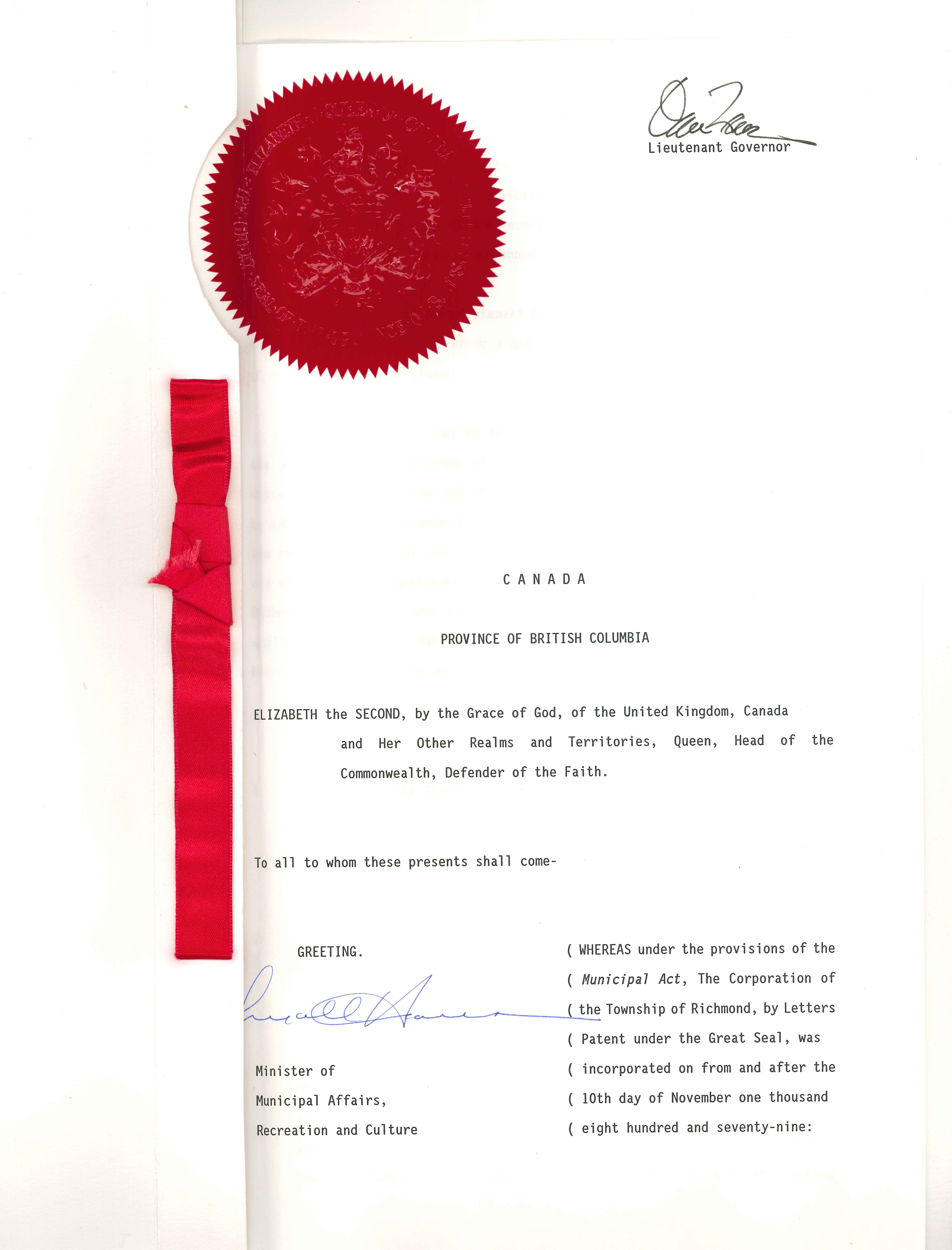
A number of letters patent have been issued which have defined Richmond as a municipality. These letters patent have demarcated Richmond’s geographic boundaries and have specified the nature, composition, and powers of its governing Council.

“Letters patent”, as a documentary form, date back to medieval England. Initially, they were created by the monarch to be read aloud as a proclamation granting status to an entity. Letters patent were in contrast to “letters close”, which were documents from the king directed privately to particular recipients. By the late middle ages, letters patent were often written to grant petitions from citizens, a use which is still prevalent today.

“The Corporation of Richmond” was incorporated as a municipality by means of letters patent, issued on November 10, 1879, in the name of the Queen under the Public Seal of the Province, in response to a petition of residents submitted to the provincial government. In addition to defining the first geographic boundaries of the municipality, these letters patent mandated the date of the first municipal election (January 5, 1880) and the date of the first Council meeting (January 12, 1880). The contents of the letters patent were subsequently published in the British Columbia Gazette as required by statute.

1879 Letters Patent

1879 letters patent as published in the BC Gazette. City of Richmond Archives MR 300, File LP1

These first letters patent were revoked in 1885 in order to change Richmond’s boundaries. New letters patent gave the municipality all of the islands in the North Arm of the Fraser River and some islands in the South Arm, and ceded the east end of Lulu Island (Queensborough) to New Westminster. They also renamed the municipality “The Corporation of the Township of Richmond” and reduced the size of Council from seven councillors to five, in addition to a reeve.

In 1892, the second letters patent were suspended due to irregularities occurring during the conduct of the municipal election for the Council of 1892. New letters patent re-established the municipality and mandated a new election date, but were written in a manner that caused some confusion as to the municipal boundaries. An amendment was made to these letters patent in 1896 to redefine the boundaries to correspond exactly with those of the letters patent of 1885.

Top of first page of new letters patent of 1892, with 1896 annotations. City of Richmond Archives MR 300, File LP3

Supplementary letters patent were issued in 1910 which reduced the municipal limits of Richmond by extending the boundaries of the municipality of South Vancouver. In 1957, supplementary letters patent increased the number of councillors from five to six. Similarly in 1966, supplementary letters patent increased the number of councillors from six to eight.

First page of 1990 letters patent. City of Richmond Archives MR 300, File LP8

1990 marked the issuing of new letters patent reincorporating the “Corporation of the Township of Richmond” as the “City of Richmond”, an action that was celebrated as a coming of age for the municipality. In 1996, supplementary letters patent extended municipal boundaries to include Sturgeon Bank.

The holdings of the City of Richmond Archives include some of the original, sealed letters patent, along with copies of the contents of the other letters patent as published in the BC Gazette.

[Note – this is an updated version of an article first published in the Spring 2011 issue of the Archives News]

New at the Archives – Duck Island Research Guide

Duck Island Research Guide

City of Richmond Archives Duck Island Research Guide (Cover showing Archives photograph of Duck Island in 1919.)

One of the biggest mixed-use developments in Richmond’s history is now in the planning stage. It consists of a hotel and conference centre, as well as retail and entertainment amenities. If it goes ahead it will be located in the City Centre area, where the old bridge to Sea Island and Vancouver once stood. This site was used primarily as industrial land and is still known as Duck Island. The island however doesn’t exist anymore. It has physically merged with Lulu Island through infill, and so doesn’t show up on modern maps. If you have been to the Richmond Night Market next to the River Rock Casino you have been on the island.

195 153 1 detail

Detail of 1909 Map of the Municipality of Richmond, showing legal property divisions. (City of Richmond Archives map #1985 153 1)

In anticipation of increased research on this site, the Archives has recently created a research guide, compiled by Friends of the Richmond Archives Director Christine McGilvray. The guide will assist researchers by listing and describing those textual, cartographic and photographic records held by the Archives which explain the progress of land use at this location.

City of Richmond Archives photograph #2004 70, detail

Aerial photograph of Duck Island taken in 1954. (City of Richmond Archives photograph #2005 70, E-4, detail)

Focus on the Record – Election Records

With municipal election day nearing (Saturday, November 15, 2014), we thought it timely to provide an overview of the records in the holdings of the City of Richmond Archives relating to past elections. These records not only provide evidence of election procedures, nominations and final results, but also document the evolution of voting rights and voting systems in the municipality.

Official election results, dating back to the first municipal election in 1880, can be found in the reports of the Returning Officer/Chief Election Officer. These reports form part of the minutes of Council, and are accessible to researchers at the Archives on microfilm. The original minutes are housed in the Archives’ vault. The reports document the precise vote count for all candidates and for all referenda or plebiscites put to the electorate. It is interesting to note that although the first election for Council was carried out in January, 1880, the first actual balloting occurred with the election for Council of 1889. Prior to this date, all candidates had been elected by acclamation.

Council minutes, and various bylaws, also document the establishment of a ward system for Council representation. Initially, the municipality was divided into three wards but for the municipal election of 1891, five wards were established. All voters in the municipality could vote for Reeve (the term used before the adoption of the title “Mayor”) but those registered on the voters’ list for a specific ward or district could only vote for a councillor nominated to represent that ward. Ward 1 constituted Sea Island, Ward 2 the northwest part of Lulu Island, Ward 3 Steveston and area, Ward 4 most of the South Arm and parts of eastern Richmond, and Ward 5 eastern Richmond. The ward system was discontinued after the municipal election of 1946, when an “at-large” system was adopted for the election of councillors.

Another important group of election records at the Archives are the official voters’ lists. They provide not only detailed listings of property owners and residents in Richmond but also illustrate the evolution of the voting system and the municipal franchise. The first complete voters list at the Archives dates to 1915. It is assumed that earlier lists were lost in the fire of 1913 which destroyed the original Town Hall.

Voters List 1915 Front Cover

Front page of voter’s list, 1915. City of Richmond Archives, MR35, File VL-1915.

The 1915 list shows voters registered by ward and also contains the names of women who owned property in the municipality, demonstrating how women were given the right to vote in municipal elections prior to being granted the right to vote in federal and provincial elections.

Election Ballot - 1931 - Reeve

Election Ballot for Reeve, 1931. City of Richmond Archives, MR35, File 4501 – Election Procedure.

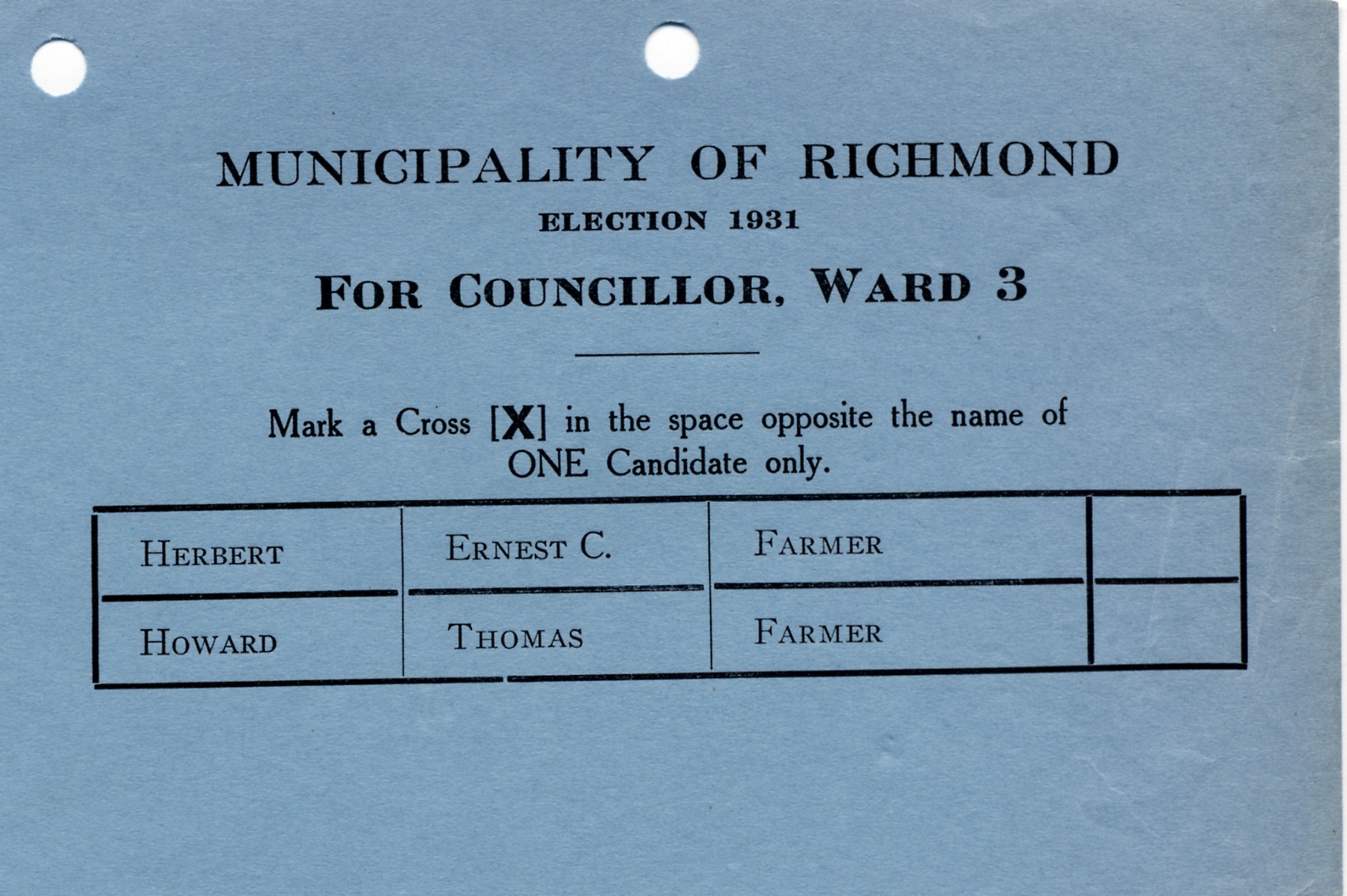
Election Ballot - 1931 - Councillor Ward 3

Election Ballot for Councillor, Ward 3, 1931. City of Richmond Archives, MR35, File 4501 – Election Procedure.

The voters’ lists also show how provincial legislation discriminated against the rights of First Nations people and people of South Asian, Japanese and Chinese ethnicity. The names of property owners of South Asian descent first appear on the voters list of 1948, following changes to provincial statute in 1947 giving them the right to vote in municipal elections. The names of First Nations, Japanese-Canadian, and Chinese-Canadian property owners do not appear on the voters list until 1949, again following changes in provincial legislation in 1948 granting them the municipal franchise.

Voters’ lists for municipal elections of 1915 through 1985 are available to researchers at the Archives. Other election records available include extensive election files, including the records of the Court of Revision, all of which document the procedures carried out by municipal officers to ensure the validity of the election process.

Ted Youngberg and Election Staff 1965

Municipal Clerk Ted Youngberg with election staff, Elaine Smith, Bill Lane and Bev Harper, 1965. City of Richmond Archives Photograph 1986 16 4.

[Note – this is an updated version of an article first published in the Fall 2011 issue of the Archives News]