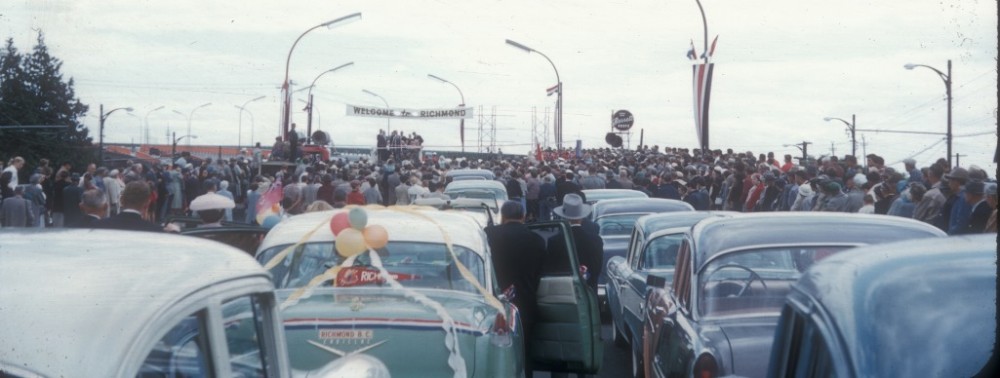
A city or municipality needs to define itself with a symbol of its identity, a connection to its history and a visual representation of its stature and image. Coats of Arms, official seals, flags, and logos all function to promote a positive public image to residents, visitors, and potential investors, as well as serve to authenticate documents and official correspondence. Here is a brief history and explanation of Richmond’s symbols.
The Official Seal
On November 10, 1897, Lulu and Sea Islands became the Corporation of Richmond by Letters Patent under the Public Seal of the Province of British Columbia. One of the orders of business during the first year of Richmond’s incorporation was the adoption of an official seal. Used to authenticate legal documents and be a credible indication of the validity of municipal documents, Richmond’s first official seal was adopted at the Council meeting of Saturday June 19, 1880. The entry in the minutes reads, “Moved by Councillor Smith seconded by Councillor Kilgour that the seal impressed on the margin be adopted as the seal of the Corporation of Richmond … Carried”. In the left margin of the page beside the entry, a blob of red sealing wax is impressed with an indistinct shape.

The first seal was not in use for very long. It was quickly replaced by the more modern embossed seal using a design which has symbolized Richmond up to today, the Cornucopia (Horn of Plenty). The design was suggested by Richmond’s first Warden (Reeve, Mayor) Hugh Boyd and was adopted at the July 5, 1880 council meeting. It shows the cornucopia in the centre, encircled by the words “Municipality of Richmond B.C.” In the words of early Richmond historian Thomas Kidd, it was “considered a very appropriate symbol at that time and it is to be hoped that the prosperity of these islands will always justify it remaining so.”


The cornucopia has been a constant symbol of Richmond’s identity, the image changing slightly over the years and the text changing from “Municipality of Richmond B.C.” to “The Corporation of the Township of Richmond B.C.” to “Corporation of Richmond” with “Incorporated 1879” placed inside the circle. In 1979 in celebration of Richmond’s 100th Anniversary a new emblem of the Corporation was unveiled, still bearing the image of the cornucopia but incorporating registered symbols of heraldry.
The Coat of Arms
In August 1978 the Richmond’s Municipal Council adopted a resolution to petition the College of Arms in London, England to grant the Municipality a Coat of Arms and Badge as part of the celebrations around the Municipality’s centennial on November 10, 1979. After consultation with Mr. Robert D. Watt, Chief Curator of the Vancouver Centennial Museum and a Director of the Heraldry Society of Canada, a letter was sent to the York Herald of Arms, Dr. Conrad Swan, PhD., M.A., requesting that the Municipality be granted a Coat of Arms and badge. Some preliminary design ideas were provided which were considered, modified slightly to conform with the requirements of the Kings of Arms and approved. Once the design was approved the process of producing Letters Patent of Armorial Bearings was undertaken over several months. The Letters Patent were presented to the Corporation of the Township of Richmond by Lieutenant Governor Henry Bell-Irving, representing the Crown and assisted by Dr. Conrad Swan, York Herald of Arms at a ceremony on November 10, 1979, the centennial of the incorporation of Richmond.

Heraldry harks back to the 12th century when the markings were used to identify the warriors on the battlefield, much like the colours and logos on the uniforms of modern sports teams. A Coat of Arms is made up of several elements:

Colours – The predominant colours in Richmond’s Coat of Arms are Blue and Gold.
The Shield – The shield is gold with a wavy blue bar, known as the pale, symbolizing the Fraser River and featuring three leaping salmon, representing the most common species in the waters around Richmond and its links to the fishing industry. From the Letters Patent: “Or on a Pale wavy Azure three leaping Salmon proper”.
The Helmet and Mantling – Above the shield sits a helmet mantled in blue and gold.
The Crest and Wreath – Atop the helmet is the wreath of gold and blue supporting a circlet of red maple leaves, representing Canada, and white dogwood flowers for British Columbia. The Crest is a dove rising with an olive twig in its beak, relating to the story of Noah and land rising from the waters as the islands of Richmond have. From the Letters Patent: “And for the rest Upon a Helm with a Wreath Or and Azure Rising from a Circlet of Maple Leaves Gules and Dogwood Flowers alternatively a Dove volant in its beak a sprig of Olive proper”.
The Supporters – On either side of the shield are two supporters, both representing the Goddess Fortuna, the bearer of prosperity. Each supporter holds a cornucopia, representing the fruitfulness of the land. The supporter to the right of the shield wears a red ribbon embroidered with white roses. The red and white represents Canada while the white roses represent the first Richmond in Yorkshire which has white roses in its coat of arms. From the Letters Patent: “Supporters following that is to say: – On the Lecter side a female figure proper crined or vested Argent supporting with the exterior hand a Cornucopia at the mouth its tail over her shoulder proper On the sinister side a like figure above her shoulders a Riband Gules thereon Roses Argent barbed and seeded proper and supporting with the exterior hand a Cornucopia by its tail also proper its mouth to the ground”.
The Compartment – The area upon which the shield and supporters stand is known as the compartment and shows green foliage and stems of blueberries, a common local crop, and once again representing the fertility of the land. From the Letters Patent: “the Compartment comprising a grassy mount with sprigs of Blueberry fructed growing therefrom all proper”.
The Motto – Below the compartment is a banner with the Motto, “Child of the Fraser.” The Motto comes from the first line of the poem “Lulu Island” by early Richmond settler and historian Thomas Kidd. The first verse of the poem reads, “Child of the Fraser River and the Sea, / Fair Lulu Island where I built my home, / Though I had seen fair lands ere I saw thee, / I came and saw and said, ‘No more I’ll Roam.'”
The Badge

Included with the granting of a Coat of Arms is a Badge. Richmond’s Badge shows an anchor, signifying the sea and a connection to the fishing industry, and a strawberry vine and blossoms, signifying the fruitfulness of the land. The strawberry blossom also connects to the Coat of Arms of the Frasers, which also carry the strawberry blossom and gives a link to the Fraser River. From the Letters Patent: “And We do further grant and assign the following Device or Badge that is to say: An Anchor Azure charged in base with a Strawberry Flower proper from the ring reflexed towards the sinister fluke and behind the Anchor’s stock a branch of Strawberry flowered and leaves proper”.
The Flag
On July 22, 1985, Municipal Council directed staff to prepare a report on the design of a civic flag. The civic flag was designed by Municipal employees Rod Lynde with assistance from Frank Sciberras and was officially introduced to the public at the opening of Brighouse Park on April 12, 1986 by Mayor Gil Blair.

The flag is blue and gold, Richmond’s accepted colours. The shield in the centre of the flag is from the Coat of Arms, gold with a wavy pale bar in blue and three salmon. The gold background and blue borders of the flag represents Richmond’s fertile lands surrounded by the waters of the Fraser River.
The Heron Logo
Richmond’s most familiar symbol today is based on the bird commonly seen fishing in the shallows around our city. The stylized heron logo is simple, yet iconic and was first used by Tourism Richmond in the 1990s. This first logo featured the words “Richmond – Island City, by Nature” with the heron’s head rising from the “N” in Richmond.

The heron logo and slogan was adopted a in 1998 by Richmond’s Year 2000 Committee. In 2000 the City also adopted the heron logo, but in 2002 changed the slogan to “Better in Every Way” as part of a promotional campaign to attract investment to the city.

City of Richmond image.
In 2008, with the 2010 Winter Olympics on the horizon, the City adopted a new consolidated visual identity and logo for itself and its partners, one which would reflect the past but fit in with the changes occurring with the Olympic era. The new logo was also a stylized heron, but facing to the right and in colours consistent with the Olympic palette, although the design’s colour is easily changed for other uses. The design of the heron demonstrates the elements of flow, flight, and fusion – concepts used in the design of Richmond’s Olympic Oval. The “Better in Every Way” logo was dropped and a new tagline, “Soar Beyond” was suggested. The design was accepted by the committee but the new tagline was rejected and the tried and true “Island City, by Nature” was preserved to be used when a slogan was found to be desirable.


The City’s corporate symbols have changed over its history but it retains an image from its earliest past with the cornucopia in the Coat of Arms, still used in official documents, and an image from more recent times, the stylized heron seen widely around the city on signs, buildings, and City vehicles. The future may bring new designs to represent our city but the images shown in this post will always remain as a part of Richmond’s visual identity.
 Outside the Box - The Richmond Archives Blog
You must be logged in to post a comment.